
Oct 14, 2007
was Moses a Hassid? (video)
Was Moshe Rabbeinu a hassid or misnaggid, and what brand of hassid? here is one opinion on the great debate....
One Rabbi, six hundred soldiers, a Torah and more
I just received (from Naomi Ragen's email list)the following article of a story that happened during the Lebanon War last year. It is a fascinating story and well worth your reading it.
A Light in the Darkness of War
Original article written by Shula Weissfer
A year has passed but First Lieutenant M. has not forgotten about the activities of Migdal Ohr which had been discreetly accomplished. With minor changes, we publish here for the first time in English, Lieutenant M's written recording of his experience.
"I remember the two weeks of near face-to-face combat, the confused orders and insufficient combat gear, the intense hunger, physical and emotional exhaustion and toughest of all, the self-imposed silence and disassociation with our surroundings."Now is not the right time to complain, but when it is over," we thought to ourselves, "when the air raid sirens stop and we are out of these fatigues, we can talk and the truth will be known."
When the news came that we were receiving a day off, our hearts soared. We suffered so much stress and hardship. Where would we go? How should we take full advantage of this gift? Rumors begin to circulate that we were going to some school in Migdal Ha'Emek. "This must be a joke! Who ordered ten buses tobring us to some yeshiva with some Rabbi who is just going to try and brainwash us?"
Then, a few of the guys remembered. "Rabbi Grossman, that's the Disco Rabbi right? The guys all give him great respect." But what do they know? He is still some rabbi. Tired and emotionally drained, we got off the buses and stood face to face with an old-world looking Jew, complete with a white beard, side locks and long jacket.
"So here it comes," I thought, "the push to put on tefillin or to say prayers together. Some day off." "Boys," the rabbi's words thundered, "I suggest that first thingyou do is take a dip in the pool and freshen up. In the meantime, we will make you something to eat."
In amazing simplicity, Rabbi Grossman heard in passing that the brigade was looking for a home for a day, and he immediately volunteered his campus. "What's the problem? 600 soldiers? They should all come, of course we have room!"
With the echoes of war from the battlefield still in our ears, it seemed like a mirage or hallucination. Soft music came from everywhere and flowing water and greenery surrounded us. Within minutes, the tables were set with cold refreshing watermelon, cakes, and beverages, followed by cheeses, fresh vegetables, and soft rolls.
Then we heard, "Out of the pool, get dressed and eat something."We saw piles of new undergarments. 600 new undershirts and underwear appeared as if out of nowhere, laid out on tables for our choosing.
Rabbi Grossman sat with us and laughed, "Have a good time boys! Have a great time! This evening, I will put on the most spectacular performance you have ever seen."
I am not a religious person by any means, but I can't help but envision the first Jew, Avraham, standing and personally serving his guests perfectly naturally and without the slightest hint of condescension. He respected each individual and cared for all their needs. Like Avraham, Rabbi Grossman saw in this an obvious act of kindness, a mission of a Mitzvah that had fallen into his hands.
As the evening continued, we learned quickly that this was the essence of who Rabbi Grossman is and what he is all about. He loves everyone and accepts everyone as they are with all his heart and soul. "Tell me friends," Rabbi Grossman said, "I heard you are lacking different pieces of equipment. Do me a favor. Here is a pencil and paper, just write down everything you are missing and leave the paper on the table."
That night, we enjoyed the entertainment and afterwards, slept in soft beds and air-conditioned rooms. Like in a fairytale, we awoke in the morning and could not believe our eyes. Mounds of gear which we so desperately needed had arrived at Migdal Ohr. Attached, was a small note from Rabbi Grossman, "To my dear solders, from all my heart!"
Rabbi Grossman personally and immediately raised over $60,000 worth of equipment from friends literally overnight! The essential equipment included ceramic bulletproof vests, helmets, canteens, knee pads, backpack water canteens, night vision goggles, toothbrushes, socks and more.
Interestingly, a few months before the war broke out, a special friend of Rabbi Grossman from France was interested in donating a new Torah scroll to the main Migdal Ohr Beit Midrash (studyhall).
For some reason, Rabbi Grossman requested to postpone the event until an unspecified later date."Now is the right time!" Rabbi Grossman realized. He immediately made arrangements and in an early evening ceremony, we participated in the completion of writing the Torah.
While the scroll was carefully laid on the table next to a special pen and ink, Rabbi Grossman addressed the soldiers. "My holy ones! I am going to bestow upon you the merit of a holy mitzvah, which can be considered a once in a life time opportunity. Each one of you will complete a letter in the Torah scroll. While you are executing this holy task, each one of you should pray the prayer of his heart and request from G-d that the merit of the letter he has completed will protect him in battle. Holy sparks will emanate from these sacred letters and disperse around you, creating a protective shield which will keep you safe and bring you home safely.
"Those moments were the most exciting and emotional ones in my life. Shaking from the intensity of the immeasurable experience,still not believing, we held the edges of the Torah scroll while our hearts beat rapidly. There was complete silence all around. One after the other, we dipped the quill in the ink and completed a letter in the Torah scroll.
A bystander would have seen a breathtaking scene of incredible elation and spiritual exuberance. The world seemed as if shrouded in silence. The strings of our heart felt strummed and the tears flowed freely down our cheeks.
"Mother!" cried one of the soldiers into his cell phone, "you wont believe what I have done! I have written a letter in a Torah scroll! Mother, are you there? Can you hear?! Me, a Shmutznik (a member of a non- religious Kibbutz), who can't differentiate between Shabbat and the rest of the week, who has not seen tzizit(ritual garment) in my life. Me, I wrote a letter in a Torah scroll! I can't believe it. I can't believe it. "
After the completion of the Torah, the ceremony continued. Leading the procession was a decorated car with multi-colored lights strung all over it and with a crown of lights spinning around on its roof. Following the car, bearers of a decorated canopy marched while people danced around it. Under the canopy, others held the Torah scroll, which was clothed in white and crimson with a silver crown at its top. 600 soldiers and thousands of the town residents marched and danced in the procession, a loud speaker accompanying them, playing traditional Jewish music.
As the ceremony came to a close, Rabbi Grossman approached every soldier and kissed him while placing a half-shekel coin in his hand and said "shliach mitzvah aino nezok," messengers of a mitzvah are not harmed. Rabbi Grossman concluded, "When you return, G-d willing, healthy and unharmed, you will fulfill this mission I am placing upon you, and you will donate this money to charity.
"The night came. Twelve buses made their way atop the Galilee Mountains. Heavy darkness engulfed us, yet behind, in the growing distance, a bright flame pierced the night sky. In the midst of war and violence, we found love and unending human compassion at Migdal Ohr, the educational center established in Migdal Ha'Emek by Rabbi Yitzchak Dovid Grossman. Rabbi Grossman speaks "This was an immense "Kiddush Hashem."
For a long period of time, I cried and was very emotional." Thus Rabbi Grossman recalled the moment when he first read the words above written by First Lieutenant M.Rabbi Grossman has what to add to the end of this exciting memoir. "A moment before they returned to Lebanon, I told the soldiers, 'in the merit that you said "shema" and put on tefillin, wrote a letter in the torah, and are messengers of a mitzvah, I promise you, that you will all return safe and sound. None of you will be wounded or killed.'"
"Wasn't the Rabbi scared to commit to 600 soldiers that they would return home safe and sound?" asked Shula Weissfer, a journalist. "That is what came out of my mouth word for word," he replied. "This was a moment of exuberance."
"I continued and told them," Rabbi Grossman relates, "if this does actually happen that you come back safely, the first place you must come back to - before you go home - is Migdal Ohr. We will thank G-d together and from there we will say goodbye." I told them, "think of this as an emergency call-up. Do you accept?" The commanding officer replied in the affirmative.
Two weeks later, around midnight, Rabbi Grossman received a phone call. "Rabbi, your blessing has come true!" exclaimed the commander over the phone. "Everyone is safe and we are on our way to you. We will be there by two 'O clock in the morning"
Rabbi Grossman immediately contacted the kitchen staff and asked them to prepare a meal while he worked to organize a band. People asked him 'You need a band at 2 a.m.? Is Moshiach here?'
"At 2:30 a.m. the soldiers disembarked from the buses, each one carrying 60 kilo of equipment on his back. The band started playing music and the soldiers approached Rabbi Grossman, each one lovingly received with a hug and a kiss. This continued for two hours.
"I felt as I had never felt before," recalls Rabbi Grossman. "Each one told me his personal miracle. "One soldier, a kibbutznik and a lawyer in civilian life, relayed an incredible miracle. A group of soldiers were gathered in an empty house in a Lebanese village when one of them forgetfully lit a cigarette. Hezbollah terrorists immediately noticed the light and fired an anti-tank missile at the house. Coincidentally, two horses from the village ran in front of the house and were hit and killed. The missile, deflected by the horses, veered away from the house, landing elsewhere. Incredibly, the horses miraculously saved the soldiers inside the house.
After the warm reception, the soldiers recited "birkat hagomel,"and together with Rabbi Grossman, sang and danced until daybreak.
"To this day," says Rabbi Grossman, "we maintain contact with each soldier and have thus become one family."
Rabbi Grossman is a recipient of the "Award of Recognition for his Actions on Behalf of Soldiers of the Israeli Defense Forcesand the Second Lebanon War"
Original article written by Shula Weissfer
A Light in the Darkness of War
Original article written by Shula Weissfer
A year has passed but First Lieutenant M. has not forgotten about the activities of Migdal Ohr which had been discreetly accomplished. With minor changes, we publish here for the first time in English, Lieutenant M's written recording of his experience.
"I remember the two weeks of near face-to-face combat, the confused orders and insufficient combat gear, the intense hunger, physical and emotional exhaustion and toughest of all, the self-imposed silence and disassociation with our surroundings."Now is not the right time to complain, but when it is over," we thought to ourselves, "when the air raid sirens stop and we are out of these fatigues, we can talk and the truth will be known."
When the news came that we were receiving a day off, our hearts soared. We suffered so much stress and hardship. Where would we go? How should we take full advantage of this gift? Rumors begin to circulate that we were going to some school in Migdal Ha'Emek. "This must be a joke! Who ordered ten buses tobring us to some yeshiva with some Rabbi who is just going to try and brainwash us?"
Then, a few of the guys remembered. "Rabbi Grossman, that's the Disco Rabbi right? The guys all give him great respect." But what do they know? He is still some rabbi. Tired and emotionally drained, we got off the buses and stood face to face with an old-world looking Jew, complete with a white beard, side locks and long jacket.
"So here it comes," I thought, "the push to put on tefillin or to say prayers together. Some day off." "Boys," the rabbi's words thundered, "I suggest that first thingyou do is take a dip in the pool and freshen up. In the meantime, we will make you something to eat."
In amazing simplicity, Rabbi Grossman heard in passing that the brigade was looking for a home for a day, and he immediately volunteered his campus. "What's the problem? 600 soldiers? They should all come, of course we have room!"
With the echoes of war from the battlefield still in our ears, it seemed like a mirage or hallucination. Soft music came from everywhere and flowing water and greenery surrounded us. Within minutes, the tables were set with cold refreshing watermelon, cakes, and beverages, followed by cheeses, fresh vegetables, and soft rolls.
Then we heard, "Out of the pool, get dressed and eat something."We saw piles of new undergarments. 600 new undershirts and underwear appeared as if out of nowhere, laid out on tables for our choosing.
Rabbi Grossman sat with us and laughed, "Have a good time boys! Have a great time! This evening, I will put on the most spectacular performance you have ever seen."
I am not a religious person by any means, but I can't help but envision the first Jew, Avraham, standing and personally serving his guests perfectly naturally and without the slightest hint of condescension. He respected each individual and cared for all their needs. Like Avraham, Rabbi Grossman saw in this an obvious act of kindness, a mission of a Mitzvah that had fallen into his hands.
As the evening continued, we learned quickly that this was the essence of who Rabbi Grossman is and what he is all about. He loves everyone and accepts everyone as they are with all his heart and soul. "Tell me friends," Rabbi Grossman said, "I heard you are lacking different pieces of equipment. Do me a favor. Here is a pencil and paper, just write down everything you are missing and leave the paper on the table."
That night, we enjoyed the entertainment and afterwards, slept in soft beds and air-conditioned rooms. Like in a fairytale, we awoke in the morning and could not believe our eyes. Mounds of gear which we so desperately needed had arrived at Migdal Ohr. Attached, was a small note from Rabbi Grossman, "To my dear solders, from all my heart!"
Rabbi Grossman personally and immediately raised over $60,000 worth of equipment from friends literally overnight! The essential equipment included ceramic bulletproof vests, helmets, canteens, knee pads, backpack water canteens, night vision goggles, toothbrushes, socks and more.
Interestingly, a few months before the war broke out, a special friend of Rabbi Grossman from France was interested in donating a new Torah scroll to the main Migdal Ohr Beit Midrash (studyhall).
For some reason, Rabbi Grossman requested to postpone the event until an unspecified later date."Now is the right time!" Rabbi Grossman realized. He immediately made arrangements and in an early evening ceremony, we participated in the completion of writing the Torah.
While the scroll was carefully laid on the table next to a special pen and ink, Rabbi Grossman addressed the soldiers. "My holy ones! I am going to bestow upon you the merit of a holy mitzvah, which can be considered a once in a life time opportunity. Each one of you will complete a letter in the Torah scroll. While you are executing this holy task, each one of you should pray the prayer of his heart and request from G-d that the merit of the letter he has completed will protect him in battle. Holy sparks will emanate from these sacred letters and disperse around you, creating a protective shield which will keep you safe and bring you home safely.
"Those moments were the most exciting and emotional ones in my life. Shaking from the intensity of the immeasurable experience,still not believing, we held the edges of the Torah scroll while our hearts beat rapidly. There was complete silence all around. One after the other, we dipped the quill in the ink and completed a letter in the Torah scroll.
A bystander would have seen a breathtaking scene of incredible elation and spiritual exuberance. The world seemed as if shrouded in silence. The strings of our heart felt strummed and the tears flowed freely down our cheeks.
"Mother!" cried one of the soldiers into his cell phone, "you wont believe what I have done! I have written a letter in a Torah scroll! Mother, are you there? Can you hear?! Me, a Shmutznik (a member of a non- religious Kibbutz), who can't differentiate between Shabbat and the rest of the week, who has not seen tzizit(ritual garment) in my life. Me, I wrote a letter in a Torah scroll! I can't believe it. I can't believe it. "
After the completion of the Torah, the ceremony continued. Leading the procession was a decorated car with multi-colored lights strung all over it and with a crown of lights spinning around on its roof. Following the car, bearers of a decorated canopy marched while people danced around it. Under the canopy, others held the Torah scroll, which was clothed in white and crimson with a silver crown at its top. 600 soldiers and thousands of the town residents marched and danced in the procession, a loud speaker accompanying them, playing traditional Jewish music.
As the ceremony came to a close, Rabbi Grossman approached every soldier and kissed him while placing a half-shekel coin in his hand and said "shliach mitzvah aino nezok," messengers of a mitzvah are not harmed. Rabbi Grossman concluded, "When you return, G-d willing, healthy and unharmed, you will fulfill this mission I am placing upon you, and you will donate this money to charity.
"The night came. Twelve buses made their way atop the Galilee Mountains. Heavy darkness engulfed us, yet behind, in the growing distance, a bright flame pierced the night sky. In the midst of war and violence, we found love and unending human compassion at Migdal Ohr, the educational center established in Migdal Ha'Emek by Rabbi Yitzchak Dovid Grossman. Rabbi Grossman speaks "This was an immense "Kiddush Hashem."
For a long period of time, I cried and was very emotional." Thus Rabbi Grossman recalled the moment when he first read the words above written by First Lieutenant M.Rabbi Grossman has what to add to the end of this exciting memoir. "A moment before they returned to Lebanon, I told the soldiers, 'in the merit that you said "shema" and put on tefillin, wrote a letter in the torah, and are messengers of a mitzvah, I promise you, that you will all return safe and sound. None of you will be wounded or killed.'"
"Wasn't the Rabbi scared to commit to 600 soldiers that they would return home safe and sound?" asked Shula Weissfer, a journalist. "That is what came out of my mouth word for word," he replied. "This was a moment of exuberance."
"I continued and told them," Rabbi Grossman relates, "if this does actually happen that you come back safely, the first place you must come back to - before you go home - is Migdal Ohr. We will thank G-d together and from there we will say goodbye." I told them, "think of this as an emergency call-up. Do you accept?" The commanding officer replied in the affirmative.
Two weeks later, around midnight, Rabbi Grossman received a phone call. "Rabbi, your blessing has come true!" exclaimed the commander over the phone. "Everyone is safe and we are on our way to you. We will be there by two 'O clock in the morning"
Rabbi Grossman immediately contacted the kitchen staff and asked them to prepare a meal while he worked to organize a band. People asked him 'You need a band at 2 a.m.? Is Moshiach here?'
"At 2:30 a.m. the soldiers disembarked from the buses, each one carrying 60 kilo of equipment on his back. The band started playing music and the soldiers approached Rabbi Grossman, each one lovingly received with a hug and a kiss. This continued for two hours.
"I felt as I had never felt before," recalls Rabbi Grossman. "Each one told me his personal miracle. "One soldier, a kibbutznik and a lawyer in civilian life, relayed an incredible miracle. A group of soldiers were gathered in an empty house in a Lebanese village when one of them forgetfully lit a cigarette. Hezbollah terrorists immediately noticed the light and fired an anti-tank missile at the house. Coincidentally, two horses from the village ran in front of the house and were hit and killed. The missile, deflected by the horses, veered away from the house, landing elsewhere. Incredibly, the horses miraculously saved the soldiers inside the house.
After the warm reception, the soldiers recited "birkat hagomel,"and together with Rabbi Grossman, sang and danced until daybreak.
"To this day," says Rabbi Grossman, "we maintain contact with each soldier and have thus become one family."
Rabbi Grossman is a recipient of the "Award of Recognition for his Actions on Behalf of Soldiers of the Israeli Defense Forcesand the Second Lebanon War"
Original article written by Shula Weissfer
Oct 12, 2007
two letter word with seven spelling mistakes
This week is the custom for a fairly fun exercise. The Torah portion for the week is No'ah. In Hebrew that is spelled with two letters - נח.
The exercise is to try to spell the two letter word with seven spelling mistakes.
My Rav alerted me to this phrase in conversation when commenting on a few mistakes someone made in a very short piece of writing. He said how many mistakes can a person make in such a short piece - No'ah mitt zaiben graiben. Which he then explained to me to mean "Noah with seven mistakes" (I do not speak yiddish).
After doing some research it seems this is a fairly common exercise enjoyed on the week of Noah, to try to see how many ways you can spell the two letter word of Noah.
The source for this exercise seems to actually be from the Russian Czarina, Catherine the Great. She was of German descent and her Russian was fairly weak. She spelled Shchi, some sort of cabbage soup with a two letter Russian spelling, with 8 letters.
Somehow this became an exercise for two letter words, and Noah is the Jewish version of this game.
ןויעהאך
The exercise is to try to spell the two letter word with seven spelling mistakes.
My Rav alerted me to this phrase in conversation when commenting on a few mistakes someone made in a very short piece of writing. He said how many mistakes can a person make in such a short piece - No'ah mitt zaiben graiben. Which he then explained to me to mean "Noah with seven mistakes" (I do not speak yiddish).
After doing some research it seems this is a fairly common exercise enjoyed on the week of Noah, to try to see how many ways you can spell the two letter word of Noah.
The source for this exercise seems to actually be from the Russian Czarina, Catherine the Great. She was of German descent and her Russian was fairly weak. She spelled Shchi, some sort of cabbage soup with a two letter Russian spelling, with 8 letters.
Somehow this became an exercise for two letter words, and Noah is the Jewish version of this game.
ןויעהאך
now American Football is in Israel!!
While rumors abound about whether or not the Israel Baseball League will be opening for a second season or shutting its doors, another American sport is trying to find its way in Israel.
American Football. That's right - tackle football.
The Israel Football League will be trying to draw the attention of fans and players who enjoy the hard hitting, bone snapping game and considered baseball too complicated and boring.
The Messiah did not come at the end of the Israeli baseball season, so he must have been waiting for an American football league to open up...
American Football. That's right - tackle football.
The Israel Football League will be trying to draw the attention of fans and players who enjoy the hard hitting, bone snapping game and considered baseball too complicated and boring.
The Messiah did not come at the end of the Israeli baseball season, so he must have been waiting for an American football league to open up...
Oct 11, 2007
supermodel suing Israeli paper
Bar Rafaeli, the Israeli supermodel who lives abroad and recently chose to malign Israel in a couple of interviews in the foreign press, has come out swinging.
In reaction to her interviews in which she spoke harshly against Israel, the local papers wrote articles describing the interviews. Yediot Acharonot, Israel's largest paper, wrote such an article with the headline stating, "Bar Rafaeli against the State of Israel".
Rafaeli decided to sue the paper for damages claiming that such an inflammatory headline set off a fury of hate and animosity towards her.
I think Israel should counter sue her right back for the way she maligned Israel in the world press.
I am sure that her statements against Israel in major newspapers in Europe received much more exposure than a local Israeli papers reaction did. She probably did much more damage than the newspaper did.
In reaction to her interviews in which she spoke harshly against Israel, the local papers wrote articles describing the interviews. Yediot Acharonot, Israel's largest paper, wrote such an article with the headline stating, "Bar Rafaeli against the State of Israel".
Rafaeli decided to sue the paper for damages claiming that such an inflammatory headline set off a fury of hate and animosity towards her.
I think Israel should counter sue her right back for the way she maligned Israel in the world press.
I am sure that her statements against Israel in major newspapers in Europe received much more exposure than a local Israeli papers reaction did. She probably did much more damage than the newspaper did.
learning in your underwear
----------This is a paid advertisement-------------------
This is really cool. The first hi-tech yeshiva! It was bound to happen eventually, and now it has.
Rav Chaim Brovender has differentiated himself from the pack of online yeshivas. They all offer shiurim for download, either in audio format for in text format. You can learn a lot from the various yeshiva programs that are online.
The Web Yeshiva, however, is the first fully interactive online yeshiva with classes that can be watched and participated in, live and online.
It is probably not appropriate, but I guess you could sit in your underwear at your computer with a beer and chips (not that I am recommending this of course - this is not an appropriate way to learn Torah or any discipline, but you could) log on to the WebYeshiva and get your full yeshiva program!
You can't really do this, because, if I understood correctly, you are on video as well. So you would have to do it like those online interviews where people sit in their underwear but also wear a shirt, so as long as they do not have to get up from their seat nobody can tell the difference!
Doesn't matter - you should be wearing underwear when you learn, but you should also be wearing outerwear!
The only question I have is what does it mean when he says "Separate men's and women's programs"? You and your wife cannot sit in the same room when you log onto the system? They are concerned about mingling between the sexes during class?
Anyways, I just got a note of their press release that was just released, and they are offering a free 14 day trial..
So, go check it out and learn some Torah..
----this was a paid advertisement-----------
This is really cool. The first hi-tech yeshiva! It was bound to happen eventually, and now it has.
Rav Chaim Brovender has differentiated himself from the pack of online yeshivas. They all offer shiurim for download, either in audio format for in text format. You can learn a lot from the various yeshiva programs that are online.
The Web Yeshiva, however, is the first fully interactive online yeshiva with classes that can be watched and participated in, live and online.
It is probably not appropriate, but I guess you could sit in your underwear at your computer with a beer and chips (not that I am recommending this of course - this is not an appropriate way to learn Torah or any discipline, but you could) log on to the WebYeshiva and get your full yeshiva program!
You can't really do this, because, if I understood correctly, you are on video as well. So you would have to do it like those online interviews where people sit in their underwear but also wear a shirt, so as long as they do not have to get up from their seat nobody can tell the difference!
Doesn't matter - you should be wearing underwear when you learn, but you should also be wearing outerwear!
The only question I have is what does it mean when he says "Separate men's and women's programs"? You and your wife cannot sit in the same room when you log onto the system? They are concerned about mingling between the sexes during class?
Anyways, I just got a note of their press release that was just released, and they are offering a free 14 day trial..
So, go check it out and learn some Torah..
----this was a paid advertisement-----------
Shmitta: some of the basics and Otzar Ha'aretz
I have decided to finally write about shmitta. I am going to make it into a series of posts, each will be regarding a different aspect of shmitta. Hopefully this will help me clarify my thoughts and resolve some of my issues.
Briefly, Shmita is the 7th year of a 7 year cycle. On this 7th year we are commanded in the Torah to let the land lie fallow. No work can be done, no plowing, planting, etc. The farmer must allow anyone who wants to come eat from any crops that might grow.
The purpose of this (on a basic level) is to ingrain in the farmer trust in God, that it is not his own efforts in working the land rather (while they help and are necessary it is really..) Gods control. God promises that He will provide enough crops for those who keep the shmita and do not work the land.
There is a debate among the poskim whether the mitzva is to not work the land or if there is more to it than that. Some are of the opinion that aside from not working the land, there is another mitzva to eat produce grown in shmita with "kedushas shviis" - holiness of the 7th year. According to these opinions, priority should be given when purchasing fruit/veggies to those grown with the holiness over imported produce or other.
Others are of the opinion that there is no such mitzva, rather one must not work the land, one must treat any fruit/veggies with extra care, but there is no actual mitzva to eat such produce. one could just as well import vegetables from other places or not eat veggies at all or whatever, but they say there is no priority to these veggies.
Any fruit/vegetables that grow during the shmitta year can be eaten but they are imbued with a level of holiness due to the special shmitta year. They have to be treated special. All food must be treated well - not wasted or abused, but with shmita produce one must be extra careful.
because of the great detail involved in dealing with produce from shmita, it is very expensive and consuming. Not only that but there are many debates on what can be eaten and what cannot be eaten at all! It is prohibited to do business with such produce, making it difficult to buy/sell. There are innovative solutions to this problem, one of which is called Otzar Beis Din. This is a solution in which beis din sort of takes control of the produce and they sell it at "cost of production" with no profit.
Otzar beis din generally deals only in fruit and not vegetables because vegetables have some added problems (called sefichin) in growing them past certain dates. The timeframe in which it is a viable solution (for veggies0 is fairly small, and most Otzar Beis Din (OBD) solutions therefore choose not to get involved, as the effort is too great for too little return.
There is one organization that chose to deal with vegetables in this fashion, despite the difficulties. It is called the OBD of Otzar Ha'Aretz.
While other kashrut organizations get around the problem of not having vegetables by importing from Arab areas which do not have that holiness (a debate on its own whether this is true or not and how it works), this Otzar Ha'Aretz chose not to use those solutions.
Otzar Ha'Aretz prefers to not use Arab produce. Much of the proceeds of such produce is assumed (and in some cases proven) to end up supporting terror and terror acts against Israel. This is a very sensitive issue and will be discussed more in future posts. Otzar Ha'Aretz prefers to use Jewish produce that is grown in an acceptable manner. Using Jewish grown produce is a way of supporting the Jewish farmers, who financially have a very difficult year, aside form not supporting terror.
Because Otzar Ha'Aretz is a new system, they requested people register with them. They did this so they could gauge how much of a demand there would be for such produce. This would help them calculate how much they needed (so there would not be too much or too little in the stores) and it also gave them leverage with the farmers when trying to convince farmers to work through their system.
I signed up for Otzar Ha'Aretz. I liked the concept they used, and my Rav supported it and urged members of our community to join Otzar Ha'aretz.
I got my vouchers very late, just at the end of sukkos. I did not want to buy Arab produce, and I was too lazy to go to the store selling Otzar Ha'aretz produce, at least without the vouchers, so from about 2 days after Rosh Hashana (when shmitta began) until now, I had not bought fresh vegetables.
Let me add that not everything has a problem yet. Many types of produce are still being sold from 6th year produce (out of storage), such as potatoes, onions, carrots, etc.. but cucumbers, tomatoes, peppers, etc are a problem now and I had not bought them since Rosh Hashana.
Because I finally received my vouchers, I decided to head out to the local Otzar Ha'aretz distributor and buy some. They had nice looking produce (much nicer than the Arab produce being sold int he supermarkets) and the prices were more or less the same, on some things lower and on others equal.
I still have not bought my "pach shmita". I will try to do that tonight. the special garbage can for shmita produce is necessary because the veggies cannot be disposed of in the regular garbage. Due to their holiness, it is considered disgraceful to mix them in the regular garbage can. This is in addition to the problem of putting into the regular garbage would cause the spoilage process to speed up, which would mean you caused their spoilage in a sense.
This is the first installment of my shmita series. Because shmita is a year long, even more because certain fruits extend into the following year, you can look forward to a lot of posts on the shmita topic.
Briefly, Shmita is the 7th year of a 7 year cycle. On this 7th year we are commanded in the Torah to let the land lie fallow. No work can be done, no plowing, planting, etc. The farmer must allow anyone who wants to come eat from any crops that might grow.
The purpose of this (on a basic level) is to ingrain in the farmer trust in God, that it is not his own efforts in working the land rather (while they help and are necessary it is really..) Gods control. God promises that He will provide enough crops for those who keep the shmita and do not work the land.
There is a debate among the poskim whether the mitzva is to not work the land or if there is more to it than that. Some are of the opinion that aside from not working the land, there is another mitzva to eat produce grown in shmita with "kedushas shviis" - holiness of the 7th year. According to these opinions, priority should be given when purchasing fruit/veggies to those grown with the holiness over imported produce or other.
Others are of the opinion that there is no such mitzva, rather one must not work the land, one must treat any fruit/veggies with extra care, but there is no actual mitzva to eat such produce. one could just as well import vegetables from other places or not eat veggies at all or whatever, but they say there is no priority to these veggies.
Any fruit/vegetables that grow during the shmitta year can be eaten but they are imbued with a level of holiness due to the special shmitta year. They have to be treated special. All food must be treated well - not wasted or abused, but with shmita produce one must be extra careful.
because of the great detail involved in dealing with produce from shmita, it is very expensive and consuming. Not only that but there are many debates on what can be eaten and what cannot be eaten at all! It is prohibited to do business with such produce, making it difficult to buy/sell. There are innovative solutions to this problem, one of which is called Otzar Beis Din. This is a solution in which beis din sort of takes control of the produce and they sell it at "cost of production" with no profit.
Otzar beis din generally deals only in fruit and not vegetables because vegetables have some added problems (called sefichin) in growing them past certain dates. The timeframe in which it is a viable solution (for veggies0 is fairly small, and most Otzar Beis Din (OBD) solutions therefore choose not to get involved, as the effort is too great for too little return.
There is one organization that chose to deal with vegetables in this fashion, despite the difficulties. It is called the OBD of Otzar Ha'Aretz.
While other kashrut organizations get around the problem of not having vegetables by importing from Arab areas which do not have that holiness (a debate on its own whether this is true or not and how it works), this Otzar Ha'Aretz chose not to use those solutions.
Otzar Ha'Aretz prefers to not use Arab produce. Much of the proceeds of such produce is assumed (and in some cases proven) to end up supporting terror and terror acts against Israel. This is a very sensitive issue and will be discussed more in future posts. Otzar Ha'Aretz prefers to use Jewish produce that is grown in an acceptable manner. Using Jewish grown produce is a way of supporting the Jewish farmers, who financially have a very difficult year, aside form not supporting terror.
Because Otzar Ha'Aretz is a new system, they requested people register with them. They did this so they could gauge how much of a demand there would be for such produce. This would help them calculate how much they needed (so there would not be too much or too little in the stores) and it also gave them leverage with the farmers when trying to convince farmers to work through their system.
I signed up for Otzar Ha'Aretz. I liked the concept they used, and my Rav supported it and urged members of our community to join Otzar Ha'aretz.
I got my vouchers very late, just at the end of sukkos. I did not want to buy Arab produce, and I was too lazy to go to the store selling Otzar Ha'aretz produce, at least without the vouchers, so from about 2 days after Rosh Hashana (when shmitta began) until now, I had not bought fresh vegetables.
Let me add that not everything has a problem yet. Many types of produce are still being sold from 6th year produce (out of storage), such as potatoes, onions, carrots, etc.. but cucumbers, tomatoes, peppers, etc are a problem now and I had not bought them since Rosh Hashana.
Because I finally received my vouchers, I decided to head out to the local Otzar Ha'aretz distributor and buy some. They had nice looking produce (much nicer than the Arab produce being sold int he supermarkets) and the prices were more or less the same, on some things lower and on others equal.
I still have not bought my "pach shmita". I will try to do that tonight. the special garbage can for shmita produce is necessary because the veggies cannot be disposed of in the regular garbage. Due to their holiness, it is considered disgraceful to mix them in the regular garbage can. This is in addition to the problem of putting into the regular garbage would cause the spoilage process to speed up, which would mean you caused their spoilage in a sense.
This is the first installment of my shmita series. Because shmita is a year long, even more because certain fruits extend into the following year, you can look forward to a lot of posts on the shmita topic.
Oct 10, 2007
suicide on the side of the road
Last night at about 10:45 pm I was in a car home from a softball game, when we noticed unusual activity on the side of the road. We were approaching the entrance to bet Shemesh and just on the opposite side of the road there were about 20 or so Hatzalah guys searching in the woods and in the area of Nahal Soreq with flashlights. They had a number of cars and ambulances parked on the side of the road.
I called a friend of mine in Hatzalah (not Jameel, but somebody in Hatzalah Bet Shemesh) and asked what was going on. He told me that someone had called in to the police that they were in that area and they were going to be committing suicide. So Hatzalah and the police went down to look for them.
I do not know what happened (I might see him tonight in a little bit, if I do I will ask him).
I do not understand why people make such calls to announce these things. Do they really want to commit suicide? If they really did, they would just jump/shoot/hang/whatever and maybe leave a note. The fact that they called the police in advance sounds to me like they are really just looking for attention, and hoping somebody will say something nice to them to try to talk them out of it.
My guess would be that this person had no intention of committing suicide and just wanted the attention. It was probably a massive waste of Hatzalah/police resources.
The coolest part of it was that Hatzalah had a cool dune buggy at the scene. I wonder which volunteer gets the right to drive that thing around..... It is worth volunteering just for that!!!
I called a friend of mine in Hatzalah (not Jameel, but somebody in Hatzalah Bet Shemesh) and asked what was going on. He told me that someone had called in to the police that they were in that area and they were going to be committing suicide. So Hatzalah and the police went down to look for them.
I do not know what happened (I might see him tonight in a little bit, if I do I will ask him).
I do not understand why people make such calls to announce these things. Do they really want to commit suicide? If they really did, they would just jump/shoot/hang/whatever and maybe leave a note. The fact that they called the police in advance sounds to me like they are really just looking for attention, and hoping somebody will say something nice to them to try to talk them out of it.
My guess would be that this person had no intention of committing suicide and just wanted the attention. It was probably a massive waste of Hatzalah/police resources.
The coolest part of it was that Hatzalah had a cool dune buggy at the scene. I wonder which volunteer gets the right to drive that thing around..... It is worth volunteering just for that!!!
seizure on the train
There was a guy on the train (sitting not too far from me) this morning who had an epileptic seizure during the ride. He was smashing his head into the wall next to him. The person sitting near him called out for a doctor. People went scouring the train looking for a medic or a doctor.
None was to be found. They made an announcement over the loudspeaker but still nobody came forward. Plenty of people went over to help out with what they could. I preferred to stay in my seat because there was pretty much nothing I could to to help more than the 7 or 8 people who were already standing around him. I preferred not to stand around in the crowd because I do not like making these things into circuses with the poor victim as the sideshow, so I watched from afar (about 30 feet away).
After his seizure he went unconscious for a bit. When he came to he answered a few questions about who he is. He seemed kind of out of it.
The usher on the train called Magen David Adom in Ramle (the upcoming station), so they should be prepared with a team at the station ready to check him and take him to a hospital.
When we pulled into Ramle, MDA for some reason was still not there. They were just a couple of minutes away. When they came, they spoke to the guy. He answered one or two questions then went unconscious again. When that happened, they decided to take him off the train to a hospital.
He was a pretty big guy and they had a tough time carrying him off.
I hope he is ok. It seems this (having seizures on the train) has happened to him a number of times before, based on what other people said.
Kol hakavod to the kindness of all the people who did get involved and helped look for a doctor and those who tried to help in other ways.. There were all types of people helping out;men, women, religious, not religious.
The best thing of the whole story was that our train was "green lighted" all the way through our normal stops and delays. I think because of the incident we were a bit off schedule so they gave us priority through the various stops so as not to cause bigger scheduling mess-ups with other trains. This means our train came in today to the station only 8 minutes late instead of the normal 22 minutes late!
None was to be found. They made an announcement over the loudspeaker but still nobody came forward. Plenty of people went over to help out with what they could. I preferred to stay in my seat because there was pretty much nothing I could to to help more than the 7 or 8 people who were already standing around him. I preferred not to stand around in the crowd because I do not like making these things into circuses with the poor victim as the sideshow, so I watched from afar (about 30 feet away).
After his seizure he went unconscious for a bit. When he came to he answered a few questions about who he is. He seemed kind of out of it.
The usher on the train called Magen David Adom in Ramle (the upcoming station), so they should be prepared with a team at the station ready to check him and take him to a hospital.
When we pulled into Ramle, MDA for some reason was still not there. They were just a couple of minutes away. When they came, they spoke to the guy. He answered one or two questions then went unconscious again. When that happened, they decided to take him off the train to a hospital.
He was a pretty big guy and they had a tough time carrying him off.
I hope he is ok. It seems this (having seizures on the train) has happened to him a number of times before, based on what other people said.
Kol hakavod to the kindness of all the people who did get involved and helped look for a doctor and those who tried to help in other ways.. There were all types of people helping out;men, women, religious, not religious.
The best thing of the whole story was that our train was "green lighted" all the way through our normal stops and delays. I think because of the incident we were a bit off schedule so they gave us priority through the various stops so as not to cause bigger scheduling mess-ups with other trains. This means our train came in today to the station only 8 minutes late instead of the normal 22 minutes late!
Oct 9, 2007
post on my mind
Sorry for the dearth of posts. The one thing, aside from politics which I have been trying to post less and less of, that I keep thinking about nowadays, especially when thinking about posting, is a shmitta related post.
Shmitta is at the forefront of my thoughts right now and I really want to write a comprehensive post on the topic. The problem is I still have a bunch of issues that are unresolved and questions that bother me regarding shmitta. I am doing a lot of research and trying to come to some answers. When I do, I will write the post.
In the meantime, my blogging might be spotty, or even worse, weak.
Shmitta is at the forefront of my thoughts right now and I really want to write a comprehensive post on the topic. The problem is I still have a bunch of issues that are unresolved and questions that bother me regarding shmitta. I am doing a lot of research and trying to come to some answers. When I do, I will write the post.
In the meantime, my blogging might be spotty, or even worse, weak.
Oct 8, 2007
Olmert manipulated us all
When Ehud Olmert agreed to set up a commission to investigate the failures of the Lebanon War part II, he was under tremendous pressure to establish a State Commission of Inquiry. A full blown State Commission has teeth to implement decisions and recommendations.
Olmert was obviously against that because it threatened him and his job the most. He withstood the pressure and established an investigative commission called the Winograd Commission. He claimed he would allow it to have the power to implement recommendations, though by law it does not have that power, so I think he was only saying that in order to be able to deflect criticism.
Olmert justified his decision with the rationale that a full blown commission would take too long to investigate because of legal issues and bureaucracies. Olmert " was concerned" that delays in the investigation would mean delays in implementing improvements to the system and resolving the failures.
By establishing a lesser body of inquiry, they would be able to come to their conclusions within just a few months and the country could move on, with the government fixing the problems.
So now we have the Winograd Commission still not having given its final report, with no date for it yet to be announced. It is assumed to be expected sometime in December/January. That means the "few months" of efficiency to investigate quickly and implement recommendations will have taken, in the best case scenario, about 1.5 years.
There have already been numerous delays. Most of these have been due to politicians and army people being concerned they would be named at fault in the report for various levels of failure. they took the Commission to court a number of times to force them to change their methods, to not name anybody, to send warning letters, etc.
The Commission said in its interim report that it would not name anybody but would leave it up to the public to decide who to blame and what to do with them and the politicians should be able to figure out how to take responsibility. The main person to blame avoided any responsibility, so Winograd announced that in the final report it would name names and make recommendations, due to certain people obviously not having gotten the message.
Yet today the Winograd Commission announced that it would not name names. It would not make personal recommendations. It would be up to the Israeli public to decide whom to blame and what to do with them.
All that for this? All those trips to court to finally give in and not name names or make recommendations? So what were all the delays for if you were not going to name names anyway?
Everybody thought that when Olmert named his buddies as the people who would investigate him, that he was making a mockery of the system.
When the Winograd Commission came back with its harsh interim report, people were surprised and thought the Commission figured out how not to be beholden to Olmert and that they would actually work independently.
Now it turns out the whole thing was a bluff. Winograd had no intentions of making waves. They have been beholden to Olmert. They delayed as much as they could to get people to forget the importance of the issues. And Olmert comes out having manipulated the whole system.
Olmert was obviously against that because it threatened him and his job the most. He withstood the pressure and established an investigative commission called the Winograd Commission. He claimed he would allow it to have the power to implement recommendations, though by law it does not have that power, so I think he was only saying that in order to be able to deflect criticism.
Olmert justified his decision with the rationale that a full blown commission would take too long to investigate because of legal issues and bureaucracies. Olmert " was concerned" that delays in the investigation would mean delays in implementing improvements to the system and resolving the failures.
By establishing a lesser body of inquiry, they would be able to come to their conclusions within just a few months and the country could move on, with the government fixing the problems.
So now we have the Winograd Commission still not having given its final report, with no date for it yet to be announced. It is assumed to be expected sometime in December/January. That means the "few months" of efficiency to investigate quickly and implement recommendations will have taken, in the best case scenario, about 1.5 years.
There have already been numerous delays. Most of these have been due to politicians and army people being concerned they would be named at fault in the report for various levels of failure. they took the Commission to court a number of times to force them to change their methods, to not name anybody, to send warning letters, etc.
The Commission said in its interim report that it would not name anybody but would leave it up to the public to decide who to blame and what to do with them and the politicians should be able to figure out how to take responsibility. The main person to blame avoided any responsibility, so Winograd announced that in the final report it would name names and make recommendations, due to certain people obviously not having gotten the message.
Yet today the Winograd Commission announced that it would not name names. It would not make personal recommendations. It would be up to the Israeli public to decide whom to blame and what to do with them.
All that for this? All those trips to court to finally give in and not name names or make recommendations? So what were all the delays for if you were not going to name names anyway?
Everybody thought that when Olmert named his buddies as the people who would investigate him, that he was making a mockery of the system.
When the Winograd Commission came back with its harsh interim report, people were surprised and thought the Commission figured out how not to be beholden to Olmert and that they would actually work independently.
Now it turns out the whole thing was a bluff. Winograd had no intentions of making waves. They have been beholden to Olmert. They delayed as much as they could to get people to forget the importance of the issues. And Olmert comes out having manipulated the whole system.
national religious need haredi approval?
A lot of people are upset. They feel the honor of their Rebbe has been slighted. And if he was not their Rebbe, he was still a great man and deserved better.
Rav Avraham Shapira, a former Chief Rabbi of Israel, one of the founders and heads of Religious Zionism, the Rosh Yeshiva of Merkaz HaRav, a tremendous talmid chochom and brilliant mind, passed away last week.
The Yated Ne'eman wrote about his passing. They called him "Ha'Gaon Rav Avraham Shapira z"l".
People are upset about that title. They are upset the Yated Ne'eman wrote z"l and not ztz"l.
Z"l is an acronym for "zichrono l'vracha" his memory should be blessed.
Ztz"l is an acronym for "zecher tzaddik l'vracha" - the memory of the righteous should be blessed.
They feel that the Yated Ne'eman was slighting Rav Shapira's honor by writing z"l and they did so only because he not "one of ours" (from the perspective of the Yated). Because he was a Nationl Zionist Rabbi he could not have been deserving of the title tzaddik.
I say they should get over it.
First of all the Yated did call him "ha'gaon".
Second, the Yated is an ultra-Haredi newspaper, the mouthpiece of super-Litvish Haredi Judaism.
Sure, it would be appropriate for them to show proper respect to great people of other streams as well. However they showed him respect and it is not unusual that they would give him one notch lower than their own people. That is the nature of politics and social wars.
Get over it. Stop looking for the approval of the Haredi mouthpiece.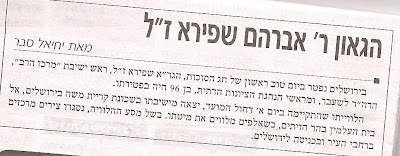
Rav Avraham Shapira, a former Chief Rabbi of Israel, one of the founders and heads of Religious Zionism, the Rosh Yeshiva of Merkaz HaRav, a tremendous talmid chochom and brilliant mind, passed away last week.
The Yated Ne'eman wrote about his passing. They called him "Ha'Gaon Rav Avraham Shapira z"l".
People are upset about that title. They are upset the Yated Ne'eman wrote z"l and not ztz"l.
Z"l is an acronym for "zichrono l'vracha" his memory should be blessed.
Ztz"l is an acronym for "zecher tzaddik l'vracha" - the memory of the righteous should be blessed.
They feel that the Yated Ne'eman was slighting Rav Shapira's honor by writing z"l and they did so only because he not "one of ours" (from the perspective of the Yated). Because he was a Nationl Zionist Rabbi he could not have been deserving of the title tzaddik.
I say they should get over it.
First of all the Yated did call him "ha'gaon".
Second, the Yated is an ultra-Haredi newspaper, the mouthpiece of super-Litvish Haredi Judaism.
Sure, it would be appropriate for them to show proper respect to great people of other streams as well. However they showed him respect and it is not unusual that they would give him one notch lower than their own people. That is the nature of politics and social wars.
Get over it. Stop looking for the approval of the Haredi mouthpiece.

Oct 7, 2007
Get rid of Aramis Ramirez!
With two men on and two outs Aramis strikes out looking. Again. He is still 0 fer playoffs. Get rid of his big fat contract.
Oct 5, 2007
Blogrush
I just added Blogrush to my blog. It is supposed to drive up traffic to my blog. We will see if it really works.. If you want to try it for your blog, sign up here...
Oct 3, 2007
It is my son's penis
There has always been a movement against circumcision. Most Jews tended to ignore it and would continue circumcising their male children. Bris mila is something that Jews throughout history were steadfast in continuing despite being under great threat and danger.
It seems like that is no longer true. Circumcision is on a decline and it seems that among the Reform community many are opting to not circumcise their children.
I never understood the argument that is often mentioned when attempting to ban circumcision, or at least to explain why someone chose not to perform it on their child. The argument is: (quoting the end of the linked to article) "Hey, it's my son's penis, it's not mine to discuss in the same way it's not mine to cut."
This is an argument that is commonly stated. What right do I have to cut my child, to cause him pain, to choose a path for him, etc.
As parents, everything we do is choosing a path. We cause pain all the time.
We send our child to the dentist to pull a tooth - what right do you have to do that? Did you ask the child first what he thinks about it?
You sent a child to the school you thought would be best for him - you have chosen a path for him. You did not let him choose his life quest. You decided he should get this type of education rather than that type of education. What right do you have to do that?
You give the child medicine, or vitamins. Did you hold a meeting with the child first to discuss the pros and cons and then let the child make the final decision?
You gave birth to the child - what right did you have to bring him into the world? Did you ask him? Maybe he would have preferred you use birth control?
Do you let your child set his own bedtime? Can he choose how much television he wants to watch and whether he can stay home from school or not?
Did you pierce your daughter's ears?
As parents it is our job to make decisions that affect our children and their paths and directions in life. We cannot abstain from making a decision with the argument that I have no right to decide for him.
It seems like that is no longer true. Circumcision is on a decline and it seems that among the Reform community many are opting to not circumcise their children.
I never understood the argument that is often mentioned when attempting to ban circumcision, or at least to explain why someone chose not to perform it on their child. The argument is: (quoting the end of the linked to article) "Hey, it's my son's penis, it's not mine to discuss in the same way it's not mine to cut."
This is an argument that is commonly stated. What right do I have to cut my child, to cause him pain, to choose a path for him, etc.
As parents, everything we do is choosing a path. We cause pain all the time.
We send our child to the dentist to pull a tooth - what right do you have to do that? Did you ask the child first what he thinks about it?
You sent a child to the school you thought would be best for him - you have chosen a path for him. You did not let him choose his life quest. You decided he should get this type of education rather than that type of education. What right do you have to do that?
You give the child medicine, or vitamins. Did you hold a meeting with the child first to discuss the pros and cons and then let the child make the final decision?
You gave birth to the child - what right did you have to bring him into the world? Did you ask him? Maybe he would have preferred you use birth control?
Do you let your child set his own bedtime? Can he choose how much television he wants to watch and whether he can stay home from school or not?
Did you pierce your daughter's ears?
As parents it is our job to make decisions that affect our children and their paths and directions in life. We cannot abstain from making a decision with the argument that I have no right to decide for him.
Subscribe to:
Posts (Atom)
Related Posts
