
May 31, 2006
Staying up all night on Shavuos
I am sure some of those years I stayed up learning more and some less. Some I probably would have done better sleeping at night and some not. Bute every year I stayed up. Also, every year by the end of the night I say to myself that this is the last time I do this and next year I am going to sleep at night. By the end of the night many people, myself included, are sleeping through much of davening, definitely the parts of akdamus (why do we say that anyway? I don't think anybody knows what it means or why we say it..) and Ruth and Torah reading, if not other parts as well. The last hour or two of learning, even if one learned very well until then, is often spent trying to find something to nosh on, something to talk about, something to keep you awake. Not much actual learning.
So, every year before Shavuos I debate whether I am going to stay up this year or not. This year I have not yet debated it in my mind, but just assume I will as a fait accompli.
Is that the way it should be? Is it better to stay up all night, most of the time learning, if it will adversely affect your ability to function during davening or function the next day? Is it better, perhaps to learn part of the night, go to sleep and wake up at a normal time to daven properly? Maybe learn all night and then go to sleep for a few hours at alos and wake up later to daven (my shul is having that option for a second minyan this year) properly?
I do not have the answer. But I will be staying up this year again.
May 25, 2006
Freedom of Religion in our Government
I have written on this previously, but a speech like this creates a good moment to mention it again. Olmert says he promises freedom of religion and worship and will guard the holy sites. What is he talking about? A Jew cannot go up onto Har Habayit freely. He is practically strip searched before going up and he is not being searched for weapons. We are searched in case God forbid someone would try to bring up a prayer book. If someone is seen by the police on the Mount moving his lips, he is warned due to suspicion he might be praying and if the warning goes unheeded he will be thrown off the Mount and possibly arrested. Today the courts prohibited the Temple Mount Faithful group to go up on Temple Mount.
Are we allowed to go to the holy gravesire of Yosef Hatzaddik? No. They almost never even allow scheduled visits for Jews anymore. The other night was yesod she'byesod of the omer, which is considered Yosef Hatzadik's night where traditionally many would go to his grave to spend the night in prayer. I have gone in years past. This year they did not allow any Jews to go there, even on this night!
This is freedom of religion? Freedom of worship? This is not Communist Russia we are talking about, nor any other country that subjected Jews to persecution over the ages. This is modern day Israel that does not allow a Jew to pray in Judaism's holiest site. That is freedom of religion? Freedom of Worship?
Whose freedom does Olmert profess to protect? Is he trying to fool everybody with such statements? He is only protecting the rights of the Arabs and Christians, yet he tramples upon the rights of the Jews.
This seems to be the way of the government in general. Bend over backwards to do everything for the Arabs and nothing for the Jews. Since the elections, Amir Peretz, our Defense Minister, has acted more like the Defense Minister of Palestine than of Israel. He is always very quick to denounce settlers and Jews he does not like, but always finds excuses for the Arabs. He has done everything in his power for the Palestinians, but little to protect Jews. He opened border crossings and allowed more Palestinians in for work. He told people in Sderot to stay off the top floor of buildings, instead of protecting them from the nearly daily rocket attacks. Now the news sites are reporting that Peretz is transfering weapons to Abbas' people.
I am not saying that we should deny Arabs their rights. Their rights should be protected as well. But our governments priority should first be protecting us and guarding our rights to religion and worship.
in memory of
My friend decribed to me the unusual experience. They had to figure out what to do with her, because dead bodies are considered muktza on shabbos. He remembered we had learned it and discussed the topic not too long ago in daf yomi, but he could not remember the conclusion. So. he ran over to his Rabbis house to ask what is to be done. He ended up after some research putting a piece of bread on the body which then allowed him to move the body. But he had a hard time moving the body (let's not forget, the body is right next to the table. would not make for any sort of non-tense shabbos) because "chai nosei es atzmo" and a dead body seems to weigh much more and is unwieldy. Anyway, he and his son teamed up and moved the body downstairs to her apartment. They then spent the rest of shabbos through Sunday doign shmirah on the body until the funeral..
Tonight I went to be menachem aveil another friend. This was a man who came for a while to my daf yomi shiur a number of years ago for some time. He was 72 years old and passed away. I went to visit his son (also a friend of mine) and wife. They are sefardim and were preparing for a traditional seuda that sefardim make near the end of the shiva period. The son told me that his father had been born in Afghanistan and lived there until he was about 30. He then went to Calcutta, and eventually India where he met his wife and eventually Toronto then home to Israel the last few years.
His son told me that he had had intestinal cancer. He had a large growth which they surgically removed. The surgery made him very weak, but he felt it his responsability to do all he could to fight it. After a couple of months the growth returned in another lcoation but they could not operate as his body was not strong enough. They told him he has to eat a lot to build up strength so they would be able to operate. He could not eat because of the growth in the intestine. Anything he would eat he would almost immediately vomit out. But he was a fighter and tried to get his body some nutrients to make himself strong, despite how it made him so sick. Eventually he succumbed and passed on.
Somebody in my daf yomi shiur had a yahrtzeit tonight for his grandfather. He told us that his grandfather was from Europe and went to America to make money to send back to his family until he could bring them over. Then World War 1 broke out. He could not send them any letters and could not go back. He lived apart from his wife for 9 years until he could bring her and the kids over.. He could not deal with workign on shabbos or looking for a new job every Sunday, so he opened up his own little shop and slept in the back room.
These people's neshamos should all have aliyos and they should be meilitz yosher for us down here.
May 24, 2006
explosion
I hope everybody is ok.
*******Update*********
It seems the explosion was in a nearby carwash run by known mafiosa named Alperon...
May 23, 2006
Jewish or Israeli?
The impression I had from the interview is that the Wertheimer family is not religious (though they are descendants of Rashi). However they are also not anti-religious and in the interview he said many things that show his sensitivity to religion in different ways. He said one very interesting thing in the interview I wanted to comment on, as he said something that was similar to a topic I have written about previously.
The interviewer asked Mr. Wertheimer if during business dealing abroad does his Jewish identity, rather than just his Israeli identity, become more dominant?
Mr. Wertheimer's response was (my translation from Hebrew),"In Israel I generally think Israeli. Abroad - generally Jewish. When I am in Israel there is less meaning to being Jewish. Specifically when I am abroad I find myself putting on a kippa and visiting shuls.. etc.."
Something about Israel makes Israelis feel that just being here makes them feel Jewish and they do not need to act Jewish or perform the requiremensts of a Jew. I am Israeli - that is most important and supercedes yet includes Jewishness, and therefore i do not need to show my jewishness in any other way, as it is already manifested in my being Israeli.
This is a major factor in the argument of those who reject Zionism, specifically secular Zionism. Aside from the specific problems that upset them at the founding and early years of the State, what upsets them greatly is the fact that Jews no longer need to perform mitzvos or act Jewish in order to feel part of the Jewish nation. They can live in Israel and that makes them feel Jewish. Just the fact that when an Israeli leaves Israel and feels the natural need to show his Judaism in ways he normally does not proves the fact that Israel has replaced the concept and community of Judaism.
Thuis argument does have a point and if one pays attention he will see very commonly that Israelis travelling abroad (in jewish communities around the world - not necessarily backpacking in Thailand or Singapore) will act more "Jewish" than they do back at home.
It is an interesting phenomenon
no more non-Israeli conversions
The Cheif Rabbinate has decided to make procedures uniform and require any Rabbi abroad who wishes to be approved to effect conversions, will have to pass the Rabbanut exams for conversion, effectively making the Rabbanut the sole decider on conversions around the world. They have prepared a list of 50 Rabbis who are allowed to perform conversions without taking the exams. Rabbi Schwartz from the RCA is on the list. The Rabbanut response though is that only conversions actually performed by these 50 Rabbis will be accepted, but not those they sign on as part of the overall beis din, if they were not the officiating Rabbi.
I do not even know what to write about this. I am completely in shock as to how the Rabbanut can overtly reject Orthodox Rabbis all over the USA and Europe. How can the Rabbanut think that they are more of an authority on conversions and have the gall to reject conversions by others? Does that mean that converts, either those already converted or those future converts, will not be allowed to come to Israel, as they will be recognized as non-Jews?
May 18, 2006
Israeli bureaucracy? NOT!!!
May 16, 2006
do as much as you can or try to be perfect?
The Gemarah discussed whether the bones of the Korban pessach need to be burned the next day (really two days later because of the chag). The premise is that the Torah says not to leave over any meat. Any meat left over must be burned. No bones are allowed to be broken. The Gemarah's concern is regarding the bone marrow. The marrow has the status of meat and therefore must be eaten. however there is no way to access the marrow without breaking the bones, yet you are not allowed to break bones of the korban. A dilemma.
The Torah seemingly is giving a commandment that is impossible to fulfill. Eat all the meat, but you can't! By default, we are given a mitzva that we cannot completely do, and we are given a negative commandment that we have to transgress!
This obviously turned into a big discussion and debate during the shiur. What does God want from us? Are we meant to try to do things perfectly the way we are commanded to and complete things 100%? Are we meant just to try as hard as we can? Are we meant to just do as much as we can (even if it means not trying too hard)?
I know Rabbi Tarfon says in Pirkei Avot (2:19) that the task is not incumbent upon you to complete, but you are not free to desist from it. To me that means you have to try as hard as you can to do something properly and to complete something to the best of your abilities, even if you go into it knowing that you have no chance of doing 100%. You cannot do it halfheartedly, figuring you will accomplish whatever you accomplish and at least you tried. That is not good enough for a Jew. We have to try our best and put forth our best efforts.
Growing up
This past year, that family moved away to a different apartment, further away. People assumed, myself included, that we would not really have a bonfire by us this year because there was not really anyone who would take charge. We all figured we would go up the street to the really big one the kids were making over there.
Sure enough, my nine year old son and a neighbors son decided they wanted to make the bonfire. They collected and schlepped the wood. They put it together and piled the wood up. They ran the whole thing, with no help from anyone else. It was not the biggest bonfire in town, not even close, but they did a great job. I decided not even to bother going up the street to the large fire, my son's bonfire was much nicer.
Kids grow up whether you want them to or not..
May 15, 2006
A lesson from my tile guy
I get home yesterday from work and go outside to check the progress of the workers. They were just finishing up for the day and getting ready to go. The main guy shows me what he did. As I step outside to look at the work, he warns me to be careful where I step. he says don't step on the edges of the tile, only in the middle. He then goes on to explain, that just like we say Kol Yisrael Areivim Zeh L'Zeh (all Jews are gaurantors for each other) it is the same with tiles. If you step on one the wrong way and break it, it will ruin the whole thing, but if you step in the middle, they protect each other. With Jews too - hurt one of us and [it should fell as if] you have hurt us all, but we are all there to protect each other.
Even unfinished tiles on a floor can teach a lesson.
May 14, 2006
HS Trade Show to Israel in June
On a personal note, this is very exciting. Why, you might ask, as it seems kind of boring?
The reason is because my father sells an item in his business which is related to security concerns. This trade show gives him an opportunity to come to Israel in the near future and see us and the new baby. Hopefully it will work out and he will come..
Variety at the Kotel
We spent Shabbos in the Old City of Jerusalem - Ha'Ir Ha'Atika. Ha'Rova Ha'Yehudi (The Jewish Quarter). Walking around the Old City on Friday made me feel like I was back in Gush Katif erev-disengagement. All the residents we saw were wearing orange bracelets or orange ribbons. Some had orange items hanging from their cars and windows. We even saw a flag hanging from a windows. The flag was designed like the Israeli flag, but had a black background and the stripes and the star were orange. Unfortunately, for technical reasons, I could not get a picture at the time, and when I went back later to take a picture, the flag had blown in the wind and hooked on something so could only be partially seen. While the rest of us have moved on, for better or worse, in the Old City they still completely identify with the issues of the Hitnatkut.
The Old City is always special and unique and always provides an interesting and uplifting experience, especially on Shabbat. Here is a view you cannot get anywhere else..
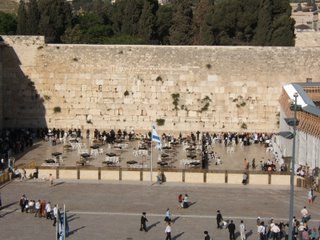
On the other hand, they also have to put up with daily views of this:
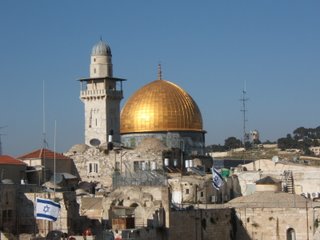
Seeing that in front of your eyes all the time should be a stark reminder of what should be there. We are all too often caught up in our daily lives and forget that the golden dome known as The Dome of the Rock was built on top of the exact spot where our Kodesh Kodoshim sat in the Bet Hamikdash. Despite the fact that Moshe Dayan said, "Har Habayit Be'Yadeinu" (The Temple Mount is in our hands) when it was recaptured in the Six Day War, we still cannot go up and pray freely. Despite the fact that we believe in freedom of religion and allow access to all churches and mosques located in jewish areas, becasue it is anathema to us to prevent others from praying and worshipping in their holy sites, it seems to be acceptable to the Arabs to consider it harmful and inciting for us to pray in our holy sites located in Arab areas (e.g. see Temple Mount, see Josephs Tomb, see Joshua's Tomb, see any other grave or synagogue in Arab areas) and the Jewish Israeli government is willing to accept that as an excuse to prevent Jews from praying there. [Religious] Jews going up are severely restricted, we cannot go in groups of usually more than 10 or so, we are searched for inflammatory prayer material and stripped of it, if lips are seen moving (even silently) you can be thrown off the mount and possibly arrested, etc. Seeing the Dome of the Rock in front of your eyes daily is a stark reminder of the idea that things are not the way they shoud be.
(note: if you wish to go up to Har Habayit you must comply with various Halachik requirements of purity, and even if you do some Rabbinic authorities still say you cannot go up. Be in contact with your LOR for further discussion on the issue. If you are interested and do not know whom to turn to, email me and I can put you in contact with either Rabbis who support going up to Temple Mount or Rabbis who are against Jews going on Temple Mount).
Anyways, Friday night at the Kotel was much more crowded than I remember it being in the past. I davened mincha with one minyan and then looked around for other interesting minyanim to participate in. There were a lot of minyanim with singing and dancing, and I was looking for one of those to join. I stumbled across a minyan near the back finishing minha and I saw that the minyan looked very interesting. It consisted of about 40 teenagers, most of whom appeared to be not religious based on their dress and haircuts (though I could be wrong), and I noticed the minyan was being led by Moshe Feiglin and Shmuel Sackett, the founders of Manhigut Yehudit. I decided to join the minyan and went over to Moshe and wished him a Shabbat Shalom and introduced myself. Whether you like him or hate him, Moshe Feiglin is an interesting person.
The minyan turned out to be inspiring. Kabbalat Shabbat was sung completely in the stye of R' Carlebach and the kids really got into it. They were singing along and dancing. They were lifting each other on shoulders and it was very lively. All sorts of other people were joining in. My kids were getting antsy because all that dancing and Carlebach style davening also means it takes a long time, so we moved on after a bit to find another minyan.
I joined for a few minutes another minyan I found in the back corner. this minyan was mostly Israeli soldiers, some religious some not, with some regular civilians mixed in, and my cousins were there as well with their friends. My cousin is a student at Aish Hatorah so he and his freinds were there making the minyan leibedig. There was a lot of singing and dancing there as well.
As always happens around sunset by the Kotel, the birds start flying around in circles right over the heads of the worshippers. I told my children that even the birds are dancing to all the singing of Kabbalat Shabbat. It did not help and they were getting even antsier. We moved on and found a faster minyan.
I noticed while beginning the maariv service, that there was a minyan of Hassidim nearby in the middle of minha still. I looked around some more (notice that I obviously did not have enough concentration on my prayers but spent much of my time looking around enjoying the site of so many Jews praying together, each in his own way) and paid more attention to the various groups of people: Two minyans over was a minyan of Yemenite Jews singing some Yemenite song, there were the carlebach minyans scattered throughout singing and dancing, there was a minyan with a young man in the center wearing a tuxedo and bow tie- probably celebrating his bar mitzva (or maybe the tux was just leftover from his bar mitzva), the various hassidic groups each having their own minyan, the National Religious, the mixed minyanim (not men and women, but mixed with different types of people), the Litvish, the Yeshivish, etc.
Everybody was there in close proximity of each other, each davening in his own style and doing his own thing. It did not disturb any other minyan and the variety only enhanced the atmosphere. That is Shabbat in the Old City of Jerusalem!
Related Posts
