
Showing posts with label wedding. Show all posts
Showing posts with label wedding. Show all posts
Jul 30, 2024
Interesting Psak: Standing at Chuppa
I have foudn that while it is common for many to stand at a chuppa when the chosson and kalla walk tot he chuppa, some do not and prefer to sit.
The reasons I have heard are usually in favor of standing due to the status of the chosson and kalla as a king and queen. Another common reason I have heard is standing int he presence of the shchina due to a mitzva being performed. The reason I have heard against standing is that it is not a real custom but absorbed from the goyim.
I must say, this is far more common in the USA (and other countries?) - many chairs are put out. Most people sit, until the chosson and kalla come out and then many stand while some continue sitting. In Israel, very few chairs are usually put out, usually just for elderly grandparents (or others who cant really stand long enough for the chuppa) and most people stand for the entire duration of the chuppa.
Rav Yitzchak Zilbershtein, rav of Ramat Elchonon neighborhood of Bnei Braq, was recently asked about this. The petitioner mentioned that they had made aliya from abroad after they married and now they are marrying off a daughter who was born in Israel. The chosson was born abroad and doesn't live in Israel but is here learning in yeshiva and has been for a few years. Most of the family who will attend the wedding will be from abroad where the minhag is to sit at the chuppa. Because of that they had planned to arrange the chuppa with enough seating for the crowd, but perhaps that would be inappropriately changing the local minhag. What is the correct thing to do regarding the seating at the chuppa of this wedding?
Rav Zilbershetin responded paskening that the minhag is to stand at the chuppa and this was always done in Eretz Yisrael and in other countries, with only some communities in the USA changing from this custom, and not for good halachic reasons, so for this wedding in Israel they should stand for the chuppa even though the family will be coming from the USA. It is bad enough that they do not keep the proper minhag there, they shouldnt change it here as well, and the communities abroad should be influenced to adhere to the original custom and stand.
source: Hamechadesh
I found this interesting. I thought the reason so few chairs, if any, were set out at chuppas in Israel was just practical or just the way halls here do it due to there being not as much as space or not having enough chairs with them all being set in the hall for the meal and other reasons like that. I did not realize it was an actual minhag dictating this...
------------------------------------------------------
Reach thousands of readers with your ad by advertising on Life in Israel
Reach thousands of readers with your ad by advertising on Life in Israel
------------------------------------------------------
Jan 29, 2023
wedding mikva
I am not sure the wedding mikva thing is going to catch on and become trendy, but nowadays you can never predict these things accurately.
Rabbi Zvi Meir Zilberberg, one of the main rabbis fighting against technology in the Haredi community, and the one behind the people who have been going around to shuls and smashing the "Nedarim Plus" screens set for announcements and donations because of their connection to the Internet, no matter how limited it is, has created the wedding mikva.
Rabbi Zilberberg participated in his grandson's wedding the other. The wedding party lasted 12 hours! As notable as that may be, the more noticeable part was Rabbi Zilberberg bringing a mikva to the wedding hall and immersed himself. The mikva was transported to the hall in a caravan. The wedding supposedly took place in full holiness with no smartphones present, even among the waiters.
The article in Behadrei says they connected it to the ground and kashered it in the most mehudar way in preparation for the use of Rabbi Zilberberg. Not being an expert in the halachos of a mikva, I can only wonder how this was anything like a kosher mikva. it looks like a kli, it was transported, and I am not aware of any heavy rainfall over the past few days to fill this mikva. Whatever.

When he arrived in Bnei Braq for the wedding, he dunked in the mikva to purify himself and then dunked again after the kabbalat panim and maariv, before the chuppa. Rabbi Zilberberg dunked again before the mitzva tanz
So besides for the questions about the kashrut of the mikva mentioned above, what is the purpose of this? Dunking three times at a wedding and at different points of the ceremony? is there any source for any of this? When do we call making up new behaviors Reform and when not? will this become a trend?
------------------------------------------------------
Reach thousands of readers with your ad by advertising on Life in Israel
Reach thousands of readers with your ad by advertising on Life in Israel
------------------------------------------------------
Nov 7, 2022
no friends at the wedding
The Admot of Toldos Ahron is concerned over too much bittul torah. To that end he has decided to prohibit students in the Toldos Ahron yeshivas from attending the weddings of their fellow students.
Any change of societal norms has a ripple effect. If 20/50/100 boys dont go to a friends wedding to dance and bring joy to their friend, the effect might be that the wedding might not be a particularly joyous event - some relatives and friends will surely come and dance, but it wont be the same as a slew of yeshiva bochurim and the chosson's friends bringing their energy. So, the Admor added to his decree the formation of a group of people who will go to weddings and be leibidige, bring joy, dance with energy, and make up, somewhat, for the lack of friends from the yeshiva.
The Admor did stress that people should not rely on the "mesamchim" group to be responsible for bringing joy to the chosson - that is an addition, but the family and older friends should make sure to do their part in bringing joy to the married couple at their affair.
According to Kikar, similar rules are already in place in several other Hassidic groups. And, in addition to bittul torah, another issue is that the young men form yeshiva coming to dance often seem to take over the simcha and the family and friends get pushed aside as if they are acquaintances and guests.
Without commenting on the decree itself, it is somewhat sad to think of people getting married and their friends not being able to attend and dance. Let's be honest - us old people dance, some more some less, but the real energy is brought by the younger people. The chosson will probably be bored with just a bunch of old people shuffling around a circle for a bit.
------------------------------------------------------
Reach thousands of readers with your ad by advertising on Life in Israel
Reach thousands of readers with your ad by advertising on Life in Israel
------------------------------------------------------
Jul 11, 2022
Back To Utah Overnight
TOI is reporting that the Court in Israel has decided that marriages performed online are valid and couple who try to register their marriages in Israel must be registered by the Interior Ministry as married.
This is specific to the online marriages recognized by the State of Utah in the USA. With no civil marriage in Israel, couple wanting to marry civilly and not religiously had to travel abroad to wed, and then would register their marriage upon return. Cyprus was a common destination for these civil unions, due to its proximity to Israel and generally cheap or reasonable prices, so it did not become an expensive event to get married. During Covid it became a problem as for long periods of time people could not travel abroad, and in Israel they could not marry civilly. At some point the State of Utah started doing online marriages, and Israelis looking for civil marriages flocked to Utah, digitally at least.
Initially these weddings were approved upon registration in Israel but at some point Aryeh Deri, Minister of Interior at the time, decided to put a stop to this process and ordered a legal review. While the Ministry under Deri published a legal opinion that because these couple were present in Israel at the time of the wedding, the State of Utah had no authority as the laws of Israel applied to them in the borders of Israel, and the marriages were invalid. Eventually Deri was ousted from the Ministry, and while nothing really changed, an eventual appeal to the courts brought about this new decision that a decision in the debate over legality of location is beyond the authority of a clerk in the Ministry of Interior - their authority is simply to determine the validity of the documents presented to them. If the marriage certificate from abroad is determined to be valid, the clerk must register them as married.
The decision has upset religious parties, bringing civil marriage to Israel. Personally I think there should be some form of civil marriage in Israel. Too many people struggle with no solution as they are not officially Jewish but also not Christian or Muslim, and have no method for getting married (among other things). When nobody is willing to present a solution to a problem, the vacuum will be filled by other people, in this case by the State of Utah and creative Israelis who came up with the idea.
.In the meantime, Aryeh Deri has petitioned the Attorney General to put an end to this saying the judge doesnt have the authority to change the Jewish character of the State and it gives every person the ability to circumvent the law in Israel.
This brings new meaning to MBD's song Yerushalayim is not for Sale, when he says "you better run for your life, back to Utah overnight..."
------------------------------------------------------
Reach thousands of readers with your ad by advertising on Life in Israel
Reach thousands of readers with your ad by advertising on Life in Israel
------------------------------------------------------
Jul 10, 2022
Interesting Psak: feeding the wife
A printing mistake in a ketuba seems to have affected tens of thousands of young couples, both in Israel and abroad - a word was left out, and it is a word that invalidates the contract.
A rav and dayan from Bnei Braq, Rav Yaakov Yosef Cohen, discovered the missing word in a ketuba he was looking at - the word "V'Izon" - where the husband says to the wife I will feed you. In the ketuba being signed, there was no commitment for the husband to support the wife (the other words of I will honor you, I will support you, etc were all there, just the I will feed you was missing). Without this commitment, the ketuba is invalid.
And it turned out, upon further research, the printing mistake involved tens of thousands of couples around the world.
Uh oh.
Big problem. That is a lot of young couples living together without a valid ketuba.
Rav Cohen paskened that anyone with such a ketuba needs to go to a mesader kedushin and have a new ketuba written to replace it. While there is a slight possibility the ketuba is kosher, and there is such an opinion, the mainstream psak is that this word missing invalidates the ketuba and people should not take such a serious situation lightly and rely on the lenient psak.
source: Behadrei
Humorously I might say that there is no problem with the ketuba in many, or at least some, of these marriages, since in some of them the man is not feeding his wife anyway nor supporting her but she is supporting him and feeding him by being the main breadwinner of the house while he is in kollel. Maybe that could be a factor for some of the affected people.
------------------------------------------------------
Reach thousands of readers with your ad by advertising on Life in Israel
Reach thousands of readers with your ad by advertising on Life in Israel
------------------------------------------------------
May 30, 2022
are these anti-Haredi laws really coming down the pipeline?
Zeev Alperovitz of Merkaz Inyanim, a Haredi news media outfit not found on the Internet (that I know of), is reporting on an upcoming series of laws soon to be passed, or at least proposed. This series of laws is being seen as an anti-Haredi blitz of legislation, and MK Uri Maklev (UTJ) is supposedly working his connections to thwart them in advance from being raised and/or passed, campaigning quietly for support among religious and right wing coalition MKs.
I would note that I have yet to see any of this reported anywhere else at this point. So, I dont know if it is real, if it is fake and simply fear-mongering, or if it is fake and when it doesnt happen (because it was never going to) it will be to the praise of Maklev for thwarting it...
Anyways, as the report goes, the laws to be proposed and passed include; making it illegal to have gender-segregated events, making it illegal to protest against the Women of the Wall, and to require Haredi and Dati rabbis to officiate at the weddings of Reform couples.
I wait to see how they will define an event that cannot be gender segregated and what events can be gender-segregated. Is davening in shul an event that can or cant be segregated? Can a bar mitzva in a shul social hall be segregated or not? What about a wedding in a wedding hall? What about a private concert or a play? Will this be an end to women's retreats or will that be ok? shiurim for men and shiurim for women? This does not seem like it is going to be easy to define or enforce, except at maybe the "more obvious" extremes.
Next, making it illegal to protest against the Women of the Wall at the Kotel. How can this possibly go down in the democratic state of Israel? During the period of CoronaVirus lockdowns, while everyone was strictly locked in their homes, the one thing people were able to go out for - even before they allowed individual exercise and services in shul - was protests. The right to protest is sacrosanct. It has been upheld when all other rights were curtailed. People have the right to protest outside the homes of ministers and the Prime Minister, outside government buildings, outside schools and outside the homes of individuals with whom they disagree - but they wont be allowed to protest against the activities of the Women of the Wall? This does not make sense. I cant believe they would pass a law making protest illegal against this or against any specific group. The Left would participate in a law curtailing the right to protest, even if it is true that some in the Coalition might want such a law?
The last one is a bit confusing as well but more form a point of why is it necessary? Haredi and Dati rabbis would not be able to refuse to officiate at the wedding of a Reform couple. At first thought, Haredi and Dati rabbis should be officiating at the weddings of anyone who wants them. Rabbis, any rabbi of any stream, should be happy to be turned to by people who want him involved in their lives at some level. But, how often do Reform couples want a Haredi rabbi officiating their wedding that this is much of an issue? Further, I am a little confused because Israel has no civil marriage allowances and any such marriages are illegal, as are any marriages outside of the Rabbanut (except for Muslim and Christian marriages, though those require involvement of their official religious representatives). So if it is illegal for a Reform couple to be married by a civil servant or by their Reform rabbi (assuming the Reform rabbi is not certified for performing weddings by the Rabbanut), how can Dati or Haredi rabbis ever be allowed to turn people away - if they are the only allowed to perform Jewish weddings, they should never be allowed to reject anyone Jewish wanting to get married!
So, none of these really make sense, making me wonder if the report is even true and not just fear-mongering. But if it is true, I dont see how they can pass the first two laws, and I dont see how they cannot pass the third unless marriage is opened up to civil and other non-Rabbanut rabbis....
------------------------------------------------------
Reach thousands of readers with your ad by advertising on Life in Israel
Reach thousands of readers with your ad by advertising on Life in Israel
------------------------------------------------------
Oct 25, 2021
Torah B'Tahara
This looks like an interesting initiative to keeps kids on the derech...
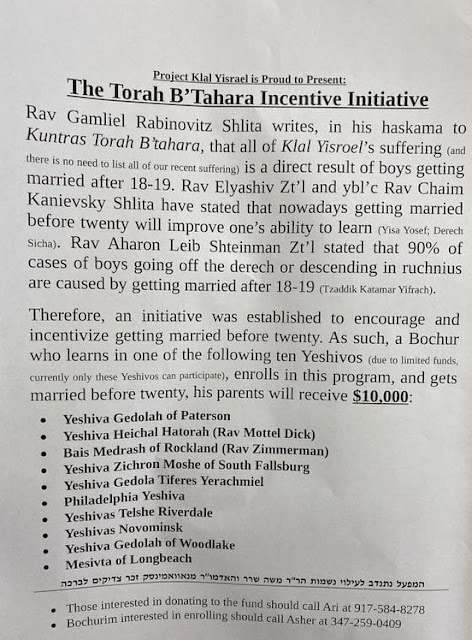

It seems like a fine initiative. Will it work or not - that we won't know until it is tried.
My only question is why do the parents get paid the $10,000 reward? It seems to me that the young couple is really the one deserving of the prize/reward money and most in need of it... they should be the ones getting it...
------------------------------------------------------
Reach thousands of readers with your ad by advertising on Life in Israel
Reach thousands of readers with your ad by advertising on Life in Israel
------------------------------------------------------
Jul 15, 2021
The Happy Tag
Prime Minister Naftali Bennett, along with Minister of Economics and Commerce Orna Berbibai, met today with a consortium of owners of events and wedding halls. The meeting was to hash out a plan by which the halls would be able to continue functioning hosting events and weddings while keeping people as safe as possible, even amidst the spreading of CoronaVirus with possible social limitations and restrictions coming.
The meeting concluded with the creation of the "Tav Sameach". The Happy Tag. Like the Purple Tag businesses were allowed to operate under during previous lockdowns, the Happy Tag will set guidelines for the continued operation of these wedding and event halls.
The main points of the Happy Tag is that an event with fewer than 100 people can function as normal with no restrictions (though masks must be worn indoors, as per the current rules), but any event with more than 100 people will require guests and participants who have not been vaccinated or recovered to present proof of being tested for Corona (with negative results) within 72 hours of the event.
There are a few more minor rules, such as how dinner and dancing should be organized, indoor and outdoor preferences, etc. but the main issue is the participants.
The goal, Bennett says, is to find a way to let them continue functioning and keep everyone safe - if we shut them down, should it become necessary, then people will go back to pirate weddings and events that will keep nobody safe.
So, that seems to mean the "green passport" is back. To get in to a wedding you were invited to, or a bar mitzva or concert, you are going to be required to show proof of vaccination or recovery, or of a negative PCR test.
For those of us vaccinated or recovered that is not such a big deal. Will unvaccinated/unrecovered guests, outside of immediate or close family, really go take Corona tests, and pay for them privately, every time a friend or neighbor or cousin invites them to a bar mitzva or wedding? I am not sure how realistic this plan is, and it will depend on the enforcement - if there is not going to be serious enforcement of any new rules it is back to the illogical rules of the last year and a half of closures and lockdowns and restriction rules that often made no sense.
------------------------------------------------------
Reach thousands of readers with your ad by advertising on Life in Israel
Reach thousands of readers with your ad by advertising on Life in Israel
------------------------------------------------------
May 3, 2021
Headlines Podcast: 5/1/21 – Show 320 – Chasunah Season post Covid: Should we change the way we make Chasunas? (audio)
------------------------------------------------------
Reach thousands of readers with your ad by advertising on Life in Israel
Reach thousands of readers with your ad by advertising on Life in Israel
------------------------------------------------------
Jan 6, 2021
Picture of the Day

Want to know why we are heading into another lockdown, from lockdown to lockdown? This picture is a good example.
While I am not quite clear on the details of what happened, there was a wedding in Beitar last night. The big event, with many guests and no adherence to any rules and restrictions, was among the Toldos Avraham Yitzchak chassidim.
The strange part of this is that the police came in at one point and instead of breaking it up, giving out fines or arresting anyone, the police went over for brachas from the Rebbe. Later the police went back in at the end of the wedding, after most people had left, and confiscated the sound equipment - I have no idea what that was supposed to accomplish.
Enough of the people don't care and the police don't enforce. That is why we are in the situation we are in.
------------------------------------------------------
Reach thousands of readers with your ad by advertising on Life in Israel
Reach thousands of readers with your ad by advertising on Life in Israel
------------------------------------------------------
Oct 14, 2020
Quote of the Day
People are asking me if we have no changed the guidelines and now weddings are allowed?
The change allows for people to leave beyond the 1000 meter limitations from their homes in order to go to a chuppa. These are the same guidelines as the ones in place for a bris and for a funeral. The intention is that up to 20 people in an open area. There is no allowance for weddings with dancing and meals. This is only for the performance of the religious service of the chuppa alone.
-- Deputy Health Minister Yoav Kisch
What he said isn't all that exciting, but it did clarify a rule I think many aren't aware of. I wasn't and I dont recall seeing it explained this way in the media. The allowance for a wedding right now under lockdown is only for a chuppa ceremony. Nothing else.
That being said, what he said made me think of all the businesses, shuls and whatever rebranding as a shul or protest to get around the guidelines and be considered something else that gives a greater allowance. It made me think of a restaurant that might host a siyum during the Nine Days in order to be able to serve meat to customers now hosting weddings so that the guests, up to 20 of course, could sit and eat diner and officially be a part of a wedding rather than a restaurant that is not currently allowed to have seating...
------------------------------------------------------
Reach thousands of readers with your ad by advertising on Life in Israel
Reach thousands of readers with your ad by advertising on Life in Israel
------------------------------------------------------
Oct 7, 2020
Marry Thy Neighbor
Marry thy Neighbor. Sounds almost like a biblical commandment.
No exception was granted form the lockdown regulations for weddings. So, it turns out, only "neighbors" can marry each other during this lockdown.
the only way two people can get married is like a VENN diagram - as long as they both live within 1000 meters of the wedding location, they can get married. If either party lives farther away, the wedding will be illegal.
People need to start dating only neighbors, considering how unknown the future looks right now.
Another difficulty is the rabbi officiating at the wedding. if it is your private rabbi or rosh yeshiva, he too must live within 1000 meters of the wedding location. The only way out of that problem is to have an official city or neighborhood or regional rabbi officiate the wedding. An official rabbi holding a position from the State is granted an exception to perform his various services throughout the city, as all city residents are his charges.
This lockdown is affecting many people in many different ways, and people are upset and inconvenienced by it. That's life under a lockdown. Maybe if more people kept to the rules of the lockdown we could possibly get out of it a bit quicker. But so many people insist on having their freedom and not following the lockdown rules, it will likely take a bit longer to get out.
------------------------------------------------------
Reach thousands of readers with your ad by advertising on Life in Israel
Reach thousands of readers with your ad by advertising on Life in Israel
------------------------------------------------------
Jun 28, 2020
Interesting Psak: witnesses at wedding with face masks
Rav Bunim Shreiber, Rosh Yeshiva of Netiv Daas and rabbi in Ashdod, has paskened that witnesses at a wedding must remove their masks, or lower them to make the face visible, during the chuppa. They must do so even though it means breaking the Ministry of Health guidelines (for a short period of time).
Rabbi Shreiber explains that by wearing the masks, the witnesses cannot be fully identified by other people. Wearing the mask would make it difficult, if not impossible, to be "meizim" the witnesses. Viable witnesses must be potentially impeachable as "plotting witnesses", eidim zomemim. Yet with their faces covered, nobody would be able to impeach their testimony by saying they were spotted elsewhere, so the testimony shouldn't be valid to start with. Thus, the masks must be removed to make them potentially impeachable.
Rav Chaim Feinstein, the Rosh Yeshiva of Ateres Shlomo, disagrees and believes that testimony requiring theability to be impeachable is only a law found in the laws of Choshen Mishpat, financial laws, and is not found discussed as a factor in Even HaEzer - the laws of family such as marriage and divorce.
source: Hamechadesh
I would add that the Gemara talks about the rules of eidim zomemim in regards to issues of the death penalty, not just financial matters. Also with regards to transgressions that would obligate one in receiving lashes. So I am not sure this categorization is accurate, but I don't know enough about the application of eidim zomemim to argue this reasonably.
I would also note that the witnesses are supposed to be witnessing Reuven marrying Sarah, or whoever. In many weddings the bride, Sarah in our example, is covered by a very thick veil that is not see through. I have almost never seen the witnesses look under the veil, have the bride lift the veil for a moment. I do know one person, and have seen it myself, who has been witness at a number of weddings, and he is always careful to insist on having the bride lift the veil so he can confirm who the bride is, that she is the person that the groom is supposed to be marrying. But that is uncommon. I find it interesting that these rabbonim are debating the mask that partially, and only for this hopefully temporary period of time, covers the faces of the witnesses, yet make no mention of the mask, the veil, that regularly covers the entire face of the bride.
Rabbi Shreiber explains that by wearing the masks, the witnesses cannot be fully identified by other people. Wearing the mask would make it difficult, if not impossible, to be "meizim" the witnesses. Viable witnesses must be potentially impeachable as "plotting witnesses", eidim zomemim. Yet with their faces covered, nobody would be able to impeach their testimony by saying they were spotted elsewhere, so the testimony shouldn't be valid to start with. Thus, the masks must be removed to make them potentially impeachable.
Rav Chaim Feinstein, the Rosh Yeshiva of Ateres Shlomo, disagrees and believes that testimony requiring theability to be impeachable is only a law found in the laws of Choshen Mishpat, financial laws, and is not found discussed as a factor in Even HaEzer - the laws of family such as marriage and divorce.
source: Hamechadesh
I would add that the Gemara talks about the rules of eidim zomemim in regards to issues of the death penalty, not just financial matters. Also with regards to transgressions that would obligate one in receiving lashes. So I am not sure this categorization is accurate, but I don't know enough about the application of eidim zomemim to argue this reasonably.
I would also note that the witnesses are supposed to be witnessing Reuven marrying Sarah, or whoever. In many weddings the bride, Sarah in our example, is covered by a very thick veil that is not see through. I have almost never seen the witnesses look under the veil, have the bride lift the veil for a moment. I do know one person, and have seen it myself, who has been witness at a number of weddings, and he is always careful to insist on having the bride lift the veil so he can confirm who the bride is, that she is the person that the groom is supposed to be marrying. But that is uncommon. I find it interesting that these rabbonim are debating the mask that partially, and only for this hopefully temporary period of time, covers the faces of the witnesses, yet make no mention of the mask, the veil, that regularly covers the entire face of the bride.
------------------------------------------------------
Reach thousands of readers with your ad by advertising on Life in Israel
Reach thousands of readers with your ad by advertising on Life in Israel
------------------------------------------------------
Jun 14, 2020
Rav Amar discovers marriage proposals and doesn't like it
Rav Shlomo Amar, Chief Rabbi of Jerusalem, spoke out against marriage proposals.
Yes, Rabbi Amar wants people to get married. he is not against people going on shidduchim and deciding to get married. Rav Amar is opposed to the "marriage proposal".
According to Rav Amar, this is a recent trend. It used to be the parents would speak and close the deal and all was good. But a new thing has crept in, even among the haredim and among yeshiva bochurim (though not true ones), and they get baloons and other stupidities and propose. Sometimes it might even cause a halachic problem is certain words are said and other people are present witnessing it. This is hefkerus, degrading. "woe tot hem" Rav Amar said, as he said their craziness has no limits. Religious people should do this? People who keep mitzvos?
Rav Amar wants the Roshei Yeshiva to put a stop to it and prohibit their students from doing such proposals.
source: Kikar
Far be it from me to argue with Rav Amar. I see some of these proposals and they do seem to be out of hand and silly. I am just surprised that Rav Amar is only discovering it now and thinks it is a recent trend. it has been going on for years.
Yes, Rabbi Amar wants people to get married. he is not against people going on shidduchim and deciding to get married. Rav Amar is opposed to the "marriage proposal".
According to Rav Amar, this is a recent trend. It used to be the parents would speak and close the deal and all was good. But a new thing has crept in, even among the haredim and among yeshiva bochurim (though not true ones), and they get baloons and other stupidities and propose. Sometimes it might even cause a halachic problem is certain words are said and other people are present witnessing it. This is hefkerus, degrading. "woe tot hem" Rav Amar said, as he said their craziness has no limits. Religious people should do this? People who keep mitzvos?
Rav Amar wants the Roshei Yeshiva to put a stop to it and prohibit their students from doing such proposals.
source: Kikar
Far be it from me to argue with Rav Amar. I see some of these proposals and they do seem to be out of hand and silly. I am just surprised that Rav Amar is only discovering it now and thinks it is a recent trend. it has been going on for years.
------------------------------------------------------
Reach thousands of readers with your ad by advertising on Life in Israel
Reach thousands of readers with your ad by advertising on Life in Israel
------------------------------------------------------
Mar 24, 2020
the weddings should outlast Corona
Last night the police broke up a wedding in Neve Yaakov, Jerusalem that had too many guests present, against the guidelines and allowances of the Ministry of Health. They had more than 30 guests present, at least when the police arrived. The police broke up the wedding party and fined the chosson 5000nis for the violation.
These ad hoc, on the sly weddings, and minyanim, kind of make me, and many other people, think back to the stories of the days of the Crypto Jews (aka Marranos), or the days of Soviet Russia, or other times when Jews had to sneak around and do their mitzvahs as best they could but in secret. The difference is that now the government is not hostile and the reason for the restrictions is due to a serious health crisis and danger to life, not an anti-religion edict.
Back to our joyous groom in Jerusalem...Even after paying the 5000NIS fine, he still saved a ton of money by having his wedding now, during the days of COVID-19, with these guests, and he probably thinks it was worth it even with the fine! He paid 5000nis vs ~50000nis a regular wedding would have cost...
After all this will be over and the danger to people's health and life will be nothing but a memory, I hope the one thing that remains is that we don't go back to make big weddings in halls with parties that we can barely afford, at best. These small intimate weddings taking place in homes with just family and select friends seem lovely, joyous and the simplicity is appealing...
These ad hoc, on the sly weddings, and minyanim, kind of make me, and many other people, think back to the stories of the days of the Crypto Jews (aka Marranos), or the days of Soviet Russia, or other times when Jews had to sneak around and do their mitzvahs as best they could but in secret. The difference is that now the government is not hostile and the reason for the restrictions is due to a serious health crisis and danger to life, not an anti-religion edict.
Back to our joyous groom in Jerusalem...Even after paying the 5000NIS fine, he still saved a ton of money by having his wedding now, during the days of COVID-19, with these guests, and he probably thinks it was worth it even with the fine! He paid 5000nis vs ~50000nis a regular wedding would have cost...
After all this will be over and the danger to people's health and life will be nothing but a memory, I hope the one thing that remains is that we don't go back to make big weddings in halls with parties that we can barely afford, at best. These small intimate weddings taking place in homes with just family and select friends seem lovely, joyous and the simplicity is appealing...
------------------------------------------------------
Reach thousands of readers with your ad by advertising on Life in Israel
Reach thousands of readers with your ad by advertising on Life in Israel
------------------------------------------------------
Mar 19, 2020
Interesting Psak: Weddings during Omer
The critical situation around the world and in Israel has generated a number of interesting piskei halacha, some of which have already been posted here. Here is another one.
Chief Rabbi Dovid Lau has paskened that anybody who has had to postpone a scheduled wedding, due to the COVID-19 crisis, will be able to have the wedding during sefiras haomer, when it is normally customary to not have weddings. Rav Lau explained that he is allowing this as a one time allowance, not for future years. Also, it will only be allowed during parts of the Omer in which some communities allow weddings (as far as I know, that would allow the entire Omer, as each part of the Omer has some people allowing weddings).
Rav Lau explains that pushing off weddings is a very difficult and damaging thing. Rav Lau says he told people not to push off the chuppa but to hold a very small event with a small number of attendees and get married, and if necessary have a party later with the friends when the crisis blows over. He is still encouraging engaged couples to get married before the holiday. However, some cannot or will not, and the crunch time because of the Omer will cause too long a delay and therefore he has paskened to allow weddings during the Omer for affected couples.
sources: Kikar, Actualic
Chief Rabbi Dovid Lau has paskened that anybody who has had to postpone a scheduled wedding, due to the COVID-19 crisis, will be able to have the wedding during sefiras haomer, when it is normally customary to not have weddings. Rav Lau explained that he is allowing this as a one time allowance, not for future years. Also, it will only be allowed during parts of the Omer in which some communities allow weddings (as far as I know, that would allow the entire Omer, as each part of the Omer has some people allowing weddings).
Rav Lau explains that pushing off weddings is a very difficult and damaging thing. Rav Lau says he told people not to push off the chuppa but to hold a very small event with a small number of attendees and get married, and if necessary have a party later with the friends when the crisis blows over. He is still encouraging engaged couples to get married before the holiday. However, some cannot or will not, and the crunch time because of the Omer will cause too long a delay and therefore he has paskened to allow weddings during the Omer for affected couples.
sources: Kikar, Actualic
------------------------------------------------------
Reach thousands of readers with your ad by advertising on Life in Israel
Reach thousands of readers with your ad by advertising on Life in Israel
------------------------------------------------------
Mar 18, 2020
Picture of the Day


A lot of weddings are happening "on the sly" because the wedding could not be held in a hall as planned with the invited guests, due to Corona restrictions by the Ministry of Health. Some o the weddings are keeping somewhat to the MoH guidelines, while some are not even trying.
The wedding pictured above happened today in the Ponevezshe cemetery in Bnei Braq. The chosson is an orphan, and the chuppa took place near the grave of his father.
It seems that there is a segula to have the wedding of an orphan in a cemetery during a time of plague, in order to stop the plague.
mazel tov, and I hope it helps!
------------------------------------------------------
Reach thousands of readers with your ad by advertising on Life in Israel
Reach thousands of readers with your ad by advertising on Life in Israel
------------------------------------------------------
Mar 4, 2020
Man Brings Llama to Sis's Wedding
I hope this story makes you smile... it is about someone who brought a llama to his sister's wedding, and dressed it in a tuxedo.
Personally I would not know where to rent a llama, nor where to get it fitted for a tuxedo, but this guy figured it all out. And they are fum Jews as well, making the story even cooler.
According to the article:

Presumably the theme song of the wedding was Avraham Fried's Llama Llama Llama..
Personally I would not know where to rent a llama, nor where to get it fitted for a tuxedo, but this guy figured it all out. And they are fum Jews as well, making the story even cooler.
According to the article:
Five years, ago, Mendl Weinstock made a promise to his sister, Riva.So cool
"My sister was talking about her wedding as if it were tomorrow when she wasn't even dating anyone at the time," he told Insider. "Just to make her mad and get a reaction, I told her if she makes me come to the wedding, I am bringing a llama with me. After a few minutes of arguing, she tried to use reverse psychology on me and said, 'OK, the llama is invited to the wedding.'"
In true little-brother fashion, Mendl made sure she never forgot about the invitation.
"He has been torturing me with this, in good fun, and has been reminding me of this probably twice a week for the last five years," Riva said. "I have tried striking so many deals, I have tried doing literally everything possible to make sure it didn't happen, and lo and behold, there was a llama at my wedding."
When Riva got engaged in October, Mendl put his plan into action.
"When he sets his mind to something, he makes it happen," she said. "Literally, I called him to tell him I was engaged, and his response was, 'Great, I'm calling the llama farm now.' Probably not even an hour later, I got a text that said his llama rental was confirmed."
Indeed, when Riva got married in Cleveland on Sunday, Shocky the llama joined the festivities. Mendl even commissioned a custom llama-sized tuxedo for the big day.Since Riva knew to expect the gag, she bargained with her brother to make it as unobtrusive as possible.
"I promised him that I would take one picture," she said. "I said, 'I will not stand next to the llama, I will not touch the llama, but I will take one picture.' My friends can attest that I went outside, I took exactly one picture, and then I went right back inside and was not having any more of it."
Presumably the theme song of the wedding was Avraham Fried's Llama Llama Llama..
------------------------------------------------------
Reach thousands of readers with your ad by advertising on Life in Israel
Reach thousands of readers with your ad by advertising on Life in Israel
------------------------------------------------------
Feb 23, 2020
Interesting Psak: Driving on Shabbos to Sehva Brachos
Kikar is reporting about an unusual situation and an unusual psak.
A haredi couple that got married this week was meant to go to Beitar Ilit for the Shabbat Chattan (aka Shabbos sheva brachos). They slept late and woke up in their apartment in Haifa 20 minutes before Shabbos. Obviously there was no way they could get from Haifa to Beitar before Shabbos.
On the other end of this story were the families preparing for Shabbos in Beitar, wondering where the chattan and kalla were. Some thought they were resting in the rooms they were meant to be staying in, but it was soon discovered that they were not there.
When the parents finally reached the young couple by telephone, likely waking them up by the incessant ringing of the phone just 20 minutes before the onset of Shabbos, they all realized the problem.
Further complicating the matter was the poor health of one of the parents involved. If the young couple would not show up for the Shabbos, it would possibly upset the ill parent and put his life at risk.
According to the article, leading poskim were called (who all remain unnamed) and the psak was given that the young couple should call a taxi to take them to Beitar. The driver of the taxi must be a non-Jew and he must also open and close the doors of the car for them. Because of the possibility of pikuach nefesh, they should do this even though it will mean driving on Shabbos.
the chattan was, understandably, hesitant and did not want to do this, despite the psak that he was being told. They got one of the gedolei hador, also unnamed, on the phone to tell the chattan directly that this is what he must do. So they did it.
The article says the young couple arrived at the entrance to Beitar 1 hour after Shabbos began, though that sounds too quick to me, especially considering they only woke up 20 minutes before Shabbos and still had to deal with calling gedolim and getting a psak and convincing the chattan to follow it, and then to drive form Haifa to Beitar. But anyway, hey got there during Shabbos and got out of the taxi. They then walked from the entrance of Beitar to the Shabbat Chattan location in the town, taking about another hour, and went on with the celebrations.
Kikar adds that family members mentioned that they could not recall ever having a Shabbat so happy with a chattan and kalla that were do "moser nefesh" to make everyone happy..
Further, an additional note added is not to apply what was said here to other situations, as similar as they might sound. If you find yourself in such a situation, call your own [unnamed] gadol.
A haredi couple that got married this week was meant to go to Beitar Ilit for the Shabbat Chattan (aka Shabbos sheva brachos). They slept late and woke up in their apartment in Haifa 20 minutes before Shabbos. Obviously there was no way they could get from Haifa to Beitar before Shabbos.
On the other end of this story were the families preparing for Shabbos in Beitar, wondering where the chattan and kalla were. Some thought they were resting in the rooms they were meant to be staying in, but it was soon discovered that they were not there.
When the parents finally reached the young couple by telephone, likely waking them up by the incessant ringing of the phone just 20 minutes before the onset of Shabbos, they all realized the problem.
Further complicating the matter was the poor health of one of the parents involved. If the young couple would not show up for the Shabbos, it would possibly upset the ill parent and put his life at risk.
According to the article, leading poskim were called (who all remain unnamed) and the psak was given that the young couple should call a taxi to take them to Beitar. The driver of the taxi must be a non-Jew and he must also open and close the doors of the car for them. Because of the possibility of pikuach nefesh, they should do this even though it will mean driving on Shabbos.
the chattan was, understandably, hesitant and did not want to do this, despite the psak that he was being told. They got one of the gedolei hador, also unnamed, on the phone to tell the chattan directly that this is what he must do. So they did it.
The article says the young couple arrived at the entrance to Beitar 1 hour after Shabbos began, though that sounds too quick to me, especially considering they only woke up 20 minutes before Shabbos and still had to deal with calling gedolim and getting a psak and convincing the chattan to follow it, and then to drive form Haifa to Beitar. But anyway, hey got there during Shabbos and got out of the taxi. They then walked from the entrance of Beitar to the Shabbat Chattan location in the town, taking about another hour, and went on with the celebrations.
Kikar adds that family members mentioned that they could not recall ever having a Shabbat so happy with a chattan and kalla that were do "moser nefesh" to make everyone happy..
Further, an additional note added is not to apply what was said here to other situations, as similar as they might sound. If you find yourself in such a situation, call your own [unnamed] gadol.
------------------------------------------------------
Reach thousands of readers with your ad by advertising on Life in Israel
Reach thousands of readers with your ad by advertising on Life in Israel
------------------------------------------------------
Feb 5, 2020
Interesting Psak: breaking the glass
Kipa is reporting on an interesting psak given by Rav Yuval Cherlo.
According to Rav Cherlo there are some things that women can do under the chuppa at a wedding, in an official capacity, while other things cannot be done by women. The purpose is to find a way to get women more involved, where possible, in the chuppa ceremony as many desire to.
Rav Cherlo warns that any changes must be made within the parameters of halacha, and care must be taken to ensure that any such changes will not be seen by some people as obligations or halachic necessities.
So, according to Rav Cherlo a woman, the kalla, could break the glass instead of (or even in addition to) the chosson. This is not a halachic necessity, but a minhag to break a glass, so a woman could do it as well.
Women, Rav Cherlo says, could also lead the chuppa ceremony. They can read the kesuba under the chuppa. The kalla can also make the bracha of Shehecheyanu on the ring or on her wedding dress, just as the chosson makes the bracha on his tallis.
On the other hand, pun intended, Rav Cherlo is strongly opposed to a two ring ceremony in which the chosson and kalla exchange rings. He even says he is opposed to such a ceremony being held after the chuppa's conclusion and even using a different text, though he concedes some rabbonim allow it after the chuppa and you cannot say it is prohibited..
Rav Cherlo is also opposed to women saying any of the sheva brachos under the chuppa. Sheva brachos requires a minyan so halachically a woman's bracha in this situation would be a bracha l'vatala. He does suggest that if a woman insists on saying a bracha under the chuppa they can add an 8th bracha, without using Hashem's name, using the text similar to that of the bracha made in the days of the Geonim - the bracha is found in the siddur of Rav Amram Gaon. The text of this bracha is:
כהיום הזה בירושלים –
ירבו שמחות בישראל, וינוסו אנחות מישראל,
ירבו בשורות טובות בישראל, ירבו ישועות בישראל,
ירבו נחמות בישראל.
תרבה אהבה בישראל, תרבה ברכה בישראל,
תרבה גילה בישראל, תרבה דיצה בישראל,
ירבה הוד בישראל, ירבה ועד בישראל,
ירבו זכות בישראל, ירבה חתן בישראל,
ירבו ימים טובים בישראל, תרבה כלה בישראל.
יצליחו חתן וכלה, ישמחו שניהם זה עם זה
ויעלצו שניהם זה עם זה,
ישמח חתן בכלה וכלה תשמח בחתן.
ברוך אתה משמח חתן בכלה וכלה בחתן.
According to Rav Cherlo there are some things that women can do under the chuppa at a wedding, in an official capacity, while other things cannot be done by women. The purpose is to find a way to get women more involved, where possible, in the chuppa ceremony as many desire to.
Rav Cherlo warns that any changes must be made within the parameters of halacha, and care must be taken to ensure that any such changes will not be seen by some people as obligations or halachic necessities.
So, according to Rav Cherlo a woman, the kalla, could break the glass instead of (or even in addition to) the chosson. This is not a halachic necessity, but a minhag to break a glass, so a woman could do it as well.
Women, Rav Cherlo says, could also lead the chuppa ceremony. They can read the kesuba under the chuppa. The kalla can also make the bracha of Shehecheyanu on the ring or on her wedding dress, just as the chosson makes the bracha on his tallis.
On the other hand, pun intended, Rav Cherlo is strongly opposed to a two ring ceremony in which the chosson and kalla exchange rings. He even says he is opposed to such a ceremony being held after the chuppa's conclusion and even using a different text, though he concedes some rabbonim allow it after the chuppa and you cannot say it is prohibited..
Rav Cherlo is also opposed to women saying any of the sheva brachos under the chuppa. Sheva brachos requires a minyan so halachically a woman's bracha in this situation would be a bracha l'vatala. He does suggest that if a woman insists on saying a bracha under the chuppa they can add an 8th bracha, without using Hashem's name, using the text similar to that of the bracha made in the days of the Geonim - the bracha is found in the siddur of Rav Amram Gaon. The text of this bracha is:
ירבו שמחות בישראל, וינוסו אנחות מישראל,
ירבו בשורות טובות בישראל, ירבו ישועות בישראל,
ירבו נחמות בישראל.
תרבה אהבה בישראל, תרבה ברכה בישראל,
תרבה גילה בישראל, תרבה דיצה בישראל,
ירבה הוד בישראל, ירבה ועד בישראל,
ירבו זכות בישראל, ירבה חתן בישראל,
ירבו ימים טובים בישראל, תרבה כלה בישראל.
יצליחו חתן וכלה, ישמחו שניהם זה עם זה
ויעלצו שניהם זה עם זה,
ישמח חתן בכלה וכלה תשמח בחתן.
ברוך אתה משמח חתן בכלה וכלה בחתן.
------------------------------------------------------
Reach thousands of readers with your ad by advertising on Life in Israel
Reach thousands of readers with your ad by advertising on Life in Israel
------------------------------------------------------
Subscribe to:
Posts (Atom)
Related Posts
