
Showing posts with label death. Show all posts
Showing posts with label death. Show all posts
Jan 11, 2023
Shul and State until death do we part
This morning Rav Shimon Baadani passed away. Baruch Dayan Haemmes.
I am not going to talk about him but something that struck me when I heard the news reports of final moments.
The news was reporting Rav Baadani's status in critical condition, of the viduy, of his impending passing and all the reports (at least the ones I heard) mentioned that Rav Aryeh Deri (and fellow Shas Minister Yoav Ben Tzur, but he's less interesting) was present in the hospital room.
Now, of course I can understand and would expect his family - children, grandkids, wife, etc - to be with him. I might even be expecting to hear about his gabbai or some close talmidim being in the room with him. But Aryeh Deri? Why is a politician in the room with him in his fial moments?
And this isnt unique to Rav Baadani's situation. This has come up numerous times before when rabbonim pass. In their final moments the politicians flock to their bedside. Sometimes it might be understandable - Rav Ovadia Yosef and Aryeh Deri were extremely close, Rav Shteinman and Rav Kanievsky with maybe Moshe Gafni for example. In some situations maybe they are close enough that it makes sense to be one of the few surrounding the bed. Besides for those unique situations I think this is a sign of how our rabbinics have gotten way too enmeshed in politics. And from the other side, it shouldn't be a time for the politicians to try to be scoring points with communities and followers. The politicians will also surely speak at the funeral. That should be left to the children and talmidim, not to the politicians.
------------------------------------------------------
Reach thousands of readers with your ad by advertising on Life in Israel
Reach thousands of readers with your ad by advertising on Life in Israel
------------------------------------------------------
Oct 19, 2021
a sad ending to a sad story
The little Jewish child in the United Kingdom, Alta Fixler, was taken off life support yesterday and died. Her parents battle to save her and leave her on life support, even by moving to another country, failed and the courts ruled against their efforts and challenge and ordered life support to be stopped.
The issue is complex. The child had no life and future, facing endless years on life support, while the parents felt that her spiritual life is more important and every additional moment alive is important, even if on life support. There does not seem to be a good decision, either way. With the decision behind us, perhaps the courts did everyone a favor, in retrospect. As always, I am happy these decisions are not in my hands.
As Alta Fixler is due to be buried in Israel tonight, it is a sad ending to a sad story.
------------------------------------------------------
Reach thousands of readers with your ad by advertising on Life in Israel
Reach thousands of readers with your ad by advertising on Life in Israel
------------------------------------------------------
Apr 22, 2021
Yehuda Meshi Zahav's suicide note
The Yehuda Meshi Zahav situation, which went from bad to worse, from horrific to tragic, was one that I did not really have anything to say about. What he was accused of was horrible, the supposed cover up, for years, was horrible, and if true everyone involved should be punished harshly.
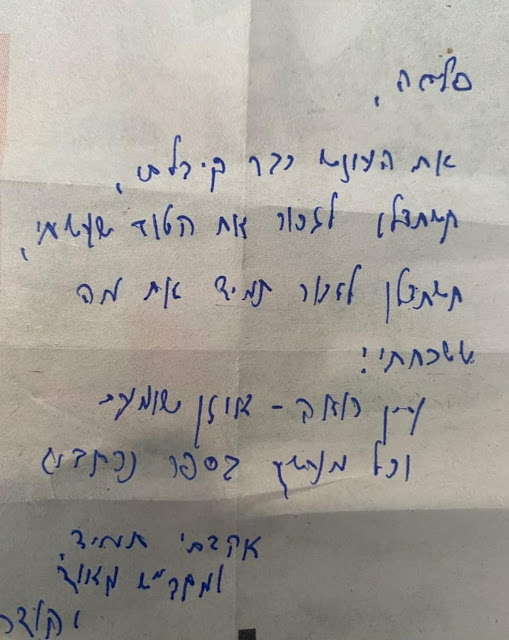
Today's suicide attempt that left him in critical condition added an element to the story. As if the family has not suffered enough, now they have this painful incident to deal with as well.
But now somehow his suicide note has been leaked to the news media.
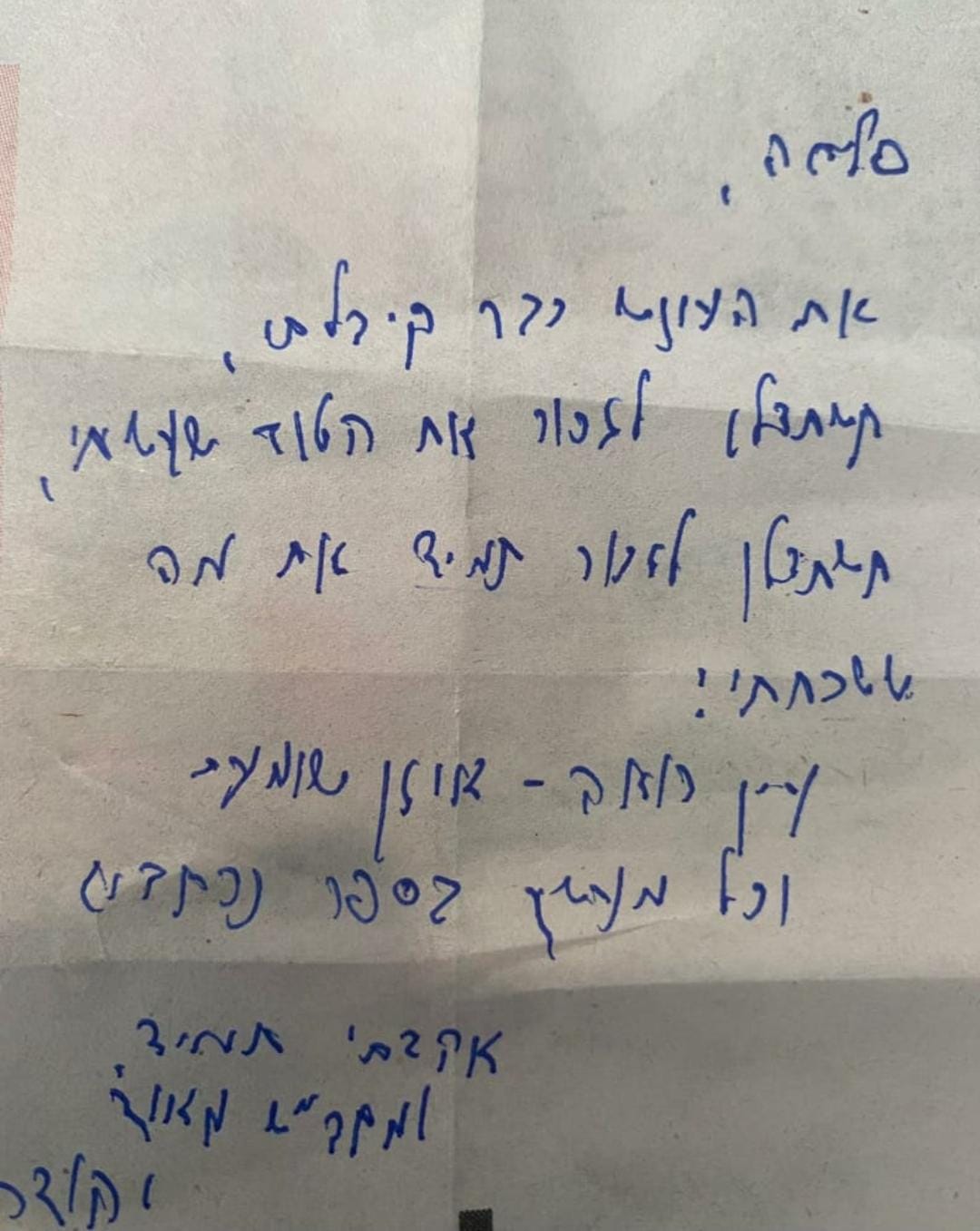
in his note he says he has already received his punishment. he implores people to remember the good he did, and to always remember what he himself forgot - there is a watching eye, a hearing ear and all your actions are written in a book. He signed the note saying I always loved you and am very embarrassed.
When I first saw this a short while ago, I had two initial immediate thoughts.
My first thought was to wonder why this is not a personal family matter and why was this released to the public. How dare the police publicize this, unless they got permission from the family - but if so, the release should include that information, that the family chose to publicize it.
A short while later Meshi Zahav's lawyer put out a statement claiming this note is fake and it is not his signature or handwriting. So, if true. that is just cruel on the part of whoever put it out - not cruel to Yehuda Meshi Zahav. I dont care about him, but his family did not do anything wrong and they are suffering enough. There is no need or benefit in being cruel to his family.
My second initial thought was to wonder, if the suicide note is not a fake, could this be used as evidence of guilt, an admission, in court, should he survive. or should his victims choose to sue his estate for damages if he dies.
------------------------------------------------------
Reach thousands of readers with your ad by advertising on Life in Israel
Reach thousands of readers with your ad by advertising on Life in Israel
------------------------------------------------------
Feb 17, 2021
dealing with the dead during Corona (video)
fascinating
------------------------------------------------------
Reach thousands of readers with your ad by advertising on Life in Israel
Reach thousands of readers with your ad by advertising on Life in Israel
------------------------------------------------------
Jan 27, 2021
if just for this we had the closure, dayeinu
Walla has the story of a fellow who is a terminal patient and was planning to travel to Switzerland for euthanasia. They can't travel now because of the lockdown and the closed airport. They tried to apply for an exception but have so far been denied.
As sad as it is, as difficult as the situation is, Judaism doesn't believe in euthanasia, as far as I know. Perhaps the entire lockdown and closure of the airport was just to prevent this. Or at least worth it to prevent this. Dayeinu, as we say. I don't know.
I wish him a refuah shleima, or if that is impossible at least as painless and as quick a natural death as possible.
------------------------------------------------------
Reach thousands of readers with your ad by advertising on Life in Israel
Reach thousands of readers with your ad by advertising on Life in Israel
------------------------------------------------------
Nov 29, 2020
Hamis Abulafia died and it didn't go unnoticed
Abulafia Bakery in Tel Aviv - Yafo is an interesting story. The bakery was opened in 1879 by an Arab baker, Masoud Abulafia (I have seen a variety of spellings of the Abulafia name and I do not know which, in English, is accurate, so I am just spelling it the easiest way of the options). The Abulafia bakery was very popular, eventually opening other branches, including a branch that is kosher mehadrin.
In 1969 the bakery began closing on Yom Kippur and Pesach. The story goes that a rabbi in Tel Aviv was concerned about Jews buying chametz during Pesach from the bakery and approached the owner, Sayeed Abulafia and asked what their profits are for the week of Pesach. Rabbi Shlomo Zalman Shtrouber agreed to pay Abulafia the profits for the week on condition the bakery would remain closed, and supposedly this arrangement continued for several years. At some point, Sayeed told Rabbi Shtrouber that it was unnecessary to continue the arrangement - Rabbi Shtrouber would not need to pay him to close the bakery as he has decided to close it anyway as they have seen nothing but blessings since deciding to close for Pesach.
This decision has been in effect since then. Abulafia Bakery closes for Pesach, so as not to cause Jews to buy chametz on Pesach, even though they are an Arab owned bakery and it would be perfectly permissible for them to remain open.
One of the owners of Abulafuia Bakery, Hamis Abulafia, died this past week. Besides for his personal history of being pro-Israel and his history as a journalist and radio personality promoting good neighbor relations between the Arabs and Jews of Tel Aviv Yafo, Hamis and his brothers kept the original arrangement all these years by their own volition, and were clearly beloved for it. The various news sites, especially the Haredi news sites, all reported the death of Hamis, at the age of 60 years old, from Corona, with great respect.
The Abulafia clearly did something good and were beloved for it. The fact that they did it on their own without pressure from the law and threats from the "establishment", makes it an even greater decision and made them more beloved and respected in the eyes of the public. Normally the death of an Arab baker would likely go unnoticed, if at all reported, but Hamis and his family have earned themselves a special place in the hearts of many Israelis.
------------------------------------------------------
Reach thousands of readers with your ad by advertising on Life in Israel
Reach thousands of readers with your ad by advertising on Life in Israel
------------------------------------------------------
Sep 22, 2020
container to store Corona bodies in Haifa
Whoa

According to Channel 13 News, Israel's Chevra Kadisha, the Burial Society, has acquired and set up in Haifa a refrigerator container that will be used to store hundreds of bodies of CoronaVirus victims expected in the coming weeks due to the expected increased mortality in the immediate future.
This container will give them the ability to handle a large number of bodies in a short period of time. For now, the report says, there is only the one up north, but they are prepared, if necessary, God forbid, to quickly set up more containers like this in other parts of the country.
What a morbid report.
I hope it isn't too close to the port. It looks like any other shipping container. Hopefully a cargo ship doesn't load it aboard accidentally.
But seriously, that is really morbid and brings home the reports. I hope they are only exaggerating to scare people into following the rules of the lockdown and that this really won't be necessary, but it doesn't look good.
.
------------------------------------------------------
Reach thousands of readers with your ad by advertising on Life in Israel
Reach thousands of readers with your ad by advertising on Life in Israel
------------------------------------------------------
Jun 17, 2015
lack of dignity is the worst part of the baby story
The story from the other day that knocked a lot of people for a loop is certainly upsetting. The story was about a premature stillborn baby. In this instance, the father insisted on burying the baby rather than leaving it to the responsibility of the hospital and chevra kadisha. The father was upset that the chevra kadisha was going to be following its tradition (while claiming it as actual halacha) and not allow the parents to participate or know where the grave would be. Somehow, it is unclear who did this, the baby was placed in a cardboard box and given to the father with a sense of leave us alone, go deal with it yourself. Obviously this was very upsetting, and was turned into a big story.
I am not upset that the chevra kadisha wanted to follow its protocol and tradition. Tradition is very strong, especially in Jerusalem and especially with regards to matters of mourning and death. They make exceptions to their rules, but they are not that common and only in unique cases.
This could have been such a unique case warranting an exception, but I am not going to judge that.
The main thing they did wrong was act with lack of sensitivity to a grieving parent. Whether they were going to make an exception or insist on keeping tradition, they need to do whatever they do in a way that is more sensitive to the families they deal with. I am sure being a part of a chevra kadisha is very difficult - dealing with death and mourning all the time cannot be easy - and brings about delicate situations. The chevra kadishas should be highly sensitive to these situations and families, and whatever they decide to do in regards to the various traditions involved, the decisions should be made and conveyed with respect and dignity.
.
I am not upset that the chevra kadisha wanted to follow its protocol and tradition. Tradition is very strong, especially in Jerusalem and especially with regards to matters of mourning and death. They make exceptions to their rules, but they are not that common and only in unique cases.
This could have been such a unique case warranting an exception, but I am not going to judge that.
The main thing they did wrong was act with lack of sensitivity to a grieving parent. Whether they were going to make an exception or insist on keeping tradition, they need to do whatever they do in a way that is more sensitive to the families they deal with. I am sure being a part of a chevra kadisha is very difficult - dealing with death and mourning all the time cannot be easy - and brings about delicate situations. The chevra kadishas should be highly sensitive to these situations and families, and whatever they decide to do in regards to the various traditions involved, the decisions should be made and conveyed with respect and dignity.
.
------------------------------------------------------
Reach thousands of readers with your ad by advertising on Life in Israel
------------------------------------------------------
Jul 7, 2014
Interesting Psak: apply the death penalty equally
In a psak that, I think, took the Israeli community by surprise, Rav Elyakim Levanon, Rav of the Regional Council of the Shomron and Rosh Yeshiva of Elon Moreh, announced his opinion that the death penalty should be applied to the murderer/s of the Arab boy, Mohammed Abu-Kheidar.
 Rav Levanon said that Jewish law is not merciful, when talking about a cruel murder. The same is true when talking about the murder of the Jewish boys and when talking about the murder of the Arab boy.
Rav Levanon also said further that even today with no Sanhedrin, the courts in Israel have the ability to give the death penalty on someone who committed a public crime. So too with the murderers who abducted and killed the three Jewish boys - we must give them the death penalty. And with the murderers of the Arab boy as well, we must give the death penalty and fulfill the dictate of removing evil from amongst us.
sources: Walla, NRG, Kikar, and others
It is not clear to me whether Rav Levanon is referring to the secular court system of Israel having that right and ability due there being no sanhedrin today, or if only the religious courts, the batei din, have that ability. It seems to me he is referring to the secular courts, but I do not understand how they adopt that right from the Sanhedrin, if he is referring to a halachic death penalty rather than one based on secular law.
Personally I have always been in favor of the death penalty, but that is from a secular legal perspective, rather than a halachic one. I have always been told that halacha does not mandate a death penalty nowadays. I could accept that Rav Levanon holds the batei din have the right to administer the death penalty nowadays, with no Sanhedrin, but I don't understand how he can give that right to the secular courts.
What I do like is that this psak seems to be without any hypocrisy. He is not just sayng it because the public is outraged, and he is not just saying it because a Jew was murdered, but he is saying it for both situations - for the Jews that were murdered and for the Arab that was murdered.
 As well, Yariv Oppenheimer, director of Peace Now, publicized his opposition to the death penalty. I almost suspected that leftists would now call for the death penalty because a Jew murdered an Arab. I was impressed when Oppenheimer argued with Rav Levanon and said that he is against the death penalty, both for the Jewish murderers and for the Arab murderers, as it is unethical - nobody, including the State, has the right to take a life. I personally disagree with that outlook, but I appreciate that he is at least applying it equally.
Rav Levanon also said further that even today with no Sanhedrin, the courts in Israel have the ability to give the death penalty on someone who committed a public crime. So too with the murderers who abducted and killed the three Jewish boys - we must give them the death penalty. And with the murderers of the Arab boy as well, we must give the death penalty and fulfill the dictate of removing evil from amongst us.
sources: Walla, NRG, Kikar, and others
It is not clear to me whether Rav Levanon is referring to the secular court system of Israel having that right and ability due there being no sanhedrin today, or if only the religious courts, the batei din, have that ability. It seems to me he is referring to the secular courts, but I do not understand how they adopt that right from the Sanhedrin, if he is referring to a halachic death penalty rather than one based on secular law.
Personally I have always been in favor of the death penalty, but that is from a secular legal perspective, rather than a halachic one. I have always been told that halacha does not mandate a death penalty nowadays. I could accept that Rav Levanon holds the batei din have the right to administer the death penalty nowadays, with no Sanhedrin, but I don't understand how he can give that right to the secular courts.
What I do like is that this psak seems to be without any hypocrisy. He is not just sayng it because the public is outraged, and he is not just saying it because a Jew was murdered, but he is saying it for both situations - for the Jews that were murdered and for the Arab that was murdered.
------------------------------------------------------
Reach thousands of readers with your ad by advertising on Life in Israel
------------------------------------------------------
Nov 28, 2012
Interesting Psak: Don't Say Shema by Deathbed of...
Rav Nissim Karelitz was recently asked a halachic question regarding a family that had asked the Lev Malka organization, an organization that assists children with cancer, to come say shema by the deathbed of their child.
The question was raised because the family has decided to disconnect the child from his machines because they no longer can bear to see him suffer. The doctors have not said, according to the report, that the boys situation is so critical that his days are or hours are numbered. The question asked, threfore, was can, or should, they say shema and the vidui for this child, as doing so might be considered assisting in causing his death?
Rav Nissim Karelitz paskened that it is prohibited to say shema by the deathbed of a child who's family want to disconnect his machines, as doing so will shorten his life that was designated for him by heaven.
(source: Kikar)
I find this psak fascinating, and surprising. The child is going to die anyway, as the family is cutting his machines. I would have thought that we would not want to deny the child his deathbed shema and vidui, considering the situation isnt of our choosing anyway. It is determined that the shema will hasten the child's death, and therefore it cannot be said. It makes sense to me, but it is surprising.
A question I do have based on the way it was reported, is that supposedly Rav Karelitz said that saying the shema would shorten the lifespan of the child as it had been determined by heaven - that makes me wonder: if heaven gave a specific lifespan to the child, won't he (or she) live that out regardless of the machines he is or is not attached to? Maybe this is the correct amount of time that had been determined. Is it even possible to shorten a life if it was determined Above? Do we have control over such things? I never would have thought so, but that does seem to be what Rav Karelitz is saying. And if this is true, do we also have the ability to circumvent our heavenly decreed fates on other issues, like parnassa, rain or anything else that is determined above?
Obviously teshuva and doing good deeds can be a factor that might cause such changes, as becoming evil and doing bad deeds might change it the other way, but I would view that as a way of changing the decree, not circumventing it. According to the statement quoted of Rav Karelitz, there is also a way to circumvent heavenly decrees.
Thoughts?
The question was raised because the family has decided to disconnect the child from his machines because they no longer can bear to see him suffer. The doctors have not said, according to the report, that the boys situation is so critical that his days are or hours are numbered. The question asked, threfore, was can, or should, they say shema and the vidui for this child, as doing so might be considered assisting in causing his death?
Rav Nissim Karelitz paskened that it is prohibited to say shema by the deathbed of a child who's family want to disconnect his machines, as doing so will shorten his life that was designated for him by heaven.
(source: Kikar)
I find this psak fascinating, and surprising. The child is going to die anyway, as the family is cutting his machines. I would have thought that we would not want to deny the child his deathbed shema and vidui, considering the situation isnt of our choosing anyway. It is determined that the shema will hasten the child's death, and therefore it cannot be said. It makes sense to me, but it is surprising.
A question I do have based on the way it was reported, is that supposedly Rav Karelitz said that saying the shema would shorten the lifespan of the child as it had been determined by heaven - that makes me wonder: if heaven gave a specific lifespan to the child, won't he (or she) live that out regardless of the machines he is or is not attached to? Maybe this is the correct amount of time that had been determined. Is it even possible to shorten a life if it was determined Above? Do we have control over such things? I never would have thought so, but that does seem to be what Rav Karelitz is saying. And if this is true, do we also have the ability to circumvent our heavenly decreed fates on other issues, like parnassa, rain or anything else that is determined above?
Obviously teshuva and doing good deeds can be a factor that might cause such changes, as becoming evil and doing bad deeds might change it the other way, but I would view that as a way of changing the decree, not circumventing it. According to the statement quoted of Rav Karelitz, there is also a way to circumvent heavenly decrees.
Thoughts?
------------------------------------------------------
Reach thousands of readers with your ad by advertising on Life in Israel
------------------------------------------------------
Sep 20, 2012
Interesting Psak: Saying Kaddish Against The Wishes Of The Dead
Yesterday, Haim Hefer, one of the old Israeli poets, died at age 86. Hefer seems to have been one of those people with a "spicy" personality. I don't know much about him, besides for little tidbits I have heard over the years, but I was reading about some things he had said. The one that got me laughing, while at the same time disheartened as it indicated his position on Jewish tradition, is when he referenced that in the future the tzadikim will be sitting at a table and will eat the meat of the leviathan and of the wild ox. Hefer said, "when I was on Norway I ate leviathan (RG: commonly translated today as whale), and I say phooya - disgusting!"
Anyways, Hefer had left instructions regarding his death and burial. He did not want anything too unusual and against Jewish tradition, as some do, but he did say he did not want the kaddish or the "Kel Maleh" to be recited at his funeral.

In light of those instructions, which Hefer seems to have made known well before his actual death, Rav Baruch Efrati was asked about the priority of Jewish tradition or fulfilling the wish of the dead person. In other words, someone suggested that despite the wishes of Haim Hefer, when he would die, perhaps they should bring a minyan to his funeral and say kaddish anyway.
Rav Efrati responded, according to this report on Ynet, saying that it would be a mitzva to ignore his living will and to say kaddish at his funeral. Rav Efrati said it should not be done in a way that would cause a disruption, but it should be done on the side and quietly. Efrati referred to a psak of the Chasam Sofer who said that kaddish must be said even for someone who is not God-fearing... and especially for someone like Hefer who was a good person, who loved Eretz Yisrael and the Jewish people...
Reports of his funeral left no indication that anybody actually went ahead and arranged a minyan against his wishes to say kaddish. Either they did it so quietly and non-intrusively that it went unnoticed, or it just did not happen....
------------------------------------------------------
Reach thousands of readers with your ad by advertising on Life in Israel
------------------------------------------------------
Anyways, Hefer had left instructions regarding his death and burial. He did not want anything too unusual and against Jewish tradition, as some do, but he did say he did not want the kaddish or the "Kel Maleh" to be recited at his funeral.
In light of those instructions, which Hefer seems to have made known well before his actual death, Rav Baruch Efrati was asked about the priority of Jewish tradition or fulfilling the wish of the dead person. In other words, someone suggested that despite the wishes of Haim Hefer, when he would die, perhaps they should bring a minyan to his funeral and say kaddish anyway.
Rav Efrati responded, according to this report on Ynet, saying that it would be a mitzva to ignore his living will and to say kaddish at his funeral. Rav Efrati said it should not be done in a way that would cause a disruption, but it should be done on the side and quietly. Efrati referred to a psak of the Chasam Sofer who said that kaddish must be said even for someone who is not God-fearing... and especially for someone like Hefer who was a good person, who loved Eretz Yisrael and the Jewish people...
Reports of his funeral left no indication that anybody actually went ahead and arranged a minyan against his wishes to say kaddish. Either they did it so quietly and non-intrusively that it went unnoticed, or it just did not happen....
------------------------------------------------------
Reach thousands of readers with your ad by advertising on Life in Israel
------------------------------------------------------
Jul 16, 2012
Death Is Part Of Aliyah
A Guest Post by Dr. Harold Goldmeier
Our aliyah is all highlights until today. My previous articles and posts describe the lighter side of daily life through the eyes of olim chadashim, new immigrants.
This morning those eyes shed tears, as my wife and I hugged our friends at the first annual IDF memorial service for their youngest son, David. They are our friends and former neighbors. Their children grew up with ours. One of theirs just married our cousin. The connection is long, strong, and deep. Made more so, because when David was pressing his folks to let him join the IDF as a “Chayal Boded”, a lone soldier, his father asked me about the conversations and experiences we had with our youngest son who was completing his nearly two years as a lone soldier in the IDF.
My enthusiasm for the experience haunts me, as I wonder whether it contributed to their decision to let David sign-up. My son came home healthy, in one piece, and mentally better prepared for adulthood than when he joined. David lies in Mt. Herzl Military Cemetery in Jerusalem. He rests among the graves of other heroes who gave their lives in defense of their nation. It is a gathering of the young: 19 years old, 20, 21, 22, 32. They lie not far from the recently deceased Prime Minister, Mossad Operative, and Lehi fighter, Yitzchak Shamir. Privates and officers lie side-by-side not separated by rank, because in Israel, “follow me” means I will always be with you.
The IDF web site defines lone soldiers as those “who do not have a financial supporter during their service, such as: soldiers whose parents who have emigrated from the country, new immigrants who have arrived in Israel on their own, orphans and soldiers who do not have contact with their families. If you are a lone soldier in need of aid, apply at the IDF Recruitment Center. “
That’s not the whole story. Sometimes men or women cannot find a place for themselves in their late teens and twenties. They are betwixed and between doors to careers or further education others find so easily. “Boded” often implies lonely more than alone. David did not die alone, and affirmative reports from his training experiences confirm that he was with the friends he wanted to be with when he died, not lonely. They all share a virtue of audacity and love of Israel.
Each week there are inspirational stories about other Chayal Bodeds in the news. It is almost as if joining the IDF is going off to summer camp with pictures of happy, smiley faces. A Canadian Jewish boy is now a Captain in the IDF; he loves Canada donning a Maple leaf T-shirt for the camera. The Jerusalem Post reports about a Russian girl making aliyah alone, serves in the IDF as an “inseparable part of making aliyah,” and eventually enters the legal division as a defense attorney. A young man from Brazil joins the IDF where he is now a prosecutor. These are feel good stories, but there is another side, no less inspirational, but more emotionally challenging.
What do Chicagoans know of soldiers dying? It was 67 years before I ever knew a family who lost a son in war, the war in Iraq. A Jewish boy much like David, a lone soldier in the armed forces, because he loved his country, and joined the armed forces for his personal, private reasons. His death is metempirical, an anomaly to us. It is the worst nightmare everyday for his parents. The military and religious funeral was performed in our synagogue. The Army planted large American flags lining the sidewalk to the entrance for the slow processional of the young man’s coffin and his family.
Soldiers from David’s brigade were at the memorial service donning their purple berets as the service began; they continue the missions that ensure Israel’s independence and security. The Army Chaplain lead the Psalms, the kaddish, and chant the prayer for mercy recited at cemetery and memorial services for the souls of the departed. We pray that the soul finds a resting place in the Garden of Eden. Mt. Herzl Military Cemetery is about as close to that Garden as one mind can imagine it to be here on earth.
We stand among the graves. The graves are perfectly aligned with identical headstones, tranquil and serene. The smell of greenery and a summer breeze through the shade from the trees overhead. Perfectly pruned greenery offers comfort to mourners. Soldiers are buried in sections according to the wars in which they died. David is in a section reserved for those who died in service since 2000. It is nearly full. On David’s grave is his beret and company insignia among some other tokens. Another’s grave is adorned with birthday messages, the soldier’s company flag laid out, his picture, and keepsakes from brothers, sisters, perhaps a girlfriend. Stuck in the dirt amid plants and flowers of another soldier’s grave is a child’s plastic windmill with green and yellow polka dots. On another grave sits a tehillim book of Psalms, beseeching others to recite just a few on his behalf. All the graves have many stones lining the edges left by mourners as a reminder to all who visit that people care and remember.
David’s Mom tells us about this beautiful young man with a wide smile. How he was great with numbers and math. The youngest sibling often asserted his independence, while deeply aware of his reliance on his older three brothers. The soldiers from his brigade listened intently. Some knew him, some never served with him. The rest of us trembled knowing David was our son, or so easily can be one of our children. And then, we all went home leaving him behind with thousands of others forever nestled in the hardscrabble soil of Israel in the land not alone or lonely, but with the people he loves in the merit of his ancestors.
------------------------------------------------------
Reach thousands of readers with your ad by advertising on Life in Israel
------------------------------------------------------
Apr 30, 2012
Does Prime Minister Netanyahu Have The Halachic Status Of A King?
Sure enough, as the morning progress, Srugim published an article detailing what the halachos would be in regards to the prime minister sitting shiva. As the author points out, there is little written about such a situation, as for most of the past 2000 years the question has not been relevant.
The author details what the relevant halachot are: the king, unlike the kohein gadol, cannot shave or get a haircut, but he also is not allowed to go to the funeral. It is possible, using King David as a precedent when he went to the funeral of Avner ben Ner, that nowadays when it is common for heads of state to go to state funerals, that Netanyahu would be allowed to go.
Regarding the shiva customs, the halacha says that people do not go to pay "shiva calls" when a king is sitting shiva. Only certain people would be allowed to go, those specially invited and expected, and "his servants". As well, the king is not supposed to sit on the ground when he is being visited. He is not allowed to shave, so we might soon be seeing Netanyahu sporting a beard.
With Netanyahu sitting shiva, I expect his substitute will be filling in for him during this period. However, if there is any situation of pikuach nefesh that would require Netanyahu's attention, he would be allowed to deal with it.
One issue not dealt with in the article is whether a prime minister has the halachic status of a king. I have never heard of anybody saying the bracha for seeing a king when seeing the prime minister. if such a status is not bestowed upon him, then some of these issues might not be relevant.
------------------------------------------------------
Reach thousands of readers with your ad by advertising on Life in Israel
------------------------------------------------------
Aug 25, 2011
Hetter Mechira In Bnei Braq
Someone paying attention to advertisements on Israeli websites might notice that Optica Halperin is running advertisements for a huge end of the summer sale. For one week only glasses are something like 50% off.

It looks like it is a shiva sale. The owner of the chain of Optica Halperin, Rav Raphael Halperin, just died and his family is sitting shiva. According to the halacha they should be shutting the business for the week, especially because the identity of the business is so closely identified with him. It is not really a shiva sale, but an end of the summer sale. The point of the sale does not make a difference, but the chain should really be closed for the week of shiva.
The problem with closing Optica Halperin for the week is that it would incur a tremendous loss by doing so.
The solution, to allow Optica Halperin to stay open, is to allow a form of "hetter mechira". The business cannot be open as long as it is owned by the Halperin family. They asked Rav Wosner what they could do,as it would be a tremendous loss.
According to Bechadrei, the psak Rav Wosner gave them was that they could open the stores and operate as normal if they would, for one week and one day, legally change the ownership of the business to the family lawyer, someone they would trust to transfer it back at the end of the period.
So they did, and so the chain continues to operate.
So, at times, the hetter mechira is even used in Bnei Braq.

It looks like it is a shiva sale. The owner of the chain of Optica Halperin, Rav Raphael Halperin, just died and his family is sitting shiva. According to the halacha they should be shutting the business for the week, especially because the identity of the business is so closely identified with him. It is not really a shiva sale, but an end of the summer sale. The point of the sale does not make a difference, but the chain should really be closed for the week of shiva.
The problem with closing Optica Halperin for the week is that it would incur a tremendous loss by doing so.
The solution, to allow Optica Halperin to stay open, is to allow a form of "hetter mechira". The business cannot be open as long as it is owned by the Halperin family. They asked Rav Wosner what they could do,as it would be a tremendous loss.
According to Bechadrei, the psak Rav Wosner gave them was that they could open the stores and operate as normal if they would, for one week and one day, legally change the ownership of the business to the family lawyer, someone they would trust to transfer it back at the end of the period.
So they did, and so the chain continues to operate.
So, at times, the hetter mechira is even used in Bnei Braq.
May 22, 2011
The Death Of An Icon - Randy "Macho Man" Savage
 |
| Randy Macho Man Savage with buddy Hulk Hogan. I probably watched this WrestleMania on a Saturday night. |
One of the greatest WWF wrestlers ever has died. Randy "Macho Man" Savage. I am not exactly all broken up about this, but due to not being quite sure what to say about him, other than that he was very entertaining of a wrestler with his blowhard antics, I will just quote the article on Fox News:
Pro wrestling superstar Randy "Macho Man" Savage died after having a heart attack while driving his Jeep Wrangler, Fox News confirms.Randy Poffo? really? Randy Poffo was his real name?
The accident happened in Seminole, Fla.
A source tells Fox News that he "suffered a heart attack while driving and hit a tree."
Florida Highway Patrol said Savage, 58, leapt a concrete median, veered into oncoming traffic and smashed into a tree head on.
He died from his injuries at largo Medical Center.
The life of a professional wrestler has been unkind to many, as they have battled their own demons and personal tragedies.
Savage, whose real name is Randy Poffo, had just celebrated his first wedding anniversary with his wife Lynn. It was his second marriage.
Lynn was in the car at the time of the accident, which was first reported by TMZ. She suffered only minor injuries.
He married his first wife Elizabeth Hulette, better known as "Miss Elizabeth," in 1984. They divorced in 1992. She ended up dying from a drug overdose in 2003.
World Wrestling Entertainment said in a statement that Savage's death was a huge loss.
"WWE is saddened to learn of the passing of one of the greatest Superstars of his time, Randy Poffo, aka Randy "Macho Man" Savage. Poffo was under contract with WWE from 1985 to 1993 and held both the WWE and Intercontinental Championships. Our sincerest condolences go out to his family and friends. We wish a speedy recovery to his wife Lynn. Poffo will be greatly missed by WWE and his fans."
The wrestling world took to Twitter to grieve over the former wrestler.
"He had so much life in his eyes & in his spirit, I just pray that he's happy and in a better place and we miss him," Hulk Hogan posted on his Twitter account.
"RIP Randy 'Macho Man' Savage - you were one of my childhood inspirations and heros. Strength, love and prayers to the Savage/Poffo family," Dwayne "The Rock" Johnson said on Twitter.
"I lost a close friend today. If anybody in heaven is wondering who the cat in the ugly cowboy hat is it's Randy. Love you Bro. Never another," Kevin Nash tweeted.
Savage helped put WWF wrestling on the map in the 1980s and '90s, becoming, along with Hulk Hogan, one of its biggest draws. His outrageous outfits and his "Oooh Yeah!" catchphrase made him a fan favorite.
He also used to be the pitchman for Slim Jims.
Many good Saturday nights were wasted enjoying the antics of guys like Randy "Macho Man" Savage, Hulk Hogan and others.
Jan 25, 2011
Interesting Psak: No Davening For The Dead
Rav Reem HaKohein, the rav of Otniel, has written an interesting psak in a shabbos parsha sheet article.
The topic is the current hot issue of brain death and what is considered halachic death. There are some rabbonim who consider brain death to be the time of halachic death, while there are some rabbonim who hold brain death is not death but cardiac death is the halachic point of death. The ramification of the debate is at what point can one in such a situation possibly donate organs.
Rav Reem Hakohein is a proponent of organ donation, and he holds that brain death is halachic death. Rav Hahohein paskened in his article that one would not be allowed to daven for the recovery of someone who is brain dead. The reason is because once one has gone through brain death, there is no recovery. Rav Hakohein adds that even according to those opinions that are machmir to not call it death until cardiac death, and that one could not donate organs after brain death because the person is still technically alive, one still cannot daven for the recovery of a brain dead patient.
And the reason is because davening for such a person would be a tefillas shav, a prayer in vain, which one cannot say. There is no recovery from brain death, and therefore one cannot daven for such a recovery. Therefore, irregardless of whether or not you hold brain death is halachic death, one would still not be allowed to pray for the recovery of a brain dead patient. (source: ynet)
I see no reason to say person could not daven for the patient in other aspects, that he should not suffer, that he should pass quickly rather than languish, that he should have merit in shamayim, etc. The only problem is regarding praying that he recover, which is impossible.
The topic is the current hot issue of brain death and what is considered halachic death. There are some rabbonim who consider brain death to be the time of halachic death, while there are some rabbonim who hold brain death is not death but cardiac death is the halachic point of death. The ramification of the debate is at what point can one in such a situation possibly donate organs.
Rav Reem Hakohein is a proponent of organ donation, and he holds that brain death is halachic death. Rav Hahohein paskened in his article that one would not be allowed to daven for the recovery of someone who is brain dead. The reason is because once one has gone through brain death, there is no recovery. Rav Hakohein adds that even according to those opinions that are machmir to not call it death until cardiac death, and that one could not donate organs after brain death because the person is still technically alive, one still cannot daven for the recovery of a brain dead patient.
And the reason is because davening for such a person would be a tefillas shav, a prayer in vain, which one cannot say. There is no recovery from brain death, and therefore one cannot daven for such a recovery. Therefore, irregardless of whether or not you hold brain death is halachic death, one would still not be allowed to pray for the recovery of a brain dead patient. (source: ynet)
I see no reason to say person could not daven for the patient in other aspects, that he should not suffer, that he should pass quickly rather than languish, that he should have merit in shamayim, etc. The only problem is regarding praying that he recover, which is impossible.
Jan 6, 2011
Quote Of The Day
brain-stem death constitutes halachic death; our rabbis don't have the necessary background to understand it. Scientific ignorance can be dangerous, especially when people with inadequate knowledge are faced with and decide upon questions that demand expertise... Our rabbis enter the field at its most advanced stage, without the background necessary to understand it. The idea that greatness in Torah is adequate to make up with this deficit in education, is erroneous. Lo bashamaim hi – the Torah is down on the earth. Therefore, Rabbi Moshe Feinstein waited two years before he could answer the question [on whether brain-stem death qualifies as death], During this time, in addition to info I provided him, he had personal contact with leaders in the scientific field. After seeing patient after patient who were brain dead, and the protocol according to which the death was determined, [Feinstein] was confident to say that breathing by machine was no evidence of life, nor was a beating heart.
When people die, they all become haredim.
-- Rabbi Dr. Moshe Tendler
When people die, they all become haredim.
-- Rabbi Dr. Moshe Tendler
Dec 27, 2010
Interesting Psak: A Torah In Memory Of A Suicide VIctim
Suicide is treated very seriously in halacha. According to the Shulchan Aruch, if someone commits suicide, we basically write him off. No sitting shiva, burial outside the Jewish cemetery, etc. However, the community generally tries to find a way to not call it a suicide. There are some rules delineated in Shulchan Aruch that must come together for it to be considered a halachic suicide, and if they do not, one can avoid the unpleasantness. A common way is to say that he was not of sane mind, and therefore his suicide was not suicide. He was mentally unstable, or something like that (in halacha he has to have told someone prior what he intended to so so we know he was aware of what he was about to do, and he had to have been seen performing the whole suicide).
An avreich in Bnei Braq recently committed suicide. The family, or the community decided to have a sefer torah written in the fellow's memory. Realizing it might be a problem to have a Torah written in his memory, perhaps it is simply inappropriate, they decided to ask Rav Chaim Kanievsky.
A group of askanim (why is it always askanim, and not simply family members or the shul gabbai or someone else like that??) went to Rav Chaim Kanievsky to ask.
Rav Kanievsky asked them if he was aware of what he was doing when he committed suicide. When they responded that he was not, Rav Kanievsky said that if he was not aware then it is ok to write the Torah in his memory, whereas had he been aware it would not be proper. (source: Kikar)
An avreich in Bnei Braq recently committed suicide. The family, or the community decided to have a sefer torah written in the fellow's memory. Realizing it might be a problem to have a Torah written in his memory, perhaps it is simply inappropriate, they decided to ask Rav Chaim Kanievsky.
A group of askanim (why is it always askanim, and not simply family members or the shul gabbai or someone else like that??) went to Rav Chaim Kanievsky to ask.
Rav Kanievsky asked them if he was aware of what he was doing when he committed suicide. When they responded that he was not, Rav Kanievsky said that if he was not aware then it is ok to write the Torah in his memory, whereas had he been aware it would not be proper. (source: Kikar)
Oct 19, 2010
Green/Jewish Burial
"Green burials" are becoming popular in the US.
The explanation of what a green burial is actually sounds just like Jewish burial.
From Green Chip Stocks:
(HatTip to Commenter Abbi)
The explanation of what a green burial is actually sounds just like Jewish burial.
From Green Chip Stocks:
While there are varying degrees of green burials, the general rule is that there is no use of concrete, metal, or chemicals in the burial process.
This means bodies are not embalmed, and are either wrapped in a linen or cotton shroud, or are laid to rest in a box made of pine, wicker, cardboard, or bamboo.
The GBC requires that, for the container to be considered green, it must be nontoxic and biodegradable — as well as made from materials sourced in a way that does not destroy habitats.
Embalming fluid, made with the chemical formaldehyde, has been proven to pose health risks, particularly among funeral directors.
Many countries throughout the world have banned it, and Jewish law prohibits it.
One thing to consider, though, that is if a body is not embalmed, it must be buried within a short period of time — usually within 48 hours. This can pose problems for loved ones needing to travel in order to attend a funeral.
If this is a concern, there are several formaldehyde-free embalming fluids available now, including one approved by the GBC made entirely of nontoxic and biodegradable essential oils.
Even if you're not an environmentalist or a lover of the outdoors, you might consider cost as a factor.
The average funeral in the United States costs $6,500, according to the National Funeral Directors Association.
The casket alone can cost anywhere from $2,000 to $10,000 — and no casket, regardless of its qualities, will preserve a body forever...
While cremation is a less expensive way of interment (usually around $1,500) and is lower impact environmentally, it is not considered green.
Cremation burns a lot of fossil fuels and can pump mercury or other chemicals into the air if a person has dental amalgam fillings or other surgical items inside them.Rest assured, even if you aren't very green in life, it turns out that in death you are.
(HatTip to Commenter Abbi)
Jun 2, 2008
more Haredi reactions to the death of Tommy Lapid (video)
Continuing what I wrote yesterday about the reactions of the Haredi politicians upon hearing of the death of their bitter rival Tommy Lapid....
A reporter went out to Bnei Brak to hear how the Haredi person on the street would react to the news.
A reporter went out to Bnei Brak to hear how the Haredi person on the street would react to the news.
Subscribe to:
Posts (Atom)
Related Posts
