
Showing posts with label esrog. Show all posts
Showing posts with label esrog. Show all posts
Nov 13, 2023
Tweet of the Day
אריה דרעי דומע כשמציג לראשונה את מה שנשאר מהאתרוג מהטבח בבארי. pic.twitter.com/tmbT0a4Qvo
— ישי כהן (@ishaycoen) November 13, 2023
Amazing, he is talking to families of the hostages but he cries over the esrog... maybe it reminded him of his famous $5000 esrog....
------------------------------------------------------
Reach thousands of readers with your ad by advertising on Life in Israel
Reach thousands of readers with your ad by advertising on Life in Israel
------------------------------------------------------
Aug 15, 2018
how to get a blue and white esrog
As we get closer to the holidays, it seems the authorities are aware of the increase in people attempting to smuggle fruits into the country and they therefore step up their level of inspection and enforcement. The fruits commonly being smuggled are esrogim for the upcoming Sukkos holiday.
Some bring an esrog for themselves, or a few for the members of their family, while others bring in tens or hundreds of esrogs to sell.
From the perspective of fruit being smuggled in, it does not matter if you are bringing in 1 or 100 or 1000 - the problem of importing foreign bugs along with the fruit is the same and thus possibly causing new infestations of unknown species, as is the concern of the Ministry of Agriculture.
According to Behadrei, a woman from Ashdod was just caught smuggling 40 esrogim in from Spain, after he suitcase did not arrive with her, and she reported it missing. When they found the suitcase and brought it in, they checked it and found the esrogim.
Anyways, the funny part of this is that Ministry of Agriculture statement on the matter included a note that because it is prohibited to bring in "4 species" from foreign countries, in order to avoid distressing situations, the Ministry of Agriculture will gift a "blue and white" set to any traveler who brings a set in with him or her from abroad.
The Ministry will exchange your foreign set with a local Israeli set.
That is a nice gesture. I wonder if they will do so at the equivalent value of the set confiscated, or at least a similar level of kashrut. Meaning, if someone bought a set of Mehudar aleph aleph mehadrin min hamehadrin chazin ish esrog in New York or London and tries to bring it in with him, will the Ministry give him a kosher lbracha set or a mehudar set?
While the ministry isnt obligated to, and thus I would not expect it of them, it is basically pointless if most people won't use the set given to them by the Ministry and they really should not bother wasting their money. Cute idea, but basically a waste of money
Some bring an esrog for themselves, or a few for the members of their family, while others bring in tens or hundreds of esrogs to sell.
From the perspective of fruit being smuggled in, it does not matter if you are bringing in 1 or 100 or 1000 - the problem of importing foreign bugs along with the fruit is the same and thus possibly causing new infestations of unknown species, as is the concern of the Ministry of Agriculture.
According to Behadrei, a woman from Ashdod was just caught smuggling 40 esrogim in from Spain, after he suitcase did not arrive with her, and she reported it missing. When they found the suitcase and brought it in, they checked it and found the esrogim.
Anyways, the funny part of this is that Ministry of Agriculture statement on the matter included a note that because it is prohibited to bring in "4 species" from foreign countries, in order to avoid distressing situations, the Ministry of Agriculture will gift a "blue and white" set to any traveler who brings a set in with him or her from abroad.
The Ministry will exchange your foreign set with a local Israeli set.
That is a nice gesture. I wonder if they will do so at the equivalent value of the set confiscated, or at least a similar level of kashrut. Meaning, if someone bought a set of Mehudar aleph aleph mehadrin min hamehadrin chazin ish esrog in New York or London and tries to bring it in with him, will the Ministry give him a kosher lbracha set or a mehudar set?
While the ministry isnt obligated to, and thus I would not expect it of them, it is basically pointless if most people won't use the set given to them by the Ministry and they really should not bother wasting their money. Cute idea, but basically a waste of money
------------------------------------------------------
Reach thousands of readers with your ad by advertising on Life in Israel
Reach thousands of readers with your ad by advertising on Life in Israel
------------------------------------------------------
Sep 28, 2014
esrog with a one year warranty!
This has got to be the best deal available for buying the 4 minim, the lulav and esrog (and others) for sukkos... it is a great price, depending on the quality of the merchandise of course, but it even comes with a one year warranty!

on Walla Shops
and, not only that, but you can split the 39nis price into 5 interest-free payments, or 36 maximum payments with interest! That is either 7.8nis per month for 5 months, or a little over a shekel a month (plus interest) for 3 years!
The deal is limited and will expire soon, so don't waste time.. decide quickly.. at this price, what could possibly be a reason not to buy?
on Walla Shops
and, not only that, but you can split the 39nis price into 5 interest-free payments, or 36 maximum payments with interest! That is either 7.8nis per month for 5 months, or a little over a shekel a month (plus interest) for 3 years!
The deal is limited and will expire soon, so don't waste time.. decide quickly.. at this price, what could possibly be a reason not to buy?
------------------------------------------------------
Reach thousands of readers with your ad by advertising on Life in Israel
------------------------------------------------------
Sep 17, 2013
cracking down on the esrog black market
According to Kipa, if you are an esrog or lulav merchant you had better watch out.. Kipa is reporting that undercover tax officials are going to "4 species markets" around the country and catching merchants who are not registered with the tax authorities and/or doing businesses without paying the necessary taxes.

They say the lulav-esrog market is mostly a black market, with nearly the entire thing being off the books. Tax officials have supposedly been going to markets in various towns and after questioning sellers about getting receipts for purchases are slapping fines on the sellers.
I remember a few years agon in Bet Shemesh the mayor decided to crack down on the black market, to a certain extent. People who would set up booths without paying the necessary fees to the Iryah would get shut down and fined. There was an outcry, but they still seem to do it. The other outcry that was ignored was from the merchants who claimed it to be unfair - the ones with booths are being stopped, but many sell otu of their homes, and the ads are all over the neighborhood, but no supervisors go to those houses to shut down those merchants or to fine them..
So, watch out. Or register your business and give receipts.
They say the lulav-esrog market is mostly a black market, with nearly the entire thing being off the books. Tax officials have supposedly been going to markets in various towns and after questioning sellers about getting receipts for purchases are slapping fines on the sellers.
I remember a few years agon in Bet Shemesh the mayor decided to crack down on the black market, to a certain extent. People who would set up booths without paying the necessary fees to the Iryah would get shut down and fined. There was an outcry, but they still seem to do it. The other outcry that was ignored was from the merchants who claimed it to be unfair - the ones with booths are being stopped, but many sell otu of their homes, and the ads are all over the neighborhood, but no supervisors go to those houses to shut down those merchants or to fine them..
So, watch out. Or register your business and give receipts.
------------------------------------------------------
Reach thousands of readers with your ad by advertising on Life in Israel
------------------------------------------------------
Pittem-Insurance for the risk-takers
Do you prefer to buy an esrog with a pittem? (I don't even know the proper spelling for pittem, if there is one..). Back in the USA, way back when, I remember, esrog with pittem was the standard. Here in Israel, esrog without pittem is the standard, and some people look for the esrog with the pittem, which is usually a bit more expensive and also a bit harder to find.
By the way,, another thing different today than back in the good old days is the horsehair wrapping. It used to be when you buy an esrog it would be wrapped in this amazing bed of horsehair. In shul you would unwrap it, and after shaking and doing what you need to do, you would lovingly rewrap it. Nowadays they almsot all come with foam wraps that just are not the same.
It used to be thought that people who bought the esrog with a pittem either did not have little children at home, or they were just big risk-takers. If the pittem breaks off, the esrog becomes invalid. After spending a lot of money on an esrog with a pittem, that could be a big loss for the pittem to break off...

If you are one of those pittem risk-takers, you now have a solution to your hedge against your risk. We used to joke about pittem-insurance, but now it is a reality, at least in New York.
The way it works is that the buyer of the pittemed esrog will pay an additional $10 to the merchant above the price of the esrog. That $10 is his insurance payment, in case the pittem breaks off. If it does break during the holiday, he will be given a brand new beautiful pittemed esrog.
I wonder how easy or difficult it will be to find the esrog merchant to cash in on the insurance, should it be necessary, once the holiday has begun..
The next stage is selling all sorts of complimentary insurance packages. Against black dots, against dry spots, against aravot drying out, against the tip of the lulav splitting, etc. all sorts of possibilities exist! And then investigators will be hired to look into fraud and insurance scams - did he break the pittem himself because he wanted a new fresh esrog? was he negligent? did his wife bite off the pittem too early? did his kid use it as a baseball?
This could lead to so many new industries!
By the way,, another thing different today than back in the good old days is the horsehair wrapping. It used to be when you buy an esrog it would be wrapped in this amazing bed of horsehair. In shul you would unwrap it, and after shaking and doing what you need to do, you would lovingly rewrap it. Nowadays they almsot all come with foam wraps that just are not the same.
It used to be thought that people who bought the esrog with a pittem either did not have little children at home, or they were just big risk-takers. If the pittem breaks off, the esrog becomes invalid. After spending a lot of money on an esrog with a pittem, that could be a big loss for the pittem to break off...
If you are one of those pittem risk-takers, you now have a solution to your hedge against your risk. We used to joke about pittem-insurance, but now it is a reality, at least in New York.
The way it works is that the buyer of the pittemed esrog will pay an additional $10 to the merchant above the price of the esrog. That $10 is his insurance payment, in case the pittem breaks off. If it does break during the holiday, he will be given a brand new beautiful pittemed esrog.
I wonder how easy or difficult it will be to find the esrog merchant to cash in on the insurance, should it be necessary, once the holiday has begun..
The next stage is selling all sorts of complimentary insurance packages. Against black dots, against dry spots, against aravot drying out, against the tip of the lulav splitting, etc. all sorts of possibilities exist! And then investigators will be hired to look into fraud and insurance scams - did he break the pittem himself because he wanted a new fresh esrog? was he negligent? did his wife bite off the pittem too early? did his kid use it as a baseball?
This could lead to so many new industries!
------------------------------------------------------
Reach thousands of readers with your ad by advertising on Life in Israel
------------------------------------------------------
Sep 20, 2010

How To Pick The Four Species (video)
Here is a great guide with the basics of how to pick your Four Species set, what to look for, and what to avoid.. by Rabbi Dan Roth of Torah Live
Lulav:
Esrog:
Hadas:
Arava:
(HatTip to Rabbi Green)
Lulav:
Esrog:
Hadas:
Arava:
(HatTip to Rabbi Green)
Oct 15, 2008
What a lulav!
As a postscript to my post on the esrogim and lulavim, I feel it worthwhile to mention this -
My brother in law has become a very serious "brisker". He is overly pedantic about his lulav and esrog, and spent three days looking around Yerushalayim for a lulav that would be satisfactory to his requirements. He could not find one. A couple hours before yom tov he calls me up to ask me if the lulavs I got were good and if there is a rav locally he could show them to. If not, he could not come for yom tov, because he did not yet have a lulav and would need to continue looking and would not have time to come.
I said I dont know about a rav - he can try goign to the house of any rav if he wants, but an hour before yom tov is not very promising on that. I said I would look at the lulavim and give him my opinion. I looked and told him that the lulavim I got from the shul all look great, but I did not know if they would look great to him.
he said ok, and came anyway.
He took a lulav and went to shul in the morning. He showed the lulav to the rav of the shul he davened in (different shul than where I had bought them), and the rav was very impressed with the lulav and told him it is a beautiful lulav and asked him where he bought it.
So despite my not understanding the costs involved and generally not wanting to pay so much for the 4 species, the quality of the esrogim and lulavim from the supplier for the shul was extremely high and was likely to be considerably cheaper than what he would charge for these in other years.
My brother in law has become a very serious "brisker". He is overly pedantic about his lulav and esrog, and spent three days looking around Yerushalayim for a lulav that would be satisfactory to his requirements. He could not find one. A couple hours before yom tov he calls me up to ask me if the lulavs I got were good and if there is a rav locally he could show them to. If not, he could not come for yom tov, because he did not yet have a lulav and would need to continue looking and would not have time to come.
I said I dont know about a rav - he can try goign to the house of any rav if he wants, but an hour before yom tov is not very promising on that. I said I would look at the lulavim and give him my opinion. I looked and told him that the lulavim I got from the shul all look great, but I did not know if they would look great to him.
he said ok, and came anyway.
He took a lulav and went to shul in the morning. He showed the lulav to the rav of the shul he davened in (different shul than where I had bought them), and the rav was very impressed with the lulav and told him it is a beautiful lulav and asked him where he bought it.
So despite my not understanding the costs involved and generally not wanting to pay so much for the 4 species, the quality of the esrogim and lulavim from the supplier for the shul was extremely high and was likely to be considerably cheaper than what he would charge for these in other years.
Oct 13, 2008
Shmitta: Otzar Beis Din: distributing Esrogim
Normally I buy an esrog in a closed box. My theory is that I have little patience to look at esrogim that tens or hundreds of people have already handled and rejected. As well, I hardly know what I am looking at. All the marks look the same to me, so there is no point in my inspecting it the way I see plenty of other people inspecting. I figure, if a hechsher is good enough for me to rely upon for the food I buy, for deciding Jewishness, conversions and marriage, even for my laundry detergent, bleach, and paper plates, then it is also good enough to tell me my esrog is kosher.
So instead of my inspecting the esrog just to look as frum as everyone else (which is the only reason I personally could ever have to inspect an esrog closely), I buy the closed box with the hechsher. The most inspecting I do is for where it is being sold cheaper. I see no reason to pay a hundred shekels for an esrog when I can pay 40 for the same thing. Granted, I am no big negotiator, and I am never good at bringing merchants prices down on anything, but if I wait until the prices naturally start to go down, I have saved myself a lot of money.
Also, I will generally go to buy the esrog on erev yom tov when the prices start to go down. I am not quite daring enough to wait until very late in the day, when you can really get prices at the rock-bottom, but I do ghet them as they are beginning to fall.
This year, buying esrogim and the other items are a bit more complicated. Because the esrogim still fall in the category of shmitta, because fruit still has shmitta restrictions for a few more months even though Rosh Hashana has come and gone, so you cannot just go buy an esrog. You can go, or you could have gone before Rosh Hashana, to a hefker field and pick your own esrog. the chances of you getting a kosher one like that are extremely small.
The main source for esrogim this year are Otzar Beis Din. The "legal fiction" is that they say they are "distributing" esrogim and not selling them. I don't know - these guys who were "distributing" them at our shul for a nice price did not look like they would be doing it just to cover their costs. They must have somehow been sellign them for a decent profit. Otherwise why would they go through the effort of sellign them in RBS, or anywhere for the matter?
bluke at The Jewish Worker has a good review of how the details of buying Otzar Beis Din esrogim works halachically.
Not everyone, Rav Elyashiv is supposedly included in this list, likes or agrees with the Otzar Beis Din solution, so there is also a supply of imported esrogim. While the Otzar Beis Din prices are set pretty much in stone, the sky is the limit with the prices for imported esrogim.
My shul made arrangements with a supplier to sell Otzar Beis Din esrogim, and lulavim and hadasim (they do not have the same shmitta restrictions for various reasons). Because of the short amunt of time due to the way the calendar falls out, and due to the complexity of buying shmitta esrogim, and due to some other technical issues, I decided to buy through the shul this year. I paid higher prices for my species than I would in a normal year, but I am told that the quality is so nice (they are very nice, but as I said, I am not a big mumche and it doe snot make such a difference to me), it is cheap to what I would have had to pay for an equivalent esrog in any other year. Not that I would have bought such a nice esrog any other year, but I guess it is somehow a good deal.
I still find it hard to understand how when shmitta means everything is supposed to be free, and the Otzar Beis Din system means they charge for the costs, why things are so expensive. they say they are just covering the costs, but it seems the costs are so much higher than in regular years. And not just for esrogs. Otzar Beis Din vegetables (when they were available) during the year were also expensive. Why does it cost more to pick a cucumber and send it to the "store" during shmitta than it does the other six years?
Anyways, that is the system in place and that is how I got my beautiful esrog this year.
the one drawback is that you cannot just put the esrog in the "pach shmitta" and let it rot and throw it out. You have to wait a few months, savig it in good condition the whole time. Eventually you have to remove it and make it hefker when the "zman bi'ur" arrives. And then you can get rid of it.
So instead of my inspecting the esrog just to look as frum as everyone else (which is the only reason I personally could ever have to inspect an esrog closely), I buy the closed box with the hechsher. The most inspecting I do is for where it is being sold cheaper. I see no reason to pay a hundred shekels for an esrog when I can pay 40 for the same thing. Granted, I am no big negotiator, and I am never good at bringing merchants prices down on anything, but if I wait until the prices naturally start to go down, I have saved myself a lot of money.
Also, I will generally go to buy the esrog on erev yom tov when the prices start to go down. I am not quite daring enough to wait until very late in the day, when you can really get prices at the rock-bottom, but I do ghet them as they are beginning to fall.
This year, buying esrogim and the other items are a bit more complicated. Because the esrogim still fall in the category of shmitta, because fruit still has shmitta restrictions for a few more months even though Rosh Hashana has come and gone, so you cannot just go buy an esrog. You can go, or you could have gone before Rosh Hashana, to a hefker field and pick your own esrog. the chances of you getting a kosher one like that are extremely small.
The main source for esrogim this year are Otzar Beis Din. The "legal fiction" is that they say they are "distributing" esrogim and not selling them. I don't know - these guys who were "distributing" them at our shul for a nice price did not look like they would be doing it just to cover their costs. They must have somehow been sellign them for a decent profit. Otherwise why would they go through the effort of sellign them in RBS, or anywhere for the matter?
bluke at The Jewish Worker has a good review of how the details of buying Otzar Beis Din esrogim works halachically.
Not everyone, Rav Elyashiv is supposedly included in this list, likes or agrees with the Otzar Beis Din solution, so there is also a supply of imported esrogim. While the Otzar Beis Din prices are set pretty much in stone, the sky is the limit with the prices for imported esrogim.
My shul made arrangements with a supplier to sell Otzar Beis Din esrogim, and lulavim and hadasim (they do not have the same shmitta restrictions for various reasons). Because of the short amunt of time due to the way the calendar falls out, and due to the complexity of buying shmitta esrogim, and due to some other technical issues, I decided to buy through the shul this year. I paid higher prices for my species than I would in a normal year, but I am told that the quality is so nice (they are very nice, but as I said, I am not a big mumche and it doe snot make such a difference to me), it is cheap to what I would have had to pay for an equivalent esrog in any other year. Not that I would have bought such a nice esrog any other year, but I guess it is somehow a good deal.
I still find it hard to understand how when shmitta means everything is supposed to be free, and the Otzar Beis Din system means they charge for the costs, why things are so expensive. they say they are just covering the costs, but it seems the costs are so much higher than in regular years. And not just for esrogs. Otzar Beis Din vegetables (when they were available) during the year were also expensive. Why does it cost more to pick a cucumber and send it to the "store" during shmitta than it does the other six years?
Anyways, that is the system in place and that is how I got my beautiful esrog this year.
the one drawback is that you cannot just put the esrog in the "pach shmitta" and let it rot and throw it out. You have to wait a few months, savig it in good condition the whole time. Eventually you have to remove it and make it hefker when the "zman bi'ur" arrives. And then you can get rid of it.
May 22, 2008
working his magic
Who would have thought that yesterday's surprise announcement about breakthrough talks with Syria would have worked their magic so fast??!!
 Until now, for the past 2 weeks we have been inundated with reports how this investigation is the most serious and will almost definitely lead to a very fast indictment because of how much evidence they have collected.
Suddenly we get this surprise announcement on talks with Syria, and all of the sudden we have the above headlines of not enough evidence for an indictment.
 Until now, for the past 2 weeks we have been inundated with reports how this investigation is the most serious and will almost definitely lead to a very fast indictment because of how much evidence they have collected.
Suddenly we get this surprise announcement on talks with Syria, and all of the sudden we have the above headlines of not enough evidence for an indictment.
May 5, 2008
Who did not expect this?
As Olmert is facing what looks like will finally be an indictment sometime in the next few days, suddenly he manages to have an amazing breakthrough in the peace talks and announces he is ready to make tangible changes in the West Bank...
I just want to know how many people have not expected this to happen since the police showed up at his door on Friday...
I just want to know how many people have not expected this to happen since the police showed up at his door on Friday...
Oct 10, 2006
80,000
Eighty Thousand.
That is the official estimate by the police of how many people attended the Birkat Kohanim ceremony at the Kotel yesterday. 80,000 Jews in one place at one time. That is a lot of people.
It is so many people in fact, that they say this was the largest and greatest attended Birkat Kohanim event since the Kotel was recaptured in 1967 by Israel. The police say that it was so crowded that they had to close the gates of entry to the Kotel at one point because it was too full and would be dangerous to let more people in. Overflow crowd had to stand outside of the walls and gates of the Kotel area.
And I was part of it. One person out of 80,000.
And I even got to shake a funky Yemenite Etrog while I was there. In the picture it is not me shaking (I was clicking the shot), but that is the Esrog I borrowed a few minutes later to shake..
There were people of all stripes, colors, and persuasions there. It was a fabulous event with an amazing collage of people, and I even got to bump into a few old friends I had not seen in a long time and catch up with them a bit..

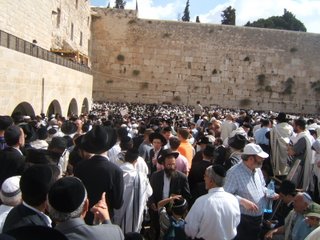
That is the official estimate by the police of how many people attended the Birkat Kohanim ceremony at the Kotel yesterday. 80,000 Jews in one place at one time. That is a lot of people.
It is so many people in fact, that they say this was the largest and greatest attended Birkat Kohanim event since the Kotel was recaptured in 1967 by Israel. The police say that it was so crowded that they had to close the gates of entry to the Kotel at one point because it was too full and would be dangerous to let more people in. Overflow crowd had to stand outside of the walls and gates of the Kotel area.
And I was part of it. One person out of 80,000.
And I even got to shake a funky Yemenite Etrog while I was there. In the picture it is not me shaking (I was clicking the shot), but that is the Esrog I borrowed a few minutes later to shake..

There were people of all stripes, colors, and persuasions there. It was a fabulous event with an amazing collage of people, and I even got to bump into a few old friends I had not seen in a long time and catch up with them a bit..



Oct 5, 2006
mehadrin lulavs and esrogs
Somebody showed me his lulav last night. He had bought a mehadrin set and paid the price of a mehudar set.
The lulav he showed was very nice. Nicely green, straight as an arrow, tight (some like it tight because it does not break as easily), and it looked like a clean tip.
Upon closer inspection the tip was slightly split. It was difficult to see and it had only been caught by the Rabbi he showed it to. While the lulav remains kosher, it is not considered mehudar.
This is the problem with the system of selling lulavs and esrogs. The guy selling the merchandise categorizes it as he wishes (note: pre-boxed items are categorized by the wholesaler) rather than by the actual quality of the item. The guy selling it might not (and is usually not) be an expert at evaluating whether the lulav/esrog is mehudar or not. Yet he sells the lulav as a mehudar lulav.
Now that the Rabbi has said the lulav is not mehudar you would think the buyer should be either given the difference (between mehudar and non-mehudar) in price back, or allowed to exchange it for one that is actually mehudar.
But that is not the case.
The way the system works is that the guarantee is only that the item is kosher, not mehudar. The lulav has to be declared passul (completely unfit for use) for the buyer to get his money back. Yet he still paid the mehudar price for a non-mehudar product.
What a scam.
The lulav he showed was very nice. Nicely green, straight as an arrow, tight (some like it tight because it does not break as easily), and it looked like a clean tip.
Upon closer inspection the tip was slightly split. It was difficult to see and it had only been caught by the Rabbi he showed it to. While the lulav remains kosher, it is not considered mehudar.
This is the problem with the system of selling lulavs and esrogs. The guy selling the merchandise categorizes it as he wishes (note: pre-boxed items are categorized by the wholesaler) rather than by the actual quality of the item. The guy selling it might not (and is usually not) be an expert at evaluating whether the lulav/esrog is mehudar or not. Yet he sells the lulav as a mehudar lulav.
Now that the Rabbi has said the lulav is not mehudar you would think the buyer should be either given the difference (between mehudar and non-mehudar) in price back, or allowed to exchange it for one that is actually mehudar.
But that is not the case.
The way the system works is that the guarantee is only that the item is kosher, not mehudar. The lulav has to be declared passul (completely unfit for use) for the buyer to get his money back. Yet he still paid the mehudar price for a non-mehudar product.
What a scam.
Subscribe to:
Posts (Atom)
Related Posts
