
Showing posts with label touring eretz yisrael. Show all posts
Showing posts with label touring eretz yisrael. Show all posts
Jul 30, 2023
Bridge over Hell
The valley in jerusalem called Gei Ben Hinom is a bad place, cursed by the prophets and is the source for the name of the place gehenom. Practically nowadays in the valley of Gei Ben Hinom there are concerts and festivals and other events on a regular basis.


the City of Jerusalem built a walking hanging bridge over the Valley Gei Ben Hinom and completed and inaugurated it today..
According to the announcement by the mayor, Moshe Lion, the bridge is 202 meters long connecting Mt Zion to modern Jerusalem, over the Gei Ben Hinom valley. This is the longest bridge in Israel (longest bridge or hanging bridge, I am not sure), and is the home to amazing views of the surrounding areas.


What frightens me is the thought of how many people will stand there and pile up on the bridge to watch concerts for free or to protest, and I would just hope the bridge can hold the weight that is sure to accumulate there
I would note the rope bridge in Nesher is pretty cool with amazing views. I am not sure anything can beat Jerusalem though and I am looking forward to checking it out
------------------------------------------------------
Reach thousands of readers with your ad by advertising on Life in Israel
Reach thousands of readers with your ad by advertising on Life in Israel
------------------------------------------------------
Jun 22, 2023
Tiyulim in Eretz Yisrael: Dead Sea Salt Pillars
We recently joined a tour led by Noam Bedein of the Dead Sea Revival Project to learn about the situation of the Dead Sea drying up. We got to see firsthand sights we have never seen before except in professional pictures.


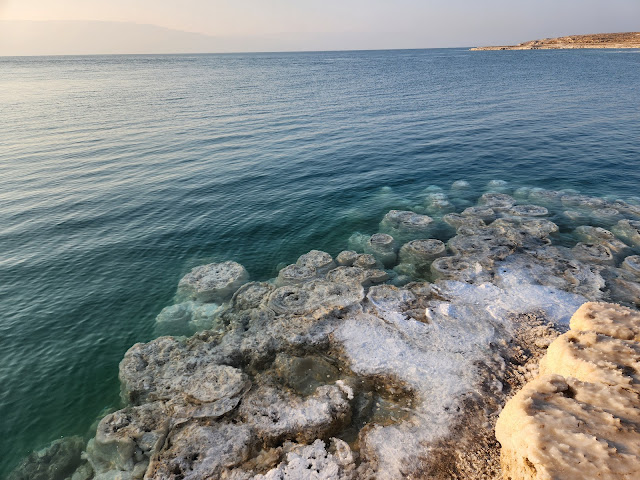


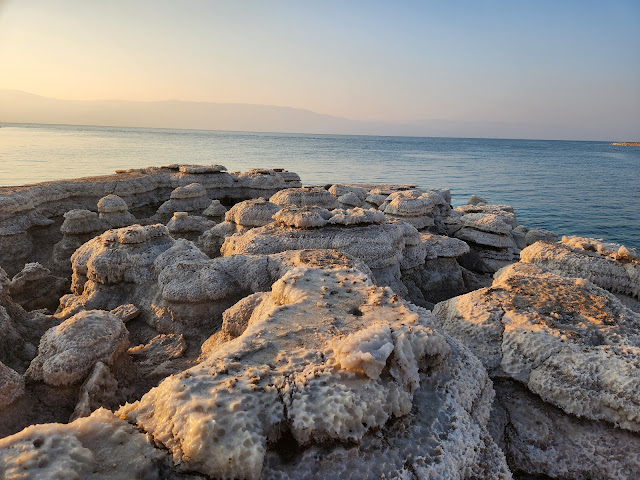


The Dead Sea is drying up. He says 600 Olympic pools worth of water disappear from the Dead Sea daily, without being replenished. The Dead Sea factories are one of the causes, but they are the minor players. The Jordan River no longer dumps into the Dead Sea in any significant way due to farmers (on both sides of the border) diverting the water for their own use, along with other problems. The northern section of the Dead Sea is closed off to the public due to dangers such as sinkholes, caused by the underground fresh water springs combined with the erosion of the area.
We went at sunrise (it gets too got to start any later). The group was not large, but it did include a German tv crew filming different interesting sites in Israel for some show they are working on to be shown in Germany. They normally film in Europe but in honor of Israel's 75th birthday/anniversary they have been shooting sites in Israel this year.
We met at Ovnat Junction and traveled to a site just a few minutes further south and hiked to the Dead Sea from the parking area. We were able to see tracks of wildlife in the sand and muddier areas while we hiked towards the sinkholes and sea.
The trip was fascinating. If you have an opportunity to go on a similar trip you should definitely do so.
Here are some of the pictures I took on the trip:
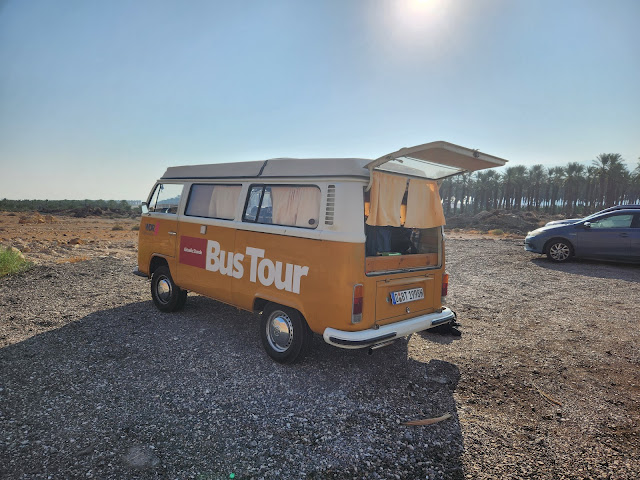 |
| this is the odd bus used by the German tv crew. you might see it around Israel. They usually travel with it around Europe. |


 |
| a "salt pillar forest" at the edge of the water |

 |
| you can see the salt pillars forming in the water, still under water level but soon will be exposed |


 |
| the mini stalactites forming from the salt and minerals |


------------------------------------------------------
Reach thousands of readers with your ad by advertising on Life in Israel
Reach thousands of readers with your ad by advertising on Life in Israel
------------------------------------------------------
Feb 21, 2023
Nosson Shulman’s Tour of Biblical Kedesh (video)
------------------------------------------------------
Reach thousands of readers with your ad by advertising on Life in Israel
Reach thousands of readers with your ad by advertising on Life in Israel
------------------------------------------------------
Dec 27, 2022
Touring Eretz Yisrael: North for Chanukah
Last week on Chanukah we went up north for a few days. Here is a synopsis of what we did while up north.
To introduce, we had decided in advance we would do basically two activities each day, one free and one paid. We broke the rule on the third day.
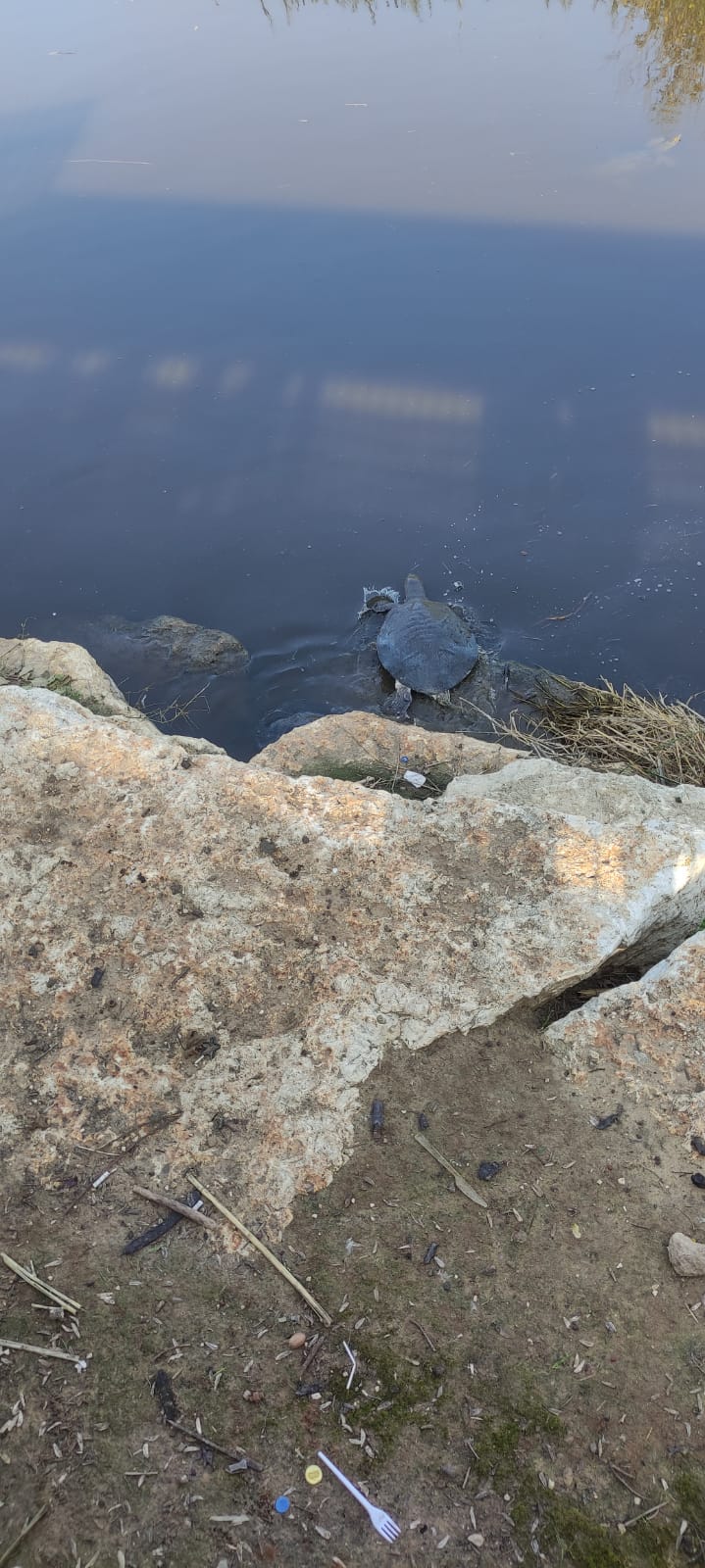
 On the way up to Tiberias we stopped at one of our favorite spots in Israel - the Turtle Bridge of Nahal Alexander, where you can see the soft shell sea turtles population. This actually used to be a much better activity than it is today - it used to just be a river you could go right up to, even go into if you wanted, and throw food in and see the turtles. Several years ago they turned it into a national park, free entry, but they fenced off the river so you cant go down and it is illegal to feed the turtles (though some people do anyway). You now no longer see nearly as many turtles as you used to (though maybe that is seasonal as well), as the food used to draw them out of the water. It is a very calm and serene place and the turtles are great. There is a park and open grassy area, great place for a picnic lunch.

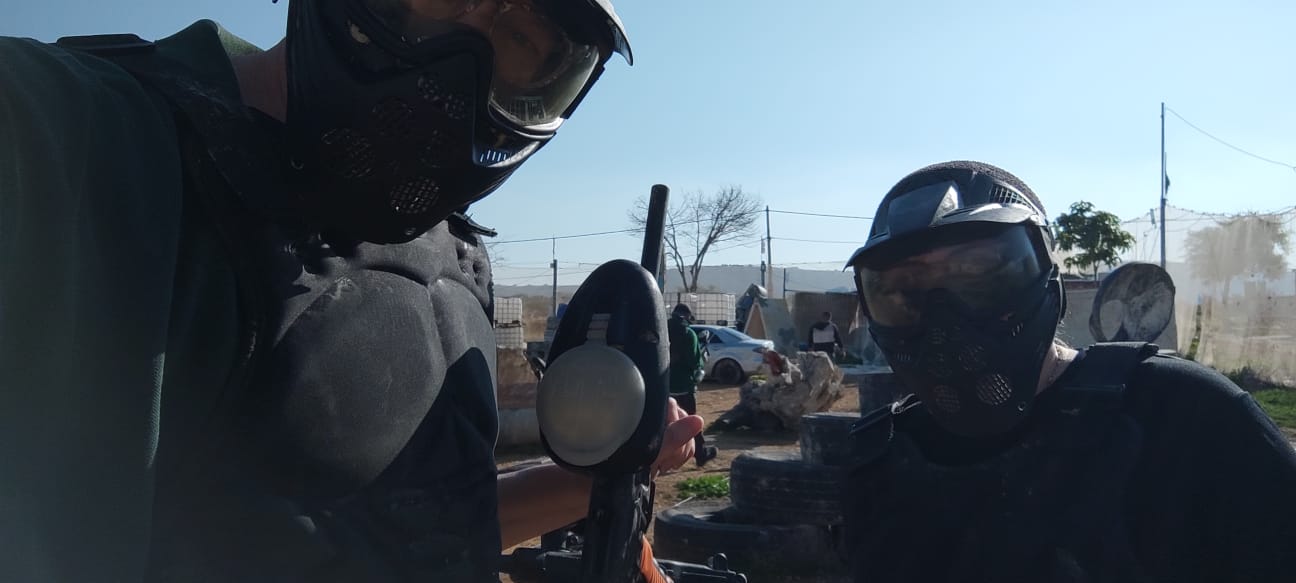
 From there we changed our plans and went to meet up with some friends who invited us at the last minute to join them for paintball. We drove out to Kalanit for that and had a lot of fun, and a little bit of pain, playing paintball.
.
We rented an apartment in Tiberias via AirBNB. That worked out great. The apartment was fine for what we needed, it was clean, fairly new, and it had an amazing view overlooking the Kinneret, and it was very close to the Kinneret as well.
From there we went to a horse ranch outside of Hadera, called (I think) the Cactus Ranch, or something like that. We went horseback riding along the Mediterranean with the water lapping up at our horses hooves. This was a lot of fun, the guides were very active and interacting with us and everyone had fun.
After dinner we went up to Tiberias, found our apartment, settled in, lit the Chanukah candles.

In the morning I went for a run along the Kinneret, including a section on the marathon route. After everyone else got up and did what they needed to do and all that we drove up to the Golan for the morning activities before the rain would hit. We headed out to a site near Merom Golan called מפקדת הכוחות הסורים - the Syrian Forces Headquarters (if you plan to go, that's what you would put into Waze). On the way up, just a few minutes before rriving we saw a nice lookout point that also had some sort of military memorial site so we stopped to take a look. It was called "Koach Nati" - Nati's Forces - and it was a memorial to a platoon that fought in that area in the Yom Kippur War and many died. It is a beautiful site with a great view. Each tree planted there has a name with a qr code so you can scan it and hear the story of that specific soldier. There is also a tank you can climb into (I didnt but kids did) and move the turret up and down.
Moving on from there we continued on our way and went to the Syrian forces headquarters. Waze was going a little crazy at that point between Koach Nati and the Syrian Forces Headquarters, I assume due to the volcanic rock in the area. Getting there a few minutes later you pull up to a massive shell of a building covered in graffiti. This is where the Syrian army headquarters for the area was before Israel recaptured the Golan Heights in 1967. Eli Cohen, the Israeli spy in Syria who reached high ranks in the Syrian government, had been in this building in 1965. The building is massive, though I said that already, with a fabulous spiral staircase in the middle. The spiral staircase is blown out at the 2nd floor. You can walk up it or via the stairs on each side of the wings of the building and go to each floor or to the roof. There are sort of escape room puzzles set up in some rooms. .jpeg)

.jpeg)

From there we went to Amuka - it has been many years since we were there and some of the kids have never been there. They did change it around a lot form what I remember including making it a full separation between men and women, and the women's side has a little marketplace to buy tchachkes and other stuff they scam you into buying for made up segulas. From there we went to Meron to visit Kever Rashbi, Rabbi Shimon Bar Yochai.
From Meron we went to Tzfat. We had arranged an activiity in the Puzzle Room there. We have been there before but they had a new puzzle customized for Chanukah so we went again and had a good time trying to solve that. We had some other plans for Tzfat but because of the rain and by then everyone was tired we decided to head back to Tiberias for shawarma, Chanukah lighting and the boardwalk.
Then back to Tiberias for shawarma, Chanukah candle-lighting and the boardwalk. It was already too late for the Chabad candle-lighting event on the boardwalk, which we have been to before and enjoy, but we walked around a little. It was pretty dead by then so we didnt hang out there much.
Day three we got up and packed up. We went down to the Kinneret and had some ice cream sitting by the water for a while. We then went in to Tiberias to visit the Donna Gracia Museum. This is in the lobby of the Donna Gracia Hotel and is a fascinating piece of history. We have been there before but wanted to take the kids to hear the story. Unfortunately there was no guided tour that day, so we took the self-guided tour using the app or website but it was not the same and not as good of an experience.
From there we headed back with a planned stop in Holon for the Israel Children's Museum to see the exhibit called "Dialogue in the Dark" where you experience what it would be like to be blind. Traffic was absolutely horrible but they were very forthcoming in letting us come late - many others were also late for their appointments. Some of us have been there before and some had not. It was an interesting and enlightening experience for all, and the kids asked some good questions at the end during the dialogue portion.
and then we went home to crash and get ready for Shabbos.
.
.
------------------------------------------------------
Reach thousands of readers with your ad by advertising on Life in Israel
Reach thousands of readers with your ad by advertising on Life in Israel
------------------------------------------------------
Apr 4, 2021
Tiyulim in Eretz Yisrael: the deep south west, Shivta and 10
We mostly took it easy this holiday. While it is wonderful that the infection rate has dropped tremendously (I would assume because of the high rate of vaccination and recovery rates) and people are able to get out, unlike the last few holidays, and travel the country, I personally hate standing in line and fighting with the crowds. So I love seeing the country filled with people having a good time, and I am happy to see that mostly from my home.
 Due to Corona, many sites and trails require advance booking. Those sites are almost all busy. Also, it is hard to get reservations, as Israelis love to book several sites and only later decide which one to visit. there is no charge to make a reservation, and no penalty for skipping, so that is what happens. It is what it is, but we found a way to not have to deal with that (after trying just a little bit).


We spent a couple of days getting together with family, along with a relative's simcha, and relaxing.
We joined the rest of Israel out touring one day of Chol Hamoed.
But even then, while most of the Israeli tourists were running around up north or all the way down in Eilat, we went out traveling in a part of the country we thought would be slightly less traveled.
And we were successful.
We went southwest. Deep southwest.
We started out driving down to Shivta National Park. Shivta is an old Byzantine town, now in ruins, from about 1500 years ago along the Spice Route. We got there and ate some lunch before touring the ruins. Another great thing about Shivta is that there was no need to make reservations to see the site (and it was free).

So we toured the ancient Shivta site, which is also a UNESCO World Heritage Site. There were other people there, but it was not crowded at all. We took our time and enjoyed climbing through the ruins.
From there we drove further southwest. There is a road called Highway 10 - not the well-known Road 10 on the edge of Bet Shemesh (which is really officially Road 3855), but Highway 10 that runs adjacent to the Israeli-Egyptian border. The road is normally closed to Israeli traffic for security reasons, but a few days a year they open it up, or at least most of it, to Israeli travelers.

The northwestern most edge of Highway 10 is at the very bottom of the Gaza Strip, just a bit northwest of the Israeli town called Kadesh Barnea. The road actually was only opened on the northern-most side from the junction of the town of Azuz, just a bit southeast of Kadesh Barnea, but it took us time to find that (that's what we get for not reading all the details). While we wasted some time looking for the opening of the road, it was pretty cool as we saw the closed borders and security stations. We eventually figured it out and as we got closer, there were also signs pointing us in the right direction.
Despite the road being officially open, it is still manned by Israeli soldiers securing the area, along with closed gates that they open for each car. They asked where we were going, and I said I heard the road was open and we just wanted to drive on it. The soldiers smiled, opened the gate and wished us an enjoyable and safe trip and we were on our way.
Obviously we were not going to drive all the way down to Eilat on this road, as we had no interest in going so far. Also it was late in the afternoon and they only keep the road open for some hours per day and then close it. So our time was limited, which was fine by us.
The border is secured by a high fence with barbed wire (and probably other forms of security), which I understand is relatively new and was installed to stop the infiltrators from Sudan and Eritrea who came through Egypt several years ago. The road adjacent to the fence is actually new and beautifully paved, and I assume is only used by the security forces. The road used by the public, when open, is just a tad away from the fence and is older and not quite as nicely paved.
After driving for a while, we stopped to ask a group of soldiers securing the road where a lookout point is. They directed us to just a bit further down the road. When we got there we pulled over and got out and walked around a bit. The ground in that area is full of iron ore rocks. We also found a lot of old bullet casings - maybe from the Yom Kippur War (or maybe not).
After checking things out there for a bit, we got back in the car and decided to drive a little bit further down the road. Someone told us there is "borot mayim" - water cisterns - in the area, and we decided to go a little further and look for them. As we got to the next group of soldiers, they directed us to the water, warning us that it won't be open much longer. We got there and the soldiers there told us we only have a little bit of time left. We parked the car and hiked out to the borot mayim. There were several other people there - some coming, some going.
The borot mayim were actually a little disappointing. It was one hole in the ground with a bit of water. A few people were climbing down to touch the water, but without actually being able to go in and swim and enjoy, I didn't see the point. The cistern had a ladder, but the cistern was only big enough for one person at a time, and it was not particularly deep. We enjoyed the area and beautiful views and hiked back to the car. When done we turned around and went back to get off the road. From there we went to Tel Nitzana to relax, eat, daven and get ready to drive home.


what interesting trips did you take or interesting things did you do and see?
------------------------------------------------------
Reach thousands of readers with your ad by advertising on Life in Israel
Reach thousands of readers with your ad by advertising on Life in Israel
------------------------------------------------------
Dec 9, 2015
culture in Mea Shearim
This has to be the funniest, and most compelling, organized tour group I have seen in a while. It might also be the funniest Groupon coupon I have seen in a while...
They are offering a Groupon coupon for a Thursday night tour of Mea Shearim. The tour is called "the bakery and cholent tour of Jerusalem".
According to the description on the site, it is far more than just looking at the best cholent spots in Mea Shearim, but that's the part of it they decided to name it for. I don't know if it includes tastings or if it is like the Hanukkah candles - to be seen only.
a cholent tour sounds like something put together by a yeshiva guy. It is something I might actually consider going on!
They are offering a Groupon coupon for a Thursday night tour of Mea Shearim. The tour is called "the bakery and cholent tour of Jerusalem".
According to the description on the site, it is far more than just looking at the best cholent spots in Mea Shearim, but that's the part of it they decided to name it for. I don't know if it includes tastings or if it is like the Hanukkah candles - to be seen only.
a cholent tour sounds like something put together by a yeshiva guy. It is something I might actually consider going on!
------------------------------------------------------
Reach thousands of readers with your ad by advertising on Life in Israel
------------------------------------------------------
Aug 17, 2015
Tiyulim in Eretz Yisrael. Tzafon 2015
As I posted on Facebook at the beginning of our recent camping trip in northern Israel, "And God said "go north, in August", and the people did as God said..."
Northern Israel was packed as the people of Israel went to enjoy a hot summer vacation up north, perhaps in part making up for last years "missed" vacation due to the war in Gaza, Operation Protective Edge...
We went, with some other people, up north for 3 days and 2 nights of camping. We stayed in the campgrounds of Dagei Dafna.
Dagei Dafna is a trout farm of sorts where people can go fishing or eat in a fish restaurant. They are located a few kilometers away from Kiryat Shmona, next to Shaar Yashuv and Kibbutz Dafna, and across the highway from Chorshat Tal, sometimes known as the Hilton of campgrounds.
Dagei Dafna has a campgrounds close by as well. The campgrounds is nice and clean, with bathrooms and showers. They do not provide electricity and also prohibit music. This is nice in the sense that campers do not have to deal with teens and young adults having late night parties, as happens on other campgrounds. They do provide phone charging stations and some other amenities one might find necessary. Dagei Dafna also has a pool they empty and fill daily (from the river), along with a section of river.
While normally we tiyul sort of on the fly deciding what to do as we go along, based on everybody's moods and abilities, even choosing activities far from our home base, this time we stayed in the immediate area for all our activities. Everything was decided on the fly, but we spent far less time in the car driving to far away hikes or activities.
So here is what we did:
Day 1 (really half a day as we spent the first half of the day driving up north and settling in):
We enjoyed the river at Dagei Dafna for a bit while eating lunch. After that we planned to go to Nahal Snir, which is 3 minutes away. Unfortunately we got there only to discover the place was absolutely jam packed and staff were warning people that it might not be worth paying the entrance fee.
We decided to turn around and find something else to do. We settled on something that we had no idea what it was - we figured we would check it out and see if it is something that would keep us busy or if we should do something else. We had seen people parking lines of cars up and down the road outside an area with a sign that said "Nabi Yehuda" - Judah the Prophet.

We went and found parking. Sure enough it was an extension of the same river and a beautiful water hike. We hiked in the river against the current. The water was not high - the highest we experienced was waist high in a few brief locations, but the current was relatively strong. The water was ncie and cold and provided great relief from the heat.
At the end of the enjoyable hike, against the current, we ended up on a pooled area called "Chorshat Hanoflim". The kids enjoyed sitting around there and swimming. In one corner there was a rope swing set up hanging from a tree and everyone enjoyed swinging and flying into the water.
 At some point some of us walked out to the road and decided to walk back, outside of the water, and go get the cars and those of us who had not wanted to hike all the way up. Some mistaken navigation had the walk taking longer than expected, but eventually we made it back with the cars. After some more relaxing and davening mincha, we made our way back towards Dagei Dafna, with a stop next door at the Helicopter Tragedy Memorial.
The memorial memorializes the 73 fallen soldiers in the helicopter disaster of 1997 in which two Yasur helicopters crashed on their way to Lebanon. The memorial is tasteful and interesting, with the names of the fallen displayed, and part of the memorial being designed from grass and trees and the flowing river in an abstract shape of the Yasur helicopter.
After the memorial we went back to the campgrounds for barbecue dinner and finishing off the day. The kids went splashing in the river while we prepared dinner, and finished off the day.
Day 2:
We started off the day going to Kfar Blum for "kayaking", which is really rafting. Kayaking is always fun, though I think we might forgo that activity in future trips and just bring our own inner tubes and have practically the same activity, for free, in other parts of the various rivers. This took a while, as some of us did the longer, more challenging and adventurous route.
After Kfar Blum came lunch, and then we had to decide on an activity for the rest of the day. We chose a tiyul someone had told us about. This was another river hike supposedly very similar to Nahal Snir, but also free like Nabi Yehuda.
We went to Nahal Hermon, in the section that flows near the village of Sde Nehemya. We went down to the river, and hiked, again against the current, upstream. Nahal Hermon, at least in this section was refreshing and with a pleasant current. It was also not high - most of the time ankle or mid-calf height, with the occasional waist high depth. We hiked upstream very calmly. Eventually we hit a spot with a great rope swing and everyone had a blast taking turns swinging over the water, getting splashed and jumping in.
Eventually we hiked back downstream and out of the water and went back to the campgrounds to finish the day.
One of the things we did differently this time was to not try to bring enough food for the entire trip, but mostly just for the first day. We planned on refreshing out supplies daily in nearby stores - in a supermarket in nearby Kiryat Shmona and nearby makolets. Wednesday night we drove into Kiryat Shmona and bought some food and drink for dinner and for breakfast and tiyulim the next day.
When we got back from shopping we prepared dinner, with the kids splashing around in the river. Eventually eating, showering and collapsing.
Day 3:
Thursday morning we went into Shaar Yashuv for morning services, due to the need of a Torah, rather than making a minyan in the campgrounds as we did on Wednesday. Shaar Yashiv has set up their shul during this period so that there can be multiple minyan of campers from all over the area, on the lawn outside the shul, and each minyan takes its turn going into the shul when it comes time to read the Torah.
 At the Shaar Yashuv shul, we saw many others from Bet Shemesh, in addition tot he many we saw in Dagei Dafna and on some of the hikes. After davening we took advantage and bought some fresh bread in the local makolet, also sort of saying thank you for use of the shul by spending some money locally.
After breakfast we decided to pack up as we would be tiyuling and then heading back to Bet Shemesh without returning to Dagei Dafna.
Nobody was int he mood for more water hikes, so we chose some easy and low-key activities.
 We started with driving to nearby Kibbutz Snir for geocaching in the old abandoned zoo called the slimy zoo. The zoo was dismantled about a dozen years ago, though there are still a couple of peacocks that hang out there and "refuse to leave" (in the words of one of the locals we stopped for directions). The spot is also the location of an old cave and grave that had been used by the Romans as a burial location.
 After Kibbutz Snir, we went to Kibbutz Dan to see the fish ponds they raise trout in. They allow the public to walk around, for free, and see the different ponds. We went from pond to pond and saw how each pond is filtered and the fish in each pond are a certain age and size and with each pond that increases to eventually pretty large fish.
After this, in the brutal heat, everyone was kind of tired and nobody really wanted to do anything else. We started to head for home with a detour to Tzfat for a pizza and ice cream lunch to close off the tiyul.
Northern Israel was packed as the people of Israel went to enjoy a hot summer vacation up north, perhaps in part making up for last years "missed" vacation due to the war in Gaza, Operation Protective Edge...
We went, with some other people, up north for 3 days and 2 nights of camping. We stayed in the campgrounds of Dagei Dafna.
Dagei Dafna is a trout farm of sorts where people can go fishing or eat in a fish restaurant. They are located a few kilometers away from Kiryat Shmona, next to Shaar Yashuv and Kibbutz Dafna, and across the highway from Chorshat Tal, sometimes known as the Hilton of campgrounds.
Dagei Dafna has a campgrounds close by as well. The campgrounds is nice and clean, with bathrooms and showers. They do not provide electricity and also prohibit music. This is nice in the sense that campers do not have to deal with teens and young adults having late night parties, as happens on other campgrounds. They do provide phone charging stations and some other amenities one might find necessary. Dagei Dafna also has a pool they empty and fill daily (from the river), along with a section of river.
While normally we tiyul sort of on the fly deciding what to do as we go along, based on everybody's moods and abilities, even choosing activities far from our home base, this time we stayed in the immediate area for all our activities. Everything was decided on the fly, but we spent far less time in the car driving to far away hikes or activities.
So here is what we did:
Day 1 (really half a day as we spent the first half of the day driving up north and settling in):
We enjoyed the river at Dagei Dafna for a bit while eating lunch. After that we planned to go to Nahal Snir, which is 3 minutes away. Unfortunately we got there only to discover the place was absolutely jam packed and staff were warning people that it might not be worth paying the entrance fee.
We decided to turn around and find something else to do. We settled on something that we had no idea what it was - we figured we would check it out and see if it is something that would keep us busy or if we should do something else. We had seen people parking lines of cars up and down the road outside an area with a sign that said "Nabi Yehuda" - Judah the Prophet.

We went and found parking. Sure enough it was an extension of the same river and a beautiful water hike. We hiked in the river against the current. The water was not high - the highest we experienced was waist high in a few brief locations, but the current was relatively strong. The water was ncie and cold and provided great relief from the heat.
At the end of the enjoyable hike, against the current, we ended up on a pooled area called "Chorshat Hanoflim". The kids enjoyed sitting around there and swimming. In one corner there was a rope swing set up hanging from a tree and everyone enjoyed swinging and flying into the water.
 At some point some of us walked out to the road and decided to walk back, outside of the water, and go get the cars and those of us who had not wanted to hike all the way up. Some mistaken navigation had the walk taking longer than expected, but eventually we made it back with the cars. After some more relaxing and davening mincha, we made our way back towards Dagei Dafna, with a stop next door at the Helicopter Tragedy Memorial.
The memorial memorializes the 73 fallen soldiers in the helicopter disaster of 1997 in which two Yasur helicopters crashed on their way to Lebanon. The memorial is tasteful and interesting, with the names of the fallen displayed, and part of the memorial being designed from grass and trees and the flowing river in an abstract shape of the Yasur helicopter.
After the memorial we went back to the campgrounds for barbecue dinner and finishing off the day. The kids went splashing in the river while we prepared dinner, and finished off the day.
Day 2:
We started off the day going to Kfar Blum for "kayaking", which is really rafting. Kayaking is always fun, though I think we might forgo that activity in future trips and just bring our own inner tubes and have practically the same activity, for free, in other parts of the various rivers. This took a while, as some of us did the longer, more challenging and adventurous route.
After Kfar Blum came lunch, and then we had to decide on an activity for the rest of the day. We chose a tiyul someone had told us about. This was another river hike supposedly very similar to Nahal Snir, but also free like Nabi Yehuda.
We went to Nahal Hermon, in the section that flows near the village of Sde Nehemya. We went down to the river, and hiked, again against the current, upstream. Nahal Hermon, at least in this section was refreshing and with a pleasant current. It was also not high - most of the time ankle or mid-calf height, with the occasional waist high depth. We hiked upstream very calmly. Eventually we hit a spot with a great rope swing and everyone had a blast taking turns swinging over the water, getting splashed and jumping in.
Eventually we hiked back downstream and out of the water and went back to the campgrounds to finish the day.
One of the things we did differently this time was to not try to bring enough food for the entire trip, but mostly just for the first day. We planned on refreshing out supplies daily in nearby stores - in a supermarket in nearby Kiryat Shmona and nearby makolets. Wednesday night we drove into Kiryat Shmona and bought some food and drink for dinner and for breakfast and tiyulim the next day.
When we got back from shopping we prepared dinner, with the kids splashing around in the river. Eventually eating, showering and collapsing.
Day 3:
Thursday morning we went into Shaar Yashuv for morning services, due to the need of a Torah, rather than making a minyan in the campgrounds as we did on Wednesday. Shaar Yashiv has set up their shul during this period so that there can be multiple minyan of campers from all over the area, on the lawn outside the shul, and each minyan takes its turn going into the shul when it comes time to read the Torah.
 At the Shaar Yashuv shul, we saw many others from Bet Shemesh, in addition tot he many we saw in Dagei Dafna and on some of the hikes. After davening we took advantage and bought some fresh bread in the local makolet, also sort of saying thank you for use of the shul by spending some money locally.
After breakfast we decided to pack up as we would be tiyuling and then heading back to Bet Shemesh without returning to Dagei Dafna.
Nobody was int he mood for more water hikes, so we chose some easy and low-key activities.
 We started with driving to nearby Kibbutz Snir for geocaching in the old abandoned zoo called the slimy zoo. The zoo was dismantled about a dozen years ago, though there are still a couple of peacocks that hang out there and "refuse to leave" (in the words of one of the locals we stopped for directions). The spot is also the location of an old cave and grave that had been used by the Romans as a burial location.
 After Kibbutz Snir, we went to Kibbutz Dan to see the fish ponds they raise trout in. They allow the public to walk around, for free, and see the different ponds. We went from pond to pond and saw how each pond is filtered and the fish in each pond are a certain age and size and with each pond that increases to eventually pretty large fish.
After this, in the brutal heat, everyone was kind of tired and nobody really wanted to do anything else. We started to head for home with a detour to Tzfat for a pizza and ice cream lunch to close off the tiyul.
------------------------------------------------------
Reach thousands of readers with your ad by advertising on Life in Israel
------------------------------------------------------
Apr 19, 2015
Tiyulim in Eretz Yisrael: rappelling, hiking and snorkeling by Eilat
As regular readers were able to tell, I took a couple of days off at the end of last week. I took my older boys on a tiyul for a couple of days, in advance of them returning to their schools.
Besides for the great tiyul we had, spending some great time together, and spending time together with the friends we went with, the next best part was being offline and missing all the rehashed talk that happens year after year of who stood and who did not stand during the memorial siren. Thankfully I knew nothing of what was and was not going on for two days.
Here is a recap of our great tiyul:
The plan was actually originally to go up north for 3 days, and hike Yam lYam - from the Nehariya coast until the Kinneret. We have don't this, in full and in part, a few times already, but this time would have been with our sons. Unfortunately, the unusual weather forecast predicting storms forced us to change our plans. We rescheduled for a two day trip of rappelling, hiking, and snorkeling, down south, on the outskirts of Eilat.
Day 1:
We drove down, heading south, and stopped near the Dead Sea for some rappelling at Nahal Tamar. We hiked up the mountain to the rappelling spots. Nahal Tamar is a short hike up a very steep mountain, and it has two spots for great rappelling.
The first, lower, spot, is the bigger drop from the cliff, for greater rappelling. The lower cliff, however, was populated by a group of tourists with a rappelling company., which meant we had to continue on to the higher cliff, with the shorter drop, to do our rappelling.
That was fine, as this was going to be the first time rappelling for some of us (me included), so the slightly shorter drop was just fine, as the rappelling experience would be great anyway.
.jpg)
.jpg)
After hiking up to the top level, we set up the rappelling gear, and took turns rappelling down. The experience of rappelling is very cool. As long as you are careful with setting your equipment properly, it seems that it is pretty safe, even though it can be frightening going over the edge of the cliff... It was a thrilling experience, and we each did it two or three times, so we could get the hang of it and enjoy.
After making our way back to the car, and enjoying some refreshments and some cold drinks from the gas station, we watched for a while 2 truckloads of dairy cows that had been shipped in from Russia. The trucks were parked there for a bit while the drivers took care of some things. One of the things was one of the cows had fallen over, and they had to figure out how to get it to stand again, or else it would likely be killed with other cows stepping on it and falling on it. They were trying to force it to stand, by both screaming at it, hitting its rump and using a "shocker". I have no idea if ultimately they were successful or not, as we left before they finished.
.jpg)
These cows were heading to an isolation farm down south for a couple weeks of isolation and inspection to make sure they were not carrying any diseases, before they will eventually be released to whatever farms bought them.
We then continued on our way down south to Eilat.
Arriving in the very late afternoon, we decided on a short hike before nightfall. The weather was already getting cool, and the rain-clouds were forming in the distance, but the hike in Red Canyon is a short one, so we decided we could probably do it before nightfall or rainfall.
Note: down south rain does not just mean getting wet, but it runs the risk of getting caught in flash floods.
The Red Canyon hike is a short circular route, taking about an hour and half, maybe a bit less, and that includes our breaks for enjoying the scenery and pictures. The red rock is amazingly unusual - red, wind-swept, smooth.
.jpg)
.JPG)
The hike is easy, and we finished it with plenty of time before it got dark or rainy. The rain actually began shortly after we finished, though it was just a very light rain - though it lasted a few hours.
At that point we had to decide whether to continue with our original plan of finding a place to camp out overnight and barbecue for dinner, or worry about the rain washing things out and instead finding a place to sleep and eat indoors.
We decided to wait out our decision a bit and see what happens with the rain. An additional problem was Wednesday night was also the night of Yom Hashoa, meaning stores and restaurants had to close early. We decided to go into a supermarket in the city and stock up on some supplies we needed - pita, water and some snacks, along with some additional snorkeling equipment in the sporting goods store next door.
The prices in Eilat were better in every instance than the prices we get at supermarkets in Bet Shemesh. The main reason being, there is no VAT in Eilat. That means prices are almost automatically about 18% cheaper, on most things. And every item we looked at was significantly cheaper. We considered doing some shopping just to take advantage of the cheaper prices, but we did not really have any space for that.
By the time we were done, it was still raining lightly, but we decided to look for the camping spot anyway. We found a good spot by the Eilat Field School - we wanted to take advantage of their bathrooms and showers, and went with that instead of just camping on some beachfront property. The ground still seemed relatively dry despite the light rain, and we enjoyed a nice BBQ and some good hot showers. We set up the tent and fell asleep pretty quickly.
Day 2:
In the morning, it is difficult to sleep in a tent once the sun is up, and we woke up pretty much with sunrise. After davening and eating breakfast, we were on the road. We were all set to hike up to the top of Har Shlomo. The Har Shlomo hike is described as a full day hike. The hike actually includes two mountains - both har Yehoram and Har Shlomo. Har Yehoram peaks at 680 meters above sea level. From there you climb down and then back up to a peak of over 700 meters on the top of Har Shlomo. The hike is difficult and challenging, and the views were exhilarating and the air refreshing.
Har Shlomo is named after King Solomon, who supposedly had mines in that area. The rock of Har Shlomo is a blackish-reddish rock, and is in stark contrast to the white rock of Har Yehoram right next to it. Interestingly, from the top of these mountains, one can see the line delineating the division of the white and red rock, both on the mountains and in the desert opposite.
.jpg)
.JPG)
.JPG)
.JPG)
When we got to the top of Har Shlomo we decided to not complete the full day hike and instead turned back. After all, we still wanted to have time to go snorkeling.
We returned to Eilat, bought some more pita, and looked for a place to eat. We found a quiet beach and parked ourselves there to eat a much-needed late lunch.
After lunch we went to Chof Almogim, Coral Beach, for snorkeling. We had some of our own equipment, and rented some from the station there. There are not really many places for swimming on this beach, as the coral is right up against the edge of the beach. Because the coral is sharp and dangerous, they have much of it roped off so you cannot swim there. Instead, they have a bridge that takes you out a bit deeper, past the coral.
From the bridge we went in snorkeling. We saw some schools of little fish in that area, but we did not really get the really impressive sights we had been expecting. Snorkeling is tiring, so at some point we all ended up going back ashore to rest a bit.
.jpg)
.jpg)
.jpg)
.JPG)
Funnily enough, we then went back in the water, but in one of the small sections available right off the beach. Even though this section was relatively small, when snorkeling there we were able to see some of the really beautiful fish - I saw the blue fish with the yellow tail, some striped fish and some others. It was really cool.
Eventually it was time to leave, and we began our long drive back home. On the way, it was getting dark and as we drove through the Ramon Crater, we were able to see the amazing sky full of stars - the sight of which we normally don't get when living in a well-lit city. Google Sky helped us identify some of the stars and the planet we could see, but it was still just a bit light outside and not quite dark enough.
By the time we were out of the crater it was fully dark. We decided to make a short detour and stop near Har Gamal, a mountain nearby that has a hump like a camel. It was pitch black out there, and after killing the car lights, we were able to see the amazing night sky. We identified Jupiter and Venus, along with the basic constellations such as Orion's Belt and the Big Dipper. Google Sky helped us identify some of the other thousands of stars, most of whose names meant nothing to me. It was freezing cold out there with a strong wind, so we kept it short and got back into the car to continue our drive home.
Besides for the great tiyul we had, spending some great time together, and spending time together with the friends we went with, the next best part was being offline and missing all the rehashed talk that happens year after year of who stood and who did not stand during the memorial siren. Thankfully I knew nothing of what was and was not going on for two days.
Here is a recap of our great tiyul:
The plan was actually originally to go up north for 3 days, and hike Yam lYam - from the Nehariya coast until the Kinneret. We have don't this, in full and in part, a few times already, but this time would have been with our sons. Unfortunately, the unusual weather forecast predicting storms forced us to change our plans. We rescheduled for a two day trip of rappelling, hiking, and snorkeling, down south, on the outskirts of Eilat.
Day 1:
We drove down, heading south, and stopped near the Dead Sea for some rappelling at Nahal Tamar. We hiked up the mountain to the rappelling spots. Nahal Tamar is a short hike up a very steep mountain, and it has two spots for great rappelling.
The first, lower, spot, is the bigger drop from the cliff, for greater rappelling. The lower cliff, however, was populated by a group of tourists with a rappelling company., which meant we had to continue on to the higher cliff, with the shorter drop, to do our rappelling.
That was fine, as this was going to be the first time rappelling for some of us (me included), so the slightly shorter drop was just fine, as the rappelling experience would be great anyway.
After hiking up to the top level, we set up the rappelling gear, and took turns rappelling down. The experience of rappelling is very cool. As long as you are careful with setting your equipment properly, it seems that it is pretty safe, even though it can be frightening going over the edge of the cliff... It was a thrilling experience, and we each did it two or three times, so we could get the hang of it and enjoy.
After making our way back to the car, and enjoying some refreshments and some cold drinks from the gas station, we watched for a while 2 truckloads of dairy cows that had been shipped in from Russia. The trucks were parked there for a bit while the drivers took care of some things. One of the things was one of the cows had fallen over, and they had to figure out how to get it to stand again, or else it would likely be killed with other cows stepping on it and falling on it. They were trying to force it to stand, by both screaming at it, hitting its rump and using a "shocker". I have no idea if ultimately they were successful or not, as we left before they finished.
These cows were heading to an isolation farm down south for a couple weeks of isolation and inspection to make sure they were not carrying any diseases, before they will eventually be released to whatever farms bought them.
We then continued on our way down south to Eilat.
Arriving in the very late afternoon, we decided on a short hike before nightfall. The weather was already getting cool, and the rain-clouds were forming in the distance, but the hike in Red Canyon is a short one, so we decided we could probably do it before nightfall or rainfall.
Note: down south rain does not just mean getting wet, but it runs the risk of getting caught in flash floods.
The Red Canyon hike is a short circular route, taking about an hour and half, maybe a bit less, and that includes our breaks for enjoying the scenery and pictures. The red rock is amazingly unusual - red, wind-swept, smooth.
The hike is easy, and we finished it with plenty of time before it got dark or rainy. The rain actually began shortly after we finished, though it was just a very light rain - though it lasted a few hours.
At that point we had to decide whether to continue with our original plan of finding a place to camp out overnight and barbecue for dinner, or worry about the rain washing things out and instead finding a place to sleep and eat indoors.
We decided to wait out our decision a bit and see what happens with the rain. An additional problem was Wednesday night was also the night of Yom Hashoa, meaning stores and restaurants had to close early. We decided to go into a supermarket in the city and stock up on some supplies we needed - pita, water and some snacks, along with some additional snorkeling equipment in the sporting goods store next door.
The prices in Eilat were better in every instance than the prices we get at supermarkets in Bet Shemesh. The main reason being, there is no VAT in Eilat. That means prices are almost automatically about 18% cheaper, on most things. And every item we looked at was significantly cheaper. We considered doing some shopping just to take advantage of the cheaper prices, but we did not really have any space for that.
By the time we were done, it was still raining lightly, but we decided to look for the camping spot anyway. We found a good spot by the Eilat Field School - we wanted to take advantage of their bathrooms and showers, and went with that instead of just camping on some beachfront property. The ground still seemed relatively dry despite the light rain, and we enjoyed a nice BBQ and some good hot showers. We set up the tent and fell asleep pretty quickly.
Day 2:
In the morning, it is difficult to sleep in a tent once the sun is up, and we woke up pretty much with sunrise. After davening and eating breakfast, we were on the road. We were all set to hike up to the top of Har Shlomo. The Har Shlomo hike is described as a full day hike. The hike actually includes two mountains - both har Yehoram and Har Shlomo. Har Yehoram peaks at 680 meters above sea level. From there you climb down and then back up to a peak of over 700 meters on the top of Har Shlomo. The hike is difficult and challenging, and the views were exhilarating and the air refreshing.
Har Shlomo is named after King Solomon, who supposedly had mines in that area. The rock of Har Shlomo is a blackish-reddish rock, and is in stark contrast to the white rock of Har Yehoram right next to it. Interestingly, from the top of these mountains, one can see the line delineating the division of the white and red rock, both on the mountains and in the desert opposite.
When we got to the top of Har Shlomo we decided to not complete the full day hike and instead turned back. After all, we still wanted to have time to go snorkeling.
We returned to Eilat, bought some more pita, and looked for a place to eat. We found a quiet beach and parked ourselves there to eat a much-needed late lunch.
After lunch we went to Chof Almogim, Coral Beach, for snorkeling. We had some of our own equipment, and rented some from the station there. There are not really many places for swimming on this beach, as the coral is right up against the edge of the beach. Because the coral is sharp and dangerous, they have much of it roped off so you cannot swim there. Instead, they have a bridge that takes you out a bit deeper, past the coral.
From the bridge we went in snorkeling. We saw some schools of little fish in that area, but we did not really get the really impressive sights we had been expecting. Snorkeling is tiring, so at some point we all ended up going back ashore to rest a bit.
Funnily enough, we then went back in the water, but in one of the small sections available right off the beach. Even though this section was relatively small, when snorkeling there we were able to see some of the really beautiful fish - I saw the blue fish with the yellow tail, some striped fish and some others. It was really cool.
Eventually it was time to leave, and we began our long drive back home. On the way, it was getting dark and as we drove through the Ramon Crater, we were able to see the amazing sky full of stars - the sight of which we normally don't get when living in a well-lit city. Google Sky helped us identify some of the stars and the planet we could see, but it was still just a bit light outside and not quite dark enough.
By the time we were out of the crater it was fully dark. We decided to make a short detour and stop near Har Gamal, a mountain nearby that has a hump like a camel. It was pitch black out there, and after killing the car lights, we were able to see the amazing night sky. We identified Jupiter and Venus, along with the basic constellations such as Orion's Belt and the Big Dipper. Google Sky helped us identify some of the other thousands of stars, most of whose names meant nothing to me. It was freezing cold out there with a strong wind, so we kept it short and got back into the car to continue our drive home.
------------------------------------------------------
Reach thousands of readers with your ad by advertising on Life in Israel
------------------------------------------------------
Subscribe to:
Posts (Atom)
Related Posts
