
Showing posts with label church. Show all posts
Showing posts with label church. Show all posts
Nov 3, 2020
Interesting Psak: entering a church to vote
It seems that residents of Crown heights and parts of Flatbush discovered their polling station for today's elections to be located inside a church. Halacha normally prohibits Jews from entering a church. According to Kikar, the affected communities tried to get their polling station changed, but were unsuccessful.
They asked Rav Yosef Yeshaya Braun, a rav in Crown Heights and one of the rabbonim on the Crown Heights beis din, if they would be allowed to enter the church in order to vote or not.
No mention is made of the option of early voting in order to avoid entering the church, so let's assume that for plenty of people early voting and voting by mail was not an option.
Rav Braun responded that as long as the polling station in the church is not located in the prayer sanctuary. The room should be a side room designated for this purpose so that anyone who sees a jew walk in will obviously realize that the Jew is entering for the purpose of voting. Rav Braun added that his psak is based on previous piskei halacha on the matter from Rav Shternbuch and Rav Yochanan Wosner of Montreal.
Rav Tuvia Bloi, a Chabad posek, supported Rav Braun's psak saying he is a major talmid chochom that can be relied upon, especially when the issue is one that directly affects pikuach nefesh that is hanging in the balance and could be the difference between a Trump victory or that of his opponent.
.
------------------------------------------------------
Reach thousands of readers with your ad by advertising on Life in Israel
Reach thousands of readers with your ad by advertising on Life in Israel
------------------------------------------------------
Sep 4, 2016
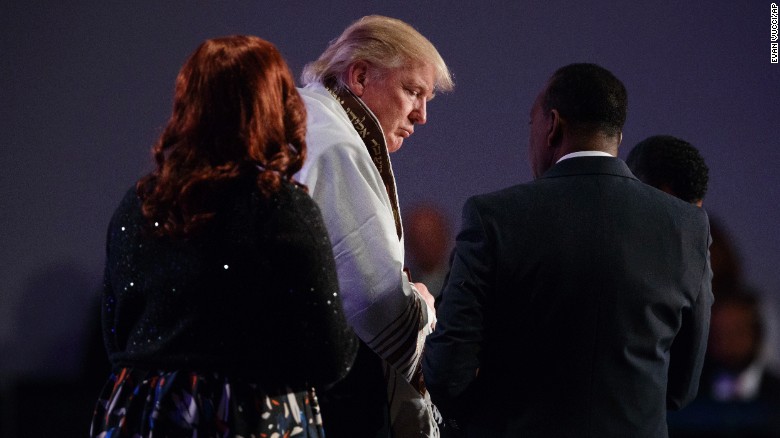
Trump in church in a tallit
After speaking at an African-American church in Detroit, the Great Faith Ministries, the pastor draped a prayer shawl, a tallit, over Trump's shoulders and gifted him with a Jewish Heritage Study Bible.
That is all fine and good. It just makes me wonder, why? do they not have any of their own prayer accessories? all a church in Detroit could find to gift a presidential candidate is Jewish paraphernalia? weird.
 |
| from CNN |
That is all fine and good. It just makes me wonder, why? do they not have any of their own prayer accessories? all a church in Detroit could find to gift a presidential candidate is Jewish paraphernalia? weird.
------------------------------------------------------
Reach thousands of readers with your ad by advertising on Life in Israel
------------------------------------------------------
Jan 20, 2014
Pope might allow investigation into Church and Papal behavior of the Holocaust-era
The Pope has indicated that he may open the Vatican archives... no, he will not be returning the Menorah or telling us where it is (the myth that won't go away, and one I particularly enjoy)... these are archives from the Holocaust-era.
Basically, the Pope is willing to look at the activity of Pope Pius XXII and address the accusations that the Pope neglected the Jews during the Holocaust (or worse).
A rabbi friend of the Pope from Argentina believes the Pope will carry through with what he has intimated. Rabbi Skorka says that the Pope has said the same when he was a cardinal and will surely carry through with it.
It sounds like a good thing. I am just not sure what then. Will it be a shock to learn that the Catholic Church was behind, or at ;east supported , Anti-Semitism and the murder of Jews? The Catholic Church was behind nearly two thousand years of anti-semitism and murder of Jews. I am not sure what benefit can come of this. Maybe it will reveal the names of many of the young children who were taken in by the Church from Jewish families and have thought of themselves as Christians until today.. besides for that? just for historical perspective? I do not think there is much that can be revealed from this.
I commend the Pope for doing the right thing, but I don't expect to be surprised by the results.
Basically, the Pope is willing to look at the activity of Pope Pius XXII and address the accusations that the Pope neglected the Jews during the Holocaust (or worse).
A rabbi friend of the Pope from Argentina believes the Pope will carry through with what he has intimated. Rabbi Skorka says that the Pope has said the same when he was a cardinal and will surely carry through with it.
It sounds like a good thing. I am just not sure what then. Will it be a shock to learn that the Catholic Church was behind, or at ;east supported , Anti-Semitism and the murder of Jews? The Catholic Church was behind nearly two thousand years of anti-semitism and murder of Jews. I am not sure what benefit can come of this. Maybe it will reveal the names of many of the young children who were taken in by the Church from Jewish families and have thought of themselves as Christians until today.. besides for that? just for historical perspective? I do not think there is much that can be revealed from this.
I commend the Pope for doing the right thing, but I don't expect to be surprised by the results.
------------------------------------------------------
Reach thousands of readers with your ad by advertising on Life in Israel
------------------------------------------------------
May 7, 2013
Let the Church of Scotland make Scotch
So the Church of Scotland thinks we Jews should not, even biblically, be in the land of Israel.
Exciting. Please remind me, in what world are they influential? Is there a reason anyone should care? Just tell them to go back to making their Scotch - stick to what you are good at...
Here is the story....from Israel Hayom:
In a new report titled "The Inheritance of Abraham? A Report on the 'Promised Land,''' the Church of Scotland, once a staunch supporter of the Jews' right to their ancient homeland, casts serious doubt on the biblical Jewish claim to the land.
The report is a culmination of more than a decade of increasingly strident anti-Zionism and pro-Palestinian activism by the church, especially by its local Palestinian Christian chapters.
"Promises about the land of Israel were never intended to be taken literally, or as applying to a defined geographical territory," it concludes. "The 'promised land' in the Bible is not a place, so much as a metaphor of how things ought to be among the people of God. This 'promised land' can be found, or built, anywhere."
Local Jewish leaders fear that if the church adopts the document at its annual general assembly, it may be become official church policy, the London Jewish Chronicle reported. The Church of Scotland's annual general assembly is to vote on the report later this month,
In the report, the church states that there has been a "widespread assumption" by many Christians and Jews that the Bible supports an essentially Jewish state of Israel.
"This assumption of biblical support is based on views of promises about land in the Hebrew Bible, and that the modern State of Israel is the fulfillment of God's promise to Abraham, as well as the fulfillment of biblical prophets such as Ezekiel, who spoke about 'the barren mountains of Israel' becoming fruitful and 'the ruined towns' being rebuilt as the people returned from exile. These views are disputed," the report says. It adds that the New Testament provides help in answering some of the "difficult questions" that arise from these disputed assumptions.
On God's promise to Abraham to make the Land of Israel a home for the Jewish people ("To your offspring I will give this land," Genesis 12:7), the Church of Scotland says that a purely literal reading does show that God promised the land to Abraham and his descendents, but that the exact geography of the land is unclear, and in any case the land was given "conditionally to the Jewish people, on the understanding the land is God's, given in trust to be cared for and lived in according to God's instruction."
The report then quotes from a slew of anti-Zionist writers who argue that Israel and Zionism are acting "unjustly" toward the Palestinian population on the land, in an effort to make the point that the current State of Israel is not acting according to God's instructions.
The New Testament, the report states, contains a "radical re-interpretation" of the concepts of "Israel," "temple," "Jerusalem," and "land."
"The boundaries of the land are described in different ways in different situations," the report says. "Abraham's descendants, 'numerous as the stars in the sky', will receive 'all these lands,' and through them 'all nations on earth will be blessed'" (Genesis 26:4). This suggests a more inclusive picture than "the land of Canaan" (Genesis 12:5) or even "from the river of Egypt to the great river, the Euphrates" (Genesis 15:18).
"The lack of detailed archaeological evidence supports the view that the range of scriptural material makes it inappropriate to try to use the Hebrew scriptures to determine an area of land meant exclusively for the Jewish people," the report says.
Making a theological leap from this geographical "lack of detailed archaeological evidence," the report then concludes that "the new 'place' where God is found is wherever people gather in the name of Jesus. If Jesus is indeed the 'yes' to all God's promises, the promise to Abraham about land is fulfilled through the impact of Jesus, not by restoration of land to the Jewish people."
The church admits that from the early 19th century, some influential Christians encouraged the concept of the land of Israel being promised to the Jews. It may well have been a church minister, the Rev. Alexander Keith, who coined the phrase "a land without people for a people without land," the report states.
Scottish Council of Jewish Communities Director Ephraim Borowski said the church should withdraw the report.
"On behalf of the Jewish community of Scotland, we call upon the church to withdraw it [the report] from the forthcoming general assembly. If the Church cannot build bridges, can it at least refrain from burning them?" Borowski told the London Jewish Chronicle newspaper.
Board of Deputies Vice President Jonathan Arkush said, "The document ... appears to have been produced with no consultation with the Scottish or national Jewish community. It is littered with misrepresentations of Jewish history, values and beliefs, as well as basic factual errors.
"It is an ignorant and tendentious document masquerading as a theological statement. The church has done a deep disservice to itself by producing a document without any regard to the trust, respect and dialogue on which interfaith relations should be based."
What I do not get is, even if we do not deserve the land of Israel by virtue of God's biblical promise to Abraham, why does the church think it is the Palestinians who do deserve the land? That's besides for the ridiculous scenario of a church saying to ignore the bible, reinterpret it, etc. - I mean, what's next? Will the church say homosexuality should be encouraged? Will the church say the Bible did not really mean murder is bad - really it is good? Or maybe incest or witchcraft?
------------------------------------------------------
Reach thousands of readers with your ad by advertising on Life in Israel
------------------------------------------------------
Dec 26, 2012
Jews attend Christmas services in church and hear Jewish song
I personally eschew any form of Jewish celebration or enjoyment in non-Jewish religious holidays. I really eschew any involvement in non-Jewish religious events or locations. Meaning, I will not visit churches or mosques, or the like, I will not reminisce about all the great and emotional Christmas music I might have heard on the radio growing up in the USA, or the shows and culture I might have seen on television and movies growing up in the USA. I will not reminisce about the lights and trees and nativity scenes I used to see on neighbors lawns and miss oh so terribly .
My form of Jewish pride is pride in being Jewish and not looking to the non-Jewish holidays and culture to make me feel good. That is for them, and this is for us. I admit, I am sure my lifestyle includes plenty of non-Jewish culture that I ingested as a child in America, but I will not spend time and energy pining for their religious holidays and surrounding culture.
This introduction to the post is more than just a comment on the report that will be below. It is also a rejection of the common trend I have seen in the past few years, but much more so this year, of Jews, even frum Jews, posting on Facebook and Twitter and other places, about how much they miss the holidays, or they post their Christmas memories, or what they miss most about Christmas now that they are in Israel, etc. Chrsitmas is out of bounds for me - not because I ban it, but because as a Jew I don't see Christmas, or other religious holidays and church culture, as being relevant to me, even if as a young man and child I did enjoy the tv shows or music of the holiday.
That is also true of the following report on bechadrei. The Beit Jimal monastery held Christmas services last night. it seems there was a significant group of Jewish spectators, mostly out of curiosity I imagine, from Bet Shemesh. Among the group of spectators were also religious and even haredi people.
According to the report, these frum spectators in a church at a religious holiday service, were shocked, SHOCKED, to suddenly hear as part of the service, a popular Jewish religious song. The song they heard sung by the nuns of Beit Jimal was the song "Avinu Av HaRachaman" written about 30 years ago by R' Chaim Bennet for the Seret-Vishnitz rebbe.
If you listen to the song in the video below (decide for yourself on kol isha relevance), you will notice that they sang a beautiful rendition of the song, but they garbled some of the words - specifically every time it mentions "Torah"
אבינו אב הרחמן של ר' חיים בנט במיסת חג המולד בבית גמאל from bhol on Vimeo.
The article expresses the shock and anger of these spectators, and eventually of the original composer after he was told of what was witnessed, that this song written by a God-fearing Jew for holy purposes could be used by the church in this way, sung by nuns for their own holy day. Bennet himself, the composer, sounded hurt when he heard how his song was being used.
I am not sure why the issue being made is of the church using a Jewish song in their services, albeit with slight changes. The real issue should be is why Jews, even frum Jews, are going to a non-Jewish religious service in a church. They claim curiosity, even knowing it is prohibited, is what drew them to attend the services. It seems to me that religious Jews going to a church on a religious holiday for services is much more shocking and troubling than nuns singing a Jewish song.
And furthermore, to the reported issue itself, should it really be shocking that they used one of our songs? Does it affect the holiness or spirituality of the original music (if there is any) just because someone else chose to sing it? Is there really any reason to care what they sing? And looking at it objectively, we do exactly the same thing so often - how many Jewish songs were originally non-Jewish songs? How many Polish marches were converted into hassidic nigunim? Is it ok to take their music for our needs, but not for them to take our music for their needs?
The entire episode is shocking, but more so that frum Jews are actively involving themselves in celebrations of a Christian holiday.
If you feel you need to clean out your ears and head after hearing the nuns sing for their religious services, feel free to listen to a Jewish rendition of the original song, with all the words...
My form of Jewish pride is pride in being Jewish and not looking to the non-Jewish holidays and culture to make me feel good. That is for them, and this is for us. I admit, I am sure my lifestyle includes plenty of non-Jewish culture that I ingested as a child in America, but I will not spend time and energy pining for their religious holidays and surrounding culture.
This introduction to the post is more than just a comment on the report that will be below. It is also a rejection of the common trend I have seen in the past few years, but much more so this year, of Jews, even frum Jews, posting on Facebook and Twitter and other places, about how much they miss the holidays, or they post their Christmas memories, or what they miss most about Christmas now that they are in Israel, etc. Chrsitmas is out of bounds for me - not because I ban it, but because as a Jew I don't see Christmas, or other religious holidays and church culture, as being relevant to me, even if as a young man and child I did enjoy the tv shows or music of the holiday.
That is also true of the following report on bechadrei. The Beit Jimal monastery held Christmas services last night. it seems there was a significant group of Jewish spectators, mostly out of curiosity I imagine, from Bet Shemesh. Among the group of spectators were also religious and even haredi people.
According to the report, these frum spectators in a church at a religious holiday service, were shocked, SHOCKED, to suddenly hear as part of the service, a popular Jewish religious song. The song they heard sung by the nuns of Beit Jimal was the song "Avinu Av HaRachaman" written about 30 years ago by R' Chaim Bennet for the Seret-Vishnitz rebbe.
If you listen to the song in the video below (decide for yourself on kol isha relevance), you will notice that they sang a beautiful rendition of the song, but they garbled some of the words - specifically every time it mentions "Torah"
אבינו אב הרחמן של ר' חיים בנט במיסת חג המולד בבית גמאל from bhol on Vimeo.
The article expresses the shock and anger of these spectators, and eventually of the original composer after he was told of what was witnessed, that this song written by a God-fearing Jew for holy purposes could be used by the church in this way, sung by nuns for their own holy day. Bennet himself, the composer, sounded hurt when he heard how his song was being used.
I am not sure why the issue being made is of the church using a Jewish song in their services, albeit with slight changes. The real issue should be is why Jews, even frum Jews, are going to a non-Jewish religious service in a church. They claim curiosity, even knowing it is prohibited, is what drew them to attend the services. It seems to me that religious Jews going to a church on a religious holiday for services is much more shocking and troubling than nuns singing a Jewish song.
And furthermore, to the reported issue itself, should it really be shocking that they used one of our songs? Does it affect the holiness or spirituality of the original music (if there is any) just because someone else chose to sing it? Is there really any reason to care what they sing? And looking at it objectively, we do exactly the same thing so often - how many Jewish songs were originally non-Jewish songs? How many Polish marches were converted into hassidic nigunim? Is it ok to take their music for our needs, but not for them to take our music for their needs?
The entire episode is shocking, but more so that frum Jews are actively involving themselves in celebrations of a Christian holiday.
If you feel you need to clean out your ears and head after hearing the nuns sing for their religious services, feel free to listen to a Jewish rendition of the original song, with all the words...
------------------------------------------------------
Reach thousands of readers with your ad by advertising on Life in Israel
------------------------------------------------------
Aug 7, 2012
Proposed Laws: Cellphones While Crossing, Reserved Parking and Church/Mosque Arnona Exemptions
A few interesting law proposal were introduced recently:
1. MK Lia Shemtov has proposed a law that would ban using a cellphone while crossing the street. The initial proposal wanted to ban the sending of messages and emails and using apps on the phone. Doing this creates a distraction for the person crossing the street, at a time when he should be paying attention. Other MKs added to the proposal that it should include using a cellphone in general, as well as having earphones in place listening to either a cellphone or music player or sorts.
If this proposal will be passed, Israel will join an increasing number of countries, or states in the US, that are instituting such a ban.
2. sometimes sections of parking on streets might be designated, or reserved, for local residents or for someone specific. if you would park in such a spot, you might come back to find a ticket on your windshield.
The real problem can be when the sign declaring the area to be reserved parking is difficult to see or unclear. it might be at the beginning of the road, and someone driving on the street might have passed it without even noticing it as he is parking nowhere near the sign.
MK Yoel Hasson has proposed a law that while general parking is indicated by the painting of the curb with a staggered blue line (blue and white), reserved parking should be designated by the painting of a staggered green line.
This still does not solve the problem of when a guest is visiting someone, or kids visiting a parent, and parks on the street in a reserved area he can still get a ticket. But it is an improvement as it will be clearer for the driver to understand where he is and is not allowed to park.
3. By law, all places of worship, no matter what religion they are associated with, are exempt from arnona payments (municipal property tax). The difference between exemptions is that in addition to the synagogue being exempt, connected areas to the synagogue are also exempt. This additional exemption only applies to synagogues, but not places of worship of other religions. That means that while a beis medrash by a shul will be exempt from arnona payments, the other areas of a mosque or church have to pay for the same type of space.
At the beginning of the year this discrepancy was appealed to the Supreme Court on the basis of discrimination. The Supreme Court gave time for the Knesset to respond with an explanation, but in the meantime, the appellant requested an order that would cancel, temporarily at least, the exemption from synagogues until the issue is resolved in the courts.
To avoid a situation in which the shuls would lose their exemption, even temporrily, MKs Moshe Gafni and Nissim Zeev submitted their proposal for an amendment to the law that would grant the same exemption to the adjacent properties of other religions as well.
This situation, of religious MKs solving problems for other religions, is being described as unusual. It might be, but it shouldn't be. There is no reason why clergy cannot cooperate to solve problems for each other.
------------------------------------------------------
Reach thousands of readers with your ad by advertising on Life in Israel
------------------------------------------------------
1. MK Lia Shemtov has proposed a law that would ban using a cellphone while crossing the street. The initial proposal wanted to ban the sending of messages and emails and using apps on the phone. Doing this creates a distraction for the person crossing the street, at a time when he should be paying attention. Other MKs added to the proposal that it should include using a cellphone in general, as well as having earphones in place listening to either a cellphone or music player or sorts.
If this proposal will be passed, Israel will join an increasing number of countries, or states in the US, that are instituting such a ban.
2. sometimes sections of parking on streets might be designated, or reserved, for local residents or for someone specific. if you would park in such a spot, you might come back to find a ticket on your windshield.
The real problem can be when the sign declaring the area to be reserved parking is difficult to see or unclear. it might be at the beginning of the road, and someone driving on the street might have passed it without even noticing it as he is parking nowhere near the sign.
MK Yoel Hasson has proposed a law that while general parking is indicated by the painting of the curb with a staggered blue line (blue and white), reserved parking should be designated by the painting of a staggered green line.
This still does not solve the problem of when a guest is visiting someone, or kids visiting a parent, and parks on the street in a reserved area he can still get a ticket. But it is an improvement as it will be clearer for the driver to understand where he is and is not allowed to park.
3. By law, all places of worship, no matter what religion they are associated with, are exempt from arnona payments (municipal property tax). The difference between exemptions is that in addition to the synagogue being exempt, connected areas to the synagogue are also exempt. This additional exemption only applies to synagogues, but not places of worship of other religions. That means that while a beis medrash by a shul will be exempt from arnona payments, the other areas of a mosque or church have to pay for the same type of space.
At the beginning of the year this discrepancy was appealed to the Supreme Court on the basis of discrimination. The Supreme Court gave time for the Knesset to respond with an explanation, but in the meantime, the appellant requested an order that would cancel, temporarily at least, the exemption from synagogues until the issue is resolved in the courts.
To avoid a situation in which the shuls would lose their exemption, even temporrily, MKs Moshe Gafni and Nissim Zeev submitted their proposal for an amendment to the law that would grant the same exemption to the adjacent properties of other religions as well.
This situation, of religious MKs solving problems for other religions, is being described as unusual. It might be, but it shouldn't be. There is no reason why clergy cannot cooperate to solve problems for each other.
------------------------------------------------------
Reach thousands of readers with your ad by advertising on Life in Israel
------------------------------------------------------
Feb 14, 2011
Interesting Psak: Davening In A Mosque
Before I begin, I would just like to point out something strange. The ynetnews article that discusses the issue references a psak issued on the Kipa website. I went to check the Kipa website for the original text and wording, and was surprised to see that the Kipa site has been taken over by the Kosharot organization and the original Kipa content is gone. So, I have not been able to find the original source and am only able to reference the ynet article.
Rav Baruch Efrati, a community rav in Efrat, was asked, on the now-missing Kipa website, by somebody who travels a lot, he puts on tefillin in advance, but he does not have time to daven, and he prefers not to daven out in public in the airport and it will disturb his focus. What is the best option for him to do under these circumstances.
 Rav Efrati's answer is that many airports have a makeshift mosque, which is generally empty except for books and Korans. While davening in a mosque is not a perfect solution, it is permissible and seems to be the best option available. Rav Efrati used the Me'aras HaMachpela as an example of the permissibility of davening in a mosque.
A mosque, however, is different than a Christian church. A church is prohibited for a Jew to enter, so if an airport has a church, that cannot be used as a solution for this man's prayer issues.
This is really not a new or radical psak - we hold that Christianity, or at least certain streams of it, are considered idolatry for Jews, and Jews cannot go into the churches. Islam however is not idolatry, and even though there are elements of heresy and problematic beliefs (such as the idea that the Koran replaced the Torah), the religion overall is not idolatry and the mosque is not "off grounds".
Interestingly enough, some of the haredi websites that have quoted and referenced this psak of Rav Efrati ran the title as "Zionist Rabbi" says to daven in mosque. As if it is sensationalist simply because he is a Zionist yet was in favor of davening in the mosque. They seem to be surprised that Zionist rabbis also keep the halacha, based same shulchan aruch.
Rav Baruch Efrati, a community rav in Efrat, was asked, on the now-missing Kipa website, by somebody who travels a lot, he puts on tefillin in advance, but he does not have time to daven, and he prefers not to daven out in public in the airport and it will disturb his focus. What is the best option for him to do under these circumstances.
Rav Efrati's answer is that many airports have a makeshift mosque, which is generally empty except for books and Korans. While davening in a mosque is not a perfect solution, it is permissible and seems to be the best option available. Rav Efrati used the Me'aras HaMachpela as an example of the permissibility of davening in a mosque.A mosque, however, is different than a Christian church. A church is prohibited for a Jew to enter, so if an airport has a church, that cannot be used as a solution for this man's prayer issues.
This is really not a new or radical psak - we hold that Christianity, or at least certain streams of it, are considered idolatry for Jews, and Jews cannot go into the churches. Islam however is not idolatry, and even though there are elements of heresy and problematic beliefs (such as the idea that the Koran replaced the Torah), the religion overall is not idolatry and the mosque is not "off grounds".
Interestingly enough, some of the haredi websites that have quoted and referenced this psak of Rav Efrati ran the title as "Zionist Rabbi" says to daven in mosque. As if it is sensationalist simply because he is a Zionist yet was in favor of davening in the mosque. They seem to be surprised that Zionist rabbis also keep the halacha, based same shulchan aruch.
Jan 31, 2011
Torah Redeemed From Church
Kikar reports on an interesting story that recently happened. A rav from Tel Aviv, Rav Avi Zarki, heard about a, antique and rare sefer torah that was being held in the basement of a church in Bethlehem, and it disturbed him greatly that the torah was being held in a place of tumah. He felt he needed to do something, to try to get it out.
Rav Zarki tried to find ways of getting the torah out, through various connections, but nothing worked. It turned out that the heads of the church were only willing to part with the torah for an astronomical sum of money. Rav Zarki easily found someone willing to donate the sum of money required to redeem the torah.
Rav Zarki then went to Rav Shteinman to ask how to proceed. His question was if, to redeem a torah, he would be allowed to go into the makom tumah of the church. (personally I would think the bigger question would be if he would be allowed to spend "an astronomical amount of money" on redeeming a torah, as it might encourage them to steal other torahs for the purpose of selling them back to the Jews for a lot of money).
Rav Shteinman said it is allowed, and he gave him his blessing to proceed.
Zarki, with the blessing of Rav Shteinman, made the arrangements. He dressed up like a tourist from France posing as an antiques collector, and went to the arranged meeting place in Jerusalem. From there, the people he met took him in a United Nations car to where they had to go.
Rav Zarki says that at one point he felt that one of the Palestinian policemen suspected that he was Jewish. The policeman tried to talk to him in English, to test his cover supposedly, but he nervously continued talking in French and withstood the test of the policeman.
Rav Zarki describes how they went into the cellar of the church, and there he saw the antique torah sitting in a very secure safe. Keeping his composure, which he describes as being very difficult because of the emotions at the moment, so as not to cause them to raise the price even more, they proceeded to finalize the deal.
The bishop gave the final approval and signature for the transfer to be made, after ensuring that the money had been deposited in the bank account. When everything was cleared, he handed over the torah to Rav Zarki.
The torah is now in a shul in Tel Aviv being used the way it was intended.
(As to this torah from Amazon, I had no idea you could buy a torah on Amazon. Perhaps Rav Zarki should redeem this one as well)
 |
| Just a picture of an ancient torah, not the actual torah from the story |
Rav Zarki then went to Rav Shteinman to ask how to proceed. His question was if, to redeem a torah, he would be allowed to go into the makom tumah of the church. (personally I would think the bigger question would be if he would be allowed to spend "an astronomical amount of money" on redeeming a torah, as it might encourage them to steal other torahs for the purpose of selling them back to the Jews for a lot of money).
Rav Shteinman said it is allowed, and he gave him his blessing to proceed.
Zarki, with the blessing of Rav Shteinman, made the arrangements. He dressed up like a tourist from France posing as an antiques collector, and went to the arranged meeting place in Jerusalem. From there, the people he met took him in a United Nations car to where they had to go.
Rav Zarki says that at one point he felt that one of the Palestinian policemen suspected that he was Jewish. The policeman tried to talk to him in English, to test his cover supposedly, but he nervously continued talking in French and withstood the test of the policeman.
Rav Zarki describes how they went into the cellar of the church, and there he saw the antique torah sitting in a very secure safe. Keeping his composure, which he describes as being very difficult because of the emotions at the moment, so as not to cause them to raise the price even more, they proceeded to finalize the deal.
The bishop gave the final approval and signature for the transfer to be made, after ensuring that the money had been deposited in the bank account. When everything was cleared, he handed over the torah to Rav Zarki.
The torah is now in a shul in Tel Aviv being used the way it was intended.
(As to this torah from Amazon, I had no idea you could buy a torah on Amazon. Perhaps Rav Zarki should redeem this one as well)
Aug 5, 2010
Protesting Solomon's Temple copycat
I must say I didn't expect this response.
A church in Brazil recently announced it had received permits and would soon begin construction on a new mega-church in the design of Solomon's Temple.
I thought it is one of those and silly things, mostly done for marketing purposes and appearance, and really overall meaningless. I mean, who cares that a church in Brazil is designing its structure according to the engineering plans of Solomon's Temple?
Turns out that some people do care, and oppose it.
Srugim reports that MK Dr. Michael Ben-Ari has sent a letter to the Brazilian Ambassador saying that they should forgo the grandiose plans to build the structure similar to the Temple, as the Temple is not just the building but the place as well. Instead, they should remove Al Aqsa from it's place and re-place it in Brazil, and allow the actual Temple to be built where it was meant to be.
As well, MK Aryeh Eldad protests it as well, saying that their intention is to "inherit" Judaism and its symbols of identity.
Seems like making a mountain out of a molehill. What do you think?
A church in Brazil recently announced it had received permits and would soon begin construction on a new mega-church in the design of Solomon's Temple.
I thought it is one of those and silly things, mostly done for marketing purposes and appearance, and really overall meaningless. I mean, who cares that a church in Brazil is designing its structure according to the engineering plans of Solomon's Temple?
Turns out that some people do care, and oppose it.
Srugim reports that MK Dr. Michael Ben-Ari has sent a letter to the Brazilian Ambassador saying that they should forgo the grandiose plans to build the structure similar to the Temple, as the Temple is not just the building but the place as well. Instead, they should remove Al Aqsa from it's place and re-place it in Brazil, and allow the actual Temple to be built where it was meant to be.
As well, MK Aryeh Eldad protests it as well, saying that their intention is to "inherit" Judaism and its symbols of identity.
Seems like making a mountain out of a molehill. What do you think?
Jan 25, 2009
Rabbi Lookstein Defends Going to the Church Service
The following is Rabbi Lookstein's response to why he participated in the service in the church as part of President Obama's inauguration. Rabbi Lookstein sent this email to his colleagues at the RCA in order to explain his actions.
Fellow RCA Members,
The RCA recently issued a press release critical of my participation at the National Cathedral on the morning after Barack Obama's inauguration. I write to explain why I did participate in this service, even though it was in the National Cathedral, an Episcopalian Church.
First, I am very much in agreement with the RCA's view, derived from the writings of the Rav zt"l opposing interfaith dialogue and theological compromise. Indeed, I have been in the rabbinate more than fifty years, and I have never participated in such an event. I followed these guidelines throughout my tenure as President of the now defunct Synagogue Council of America.
Nevertheless, I felt not only that it was permitted to participate in this event, but proper for someone in the responsible Orthodox rabbinate and, indeed, necessary.
Herewith, my explanation for my colleagues:
This event was not an interfaith dialogue or meeting. It was an invitation from the new President of the United States -- a man of incredible importance to the fate of our holy community in the land of Israel and here -- to meet him in prayer. Many clergy were invited, and I felt that the interests of our Orthodox community would be hurt if no one from our community participated.
The Shulchan Aruch notes in YD 178:2 that a person who needs to be close to the government may wear even the Torah- prohibited garments of a gentile in order to represent the Jewish community well. The prohibition to enter a church is grounded in the appearance of impropriety, rather than an actual impropriety -- indeed, wearing garments of gentiles is a Torah prohibition and this is generally thought to be a rabbinic one.
It is well known that many Chief Rabbis of England have gone into Westminster Abby when summoned there by the King or Queen, and many other great rabbis have done the same to represent our community. The Chief Rabbis of Israel have engaged in similar activities, and, most recently, the Chief Rabbi of Haifa, Rabbi Shear Yashuv Cohen was involved in similar activities. In fact, he attended the funeral of the late Pope, John Paul II.
Rabbi Michael Broyde told me that he was once asked by the Israeli government to represent the government of Israel ON A VERY SERIOUS MATTER at an event in a church during a time of worship. He spoke to the Tzitz Eliezer about this issue, and the Tzitz Eliezer told him directly that if it was a matter of significant importance to the Israeli government, then he should go wearing his kipa and looking as rabbinic as he could.
Of course, such events are few and far between, and, in most situations, I and other RCA members would never participate in such events. But, I feel that Orthodox participation in this important national event, and the opportunity to say a few words directly to the President of the United States and begin to develop a relationship with the most powerful man in the world is a chance that our community can ill afford to miss. Indeed, when I spoke to President Obama, I thanked him for his support of Israel and I urged him to remember the unforgettable statement he made in Sderot, where he said, "If anybody would shoot rockets into my house while my daughters were sleeping, I would do anything in my power to make sure they wouldn’t do it again".
The President responded with a clear assent. Maybe this will save a life or two in the future and maybe it will not; but I felt this was not an assignment I could – or should – turn down.
Rabbi Haskel Lookstein
Fellow RCA Members,
The RCA recently issued a press release critical of my participation at the National Cathedral on the morning after Barack Obama's inauguration. I write to explain why I did participate in this service, even though it was in the National Cathedral, an Episcopalian Church.
First, I am very much in agreement with the RCA's view, derived from the writings of the Rav zt"l opposing interfaith dialogue and theological compromise. Indeed, I have been in the rabbinate more than fifty years, and I have never participated in such an event. I followed these guidelines throughout my tenure as President of the now defunct Synagogue Council of America.
Nevertheless, I felt not only that it was permitted to participate in this event, but proper for someone in the responsible Orthodox rabbinate and, indeed, necessary.
Herewith, my explanation for my colleagues:
This event was not an interfaith dialogue or meeting. It was an invitation from the new President of the United States -- a man of incredible importance to the fate of our holy community in the land of Israel and here -- to meet him in prayer. Many clergy were invited, and I felt that the interests of our Orthodox community would be hurt if no one from our community participated.
The Shulchan Aruch notes in YD 178:2 that a person who needs to be close to the government may wear even the Torah- prohibited garments of a gentile in order to represent the Jewish community well. The prohibition to enter a church is grounded in the appearance of impropriety, rather than an actual impropriety -- indeed, wearing garments of gentiles is a Torah prohibition and this is generally thought to be a rabbinic one.
It is well known that many Chief Rabbis of England have gone into Westminster Abby when summoned there by the King or Queen, and many other great rabbis have done the same to represent our community. The Chief Rabbis of Israel have engaged in similar activities, and, most recently, the Chief Rabbi of Haifa, Rabbi Shear Yashuv Cohen was involved in similar activities. In fact, he attended the funeral of the late Pope, John Paul II.
Rabbi Michael Broyde told me that he was once asked by the Israeli government to represent the government of Israel ON A VERY SERIOUS MATTER at an event in a church during a time of worship. He spoke to the Tzitz Eliezer about this issue, and the Tzitz Eliezer told him directly that if it was a matter of significant importance to the Israeli government, then he should go wearing his kipa and looking as rabbinic as he could.
Of course, such events are few and far between, and, in most situations, I and other RCA members would never participate in such events. But, I feel that Orthodox participation in this important national event, and the opportunity to say a few words directly to the President of the United States and begin to develop a relationship with the most powerful man in the world is a chance that our community can ill afford to miss. Indeed, when I spoke to President Obama, I thanked him for his support of Israel and I urged him to remember the unforgettable statement he made in Sderot, where he said, "If anybody would shoot rockets into my house while my daughters were sleeping, I would do anything in my power to make sure they wouldn’t do it again".
The President responded with a clear assent. Maybe this will save a life or two in the future and maybe it will not; but I felt this was not an assignment I could – or should – turn down.
Rabbi Haskel Lookstein
Jan 22, 2009
participating in a church ceremony
(originally posted on DB)
I was in the supermarket this evening and I bumped into a friend. He asked me a question, and I did not have the answer. Something specific about the Obama inauguration irked him, and he was very disturbed by it.
He was disturbed by the fact that Rabbi Lookstein participated in the ceremony, actively participated by giving his blessings, in a church on behalf of Barack Obama yesterday? My friend insisted it is clearly prohibited to do so, and even if there are certain situations in which one can be lenient to go into a church, clearly halacha does not allow it as part of a ceremony, and even worse to participate in the ceremony!
I don't know enough on that topic, so I am not going to voice an opinion. But I will ask the question.
According to my understanding, and it seems the RCA is of the same opinion (as the RCA put out a statement against Rabbi Looksteins actions), Rabbi Lookstein was wrong and it is not allowed. Do you know, or have any suggestion, on what he based his opinion that he was allowed to participate?
I am assuming he was aware of the problem and decided it was permitted. I am sure he did not just flagrantly go against the halacha. he must have had reason to consider it permitted.
Does anybody here have a suggestion why he would have thought so?
Another question - from Barack Obama's point of view, why hold a non-denominational ceremony/service in a church? Why not in a neutral location, such as a conference center of some sort? A church is not non-denominational by any stretch of the definition....
I was in the supermarket this evening and I bumped into a friend. He asked me a question, and I did not have the answer. Something specific about the Obama inauguration irked him, and he was very disturbed by it.
He was disturbed by the fact that Rabbi Lookstein participated in the ceremony, actively participated by giving his blessings, in a church on behalf of Barack Obama yesterday? My friend insisted it is clearly prohibited to do so, and even if there are certain situations in which one can be lenient to go into a church, clearly halacha does not allow it as part of a ceremony, and even worse to participate in the ceremony!
I don't know enough on that topic, so I am not going to voice an opinion. But I will ask the question.
According to my understanding, and it seems the RCA is of the same opinion (as the RCA put out a statement against Rabbi Looksteins actions), Rabbi Lookstein was wrong and it is not allowed. Do you know, or have any suggestion, on what he based his opinion that he was allowed to participate?
I am assuming he was aware of the problem and decided it was permitted. I am sure he did not just flagrantly go against the halacha. he must have had reason to consider it permitted.
Does anybody here have a suggestion why he would have thought so?
Another question - from Barack Obama's point of view, why hold a non-denominational ceremony/service in a church? Why not in a neutral location, such as a conference center of some sort? A church is not non-denominational by any stretch of the definition....
Subscribe to:
Posts (Atom)
Related Posts
