
Showing posts with label davening. Show all posts
Showing posts with label davening. Show all posts
May 17, 2023
smart and practical in the Mir
Behadrei Haredim is reporting on an initiative by the Mir Yeshiva to encourage more of its Israeli students to join the yeshiva's minyan for shacharis.
It seems the Israeli students dont like the slow pace of the davening, so they prefer to daven elsewhere.
In an effort to bring the Israeli boys back, the yeshiva has set up several incentives.
One of those initiatives is a ten minute learning group after davening to study Mishna Brura, only for Israeli students and conditional upon being present for the yeshiva's minyan. This learning group will including testing and stipends for participants. Additionally, participants will get breakfast served.
Nice incentive.
The more interesting initiative is that from now on, for the foreseeable future, as long as there is no "chiyuv" present, only Israeli students can lead the morning services. This initiative has sped the pace of the davening up and cut it down by ten minutes. It seems the American, or foreign, students previously leading the services were too slow for the Israelis and this is meant to entice them back.
Good move. The Rosh Hayeshiva must be a smart guy to realize that, and practical to also not stick to his guns and say they have to put up with our pace, slow as it may be.
------------------------------------------------------
Reach thousands of readers with your ad by advertising on Life in Israel
Reach thousands of readers with your ad by advertising on Life in Israel
------------------------------------------------------
Feb 14, 2022
Flying the Minyan-Friendly Skies
According to Globes, El Al is going to start a trial of making official minyanim on long haul flights, in an attempt to put an end to the ad hoc minyanim that disturb passengers and crew alike.
The official minyanim will be held in the back of the plane, in the galley and times of services will be announced in advance by the cabin crew and on the screens by each seat. They say the minyanim will be contained in the galley and will not spill over into the aisles, so as not to disturb passengers seated in that area. Participants in the minyan will have to continue wearing their masks (I assume this is just for now with the mask mandate on flights but if that ever gets removed, the minyan-goers will no longer need to either).
ElAl has instructed its crews to prepare for this and to arrange their kitchen tasks and needs to be in sync with the minyanim allowances. The morning services will likely be scheduled for sunrise. In cases of weather difficulties, turbulence and the like, participants may be required to go back to their seats.
It is about time they are arranging some way to make it organized, instead of fighting about it every flight and having ill will between passengers and crew and each other.
I think they need to actually start two minyanim, so every praying-passenger will have the minyan he goes to and the minyan he wont attend.
Will women want a minyan as well? equal rights!
What happens if someone misses sunrise and wants to start another minyan?
I think they should also build a prayer area by the galley. They can install a bima and aron kodesh, have a permanent gabbai to run the minyan, maybe even hire a chazzan and a baal kriya! They will next install a bookcase with siddurim. And then next year they will open a yeshiva and kollel! ElAl should put out a fundraising call to name the ElAl inflight shuls after a dearly departed. :-)
Just joking. I really think it can be a good idea and that this is something that should have, could have, happened a long time ago.
------------------------------------------------------
Reach thousands of readers with your ad by advertising on Life in Israel
Reach thousands of readers with your ad by advertising on Life in Israel
------------------------------------------------------
Dec 14, 2020
Interesting Psak: musical Hallel
musical Hallels have become very popular in recent years. They provide inspiration and an outlet for many people to experience the joy of Hallel. And they might be fun for many.
In a Chassidishe shteibel, a kloiz, in Modiin Ilit experienced an incident at what was turning into a musical Hallel. A local resident came to the shul to daven and pulled out a violin during Hallel and started playing music to liven up the Hallel.
Somebody else in the minyan told this fellow to stop, but it turned into a bit of a ruckus, with some people saying to leave him alone, not shame him, and let him play the music, and the original upset person stood his ground claiming that music during davening came from the Reform and we cannot allow it to continue and create a breach in our walls. They argued, with examples from the Levites in the Beit Hamikdash (an argument he rejected, saying they also shechted animals on Shabbos in the Mikdash, and that does not mean we can), and from rabbonim (Rav Kook is mentioned) who did so.
Eventually they agreed to let this fellow ask a rav and they would act accordingly.
The fellow asked Rav Aviner, who said that a shul is not a beis hamikdash, and this fellow is also not King David. The Sde Chemed says not to turn davening into a concert (Rav Aviner is also against significant chazzanut performances in davening for this reason).
Rav Aviner concluded that there is a spirit of Reformism entering the Dati and even Haredi worlds, so playing instruments in shul should be avoided.
source: Actualic
The article is strange and a bit questionable. It refers to an incident in Modiin Ilit, Brachfeld, in a kloiz. Yet they asked the question of Rav Aviner and referred to Rav Kook in the arguments. Very strange. I suspect there is something incorrect or inaccurate about this.
------------------------------------------------------
Reach thousands of readers with your ad by advertising on Life in Israel
Reach thousands of readers with your ad by advertising on Life in Israel
------------------------------------------------------
Mar 29, 2020
Interesting Psak: daven at home
The city of Bnei Braq has been hit by the CoronaVirus particularly hard and the Haredi community there, and elsewhere, is reeling from it. It is not just from events like the funeral yesterday of a Peleg-associated rabbi that has hundreds in attendance not keeping any of the social distancing rules, but the minyanim and mikvas and general population density of Bnei Braq makes it troublesome. I don't know what reports are exaggerated and what is real, but they are talking about many people there having caught the virus and it spreading like wildfire. Only now are the community leaders there finally taking notice and changing their tune as far as behavioral instructions.
To that end, Rav Chaim Kanievsky just issued a psak a short while ago that they hope will be more effective in making people stop and take notice.
Rav Kanievsky paskened, currently specifically for Bnei Braq and not in general, that people should daven alone at home and not in any shul. People should NOT make private minyanim. It is pikuach nefesh.
Rav Chaim Kanievsky adds that anyone not davening at home but in a minyan has the status of a rodef and if you are aware of such a minyan or person you must report him to the authorities, even with the knowledge that this might lead to him being arrested or slapped with a large fine. If you are aware of someone who is meant to be in quarantine but is not following the quarantine rules, you are allowed to shame him publicly over this.
Rav Kanievsky also added that this is not just for davening, but people should also learn Torah at home and not in shuls, even alone in shuls and batei medrash.
source: Behadrei, Kikar, among others
Many people find interesting and creative ways around this in other cities in which this has already been in practice, such as balcony or porch minyanim with people each on their own porch davening together with someone central they can all hear leading the services. It is cute, but the rabbonim did not say to find a way around it. They said daven at home. As innovative as such solutions might be, and seemingly safe, they create an atmosphere of looking for ways around the rules, and even if this or that person is careful to do it while following the guidelines strictly, maybe other people will take example without being as careful. Additionally, I myself have seen such minyanim that seem to be ok, but then other people join in below in the center in the parking lot between the buildings and porches, and invariably those people often are not keeping the guidelines carefully. Stop trying to outwit the system. Just daven at home, as the rabbonim say to. Right now be machmir on pikuach nefesh.
To that end, Rav Chaim Kanievsky just issued a psak a short while ago that they hope will be more effective in making people stop and take notice.
Rav Kanievsky paskened, currently specifically for Bnei Braq and not in general, that people should daven alone at home and not in any shul. People should NOT make private minyanim. It is pikuach nefesh.
Rav Chaim Kanievsky adds that anyone not davening at home but in a minyan has the status of a rodef and if you are aware of such a minyan or person you must report him to the authorities, even with the knowledge that this might lead to him being arrested or slapped with a large fine. If you are aware of someone who is meant to be in quarantine but is not following the quarantine rules, you are allowed to shame him publicly over this.
Rav Kanievsky also added that this is not just for davening, but people should also learn Torah at home and not in shuls, even alone in shuls and batei medrash.
source: Behadrei, Kikar, among others
Many people find interesting and creative ways around this in other cities in which this has already been in practice, such as balcony or porch minyanim with people each on their own porch davening together with someone central they can all hear leading the services. It is cute, but the rabbonim did not say to find a way around it. They said daven at home. As innovative as such solutions might be, and seemingly safe, they create an atmosphere of looking for ways around the rules, and even if this or that person is careful to do it while following the guidelines strictly, maybe other people will take example without being as careful. Additionally, I myself have seen such minyanim that seem to be ok, but then other people join in below in the center in the parking lot between the buildings and porches, and invariably those people often are not keeping the guidelines carefully. Stop trying to outwit the system. Just daven at home, as the rabbonim say to. Right now be machmir on pikuach nefesh.
------------------------------------------------------
Reach thousands of readers with your ad by advertising on Life in Israel
Reach thousands of readers with your ad by advertising on Life in Israel
------------------------------------------------------
Aug 14, 2017
online mincha will meet at 1:15
Remember the psak from Chief Rabbi Rav Yitzchak Yosef that allows, as a bdieved, one who is unable to go to shul for services to watch a minyan online and it would be considered as davening with a minyan?
That is now happening. The horses have left the stable.
The organization Ayelet Hashachar now have a live broadcast of services from their shul in Modiin. Ayelet Hashachar is broadcasting services of Shacharis, Mincha (twice - once early and once later in the afternoon), and Maariv.
You can see the broadcast online at http://ayelethashachar.org/he/%D7%AA%D7%A4%D7%99%D7%9C%D7%94-%D7%91%D7%A9%D7%99%D7%93%D7%95%D7%A8.html
They have a disclaimer on the site saying that davening via the online broadcast would not be considered "tefilla btzibbur", but it would be beneficial for the preference in halacha of davening ins sync with a local minyan when one cannot actually be present. I would note that this is not what Rav Yitzchak Yosef said - he paskened that it would be tefilla btzibbur but can only be used in bdieved situations such as someone who is sick or for other reasons cannot physically go to shul - not just someone who is lazy and does not want to bother going.
Once the horses have left the stable, bringing them back in is not so easy.. The psak is out there and is being used. People will use the online broadcasts however they want and nobody will be the wiser. The only thing lacking is the ability to do this for longer services such as Shabbos or holidays.. but maybe with time and technological advancements and organizations like Machon Tzmoet and others eventually that might happen as well...
By the way, I connected to the online minyan at 1:15 to see the mincha services. It ran smoothly and all was fine. I would ask that if in the video screen one sees less than ten men, is it still like davening in the minyan because there are ten in the room or must one see at least ten in the video screen to be considered a part of the minyan?
That is now happening. The horses have left the stable.
The organization Ayelet Hashachar now have a live broadcast of services from their shul in Modiin. Ayelet Hashachar is broadcasting services of Shacharis, Mincha (twice - once early and once later in the afternoon), and Maariv.
You can see the broadcast online at http://ayelethashachar.org/he/%D7%AA%D7%A4%D7%99%D7%9C%D7%94-%D7%91%D7%A9%D7%99%D7%93%D7%95%D7%A8.html
They have a disclaimer on the site saying that davening via the online broadcast would not be considered "tefilla btzibbur", but it would be beneficial for the preference in halacha of davening ins sync with a local minyan when one cannot actually be present. I would note that this is not what Rav Yitzchak Yosef said - he paskened that it would be tefilla btzibbur but can only be used in bdieved situations such as someone who is sick or for other reasons cannot physically go to shul - not just someone who is lazy and does not want to bother going.
Once the horses have left the stable, bringing them back in is not so easy.. The psak is out there and is being used. People will use the online broadcasts however they want and nobody will be the wiser. The only thing lacking is the ability to do this for longer services such as Shabbos or holidays.. but maybe with time and technological advancements and organizations like Machon Tzmoet and others eventually that might happen as well...
By the way, I connected to the online minyan at 1:15 to see the mincha services. It ran smoothly and all was fine. I would ask that if in the video screen one sees less than ten men, is it still like davening in the minyan because there are ten in the room or must one see at least ten in the video screen to be considered a part of the minyan?
------------------------------------------------------
Reach thousands of readers with your ad by advertising on Life in Israel
Reach thousands of readers with your ad by advertising on Life in Israel
------------------------------------------------------
Jan 5, 2017
Interesting Psak: an Internet minyan
Rav Yitzchak Yosef has issued an interesting psak regarding davening with a minyan via the Internet.
The director of the Ayelet Hashachar organization, Rav Shlomo Raanan asked about the viability of davening with a minyan over the Internet. Rav Yosef responded that people who are stuck (e.g. soldiers and sick people) and are unable to go to shul, can participate in davening via a live stream from the shul. "Bdiavad" that would be considered as davening with a minyan.
Rav Yosef said such a person can daven shmoneh esrei together with them, hear torah reading, and answer amen.. This is considered joining with the ten people. Rav Yosef compared it to hearing the radio or internet broadcasts of slichos that are already very common.
(copies of the psak, below)
sources: Radio Kol Hai and Kikar
thoughts:
1. awesome
2. the beginning of the end of shul, unless shul is also turned into a social event where friends see each other before/after a long day/week at work
3. Rav Yosef related to a situation where there is a minyan in one place and he is "joining" the minyan remotely. What if there were only 9 together - could he make up the minyan?
4. what about no minyan in one place but 10 people with each in their own homes, army bases, hospital rooms, etc - can they all patch in to some conference call and make a minyan like that?
5. This obviously doesn't help for Shabbos. Unless you hold "half Shabbos"
6. it is clear that Rav Yosef holds the Internet is muttar to use.
7. can one simply load up the website of the Kotel Cam and participate in the minyanim of the Kotel and not worry about creating a live stream in some shul? I am not aware of a shul that has a live stream of services, though perhaps a shul might now create one for an absent member, but the Kotel always has! Though via the Kotel Cam one can't hear the minyanim - he would not be able to answer amen to brachos or hear Torah reading, but maybe he could daven shmoneh esrei together with them.
8. this could solve the prayer issue on Har Habayit - just load up a web cam and remotely daven, and you are part of a minyan on Har Habayit. It actually would not, as the minyan on Har Habayit would need to be davening, and that would get them arrested.
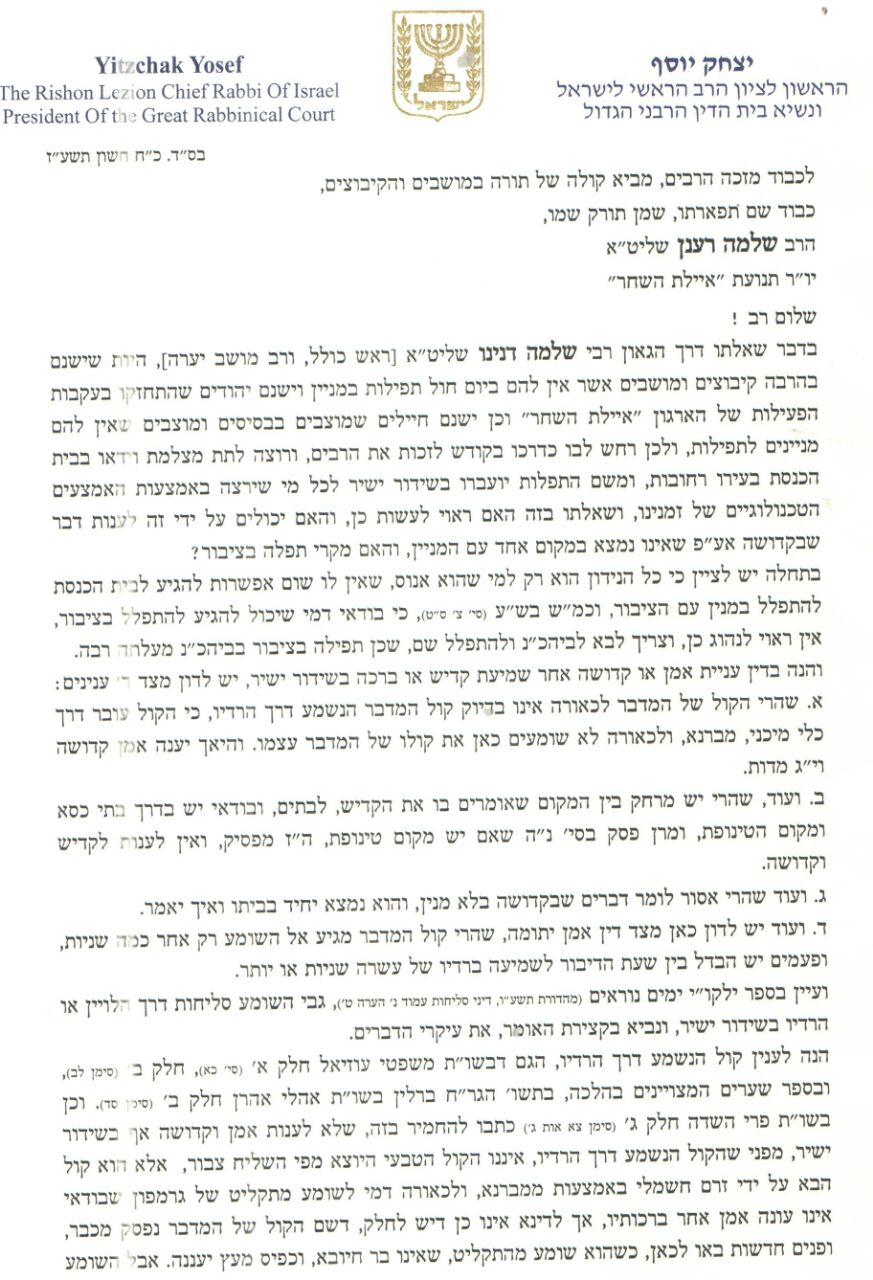
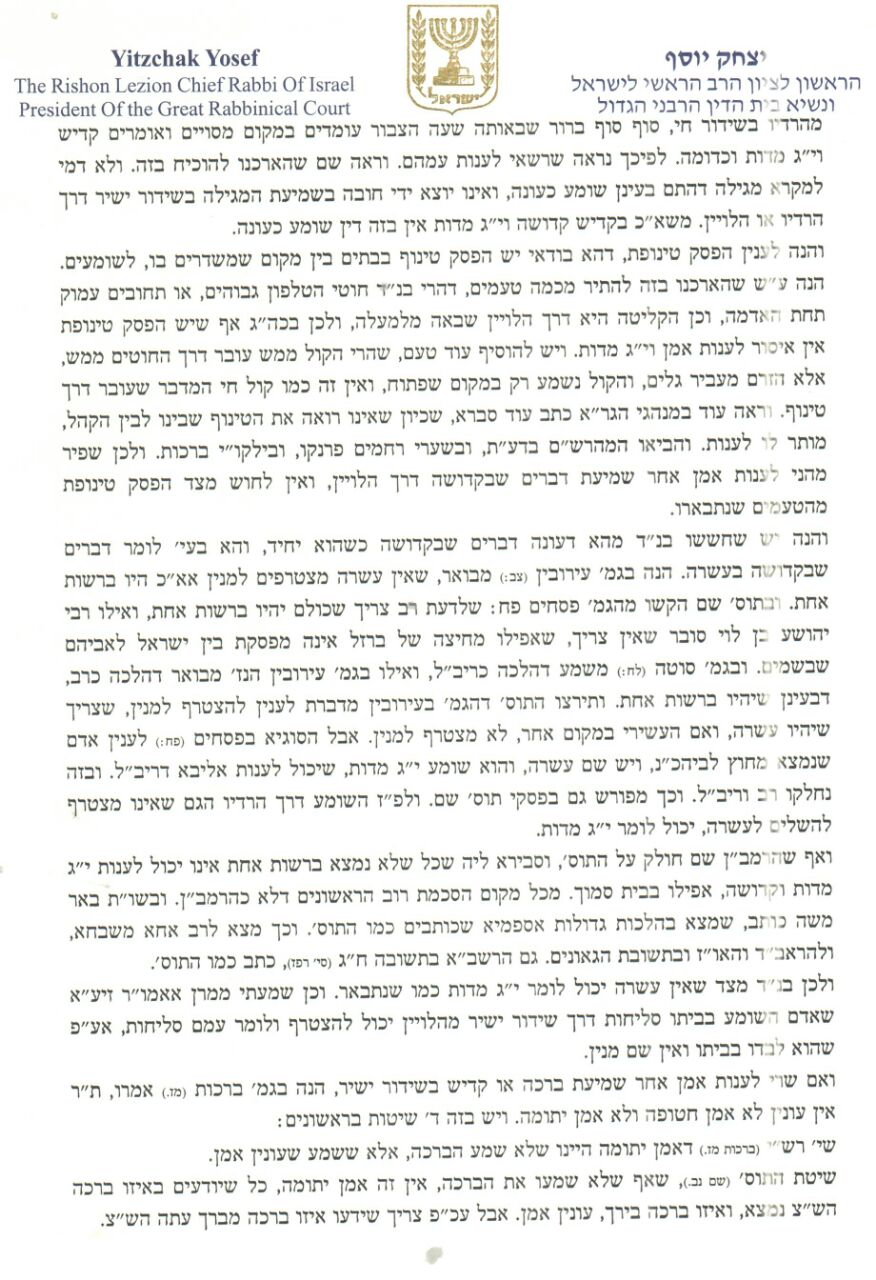
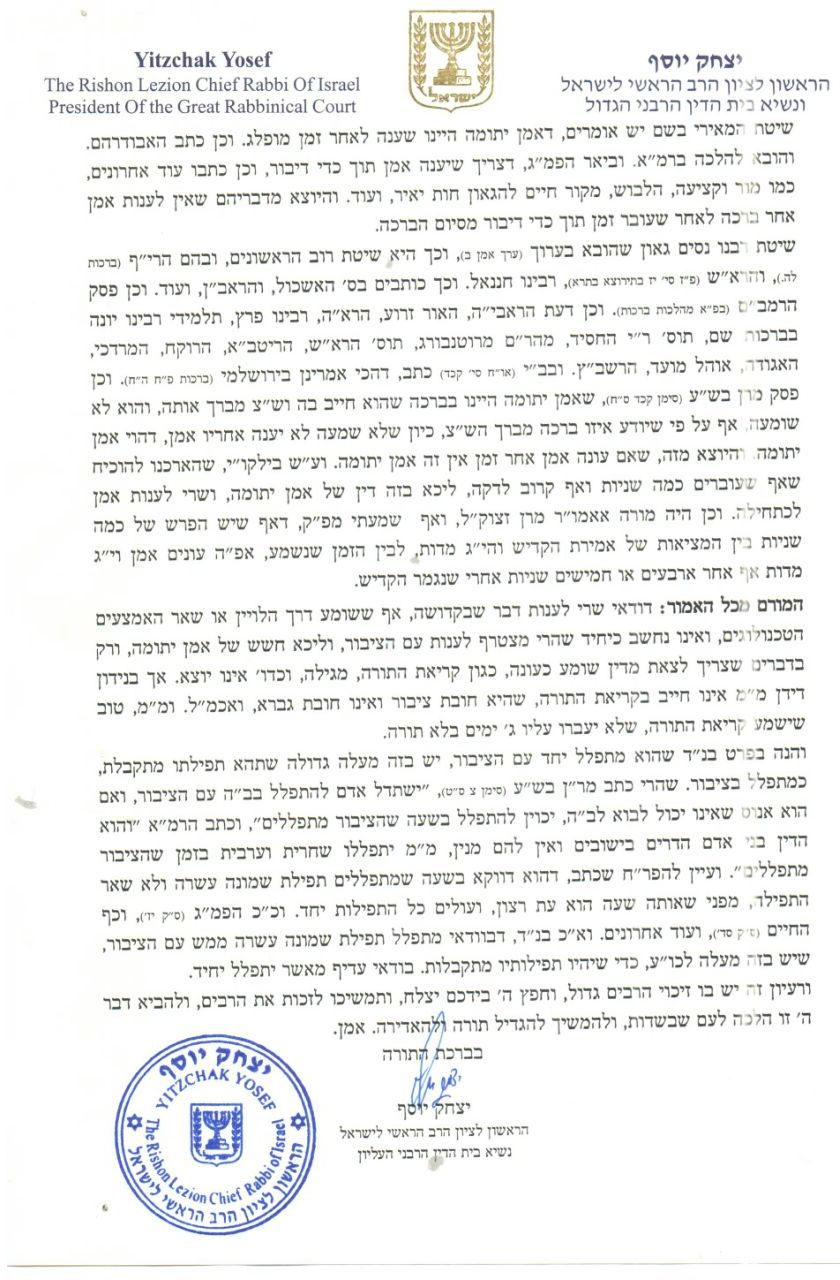
The director of the Ayelet Hashachar organization, Rav Shlomo Raanan asked about the viability of davening with a minyan over the Internet. Rav Yosef responded that people who are stuck (e.g. soldiers and sick people) and are unable to go to shul, can participate in davening via a live stream from the shul. "Bdiavad" that would be considered as davening with a minyan.
Rav Yosef said such a person can daven shmoneh esrei together with them, hear torah reading, and answer amen.. This is considered joining with the ten people. Rav Yosef compared it to hearing the radio or internet broadcasts of slichos that are already very common.
(copies of the psak, below)
sources: Radio Kol Hai and Kikar
thoughts:
1. awesome
2. the beginning of the end of shul, unless shul is also turned into a social event where friends see each other before/after a long day/week at work
3. Rav Yosef related to a situation where there is a minyan in one place and he is "joining" the minyan remotely. What if there were only 9 together - could he make up the minyan?
4. what about no minyan in one place but 10 people with each in their own homes, army bases, hospital rooms, etc - can they all patch in to some conference call and make a minyan like that?
5. This obviously doesn't help for Shabbos. Unless you hold "half Shabbos"
6. it is clear that Rav Yosef holds the Internet is muttar to use.
7. can one simply load up the website of the Kotel Cam and participate in the minyanim of the Kotel and not worry about creating a live stream in some shul? I am not aware of a shul that has a live stream of services, though perhaps a shul might now create one for an absent member, but the Kotel always has! Though via the Kotel Cam one can't hear the minyanim - he would not be able to answer amen to brachos or hear Torah reading, but maybe he could daven shmoneh esrei together with them.
8. this could solve the prayer issue on Har Habayit - just load up a web cam and remotely daven, and you are part of a minyan on Har Habayit. It actually would not, as the minyan on Har Habayit would need to be davening, and that would get them arrested.
------------------------------------------------------
Reach thousands of readers with your ad by advertising on Life in Israel
Reach thousands of readers with your ad by advertising on Life in Israel
------------------------------------------------------
Dec 7, 2015
Kollel Tefillas Shacharis - brilliant
I wonder what took so long for someone to come up with this idea...

Someone has figured out that he can turn davening into a money-maker. It has already become a classic that someone might get paid to say kaddish for someone deceased with no relatives who might do it for him/her. But just to turn the entire minyan into a paying kollel? I have not heard of that. Until now.
As the pashkevil above says, while Jewish blood is being spilled we must strengthen ourselves in prayer, and specifically in saying Amen Yehei Shmei Rabba.. with our full strength and energy.
To that end, someone has opened a "Kollel Tefillas Shacharis" that will daven at 8am daily, beginning with a short study session learnign the laws relevant to responding to kaddish and answering amen yehei...
Each 'Avreich that joins will be paid 500nis (per month, I assume). Only avreichim 30 years and older can join.
I wonder why they do not meet at the optimum time for prayer - sunrise - if they are looking to maximize their prayer and its effectiveness, rather than going to the late minyan at 8am.
This could also be the solution for anyone who has a difficult time going to daven - pay them 500nis per month, and maybe that will make it easier.
When they come collecting for Kollel Tefillas Shacharis, pleas eopen your heart, and your wallet, and pay them for something they are already doing anyway. Jewish blood is being spilled, and they can prevent it.
Someone has figured out that he can turn davening into a money-maker. It has already become a classic that someone might get paid to say kaddish for someone deceased with no relatives who might do it for him/her. But just to turn the entire minyan into a paying kollel? I have not heard of that. Until now.
As the pashkevil above says, while Jewish blood is being spilled we must strengthen ourselves in prayer, and specifically in saying Amen Yehei Shmei Rabba.. with our full strength and energy.
To that end, someone has opened a "Kollel Tefillas Shacharis" that will daven at 8am daily, beginning with a short study session learnign the laws relevant to responding to kaddish and answering amen yehei...
Each 'Avreich that joins will be paid 500nis (per month, I assume). Only avreichim 30 years and older can join.
I wonder why they do not meet at the optimum time for prayer - sunrise - if they are looking to maximize their prayer and its effectiveness, rather than going to the late minyan at 8am.
This could also be the solution for anyone who has a difficult time going to daven - pay them 500nis per month, and maybe that will make it easier.
When they come collecting for Kollel Tefillas Shacharis, pleas eopen your heart, and your wallet, and pay them for something they are already doing anyway. Jewish blood is being spilled, and they can prevent it.
------------------------------------------------------
Reach thousands of readers with your ad by advertising on Life in Israel
------------------------------------------------------
Aug 20, 2015
Interesting Psak: chazzan with iphone cant be chazzan
get your baalei tefilla in order now... according to Chief Rabbi Rav Yitzchak Yosef, a chazzan that has an iPhone cannot serve in the capacity of chazzan (any time - not just on the holidays).
Rav Yosef explained his psak by saying that the community must search for a chazzan that is God fearing - if you know someone has a television in his home or in his pocket, such as an iPhone, how can you allow him to lead the services before God?

Rav Yosef also compared it to someone who sends his son to a school that is not religious and teaches them abomination.
Rav Yosef even said that if someone with an iPhone already began to lead the services, you should leave and arrange another minyan.
sources: Ladaat and Srugim
My question is, let's say you follow all these rules (we have had piskei halacha banishing iphone holders from leading services, witnessing weddings, blowing shofar, and more), and chase away all the people with smartphones... so I guess all the smartphone holders will eventually make their own shul or minyan. So, in a minyan where everyone has an iPhone can one of them be the chazzan or must they ask someone with no iphone to join their minyan and lead the services? same for blowing shofar and all the other issues...
Too bad I have a lousy voice and only lead the services once or twice a year (if that much)... I'd love to be asked by the gabbai to lead and tell him I cannot because I have a smartphone...
Rav Yosef explained his psak by saying that the community must search for a chazzan that is God fearing - if you know someone has a television in his home or in his pocket, such as an iPhone, how can you allow him to lead the services before God?
Rav Yosef also compared it to someone who sends his son to a school that is not religious and teaches them abomination.
Rav Yosef even said that if someone with an iPhone already began to lead the services, you should leave and arrange another minyan.
sources: Ladaat and Srugim
My question is, let's say you follow all these rules (we have had piskei halacha banishing iphone holders from leading services, witnessing weddings, blowing shofar, and more), and chase away all the people with smartphones... so I guess all the smartphone holders will eventually make their own shul or minyan. So, in a minyan where everyone has an iPhone can one of them be the chazzan or must they ask someone with no iphone to join their minyan and lead the services? same for blowing shofar and all the other issues...
Too bad I have a lousy voice and only lead the services once or twice a year (if that much)... I'd love to be asked by the gabbai to lead and tell him I cannot because I have a smartphone...
------------------------------------------------------
Reach thousands of readers with your ad by advertising on Life in Israel
------------------------------------------------------
Mar 23, 2015
No Tachanun becomes No Vihi Noam
Most people who go to shul in the morning look forward to any day there might be a bris in shul or some other special day, as it means tachanun will not be said. the jackpot is hit when that bris comes out on a Monday or Thursday, as "no tachanun" means even greater "benefit" in the sense of the longer tachanun not being said.
The month of Nissan is looked forward to even more, as it means an entire month of no tachanun.
This week brings us to one of just three times a year that something else makes people feel like the "no tachanun" situation.. this Saturday night we will not say "Vihi Noam" at the end of the services. This only happens three times a year, the Saturday night before each of the holidays.
Funny how saving 1-3 minutes in shul can get us so excited! What is wrong with us?
The month of Nissan is looked forward to even more, as it means an entire month of no tachanun.
This week brings us to one of just three times a year that something else makes people feel like the "no tachanun" situation.. this Saturday night we will not say "Vihi Noam" at the end of the services. This only happens three times a year, the Saturday night before each of the holidays.
Funny how saving 1-3 minutes in shul can get us so excited! What is wrong with us?
------------------------------------------------------
Reach thousands of readers with your ad by advertising on Life in Israel
------------------------------------------------------
Sep 11, 2013
Israel recognizes prayer as valid excuse for tardiness to work
Remember the opposition to the DST extension due to it causing a problem with davening times and people needing to get to work? A possible solution had been presented to allow employees adversely affected by the DST change to arrive half an hour late to work.
Well, it is official now. The State of Israel is mandating that the need to daven is a valid excuse to arrive late to work, under certain conditions, and such an employee cannot be punished for it.
Minister of Commerce and Trade Naftali Bennet has sent out a notice of new instructions to employers instructing them that on days when sunrise is later than 6:30 AM, any employees whose work shifts begin between 7 and 8 AM will be allowed a davening break prior to work instead of during work hours (as is the normal law).
In order to not harm employers while looking out for the employees, the employee will have to make up that time either at the end of the day or at another time during the month (as per the employers decision).
I checked the law regarding the need to provide prayer time during work hours. the wording of the law is a bit complex, but basically it says that an employee who wishes to pray due to his religious, time must be allocated for the employee to be able to do so. However, that time is not deducted from the employees work hours. The employer can give 30 minutes or 45 minutes, or whatever, but he does not have to pay for that time - assuming the employee wants to not have this time deducted from his salary, and the employer wants a certain amount of work done, and time spent working, the employee can spend time praying, but must make up the work hours at other times. And that is being applied in this new situation as well - the employer will have to accept that the employee is late due to religious prayer, but that time will need to be made up at some point.
It is good to see Israel protecting both the employee and the employer and being considerate for the needs of the religious.
Well, it is official now. The State of Israel is mandating that the need to daven is a valid excuse to arrive late to work, under certain conditions, and such an employee cannot be punished for it.
Minister of Commerce and Trade Naftali Bennet has sent out a notice of new instructions to employers instructing them that on days when sunrise is later than 6:30 AM, any employees whose work shifts begin between 7 and 8 AM will be allowed a davening break prior to work instead of during work hours (as is the normal law).
In order to not harm employers while looking out for the employees, the employee will have to make up that time either at the end of the day or at another time during the month (as per the employers decision).
I checked the law regarding the need to provide prayer time during work hours. the wording of the law is a bit complex, but basically it says that an employee who wishes to pray due to his religious, time must be allocated for the employee to be able to do so. However, that time is not deducted from the employees work hours. The employer can give 30 minutes or 45 minutes, or whatever, but he does not have to pay for that time - assuming the employee wants to not have this time deducted from his salary, and the employer wants a certain amount of work done, and time spent working, the employee can spend time praying, but must make up the work hours at other times. And that is being applied in this new situation as well - the employer will have to accept that the employee is late due to religious prayer, but that time will need to be made up at some point.
It is good to see Israel protecting both the employee and the employer and being considerate for the needs of the religious.
------------------------------------------------------
Reach thousands of readers with your ad by advertising on Life in Israel
------------------------------------------------------
Sep 8, 2013
Police chief says Jewish prayer is allowed on Har Habayit
Are things changing on Har Habayit or is the Israeli police trying to make it look like everything is ok and the people complaining are just troublemakers?
In an interview with the Israel Hayom newspaper, the Chief of Police, Yohanan Danino, said that

Danino said that Har Habayit is one of their most sensitive tasks.. it is an explosive situations and the slightest thing can become a huge incident... then he says "Many times you hear, and I will not mention names of this MK or the other, that want freedom of access to pray on Har Habayit. Who is bothering them? There is already freedom of access. There is no need to use slogans. Every Jew that wants to pray on Har Habayit is able to pray on Har Habayit - but only at the designated times..."
Either Danino is lying to make the public think everything is ok, or the policy has changed. Since the police still do not actually let jews pray on Har Habayit, I think every Jew going to ascend Har Habayit who wishes to pray should print the copy of the interview - when the police officer instructs the Jews that they are not allowed to pray, they should take out the paper and demand the right as stated by the chief of police. The answer might be "now is not the designated time", but the police should be made to answer for this - announce when the designated time is, and whenever it is, prayer should be allowed.
In an interview with the Israel Hayom newspaper, the Chief of Police, Yohanan Danino, said that

Danino said that Har Habayit is one of their most sensitive tasks.. it is an explosive situations and the slightest thing can become a huge incident... then he says "Many times you hear, and I will not mention names of this MK or the other, that want freedom of access to pray on Har Habayit. Who is bothering them? There is already freedom of access. There is no need to use slogans. Every Jew that wants to pray on Har Habayit is able to pray on Har Habayit - but only at the designated times..."
Either Danino is lying to make the public think everything is ok, or the policy has changed. Since the police still do not actually let jews pray on Har Habayit, I think every Jew going to ascend Har Habayit who wishes to pray should print the copy of the interview - when the police officer instructs the Jews that they are not allowed to pray, they should take out the paper and demand the right as stated by the chief of police. The answer might be "now is not the designated time", but the police should be made to answer for this - announce when the designated time is, and whenever it is, prayer should be allowed.
------------------------------------------------------
Reach thousands of readers with your ad by advertising on Life in Israel
------------------------------------------------------
Jun 24, 2013
Daylight Savings Time extension and the halachic and legal problems that arise
Yesterday the government Cabinet approved the proposal of Interior Minister Gideon Saar to extend Daylight Savings Time until the end of October. The bill has to go to the Knesset for final approval, though it is expected to pass easily.
The discussion around the proposal has focused on mainly being harmful to religious workers. In October sunrise will be so late that it will make it difficult for people who need to get to work early to have davened prior to going to work. Some people might even be forced to choosing between davening and being late for work and between going to work and skipping davening.
There is a psak that would solve the dilemma, but it seems to be unpopular in many places. That is, technically, one could daven before sunrise. Of course, there is an earliest time one could daven, but I don't think that earliest time would ever present the same problem.
People don't like this solution, calling it a b'dieved. I have heard a rav say that davening before sunrise is just as b'dieved as davening after sunrise. So anyone willing to daven at 7:00 or 8:00, for example, should theoretically have no halachic objection to davening before sunrise either. But I know that this is not the accepted custom and while some do that, many prefer not to.
 Interestingly, I did learn something new because of this. While of course it was always halachically preferable to daven at sunrise, I have always thought that the preference for davening at sunrise is in relation to davening later. Most won't daven earlier, even though it is an option. According to what I read in Srugim, it used to be exactly the opposite - the sunrise prayers were really the late minyan, not the early minyan. According to that, people commonly davened earlier, and the halachic preference for sunrise was in reference to davening earlier, not later. I guess that would be because in the days of working in agriculture, they had to be working in the fields very early, so they davened even before sunrise. Later, when other fields of employment became more popular, with agriculture going on the decline, things got turned around, people did not need to be up and out so early any longer, and sunrise became the early minyan for most people and regular davening became the later minyanim.
I thought that was an interesting revelation. Does anybody know if this is historically accurate?
Another development is a request for a new law proposal due to the effects of the DST extension. The head of Machon Keter - an organization dealing with economic issues according to the Torah, the DST extension, as already explained, will present a problem for people who need to leave early to go to work. Even allowing them to daven early - prior to sunrise, in the second half of October, anybody who needs to leave their house before 6 AM will still have a problem.
Rav Ishon, the head of Machon Keter, says that the law allows an employee to daven at his workplace during the workday, with prayer times being arranged in accordance with the needs of the workplace and the requirements of the religion of the employee. However, unlike certain breaks that are guaranteed by law so the employee can get some air for a few minutes, while the employer has to give the employee time to pray, he does not have to pay the employee for his praying time.
Rav Ishon requested a new law proposal to adjust that, so that any employee who has to leave his house within a range of 40 minutes prior to the earliest time one is allowed to daven would be allowed to daven during work hours and would also be paid for that time.
(source: Kikar)
I see the need to protect the worker, so that he/she should not have to be put in a situation of needing to decide between working and davening - plenty of employees would decide they cannot afford to lose 20 minutes or 40 minutes of pay and might decide to continue working instead of davening. However, I do not see why the employer has to pay for it - what did he do wrong that suddenly he has to foot the bill, when he never had to before?
I would suggest that maybe Bituach Leumi should have to pay for that davening time, instead of the employer. Also, if employers know they will have to pay for non-work time, they might be reluctant to hire religious employees. Having the payment for this time taken away from them and put in the hands of the government, who is really at fault for the issue anyway, would resolve that,a s now the employer is taking no loss.
The discussion around the proposal has focused on mainly being harmful to religious workers. In October sunrise will be so late that it will make it difficult for people who need to get to work early to have davened prior to going to work. Some people might even be forced to choosing between davening and being late for work and between going to work and skipping davening.
There is a psak that would solve the dilemma, but it seems to be unpopular in many places. That is, technically, one could daven before sunrise. Of course, there is an earliest time one could daven, but I don't think that earliest time would ever present the same problem.
People don't like this solution, calling it a b'dieved. I have heard a rav say that davening before sunrise is just as b'dieved as davening after sunrise. So anyone willing to daven at 7:00 or 8:00, for example, should theoretically have no halachic objection to davening before sunrise either. But I know that this is not the accepted custom and while some do that, many prefer not to.
Interestingly, I did learn something new because of this. While of course it was always halachically preferable to daven at sunrise, I have always thought that the preference for davening at sunrise is in relation to davening later. Most won't daven earlier, even though it is an option. According to what I read in Srugim, it used to be exactly the opposite - the sunrise prayers were really the late minyan, not the early minyan. According to that, people commonly davened earlier, and the halachic preference for sunrise was in reference to davening earlier, not later. I guess that would be because in the days of working in agriculture, they had to be working in the fields very early, so they davened even before sunrise. Later, when other fields of employment became more popular, with agriculture going on the decline, things got turned around, people did not need to be up and out so early any longer, and sunrise became the early minyan for most people and regular davening became the later minyanim.I thought that was an interesting revelation. Does anybody know if this is historically accurate?
Another development is a request for a new law proposal due to the effects of the DST extension. The head of Machon Keter - an organization dealing with economic issues according to the Torah, the DST extension, as already explained, will present a problem for people who need to leave early to go to work. Even allowing them to daven early - prior to sunrise, in the second half of October, anybody who needs to leave their house before 6 AM will still have a problem.
Rav Ishon, the head of Machon Keter, says that the law allows an employee to daven at his workplace during the workday, with prayer times being arranged in accordance with the needs of the workplace and the requirements of the religion of the employee. However, unlike certain breaks that are guaranteed by law so the employee can get some air for a few minutes, while the employer has to give the employee time to pray, he does not have to pay the employee for his praying time.
Rav Ishon requested a new law proposal to adjust that, so that any employee who has to leave his house within a range of 40 minutes prior to the earliest time one is allowed to daven would be allowed to daven during work hours and would also be paid for that time.
(source: Kikar)
I see the need to protect the worker, so that he/she should not have to be put in a situation of needing to decide between working and davening - plenty of employees would decide they cannot afford to lose 20 minutes or 40 minutes of pay and might decide to continue working instead of davening. However, I do not see why the employer has to pay for it - what did he do wrong that suddenly he has to foot the bill, when he never had to before?
I would suggest that maybe Bituach Leumi should have to pay for that davening time, instead of the employer. Also, if employers know they will have to pay for non-work time, they might be reluctant to hire religious employees. Having the payment for this time taken away from them and put in the hands of the government, who is really at fault for the issue anyway, would resolve that,a s now the employer is taking no loss.
------------------------------------------------------
Reach thousands of readers with your ad by advertising on Life in Israel
------------------------------------------------------
Apr 4, 2013
Headline of the Day
Police to Women of the Wall: We will enforce the prohibition against saying Kaddish
-- Kikar
Wow. I had no idea it is also illegal to say kaddish and kedusha.
The chief of the regional police wrote to the Women of the Wall saying that they have decided to fully enforce the law and they will not just be tracking tallit-wearers, but will also be arresting, this coming Rosh Chodesh, any women who say kadish or kedusha.
Oy. Rachmuna l'tzlan. This is what it has come to. This has become way too similar to places like the Soviet Union, mandating what prayers can and cannot be said. Like Women of the Wall or hate them, the police should not be picking on them for prayers said, and the Israeli legal system should not be dealing in laws regarding who can say what type of prayer.
------------------------------------------------------
Reach thousands of readers with your ad by advertising on Life in Israel
------------------------------------------------------
Jan 24, 2013
Rav Ovadiah says to add Avinu Malkeinu to davening next week
One would have thought that with Amnon Yitzchak's party and Rav Amsalem's party not passing the minimum threshold for the Knesset Rav Ovadiah would be happy and all the problems will have been solved. After all, now that they are not stealing away strength from Shas, Shas can ward off the looming threat of the draft...
It doesn't work like that. It's not so easy. They successfully fought off the competition, but now they still have a tough battle ahead.
Rav Ovadiah is calling on everyone to include in their davening next week the prayer of Avinu Malkeinu, and to specifically request "annul the consult of our enemies" who wish to annul the Torah learning.
(source: Kikar)
the joke is told of the yekke who came home from shul one day 10 seconds later than usual. When his wife asked what happened that delayed him, he explained that davening was longer because they had begun praying for rain.
Davening is going to be a bit longer next week, at least in Sephardi shuls if not also in some ashkenazi shuls, so adjust your schedules accordingly.
It doesn't work like that. It's not so easy. They successfully fought off the competition, but now they still have a tough battle ahead.
Rav Ovadiah is calling on everyone to include in their davening next week the prayer of Avinu Malkeinu, and to specifically request "annul the consult of our enemies" who wish to annul the Torah learning.
(source: Kikar)
the joke is told of the yekke who came home from shul one day 10 seconds later than usual. When his wife asked what happened that delayed him, he explained that davening was longer because they had begun praying for rain.
Davening is going to be a bit longer next week, at least in Sephardi shuls if not also in some ashkenazi shuls, so adjust your schedules accordingly.
------------------------------------------------------
Reach thousands of readers with your ad by advertising on Life in Israel
------------------------------------------------------
Sep 11, 2012
Pashkevil: Limiting The Allowance of Davening With People Who Sin
On the Yomim Noraim, the High Holidays, we say "על דעת המקום ועל דעת הקהל, בישיבה של מעלה ובישיבה של מטה, אנו מתירים להתפלל עם העבריינים" - With the agreement of God and of the community... we allow to pray with the transgressors.
To be more precise, we actually only say that on the night of Yom Kippur, so maybe on Rosh Hashana, or even on Yom Kippur by day, we should not daven with avaryanim.
Back to the point, I'll bet you did not know that there are different types of avaryanim, transgressors, and that this allowance to pray with them only applies to some and not others...
Now you might be thinking that perhaps people involved in petty theft should be allowed into the shul, but not murderers and rapists. Perhaps people running small fraud, but not large Ponzi schemes. I don't know - I am sure you can come up with some sort of set of guidelines detailing lists of crimes that can be ignored for prayer and another set that is still beyond the pale.
Where would carrying a "smartphone" fit in?
Check out this pashkevil (the image was snagged from a friend's Facebook page):

According to this pashkevil, Rav Chaim Kanievsky said that the allowance for davening with transgressors does not apply to people carrying non-kosher phones. It actually reads: The words of Rav Chaim Kanievsky regarding those who hold iPhones and similar: While we are allowed to daven with the transgressors, it is still better to daven in a minyan that does not have anyone breaching the fence who holds these impure devices, for when he is present the prayer is less accepted (as brought in the Tzlach in Brachos 8a)."
Considering that the Tzla"ch, also known as Rav Yechezkal Landau, lived in the 1700s, I was curious how he mentioned smartphones or iphones in his sefer over 200 years ago, or else how the pashkevil people perhaps corrupted Rav Kanievsky's words. I found (thanks to Hebrewbooks.org) that the tzla"ch said, while discussing the issue of a person davening by himself or with the tzibbur, that he says he learned from the Rambam that the prayer of the tzibbur is heard only when it does not have sinners. When it does have sinners Hashem is at least not disgusted by the prayers. (he is debating whether one should at times prefer to daven at home rather than go to shul, but he seems to be against that even when sinners are present in shul).
I dont know what Rav Kanievsky actually said, but the Tzlach does not seem to differentiate between types of sins, with iphones being among the worst. If you dont want to daven with sinners, it should not matter whether he is carrying an iphone (obviously not on Rosh Hashana) (if an iphone is really a transgression) or if he dug out a chalal for his apartment without registering it, or if he smokes, or if he is a murderer or rapist.
Good luck finding a minyan with no sinners. Whatever happened to "There is no person in the land who does not sin"?
------------------------------------------------------
Reach thousands of readers with your ad by advertising on Life in Israel
------------------------------------------------------
To be more precise, we actually only say that on the night of Yom Kippur, so maybe on Rosh Hashana, or even on Yom Kippur by day, we should not daven with avaryanim.
Back to the point, I'll bet you did not know that there are different types of avaryanim, transgressors, and that this allowance to pray with them only applies to some and not others...
Now you might be thinking that perhaps people involved in petty theft should be allowed into the shul, but not murderers and rapists. Perhaps people running small fraud, but not large Ponzi schemes. I don't know - I am sure you can come up with some sort of set of guidelines detailing lists of crimes that can be ignored for prayer and another set that is still beyond the pale.
Where would carrying a "smartphone" fit in?
Check out this pashkevil (the image was snagged from a friend's Facebook page):

According to this pashkevil, Rav Chaim Kanievsky said that the allowance for davening with transgressors does not apply to people carrying non-kosher phones. It actually reads: The words of Rav Chaim Kanievsky regarding those who hold iPhones and similar: While we are allowed to daven with the transgressors, it is still better to daven in a minyan that does not have anyone breaching the fence who holds these impure devices, for when he is present the prayer is less accepted (as brought in the Tzlach in Brachos 8a)."
Considering that the Tzla"ch, also known as Rav Yechezkal Landau, lived in the 1700s, I was curious how he mentioned smartphones or iphones in his sefer over 200 years ago, or else how the pashkevil people perhaps corrupted Rav Kanievsky's words. I found (thanks to Hebrewbooks.org) that the tzla"ch said, while discussing the issue of a person davening by himself or with the tzibbur, that he says he learned from the Rambam that the prayer of the tzibbur is heard only when it does not have sinners. When it does have sinners Hashem is at least not disgusted by the prayers. (he is debating whether one should at times prefer to daven at home rather than go to shul, but he seems to be against that even when sinners are present in shul).
I dont know what Rav Kanievsky actually said, but the Tzlach does not seem to differentiate between types of sins, with iphones being among the worst. If you dont want to daven with sinners, it should not matter whether he is carrying an iphone (obviously not on Rosh Hashana) (if an iphone is really a transgression) or if he dug out a chalal for his apartment without registering it, or if he smokes, or if he is a murderer or rapist.
Good luck finding a minyan with no sinners. Whatever happened to "There is no person in the land who does not sin"?
------------------------------------------------------
Reach thousands of readers with your ad by advertising on Life in Israel
------------------------------------------------------
Jul 11, 2011
And The Jews Go Back To Jericho
From what I understand, this trip back to the shul/yeshiva in Jericho to daven is not going to be a one-time thing, but will likely become fairly regular events.

May 9, 2011
God's Sense Of Humor On Satmar
Interestingly, while some are against saying hallel on Yom ha'Atzmaut because there is no justification to change the davening for any of a variety of possible reasons, others change it in the opposite direction.
 In Satmar they have the custom of saying 5 chapters of tehillim daily as part of the davening at the end. Somehow, by "chance", it comes out that on 5 Iyar, today, the day that is supposed to be Yom Ha'Atzmaut, the day that commemorates and honors and celebrates the day the State was established, the 5 chapters of tehillim scheduled to be said are specifically 5 chapters that are parts of hallel, between chapter 113 and chapter 118.
To avoid any seeming sign of support for Israel as a Jewish State and so that nobody should think Satmar is in any way saying hallel, or parts of it, in honor of the State, the rebbe decreed that on Sunday, yesterday, they would say 8 chapters, from 111 until 118, that includes all the chapters that have the hallel verses in them, and on Monday, 5 Iyar, they would only say 119 and 120.
And who said God doesn't have a sense of humor, making the hallel verses fall out for Satmar on 5 Iyar (even though in Israel we are only celebrating on 6 Iyar this year)?
 In Satmar they have the custom of saying 5 chapters of tehillim daily as part of the davening at the end. Somehow, by "chance", it comes out that on 5 Iyar, today, the day that is supposed to be Yom Ha'Atzmaut, the day that commemorates and honors and celebrates the day the State was established, the 5 chapters of tehillim scheduled to be said are specifically 5 chapters that are parts of hallel, between chapter 113 and chapter 118.
To avoid any seeming sign of support for Israel as a Jewish State and so that nobody should think Satmar is in any way saying hallel, or parts of it, in honor of the State, the rebbe decreed that on Sunday, yesterday, they would say 8 chapters, from 111 until 118, that includes all the chapters that have the hallel verses in them, and on Monday, 5 Iyar, they would only say 119 and 120.
And who said God doesn't have a sense of humor, making the hallel verses fall out for Satmar on 5 Iyar (even though in Israel we are only celebrating on 6 Iyar this year)?
Feb 14, 2011
Interesting Psak: Davening In A Mosque
Before I begin, I would just like to point out something strange. The ynetnews article that discusses the issue references a psak issued on the Kipa website. I went to check the Kipa website for the original text and wording, and was surprised to see that the Kipa site has been taken over by the Kosharot organization and the original Kipa content is gone. So, I have not been able to find the original source and am only able to reference the ynet article.
Rav Baruch Efrati, a community rav in Efrat, was asked, on the now-missing Kipa website, by somebody who travels a lot, he puts on tefillin in advance, but he does not have time to daven, and he prefers not to daven out in public in the airport and it will disturb his focus. What is the best option for him to do under these circumstances.
 Rav Efrati's answer is that many airports have a makeshift mosque, which is generally empty except for books and Korans. While davening in a mosque is not a perfect solution, it is permissible and seems to be the best option available. Rav Efrati used the Me'aras HaMachpela as an example of the permissibility of davening in a mosque.
A mosque, however, is different than a Christian church. A church is prohibited for a Jew to enter, so if an airport has a church, that cannot be used as a solution for this man's prayer issues.
This is really not a new or radical psak - we hold that Christianity, or at least certain streams of it, are considered idolatry for Jews, and Jews cannot go into the churches. Islam however is not idolatry, and even though there are elements of heresy and problematic beliefs (such as the idea that the Koran replaced the Torah), the religion overall is not idolatry and the mosque is not "off grounds".
Interestingly enough, some of the haredi websites that have quoted and referenced this psak of Rav Efrati ran the title as "Zionist Rabbi" says to daven in mosque. As if it is sensationalist simply because he is a Zionist yet was in favor of davening in the mosque. They seem to be surprised that Zionist rabbis also keep the halacha, based same shulchan aruch.
Rav Baruch Efrati, a community rav in Efrat, was asked, on the now-missing Kipa website, by somebody who travels a lot, he puts on tefillin in advance, but he does not have time to daven, and he prefers not to daven out in public in the airport and it will disturb his focus. What is the best option for him to do under these circumstances.
Rav Efrati's answer is that many airports have a makeshift mosque, which is generally empty except for books and Korans. While davening in a mosque is not a perfect solution, it is permissible and seems to be the best option available. Rav Efrati used the Me'aras HaMachpela as an example of the permissibility of davening in a mosque.A mosque, however, is different than a Christian church. A church is prohibited for a Jew to enter, so if an airport has a church, that cannot be used as a solution for this man's prayer issues.
This is really not a new or radical psak - we hold that Christianity, or at least certain streams of it, are considered idolatry for Jews, and Jews cannot go into the churches. Islam however is not idolatry, and even though there are elements of heresy and problematic beliefs (such as the idea that the Koran replaced the Torah), the religion overall is not idolatry and the mosque is not "off grounds".
Interestingly enough, some of the haredi websites that have quoted and referenced this psak of Rav Efrati ran the title as "Zionist Rabbi" says to daven in mosque. As if it is sensationalist simply because he is a Zionist yet was in favor of davening in the mosque. They seem to be surprised that Zionist rabbis also keep the halacha, based same shulchan aruch.
Feb 6, 2011
Is OCD Behavior Regarding Davening Netz Good?
I am fairly anti anything that makes me think Judaism is OCD. One of those things that comes quickly to mind, that I have written about in the past, is measuring and preparing in advance exactly how much matza and marror is to be eaten on seder night - I prefer to just eat matza without limiting myself to the exact specific measurement. It just seems too OCD for me to do a mitzva like that.
Another one that bothers me regularly is the pedantic attention paid to the exact second of sunrise for the purpose of davening by netz ha'chama. It doesn't bother me too often, because I don't daven netz too often, but it does bother me. Shulchan Aruch talks about the preferable time being "close to sunrise".
Obviously they used to not be able to measure exactly, as they did not have the ability to measure time down to the second, at least not easily, so "close" was as good as they could get. And perhaps now that we have the ability to measure it down to the hundredth of a second, perhaps that is optimal. Yet it still bothers me. It makes me see Judaism as being too OCD.
Rav Eliyahu Zeeni, rosh yeshiva of Yeshivat Hesder Ohr V'Yeshua in Haifa, was asked if there is a foundation for such behavior in measuring it down to the second and waiting for the recorded moment before beginning to daven the shmoneh esrei.
Rav Zeini responded saying that there is no basis for this behavior and it even conflicts with what Chazal says. He says that it is negative, as Hashem does not stand with a stopwatch checking the people, especially when most people's watches are not accurate at that level. If even a dayan can only judge based on what he sees and cannot know definitively exactly what happened and what people's motives are, how much more so by davening and time we cannot expect and should not demand that level of exactness, and for sure because in the beis hamikdash they estimated the proper time based on when they saw the sun shining on the doors.
To be melamed zchus, if one should, the exactness displayed by people who do so is an expression of their attempt to properly serve Hashem with exactness. (source: Srugim)
To me it is simply a sign of being too OCD.
Another one that bothers me regularly is the pedantic attention paid to the exact second of sunrise for the purpose of davening by netz ha'chama. It doesn't bother me too often, because I don't daven netz too often, but it does bother me. Shulchan Aruch talks about the preferable time being "close to sunrise".
Obviously they used to not be able to measure exactly, as they did not have the ability to measure time down to the second, at least not easily, so "close" was as good as they could get. And perhaps now that we have the ability to measure it down to the hundredth of a second, perhaps that is optimal. Yet it still bothers me. It makes me see Judaism as being too OCD.
Rav Eliyahu Zeeni, rosh yeshiva of Yeshivat Hesder Ohr V'Yeshua in Haifa, was asked if there is a foundation for such behavior in measuring it down to the second and waiting for the recorded moment before beginning to daven the shmoneh esrei.
Rav Zeini responded saying that there is no basis for this behavior and it even conflicts with what Chazal says. He says that it is negative, as Hashem does not stand with a stopwatch checking the people, especially when most people's watches are not accurate at that level. If even a dayan can only judge based on what he sees and cannot know definitively exactly what happened and what people's motives are, how much more so by davening and time we cannot expect and should not demand that level of exactness, and for sure because in the beis hamikdash they estimated the proper time based on when they saw the sun shining on the doors.
To be melamed zchus, if one should, the exactness displayed by people who do so is an expression of their attempt to properly serve Hashem with exactness. (source: Srugim)
To me it is simply a sign of being too OCD.
Jan 17, 2011
The New Half-time Show
I don't watch Israeli basketball, nor have I ever gone to a live game at the stadium, so I had no idea the Israeli teams have cheerleaders. I don't know why I assumed they do not, as cheerleaders are pretty basic in basketball, I just never heard about them or saw mention of them in the news items (I do glance at the Israeli sports news headlines).
I mention that because I was surprised to read the following news item - a group of religious fans, at a recent Hapoel Jerusalem basketball game, got upset over the cheerleaders dancing to the tune of Shalom Aleichem, saying that their dancing insults Jewish values.
It seems like it was a one time thing, though I don't know if the general idea of having cheerleaders dancing was a one time thing or if their dancing to Shalom Aleichem was a one time thing. A number of fans registered their protest, and a city councilman has joined the protest, telling the team management to not repeat the incident.
In response, the team has purchased 70 siddurim and is designating an area for religious fans to daven mincha and/or maariv during the halftime break. Religious fans are happy, saying that the minyanim at the games have been growing increasingly large with each game. One fan is quoted as saying that tens of fans get together at the games to daven, and "we also daven for the team to win". (source: mynet)
I don't see the team saying they are or are not going to continue with the cheerleaders. Perhaps the fans will have a choice for the halftime show, either to watch the cheerleaders dance or to go out and daven. Or maybe they will have some sort of voting to decide who to put out at half-court, either the cheerleaders or the daveners.
I mention that because I was surprised to read the following news item - a group of religious fans, at a recent Hapoel Jerusalem basketball game, got upset over the cheerleaders dancing to the tune of Shalom Aleichem, saying that their dancing insults Jewish values.
It seems like it was a one time thing, though I don't know if the general idea of having cheerleaders dancing was a one time thing or if their dancing to Shalom Aleichem was a one time thing. A number of fans registered their protest, and a city councilman has joined the protest, telling the team management to not repeat the incident.
In response, the team has purchased 70 siddurim and is designating an area for religious fans to daven mincha and/or maariv during the halftime break. Religious fans are happy, saying that the minyanim at the games have been growing increasingly large with each game. One fan is quoted as saying that tens of fans get together at the games to daven, and "we also daven for the team to win". (source: mynet)
I don't see the team saying they are or are not going to continue with the cheerleaders. Perhaps the fans will have a choice for the halftime show, either to watch the cheerleaders dance or to go out and daven. Or maybe they will have some sort of voting to decide who to put out at half-court, either the cheerleaders or the daveners.
Subscribe to:
Posts (Atom)
Related Posts
