
Apr 25, 2022
PSA: Salmonella in some chocolate products
- Chocolate bars (Cow, Blondie, and Splendid brand) with a best before date between 01.10.22-24.04.23
- Pesek Zman, Memolada and Crunch chocolate snack bars with a best before date between 01.12.22 - 01.04.23
- Taami, Egozi, and Kif Kef chocolate bars with a best before date between 01.07.22 - 15.01.23
- “Energy” chocolate coated rice cakes and chocolate cereal bars with a best before date between 01.07.22 - 15.01.23
- Reva L’Sheva snack bars with a best before date between 01.05.22 - 15.12.23
- Brownie cake, Pesek Zman cake and rolls with a best before date between 10.07.22 - 31.08.22
- Chocolate “XL” wafers with a best before date between 15.11.22 - 01.01.23
- “Bonbonierre” selection boxes dated best before 9.4.23 and 21.2.23 only.
Reach thousands of readers with your ad by advertising on Life in Israel
Mar 15, 2018
Interesting Psak: B&D rice cakes are not kitniyot
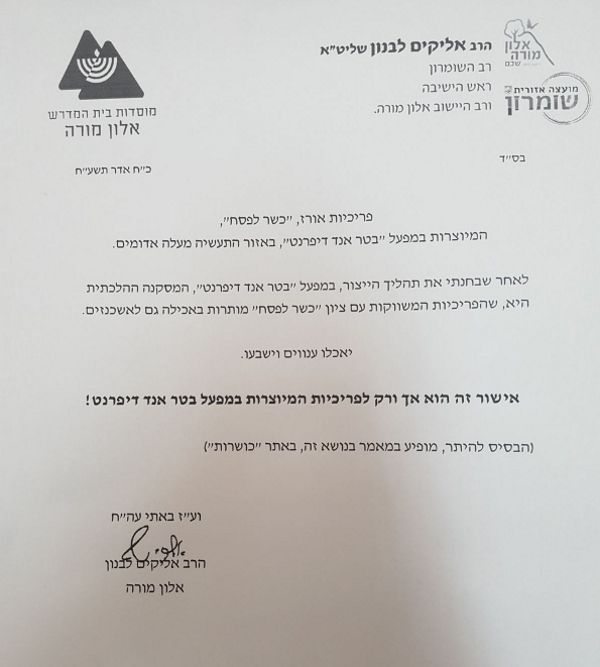 Kitniyot is always a controversial topic, and nowadays we consider as kitniyot many things that were never before considered as such. The debates renew every year in the days leading up to pesach, and this psak is definitely unique and will not be accepted by many.
It should be stressed that Rav Levanon is only referring to the rice cakes made by Better and Different company, and not rice cakes of other companies.
Rav Levanon explains that he visited the factory and inspected the process of manufacture. From the moment the rice kernels leave the sacks until they are puffed, they do not come into any contact with water. As well, the rice is sifted and inspected. Rav Levanon sys that if you consider the Ashkenazi poskim's opinions on kitniyot and their concerns, this manufacturing process raises no questions or concerns about kitniyot. And, he adds, even those who prohibit, did not prohibit rice like this.
The rice cakes are labeled kosher for Pesach for those who eat kitniyot, but, according to Rav Levanon, even people who do not eat kitniyot on Pesach can eat them.
source: Kipa
I definitely won't be eating these rice cakes on Pesach, but I dont eat rice cakes all year round either.
What I do not understand from what he says is that even those who prohibit do not prohibit this rice. Why not? Did they differentiate in types of rice? If rice is kitniyot and prohibited, who cares how much you sift it or keep it away from water? And if keeping it away form water and sifting is good enough to circumvent the custom against eating kitniyot, why not eat many other forms of kitniyot that are banned, as long as you sift it and inspect it and keep it away from water?
Reach thousands of readers with your ad by advertising on Life in Israel
Apr 20, 2016
Does this have Kitniyot or not?

the can has two hechshers on it. They are side by side and both say that the product is kosher for Pesach. The difference between them is that one says it is only for those who eat kitniyot, and the other says there is no concern of kitniyot in this product.
So, which is it? Does it have kitniyot or not?
I suspect the issue has to do with the ingredients listing canola oil among them. There is an age-old debate as to whether canola oil should be treated as kitniyot or not. I suspect that one fo the hechshers considers canola oil to not be kitniyot and the other considers it kitniyot.
What say you, dear reader?
Apr 19, 2016
Sushi at the Conservative seder
The excitement among the followers of the Conservative movement seems to be focused on the ability to now serve sushi at the Pesach seder (and throughout Pesach).
Once sushi is on the menu, another idea for interesting change might be using the seaweed wrap for Karpas, and the Wasabi for Maror. Korech would just be a sushi sandwich in the matza.
Personally, I am still sticking to the traditional menus...
Mar 23, 2015
Rabbanut on Canola Oil and other items for Pesach
regular white flour:
during the processing of normal flour, the wheat is moistened for 3-9 hours. Therefore, regular white flour is suspected to be chametz.
whole wheat flour and pearl barley:
these are not moistened during processing (I guess that means it is not chametz, but the article does not say so explicitly)
Burgul and oats:
these are moistened with hot water during processing, and are suspected chametz. Some health food stores have natural buckwheat that is not cooked or moistened during processing, and is not chametz.
Canola oil:
this is probably the most interesting. In previous years the Rabbanut has said that Canola Oil is not kitniyot. The mehadrin hechshers, as far as I know, all consider it kitniyot. Abroad there are differing opinions whether it is kitniyot or not.
Generally canola oil is not kitniyot.
one reason is that it only came into being after the gzeira of kitniyot was in effect and is therefore not included in the gezeira (like potatoes).
another reason is during the processing there is not even a minority percentage of the grain, so no kitniyot.
However, some canola oil has added Vitamin E, which is made from soy and is therefore kitniyot.
Aluminum foil:
aluminum foil is no longer made with the foil being oiled. if aluminum was used without a hechsher, no problem.
Bleach and dishwashing soap:
these do not need a hechsher for Pesach. Toothpaste and other things that go into the mouth should have a hechsher. Body soap and shampoo do not need a hechsher.
source: Srugim
Jan 12, 2015
KfP peanut oil on eBay

Apr 6, 2014
Rabbanut says Canola Oil is not kitniyot
There is a debate about oil made from kitniyot products. Some say derivatives of kitniyot are not included in the rabbinic ban on kitniyot, while others say it is.
In Israel, most oils that are not considered kitniyot are lousy. Olive oil is the exception to that rule.
In general, canola oil has been labeled in Israel as being kitniyot. The factories that don't label it as kitniyot still label it as "kosher lpesach, containing liftit (rapeseed)".
The Rabbanut is now changing that. They have now paskened that Canola Oil is not considered kitniyot.
source: Srugim
In the USA it is a matter of debate, with many kashrut agencies considering it kitniyot, while others do not.
From Kashrut.com:
Canola oil was first approved for food use in the United States in 1985 and there are those who therefore suggested that it is a “new” item which shouldn’t be included in the minhag, as per Iggeros Moshe cited above. However, the fault with this line of reasoning is that “Canola oil” is actually “Rapeseed oil” (a.k.a. colza oil) which has been used for centuries in Europe. [“Canola oil” is rapeseed oil specially bred to have less erucic acid (a suspected cause of heart disease) and therefore only this better variation of rapeseed oil is approved for food use in the USA]. In fact, Avnei Nezer (373 & 533) and Maharsham (I:183) specifically mention rapeseed and its oil in their discussions of kitnios. It is also noteworthy that canola often grows near oats, and therefore even those who might argue that canola isn’t kitnios would agree that all of the oats must be removed before the oil is extracted from the canola.Rav Yaakov Ariel has said the Rapeseed is not considered kitniyot, and therefore Canola Oil isn't either. The Rabbanut said that while they hold Canola Oil is not kitniyot, factories continue to ignore their directive and write on the labels that it is.
An example they gave of how the factories make their own decisions is a package of almonds that was being labeled as kitniyot. When they asked the factory why, the response was because before packaging the almonds, they package peanuts, so they chose to label the almonds as kitniyot as well, just in case. The Rabbanut told them to package the almonds before the peanuts, and that would solve the problem.
As an aside, the factiories should not be able to label products regarding their kashrut in opposition to the decision of the kashrut agency supplying the kashrut certification.If the Rabbanut tells them to label a product a certain way regarding kashrut, they should not be able to "not listen" and label it how they want. I see this as a problem within the Rabbanut system.
Back to canola - will the Rabbanut's psak change people's opinion about Canola Oil? Probably not. Most people are pretty obstinate about their food customs for Pesach. Some people are more liberal and anyway have been accepting canola oil and other things as non-kitniyot in recent years, but most people prefer to be strict, and will continue to be so, especially if the labels continue being marked as kitniyot - how many products have just the hechsher of the Rabbanut that will relabel canola oil as non-kitniyot?
Mar 24, 2013
Why I won't be eating Kitniyot, or many other things, this Pesach
I personally have found the logic in the arguments very compelling. Despite that I will not be eating kitniyot on Pesach. At least not this year, and I doubt I will change that tradition until there is a mass acceptance by a consensus of rabbonim on the matter.
Pesach is all about tradition. Some people do the craziest things on Pesach out of tradition. Pesach is all about doing crazy and unusual things, many of which have become tradition, just so that the "children will ask". We do things different on Pesach. We do not just do what is logical and what makes sense. We even have the main feature, or one of them at least, of the Pesach seder of children asking why we do things so differently on pesach, and the answers are not very specific. The answers talk about slavery and freedom, not explain why we dip or recline. There is something about doing things differently on pesach.
Does the ban on kitniyot make any sense nowadays? Perhaps not. An argument can easily be made that the time for such a ban is long gone, at least in Eretz Yisrael. But why must I break with a tradition that is hundreds of years old? Just to eat some hummus on pesach, or maybe some rice? Is there anyone out there that cannot survive a week without hummus or beans or rice? I know I can, and I have no interest in breaking a tradition that is hundreds of years old just so that I will be able to smear some hummus on my matza.
More or less, this is the same reason why I do not eat all the foods that have been around in the past 10 or 15 years that are made to replicate "real" foods, such as Pesach rolls and Pesach pasta and the like. I enjoy eating Pesach food for the week. The point of the holiday is to be different than the rest of the year, and I am fine with the food reflecting that. As I said about kitniyot - I can survive a week. It is just a week, not forever. And as someone said to me, our grandparents, and even more so their grandparents, did just fine for the week with far less than what we have available to us. A week without kitniyot or rolls is easily survivable. It is definitely, in my mind, not worth giving up hundreds of years of tradition for the payoff of a bowl of rice.
Apr 1, 2012
Eating Kitniyot on Shabbos After Pesach
- the rabbi has not yet had the chance to buy chametz back from the non-Jew.
- even if you found a way to get chametz, you would have a problem cooking it. You cannot cook on Shabbos, and you can't own it before Shabbos to cook (even in disposable pans).
------------------------------------------------------
Reach thousands of readers with your ad by advertising on Life in Israel
------------------------------------------------------
Apr 17, 2011
Why I Don't Eat Kitniyot On Pesach
Good question.
The truth is that the logic employed by Rav Davvid Bar-Hayyim (or however he spells it) makes sense to me. Jews have come back to Eretz Yisrael, and we should be adopting the minagim of Eretz Yisrael, which were always predominantly sephardic in origin, except for a small period of time where some communities have imported the customs from the students of the GRA.
It has always bothered me why, for the most part, our minhagim are stuck in Poland/Germany/Morocco/Iraq/Yemen/Hungary of 100 and 200 years ago. Why does the Jewish community of New York not have its own minhagim that when people moved there they should have adopted into a uniform minhag? Why only in the communities of Europe did everyone keep 1 uniform minhag?
 |
| Kitniyot mmm, can't live a week without it! |
So, in essence, I am open to the concept of people moving to Eretz Yisrael and adopting the local minhag. The problem with it is that it is only in concept. in practice it is not done, and there is no longer any uniform local minhag. For anything. Every community has sub-communities, where each keeps its own minhag from way back when, and in each sub-community there is plenty of diversity as well.
So it is kind of difficult to say that we suddenly adopt the local minhag by kitniyot, when we do not do so for just about anything else. I mean, those who eat kitniyot, do they daven nusach sefard (some daven "nusach eretz yisrael" which Rav Bar Hayyim has reprinted)? Do they put on tefillin like safrdim? do they do anything else like sefardim? It seems to me that to just pick kitniyot as the issue that you will use to adopt local customs with is disingenuous.
That being said, I have no problem with Rav Bar Hayyim paskening that way, or with his talmidim following his psak. It seems to me to be wrong that suddenly many people choose to follow a rav they follow on nothing else, and probably have no idea about anything else he says. But that is their choice, and I say that for me to adopt such a custom, to eat kitniyot against my minhag, against the original takana that was accepted among those from where my minhagim originate, would be wrong.
And to me, I see no reason to go against the takanas chachomim for one week of eating rice and chumus. I can refrain for a week.
To take the discussion a bit further, I have said I have no problem with Rav Bar Hayyim (or other rabbonim who have followed suit recently) and his students coming to this conclusion and eating kitniyot. Everyone can do what is good for them.
What does irk me, a bit, is that instead of publishing his psak in halachic and Torah journals, where he would generate discussion among rabbonim and communities, he publishes his psak in newspapers such as Yediot Acharonot and Haaretz.
So, instead of having the world of rabbinics and halacha debate the issue, he publishes his psak in secular newspapers where people who don't know much, who don't keep much (and some who do), will like what they read from him because it is getting rid of an old restriction and follow suit, even though they barely keep anything else, and definitely have no idea who he is or what else he talks about. He is encouraging people who have no ability to debate the merits of his case to go against their commonly held custom. At least those who don't eat matza on pesach keep it to themselves and don't promote it among the general public.
Furthermore, he so holds he is right that he even invalidates rabbonim from being able to pasken otherwise by saying their appointment as community rav is invalid. So anybody who argues with him can be ignored, because they have no right to pasken otherwise.
Again, I have no problem with him paskening to eat kitniyot, and I have no problem with those who follow him eating kitniyot. The logic makes sense to me, but there are too many conflicting issues that make me personally uncomfortable with it. And I see no reason to go against the takana with all that on the plate. My problem is with the way he encourages other people to go against their psak, or to adopt a new (for them) minhag they know nothing about.
Maybe one day he will generate debate among halachic scholars, and a consensus will be arrived at that says the original takana is no longer relevant, either due to our presence in Eretz Yisrael, or for other reasons, and then I will eat kitniyot as well. Until then, I see no need.
Mar 18, 2009
Rav Bar Hayyim responds to Rav Ovadiah Yosef on the kitniyot issue
הרב דוד חנוך יצחק בר-חיים
בית הועד שליד מכון שילה, רח' הרב ישראל נג'ארה 34, ירושלים, יושלם בנינה במהרה
בשם השם א-ל עולם
יום שלישי כ"א אדר תשס"ט
(17/03/2009)
תגובת הרב דוד בר-חיים, ראש מכון שילה, לדבריו של הרב עובדיה יוסף שאין להתיר לאשכנזים לצרוך קטניות בפסח:
"דבר יודע ומפורסם כי הרב עובדיה יוסף סבור שכאשר האשכנזים החלו עולים לארץ ישראל לפני כ-220 שנה, היו צריכים לקבל על עצמם את מנהגי הספרדים שהיוו את כל היישוב היהודי בארץ ישראל באותה תקופה. בעבר נהג הרב יוסף לתת פומבי לדעתו זו. מסיבות של תקינות פוליטית – כלומר כדי לא לפתוח במלחמת עולם עם הממסד הרבני האשכנזי – החליט הרב יוסף להפסיק להשמיע דעתו זו.
לעצם הענין: גם פוסקים אשכנזיים רבים התנגדו למנהג אי-אכילת קטניות. כך כתב רבינו יעקב בן הרא"ש בעל הטורים: "ויש אוסרין לאכול אורז וכל מיני קטניות בתבשיל לפי שמיני חטין מתערבין בהן. וחומרא יתירא היא זו ולא נהגו כן" (או"ח תנ"ג).
הרב יוסף, כידוע, דוגל בפסקיו של השלחן ערוך. על דברי הטור הנ"ל הביא מחבר השלחן ערוך הרב יוסף קארו את הדברים הבאים: "גם רבינו ירוחם כתב אותם שנהגו שלא לאכול אורז ומיני קטניות מבושל בפסח מנהג שטות הוא, זולתי אם הם עושים להחמיר על עצמם. ולא ידעתי למה"(או"ח תנ"ג).
ועל כך הוסיף הגאון האשכנזי היעב"ץ: "וכמה פוסקים חושבים אותה לשטות ומנהג טעות שאין צריך אפילו חרטה והתרה...." (שם).
ידוע גם שבעקבות מלחמת יום הכיפורים, הרב יוסף ישב על המדוכה של התרת עגונות רבות, גם במקרים לא פשוטים להיתר. כשהרב יוסף רוצה, הוא יודע להתיר. אם אינו נוהג כן במנהג שטות כמו קטניות, אין זה משום שאינו יכול, אלא שאיננו רוצה. חוסר הרצון הזה נובע לדעתי לא מסיבות הלכתיות אלא מסיבות השקפתיות-פוליטיות".
טל: 02 651 7822 פקס: 02 653 5417 נייד: 0544 667 557 דוא"ל: harav@machonshilo.org
In English.... he basically says that even many ashkenazy poskim through the generations have called the minhag of not eating kitniyot to be a minhag shtus, and have rejected it. He brings specific examples, such as the Tur and the Yaavetz among others.
Rav Bar Hayyim says that Rav Yosef is famous for working hard to find hetterim to be mattir agunos after the Yom Kippur War. Rav Ovadiah knows how to find hetterim. If he does not do so in this case, which is a minhag shtut, it is not because he cannot find a hetter, but because he does not want to. This lack of will [to find a hetter], is not for halachic reasons but for hashkafic-political reasons.
I would really like to see Rav Ovadiah Yosef respond to this, but he will probably just ignore it.
Mar 15, 2009
Canceling Kitniyot
Every year, in the past few years, as Pesach comes around the corner, the debate of eating kitniyot heats up. For some reason, the past few years have seen the issue adressed publicly more and more each year. I have some friends who have begun eating kitniyot on Pesach, based on rulings of their rabbonim.
Rav Ovadiah Yosef, who has normally been in faor of cancelling all Ashkenazy customs (perhaps an exagerration) and making one unified custom of Israel based on the "Maran"'s rulings (Rav Yosef Karo - the Beit Yosef) - the forebearer of Sefardic custom, claiming that the sfardic custom is the prevailing cutom in the Land of Israel, has backtracked a bit. If you call any one specific psak backtracking on a general topic..
The only reason I say backtracking is because in his shiur last night Rav Ovadiah Yosef said that the sfardim have minhagim and the ashkenazim have minhagim and they go back hundreds of years and should not be revoked. However, a sfardi should not try to be machmir on issues of kitniyot as each person needs to follow according tot he cutoms of his "eidah".
Rav Yosef says that f an ashkenazy person would ask a sfardi rav, the rav should pasken that it is assur to eat kitniyot. It is no longer a "chumrah", but is actual "din".
Again, the only reason I am surprised by what sounds like such a strong opposition is because in the past Rav Ovadiah has been in favor of making the sfardi minhag the prevailing one in Eretz Yisrael. In this shiur, Rav Ovadiah says clearly that each "eidah" has its own customs that need to be followed.
One other point quoted in the article is that Rav Ovadia said regarding sugar. He said that if it does not say the words "Kosher for Passover" on the bag of sugar, you can write them yourself. It is sugar and there is no problem with it. Sugar is kosher l'mehadrin.
(source: Ynet)
I have no problem with the ban on kitniyot continuing. This despite the fact that I understand completely the logic behind cancelling it, and I even think it makes sense. I just am wary of canceling customs that have been in effect for hundreds of years. What does bother me is the way we add to the kitniyot ban nowadays. Items that never before were considered kitniyot, specifically derivatives of kitniyot, are now considered kitniyot.
Apr 22, 2008
A few news tidbits you might have missed
- Some guy, seemingly Haredi, went to a store (Tiv Taam) that was selling Chametz under the new understanding of the courts that a store is not considered a public place and therefore is not included in the law banning the sale of chametz in public places, and stripped himself naked (he covered his privates with his sock).
His logic is difficult to argue with, considering the courts recent decision. He argued that he could not be prosecuted for an indecent act in public, as a store is no longer considered a public place.
Needless to say, they arrested him anyway.
Surprisingly enough, this did not even happen in Jerusalem. - Jimmy Carter, the Kitniyot man (as peanuts are his favorite food and peanuts are Kitniyot), is busy on a one-man, self appointed mission to bring peace to the Middle East. I commend his efforts. We can rest assured knowing that whatever Olmert does not give away to the Arabs, Carter already has.
Today Carter announced he has come to an understanding with Hamas that Hamas will live in peace with Israel (for about 10 years) if Israel goes back to the 1967 border. And if the Palestinian people approve. I wonder what happens when the 10 years will be over. What will we have to give Hamas to continue the hudna? Or will we then just accept their right to attack us regularly, but as equals at the state level? Thank you, Mr. Carter. - Speaking of Jimmy Carter, I noticed an interesting thing. Last year pesach time, the discussion of whether we should cancel the halachic decree against eating Kitniyot was all the rage. The supporters of the cancellation, mostly the followers of Machon Shilo, had articles published in mainstream media, issues were discussed in yeshivas and in the public forums, etc.
This year, I do not recall the Kitniyot issue being discussed much. I guess people figured they can live without their Hummous for a week and it is not such a big deal. Unless you are some guy in the Shomron... This topic leads in to an article that was recently published and sent to me. Maybe I will post it tomorrow. It is fairly "controversial", and provides some food (chametz free, of course, but possibly not kitniyot free) for thought.. Keep your eyes peeled for the article.
Mar 28, 2007
will talmidim of Rav Bar Hayyim be smoking marijuana this Pesah?
He paskened that the "minhag" to not eat kitniyot on pesah is not relevant in Eretz Yisrael.
According to the latest press release by the Green Leaf Party (political party in Israel supporting legalization of marijuana), marijuana, which contains hemp seed, falls under the category of kitniyot and therefore is forbidden Pesah.
Last time I checked, kitniyot is only forbidden to be eaten (by those of us who adhere to the kitniyot decree), not to be enjoyed in other manners. There is definitely no need to remove kitniyot from your house.
Also, I was unaware that hemp was included in the original ban of kitniyot, but maybe it has been added in more recent years, such as was done with peanuts.
The good news is that students of Rav Bar Hayyim can feel free to smoke marijuana this Pesah.
NOTE: According to Israeli law it is illegal to have marijuana in your possession.
NOTE: It has come to my attention that some people might have taken this post as being a serious one and a crticism of Rav Bar Hayyim and his students. I would like to make it clear that this post was humorous in nature. In no way did I intend to disparage Rav Bar Hayyim and/or his followers. In no way did I intend to indicate that he or his followers would be inclined as to smoke marijuana. It was simply a humorous post putting together two separate psakim that were not at all related to each other. It was meant to be humorous in nature and should not be taken as anything mroe than that.
Mar 21, 2007
Kitniyot is now muttar!!!
Rav Bar-Hayim holds that the decree against eating kitniyot is a ban that should be repealed.
Discussing the custom he says, "According to Rav Bar-Hayim, the custom grew up in some Jewish communities during the Exile, but no one is quite sure how it began or why. Some say it started in Medieval Europe as a response to sometimes finding wheat grains in sacks of rice. This is a problem, as rice cannot become Chametz (leavened) whereas wheat certainly can--and the consumption of Chametz is strictly forbidden during Pesah by the Torah. Others have suggested that it was to avoid confusion with the five grains that can become Chametz.
"This was a localized custom in parts of Germany, which later moved eastwards to Poland and Russia with the waves of Jewish emigration", states Rav Bar-Hayim. "The explanations offered for the custom are unconvincing. You don't find wheat in rice today. It was never accepted by Jews worldwide. Whatever the origin of the custom, Ashkenazi Jewish commentators have struggled to find good reasons for the ban. Some authorities, such as Rabbenu Yeruham, called it a ‘foolish custom'".
Over time, more and more items were arbitrarily added to the list: beans and peas, and more recently soya beans and even peanuts. Few Ashkenazi Jews today would eat peanuts or use peanut oil on Pesah, but as recently as 40 years ago peanuts were permitted by all Rabbinical authorities. Often there were economic interests at work behind the scenes, pushing for ever more stringent definitions of Kitniyoth, in order to create a market for a particular product. Products that were previously kosher were banned. Very expensive oils such as walnut oil replaced other oils that were previously acceptable and the focus of the holiday shifted from avoiding Chametz to avoiding Kitniyoth.
"We learn from the Mishnah and the Talmud that customs are connected to a particular place. When one moves permanently to another locality, one is to adopt the local custom," explains Rav Bar-Hayim. "The custom of abstaining from eating Kitniyoth during Pesah has never been the prevailing practice among all Jews in Erets Yisrael, and is therefore not binding upon Jews living in Israel. A person may choose to continue adhering to his custom, but no one has the right to enforce his custom on others."
According to the ruling, the variety of customs forbidding different foods creates divisiveness that the Torah prohibits. "The Torah specifically instructs us not to act in a divisive fashion; the Jews in a particular place should follow the same customs" says Rav Bar-Hayim. "This is the opinion of Rambam and other authorities who state that we should not have more than one beth din (religious court) or groups practicing different customs in the same city. This leads to a lack of societal cohesion. Today we see that this is all too true. We hope that this ruling will serve as the beginning of a process that will unite the Jewish People.""
I like the idea behind it. Over the years we have become more and more machmir as to what is considered kitniyot. As he writes, many items are no longer used today despite never having been included in the ban.
Some of Rav Bar-Hayim's talmidim will eat kitniyot this year, I am sure. I am not a talmid of his and will therefore continue refraining from eating kitniyot, until my rabbonim decide otherwise.
But who knows - maybe this psak of Rav Bar-Hayim's will open the file on kitniyot and spur halachik debate among the rabbonim on the issue. Maybe this is the beginning of a general change.
Related Posts
