
Showing posts with label shechita. Show all posts
Showing posts with label shechita. Show all posts
Feb 6, 2022
good reasons but bad timing
In general I do not know if this is a good idea, a good initiative, or not, but consider the sharply increasing cost of living right now, even if it is a good initiative it might be worth waiting and not implementing it right now.
According to Behadrei, MK Yasmin Fridman (Yesh Atid), and joined on by members of the coalition across the various parties, has proposed a law that would prohibit the import of live animals into Israel for the purpose of slaughter - for meat. the law, if it would pass, will actually limit the imports, after approval by a minister, decreasing by 25% each year.
Much of the meat in Israel is actually from animals that were imported alive. They are brought to Israel, kept for a while and fattened up, and then slaughtered. A lot of these animals are brought in from South America and form various European countries. The purpose of this law is to put an end to the painful journey of these animals brought in from Israel just to be slaughtered.
While this law proposal would seemingly cause the price of meat to go up, at the same time, according to Behadrei, the coalition is also working on law proposals that would make the price of meat cheaper by increasing the import of meat and also by encouraging the increase of cattle raised in Israel.
As I said above, the initiative is for the purpose of lessening the tzaar baalei chaim of these animals, which is a good thing, but perhaps this is something that should be delayed a bit until the prices and cost of living stabilize a bit. Right now, according to the news, as I write this, PM Naftali Bennett and Finance Minister Avigdor Lieberman are meeting for Finance Ministry officials to put together a plan to reverse the increasing rise in prices right now. Delaying such moves that would directly cause prices to rise might be a start.
------------------------------------------------------
Reach thousands of readers with your ad by advertising on Life in Israel
Reach thousands of readers with your ad by advertising on Life in Israel
------------------------------------------------------
Jun 4, 2020
Jewish Rabbis
A person can be Jewish without being a Rabbi, but can a person be a Rabbi without being Jewish?
Jpost has a funny error in the title of an article that reads:
To the article itself, it says 98 rabbis went from Israel to Argentina to certify the slaughter of meat when normally 15 rabbis go twice a year and stay for a few months.
It is not clear why they needed so many more rabbis now but I think the explanation is that with possibly not being able to go regularly and stay for extended periods of time, they are trying to get much more slaughtering done now in a shorter period of time so need more certifying rabbis to be present at the same time.
Jpost has a funny error in the title of an article that reads:
98 Jewish rabbis fly to Argentina to certify kosher meat
Usually gentile rabbis go to certify meat? Normally Jewish non-rabbis do the certification? The "Jewish" in the title should probably say "Israeli", making another, subconscious, case for the blurring of lines between Israeli and Jewish..To the article itself, it says 98 rabbis went from Israel to Argentina to certify the slaughter of meat when normally 15 rabbis go twice a year and stay for a few months.
It is not clear why they needed so many more rabbis now but I think the explanation is that with possibly not being able to go regularly and stay for extended periods of time, they are trying to get much more slaughtering done now in a shorter period of time so need more certifying rabbis to be present at the same time.
------------------------------------------------------
Reach thousands of readers with your ad by advertising on Life in Israel
Reach thousands of readers with your ad by advertising on Life in Israel
------------------------------------------------------
Aug 12, 2018
Moshe Friedman's daughter against kosher shechita?
The Friedman family in Belgium has been strange for a long time. Moshe Friedman made a lot of trouble as an extremist with the Neturei Karta. He was not just anti-Zionist, but after the local community in Antwerp suffered from him as well, the community put him in cherem. At some point Friedman wanted to send his sons to the local girls school and sued to be permitted to do so, thus causing the local Haredi all-girls school to become somewhat co-ed (practically it might only have been his sons there among the girls, so I am not sure if it remains co-ed or if other boys went there as well).
 At some point, after a lot of fighting and trouble, Friedman left the Neturei Karta. Some claim he became not frum, some say he just dropped his extremism. Pictures of him and his family were seen dressed in a far more modern style, and there were snippets in the news of him becoming involved in other issues of activism and politics not related to Israel.
His daughter, Raizy, is running for city council in Antwerp under the banner of the CD&V party. According to Actualic, Friedman has been quoted as saying that she has no problem shaking hands with men - this issue was contentious as a previous Jewish candidate was dropped from the party for saying he would not shake hands with women. I have no problem with that as there is a variety of piskei halacha on the matter and plenty who can be relied upon say in formal settings with no expression of intimacy shaking hands is fine.
The other issue Raizy Friedman was asked about is the possibility of banning kosher shechita. Friedman responded saying that she would have no problem with that if it were the law. She said specifically that animals need to be treated well and if the law requires slaughtering animals after they are stunned or otherwise unconscious, then that is the way it must be.
Friedman is definitely not representing the local Jewish community in her position as a candidate for this party. She might even be considered a rodef of the Jewish community if she is really going to be a part of a plan to ban kosher shechita. This is very strange. I can only hope she is saying this so as to not hurt her chances, or even to help her chances, of being elected, and then plans to work to help kosher shechita rather than hinder it. Or else I hope there was some other mistake and misunderstanding. This is bizarre.
At some point, after a lot of fighting and trouble, Friedman left the Neturei Karta. Some claim he became not frum, some say he just dropped his extremism. Pictures of him and his family were seen dressed in a far more modern style, and there were snippets in the news of him becoming involved in other issues of activism and politics not related to Israel.His daughter, Raizy, is running for city council in Antwerp under the banner of the CD&V party. According to Actualic, Friedman has been quoted as saying that she has no problem shaking hands with men - this issue was contentious as a previous Jewish candidate was dropped from the party for saying he would not shake hands with women. I have no problem with that as there is a variety of piskei halacha on the matter and plenty who can be relied upon say in formal settings with no expression of intimacy shaking hands is fine.
The other issue Raizy Friedman was asked about is the possibility of banning kosher shechita. Friedman responded saying that she would have no problem with that if it were the law. She said specifically that animals need to be treated well and if the law requires slaughtering animals after they are stunned or otherwise unconscious, then that is the way it must be.
Friedman is definitely not representing the local Jewish community in her position as a candidate for this party. She might even be considered a rodef of the Jewish community if she is really going to be a part of a plan to ban kosher shechita. This is very strange. I can only hope she is saying this so as to not hurt her chances, or even to help her chances, of being elected, and then plans to work to help kosher shechita rather than hinder it. Or else I hope there was some other mistake and misunderstanding. This is bizarre.
------------------------------------------------------
Reach thousands of readers with your ad by advertising on Life in Israel
Reach thousands of readers with your ad by advertising on Life in Israel
------------------------------------------------------
Jul 18, 2018
the road to hell is paved with good intentions
some politician in Austria has proposed a plan to limit the availability of kosher meat to Jews who register and declare such a need as an observant Jew.
The requirement to register and declare oneself as Jewish with a list being kept for legal purposes is reminiscent of certain behaviors of Nazi Germany, and a number of organizations critical of this proposal have made these references in their arguments.
source: TOI
I am not sure if it is worse to try to ban shechita entirely, as some European countries are trying to do, or if it is worse to require Jews to register and declare themselves observant in order to get a dispensation for kosher meat.
I get that the purpose of the proposal is to limit what they consider a cruel method of killing animals for food while at the same time not saying Jews who need such meat can't get it. Even though the proposal is probably being done with good intentions, as the proverb goes, the road to hell is paved with good intentions. I don't expect the proposal to pass, as it is too offensive to normal democratic thought and behavior and will likely be shot down by the more normal politicians in Austria.
The requirement to register and declare oneself as Jewish with a list being kept for legal purposes is reminiscent of certain behaviors of Nazi Germany, and a number of organizations critical of this proposal have made these references in their arguments.
source: TOI
I am not sure if it is worse to try to ban shechita entirely, as some European countries are trying to do, or if it is worse to require Jews to register and declare themselves observant in order to get a dispensation for kosher meat.
I get that the purpose of the proposal is to limit what they consider a cruel method of killing animals for food while at the same time not saying Jews who need such meat can't get it. Even though the proposal is probably being done with good intentions, as the proverb goes, the road to hell is paved with good intentions. I don't expect the proposal to pass, as it is too offensive to normal democratic thought and behavior and will likely be shot down by the more normal politicians in Austria.
------------------------------------------------------
Reach thousands of readers with your ad by advertising on Life in Israel
Reach thousands of readers with your ad by advertising on Life in Israel
------------------------------------------------------
Feb 12, 2018
Poland wants to ensure Jews do not return
The word is out the Poland is now working on passing a law to ban kosher slaughter, shechita, as other European countries have already done, or are considering doing.
I guess they are doing everything they can to make sure the Jews don't come back to Poland, between the recent Holocaust-related law and now this issue.
I have thought for a long time that people should not be making the pilgrimages to those countries that were involved in the Holocaust. We should not be giving our money to such anti-semites and going to visit places that have so much Jewish blood spilled and absorbed into the ground. Now even more so. They are going to keep hitting us and we are going to keep giving them our money and sending them tourists?
I guess they are doing everything they can to make sure the Jews don't come back to Poland, between the recent Holocaust-related law and now this issue.
I have thought for a long time that people should not be making the pilgrimages to those countries that were involved in the Holocaust. We should not be giving our money to such anti-semites and going to visit places that have so much Jewish blood spilled and absorbed into the ground. Now even more so. They are going to keep hitting us and we are going to keep giving them our money and sending them tourists?
------------------------------------------------------
Reach thousands of readers with your ad by advertising on Life in Israel
Reach thousands of readers with your ad by advertising on Life in Israel
------------------------------------------------------
Jul 30, 2013
"Kosher Style" does in kosher shechita in Poland..
"Kosher Style"..
 Kosher style refers to food that is not kosher, but it could be, or, it is similar to food that is kosher just made differently. We've all seen the restaurants in the United States that are kosher style. Some states have even banned use of the term "kosher style" in their advertising because it has been deemed to be misleading, as people don't always realize kosher style is not actually kosher.
According to MK Aliza Lavie (Yesh Atid), the reason why Poland banned shechita is because when the Prime Minister was there with his delegation, he did not insist on eating kosher food, i.e. he was fine eating non-kosher meals. When the Polish people realized kashrut is not a big deal or very important and the Jews don't really care about it, they decided they have nothing preventing them from banning it.
Somebody who had been a part of the PM's delegation on the trip to Poland denies Lavie's version of the trip and says that the food served, as always, was "kosher style", he says they ate fish (besides for people who ordered actual kosher meals), and had no connection to being the cause for the Poles banning shechita.
In his words:
On the other hand, it seems pretty stupid for Israel to send a delegation to fight a possible ban on kosher slaughter while they themselves are eating not kosher food. Just for the spirit of what they were there in Poland to do should have been enough of a reason for them to eat only kosher food on that specific trip.
Overall it seems to me to be a non-issue. Israeli prime ministers were never careful as a policy to eat only kosher food, even when on official state business. Even if they tried to not make a big deal out of it and downplay it instead, as Yehuda Avner related about a trip Yitzchak Rabin took and tried to keep his non-kosher food out of the attention of those around to avoid a coalition crisis, they did always eat non-kosher food. They just tried not to draw attention to it. Netanyahu did no differently, as stupid as it was for the reason mentioned above.
I do find it interesting that this criticism about Netanyahu's delegation not insisting on kosher food, and blaming the shchita ban on it, came from a Member of Knesset from Yesh Atid, a party accused of being anti-religion (at best), rather than from one of the explicitly religious parties...
.
According to MK Aliza Lavie (Yesh Atid), the reason why Poland banned shechita is because when the Prime Minister was there with his delegation, he did not insist on eating kosher food, i.e. he was fine eating non-kosher meals. When the Polish people realized kashrut is not a big deal or very important and the Jews don't really care about it, they decided they have nothing preventing them from banning it.
Somebody who had been a part of the PM's delegation on the trip to Poland denies Lavie's version of the trip and says that the food served, as always, was "kosher style", he says they ate fish (besides for people who ordered actual kosher meals), and had no connection to being the cause for the Poles banning shechita.
In his words:
“The whole visit was done, as is usually done, kosher-style. I distinctly remember we were served fish. For those members of the delegation who asked for it, and there are quite a few [in the PMO], there was proper kosher food under rabbinic [supervision].”I must say, "Kosher style" is not a very good defense against the accusation of eating non-kosher food, as kosher style by its very definition means the food was not kosher. Whether it actually had anything to with the Polish ban on shechita or not I have no idea. I highly doubt that with all the religious Jews and Jewish organizations that had spent many months and resources fighting the upcoming ban a delegation from Israel eating "kosher style" food is what sealed the fate.
The kosher food was served “on separate plates, and a rabbi present made sure it was really kosher,” the official recalled.
“That’s been the standard for decades,” he noted.
The official also rejected Lavie’s suggestion that Israeli officials’ level of observance was connected to the Polish decision to outlaw kosher slaughter. “I don’t see any basis in these claims,” the official said.
 |
| MK Aliza Lavie |
On the other hand, it seems pretty stupid for Israel to send a delegation to fight a possible ban on kosher slaughter while they themselves are eating not kosher food. Just for the spirit of what they were there in Poland to do should have been enough of a reason for them to eat only kosher food on that specific trip.
Overall it seems to me to be a non-issue. Israeli prime ministers were never careful as a policy to eat only kosher food, even when on official state business. Even if they tried to not make a big deal out of it and downplay it instead, as Yehuda Avner related about a trip Yitzchak Rabin took and tried to keep his non-kosher food out of the attention of those around to avoid a coalition crisis, they did always eat non-kosher food. They just tried not to draw attention to it. Netanyahu did no differently, as stupid as it was for the reason mentioned above.
I do find it interesting that this criticism about Netanyahu's delegation not insisting on kosher food, and blaming the shchita ban on it, came from a Member of Knesset from Yesh Atid, a party accused of being anti-religion (at best), rather than from one of the explicitly religious parties...
.
------------------------------------------------------
Reach thousands of readers with your ad by advertising on Life in Israel
------------------------------------------------------
Jun 17, 2013
Being a light unto the nations regarding foie gras
MK Rabbi Dov Lipman (Yesh Atid) has been promoting a bill to ban the import and trade of foie gras - goose liver due to the cruel way in which the goose is treated and dealt with in order to fatten up the livers. The bill was proposed and then appealed by Ministers Yair Shamir and and Yiyzchak Ahronovitch. Shamir and Ahronovitch have now agreed to remove their appeal if the ban would not include personal imports but only trade - their rationale is that banning imports would be breaking trade agreements already in place with some European countries, and then those countries might retaliate and ban Israeli products.
I might note that Israel has already banned, a number of years ago, local production of foie gras due to cruelty to animals, but still allows imports.
What is interesting to me about this story is a new development.
Various news media have reported that Rav Yirmia Menachem Cohen, the Av Beis Din of Paris, has protested Lipman's law proposal, even in the possibly amended form proposed by Shamir. Cohen has sent a a letter to Shamir expressing his reservations.
In the letter he wrote that such a law would do great damage to shechita in Europe. The greens have been pushing anti-shechita laws throughout Eurpoe, and governments are sympathetic to them. How would it look for Israel to be the first country to ban the importing of these livers based on cruelty to animals when these countries have deemed the methods to not be considered cruel? Such a law would be handing the sword over to our enemies.
Rav Cohen writes that the methods have changed and he himself has seen how the geese are healthy and strong, not like it used to be. The European veterinarians also see it and they approve of the methods used and do not consider it cruel. It would be absurd for Israel to be the "light unto the nations" and prove to the non-Jews that they are mistaken and prohibit this.
Rav Cohen concludes that not only would such a law do damage to Jewish interests by helping those who oppose shechita, and it would also help our enemies in their social causes against Israel and Jews when considering various practices to be cruel and inhumane.
I agree and don't agree.
One can debate whether the methods used are cruel or not. Perhaps the methods have changed over the years, as Rav Cohen says, and maybe it should be re-evaluated. Even the new methods might be overly cruel, even if they are a bit better. I don't know and am not offering an opinion on whether or not the process is cruel.
From a halachic perspective, we generally have a rule that anything that benefits humans is not considered cruel and is not prohibited. Obviously, allowing certain practices does not mean going overboard and doing things that might not be necessary or overly cruel for no added benefit of human consumption, but in general from a halachic perspective, stuffing geese should be fine.
That being said, perhaps the methods used are overly cruel with no added benefit.
I agree with Rav Cohen that we should not help those who are looking to ban shechita in general. If somehow this promotes that, and I am not sure how (perhaps in a retaliatory manner?), then perhaps it should be "rethunk". Sometimes one should look to see with whom he is getting into bed. We don't want it to come back and bite us later.

However, yes, we do have an obligation to be the light unto the nations. If it is really is overly cruel, and I am not saying it is, than the reason given is not a good reason. Yes, we are meant to be the trailblazers in morality and proper behavior. Avraham was a trailblazer, going against the world to introduce monotheism - he did not sit back and say why make waves, and that is part of the responsibility given to us as being that light unto the nations. If stuffing geese is identified as being improperly cruel, then yes we should be the light unto the nations even if it means being the first to adopt such a ban..
Though, again, I don't personally know whether the methods used are deserving of such a categorization and, ergo, such a ban.
(disclaimer: I have only eaten foie gras once that I can remember)
I might note that Israel has already banned, a number of years ago, local production of foie gras due to cruelty to animals, but still allows imports.
What is interesting to me about this story is a new development.
Various news media have reported that Rav Yirmia Menachem Cohen, the Av Beis Din of Paris, has protested Lipman's law proposal, even in the possibly amended form proposed by Shamir. Cohen has sent a a letter to Shamir expressing his reservations.
In the letter he wrote that such a law would do great damage to shechita in Europe. The greens have been pushing anti-shechita laws throughout Eurpoe, and governments are sympathetic to them. How would it look for Israel to be the first country to ban the importing of these livers based on cruelty to animals when these countries have deemed the methods to not be considered cruel? Such a law would be handing the sword over to our enemies.
Rav Cohen writes that the methods have changed and he himself has seen how the geese are healthy and strong, not like it used to be. The European veterinarians also see it and they approve of the methods used and do not consider it cruel. It would be absurd for Israel to be the "light unto the nations" and prove to the non-Jews that they are mistaken and prohibit this.
Rav Cohen concludes that not only would such a law do damage to Jewish interests by helping those who oppose shechita, and it would also help our enemies in their social causes against Israel and Jews when considering various practices to be cruel and inhumane.
I agree and don't agree.
One can debate whether the methods used are cruel or not. Perhaps the methods have changed over the years, as Rav Cohen says, and maybe it should be re-evaluated. Even the new methods might be overly cruel, even if they are a bit better. I don't know and am not offering an opinion on whether or not the process is cruel.
From a halachic perspective, we generally have a rule that anything that benefits humans is not considered cruel and is not prohibited. Obviously, allowing certain practices does not mean going overboard and doing things that might not be necessary or overly cruel for no added benefit of human consumption, but in general from a halachic perspective, stuffing geese should be fine.
That being said, perhaps the methods used are overly cruel with no added benefit.
I agree with Rav Cohen that we should not help those who are looking to ban shechita in general. If somehow this promotes that, and I am not sure how (perhaps in a retaliatory manner?), then perhaps it should be "rethunk". Sometimes one should look to see with whom he is getting into bed. We don't want it to come back and bite us later.
However, yes, we do have an obligation to be the light unto the nations. If it is really is overly cruel, and I am not saying it is, than the reason given is not a good reason. Yes, we are meant to be the trailblazers in morality and proper behavior. Avraham was a trailblazer, going against the world to introduce monotheism - he did not sit back and say why make waves, and that is part of the responsibility given to us as being that light unto the nations. If stuffing geese is identified as being improperly cruel, then yes we should be the light unto the nations even if it means being the first to adopt such a ban..
Though, again, I don't personally know whether the methods used are deserving of such a categorization and, ergo, such a ban.
(disclaimer: I have only eaten foie gras once that I can remember)
------------------------------------------------------
Reach thousands of readers with your ad by advertising on Life in Israel
------------------------------------------------------
May 21, 2013
Tnuva admits shechita is not painless
Shechita is commonly referred to, by Jews at least, as the most humane way to slaughter an animal. Not just that, but I have heard many times, and it seems at least most people I know are under the same impression regarding shechita, that shechita is considered to be painless. The reasons I have heard are - the knife is so sharp, the cut is so quick, the cutting of the arteries makes it instantaneous, and maybe some other reasons that don't come to mind right now.
Ever since I learned shechita and shechted animals - chickens, duck, goose, turkey, sheep, and cows - I have questioned the original assumption. From my experience, both in witnessing shechita done by others and by my own performance of shechita, it looks to me to be anything but painless.
Granted, I have no idea what the animal actually feels at what point. I am not a biologist or a scientist, I do not talk to animals - or at least I do not understand when they talk to me, and I have no scientific studies to back me up. But it does not look to be painless.
True, halacha declares the animal to be dead immediately upon the cutting of the trachea and/or esophagus, so halachically the animal is immediately dead. And perhaps the animal feels nothing of what it experiences after the simanim have been cut. And perhaps out of all the possible methods this is still the most humane method and perhaps it is the method that gives it the last amount of pain possible. it just, to me, never looks to be painless.
Mind you, I do not have a problem with pain in shechita. It is not tzaar baalei chaim as it is for a purpose and for a benefit. We have to minimize the pain and distress as much as possible - but some pain, however much is necessary at minimum, is acceptable in halacha and therefore to me. As long as the process is not excessive in the pain it causes and does not cause unnecessary pain, it is acceptable.
Last year there was an expose on Tnuva's slaughterhouse (Adom Adom). What looked like tremendous cruelty to the cattle was exposed to the public in the expose. After the expose, haredi activist Ruth Colian sued Tnuva for cruelty to animals, rendering the animals possibly even not kosher in some situations and at least not mehadrin after such cruelty.
With the suit soon coming to court, Tnuva has issued a response. They do not deny the allegations of cruelty, but their defense is to confirm the cruelty. Tnuva says that shechita does cause pain to animals. "in order to slaughter the animals, they have to be gathered into a trap box, totally conscious and sometimes groaning in fear. In this box they are grabbed and pressed with force against the body and head. After that they are flipped over 180 degrees and then slaughtered - the neck is sliced through and they are left to bleed to unconsciousness. Even though the behavior shown in the video is completely legal and standard, it would definitely cause shock and pain to most unsuspecting viewers."
Furthermore, Tnuva rejects the claim that they should have informed the public of the process and of the pain the animal goes through. Tnuva says that the consumer never knows the process of production of the products they consume. They do not know the process of how sports shoes are made, how cornflakes are made, or toilet paper. The same, they say, with meat production - this information is what the consumer specifically does not want to know. They want to be able to enjoy their meat while pushing away the thought of the pain caused to the animal in the process.
Tnuva basically confirmed what I learned from being involved in shechita.
That is not to say that what Tnuva was doing, what was exposed in the video, was perfectly ok. It must be analyzed and judged to see if they were using excessive force and unusual cruelty. Tnuva claims that they looked into the incidents recorded and say it was an exception to their normal practice, and they have taken steps to rectify it. The factory manager was fired, the contract workers who were abusing the animals were let go, procedures were changed and rules were tightened, there were changes to the actual physical implements and structures in the factory, video camera surveillance was installed, electric shockers have been banned form the premises, etc. Tnuva regrets what happened and is working to ensure it won't happen again.
(source: Kikar)
So, no. Shechita is not painless, but excessive cruelty and causing unnecessary pain is unacceptable.
Ever since I learned shechita and shechted animals - chickens, duck, goose, turkey, sheep, and cows - I have questioned the original assumption. From my experience, both in witnessing shechita done by others and by my own performance of shechita, it looks to me to be anything but painless.
Granted, I have no idea what the animal actually feels at what point. I am not a biologist or a scientist, I do not talk to animals - or at least I do not understand when they talk to me, and I have no scientific studies to back me up. But it does not look to be painless.
True, halacha declares the animal to be dead immediately upon the cutting of the trachea and/or esophagus, so halachically the animal is immediately dead. And perhaps the animal feels nothing of what it experiences after the simanim have been cut. And perhaps out of all the possible methods this is still the most humane method and perhaps it is the method that gives it the last amount of pain possible. it just, to me, never looks to be painless.
Mind you, I do not have a problem with pain in shechita. It is not tzaar baalei chaim as it is for a purpose and for a benefit. We have to minimize the pain and distress as much as possible - but some pain, however much is necessary at minimum, is acceptable in halacha and therefore to me. As long as the process is not excessive in the pain it causes and does not cause unnecessary pain, it is acceptable.
Last year there was an expose on Tnuva's slaughterhouse (Adom Adom). What looked like tremendous cruelty to the cattle was exposed to the public in the expose. After the expose, haredi activist Ruth Colian sued Tnuva for cruelty to animals, rendering the animals possibly even not kosher in some situations and at least not mehadrin after such cruelty.
With the suit soon coming to court, Tnuva has issued a response. They do not deny the allegations of cruelty, but their defense is to confirm the cruelty. Tnuva says that shechita does cause pain to animals. "in order to slaughter the animals, they have to be gathered into a trap box, totally conscious and sometimes groaning in fear. In this box they are grabbed and pressed with force against the body and head. After that they are flipped over 180 degrees and then slaughtered - the neck is sliced through and they are left to bleed to unconsciousness. Even though the behavior shown in the video is completely legal and standard, it would definitely cause shock and pain to most unsuspecting viewers."
Furthermore, Tnuva rejects the claim that they should have informed the public of the process and of the pain the animal goes through. Tnuva says that the consumer never knows the process of production of the products they consume. They do not know the process of how sports shoes are made, how cornflakes are made, or toilet paper. The same, they say, with meat production - this information is what the consumer specifically does not want to know. They want to be able to enjoy their meat while pushing away the thought of the pain caused to the animal in the process.
Tnuva basically confirmed what I learned from being involved in shechita.
That is not to say that what Tnuva was doing, what was exposed in the video, was perfectly ok. It must be analyzed and judged to see if they were using excessive force and unusual cruelty. Tnuva claims that they looked into the incidents recorded and say it was an exception to their normal practice, and they have taken steps to rectify it. The factory manager was fired, the contract workers who were abusing the animals were let go, procedures were changed and rules were tightened, there were changes to the actual physical implements and structures in the factory, video camera surveillance was installed, electric shockers have been banned form the premises, etc. Tnuva regrets what happened and is working to ensure it won't happen again.
(source: Kikar)
So, no. Shechita is not painless, but excessive cruelty and causing unnecessary pain is unacceptable.
------------------------------------------------------
Reach thousands of readers with your ad by advertising on Life in Israel
------------------------------------------------------
Jan 26, 2012
Bet Shemesh Scholars On Path To Save Shechita
Some local Bet Shemesh people are looking to save kosher shechita in Europe.
Some European countries have been trying to pass laws that would require stunning animals before slaughtering them. This would effectively be a ban of sorts on shechita, as a stunned animal is considered treif. Professor Rael Strous and Dr. Ari Zivotofsky have been conducting research into the effects stunning has on an animal. The results, briefly, are that stunning the animal causes far more pain and trauma than the act of shechita does.
From the Jpost:
Some European countries have been trying to pass laws that would require stunning animals before slaughtering them. This would effectively be a ban of sorts on shechita, as a stunned animal is considered treif. Professor Rael Strous and Dr. Ari Zivotofsky have been conducting research into the effects stunning has on an animal. The results, briefly, are that stunning the animal causes far more pain and trauma than the act of shechita does.
From the Jpost:
Bet Shemesh might end up saving Europe... Who would have thought....An Israeli study on electro-convulsive therapy (ECT) for severely depressed or psychotic patients has apparently disproved the claim that the similar process of stunning animals before slaughter is humane and minimizes their suffering.
Prof. Rael Strous, a psychiatrist at Tel Aviv University’s Sackler Faculty of Medicine and the Be’er Ya’acov Mental Health Center, has just published an article on the subject in the journal Meat Science together with Bar-Ilan University researcher Dr. Ari Zivotofsky.
The researchers reached the conclusion that electric stunning of animals, often advocated as kinder than kosher slaughter, “is in fact cruel and barbaric,” as if one administered ECT without first giving patients sedation and/or general anesthesia.
The team studied ECT given to depressed patients – in which a strong electric shock is given under sedation and/or anesthesia to those who are not helped by conventional anti-depressive medication – as a comparison for the stunning of animals. This was unique research in which medical procedures used on humans were investigated to learn about the suffering of animals.
“Thus, introducing stunning, as we know from the experience in psychiatry on humans, defeats the objective of more humane slaughter,” they wrote. Animals that are inadequately stunned because of improperly positioned electrodes or other problems could suffer pain for a minute or more before losing consciousness, they said.
Strous said all leading Orthodox rabbinical arbiters around the world – except for a single rabbi in New Zealand – insist electrical stunning of animals before ritual slaughter is forbidden. In shechita, Jewish ritual slaughter of kosher animals, an extremely sharp knife is used to quickly sever a major blood vessel in the animal’s neck. This, the rabbis have long said, minimizes distress and pain to the animal as it loses a large amount of blood and consciousness very rapidly.
“Several European countries are introducing compulsory stunning prior to animal slaughter,” Strous told The Jerusalem Post. “This would in essence ban shechita for the first time since the Nazis in Europe.
The “stunning bill” was already passed in the lower house in the Netherlands, Strous said, “and only recently delayed in the upper house due to much lobbying – including, I am led to believe, with the help of academic input, such as our article.”
The article includes a description of ECT, in which electrodes are placed on the patient’s temples, after which a rapid burst of electric current of 70 to 170 volts is meted out. The mechanism by which the electricity “rearranges the brain cells” and provides relief to psychiatric disease is not fully understood but it is often very effective, at least for a while. It can even prevent psychiatric symptoms.
Without putting the patient “under,” ECT is considered a form of “medical torture.”
Patients who have been subjected to it without general anesthesia have reportedly suffered much more anxiety and trauma than they had before.
The authors show that “reversible electrical stunning,” very commonly employed in commercial abattoirs abroad, is very similar to ECT given without general anesthetic. Stunned animals behave as if they had an epileptic seizure, their bodies rigid with muscle contraction.
But it is reversible stunning, and they do not all lose consciousness.
The amount of voltages varies according to the type of animal, techniques used and the individual creature’s size and behavior. The animals going to slaughter can thus regain consciousness and then face the knife that will kill them.
Stunning a chicken, they write, is more problematic than in cows, sheep or other animals.
A common stunning method for poultry is to give them an “electrical water bath through the birds to the metal shackle.”
Every component must be adjusted perfectly to ensure a proper stun. There has to be a solid electrical ground, water height must perfectly match the bird size, and there must be some form of isolation at the beginning to pressure pre-stun electrical shocks.
In practice, the authors write, these conditions are often not met. The stunning process can also cause blood blemishes on the meat, broken bones and painful muscle contractions in the birds, which can still sense what is happening.
Sep 6, 2011
Dati Leumi Start Their Own Hechsher Orot Eliyahu For Slaughtering Chicken
This was bound to happen, and I am a bit surprised it has taken so long.
The Dati Leumi community has started it's own private mehadrin hechsher at the level of any haredi Badatz.
I suspect the reason they have not done so until now is because of a concern that opening a private hechsher might have been viewed as a rejection of the Rabbanut and it's authority. Perhaps the way has been paved now due to the increase of haredi control over the Rabbanut, which is seen as being the cause of many of the Rabbanut's failings in recent years (they have gotten much better in some areas, but in others they are having problems).
A family magazine called Maayanei Hayeshua (page 11 if you are looking for it) ran an article (HatTip to A Mother in Israel) about the new mehadrin Dati Leumi founded Badatz hechsher called Orot Eliyahu. The hechsher is under the auspices of Rav Shmuel Eliyahu, rav of Tzfat, and under the management of Rav Ezra Sheinberg. Orot Eliyahu operates under guidelines from Rav Mordechai Eliyahu' zt"l and it is Rav Mordechai Eliyahu's personal mashgiach and shochet, Rav Giat, that directs them in policy.
Orot Eliyahu has a slaughterhouse in tzfat in which they shecht chickens. They currently sell directly, via a phone number (you can get it from their website), and deliver to the house. It has started as a small operation but they deliver all over the country. They claim to be at the same kashrus level of any haredi Badatz, and, unlike any of the haredi hechshers, they actually publicize what their policy is on the various kashrus issues involving chicken.
Their goal, they say, is to provide high level kashrus of chickens at reasonable prices. According to their price list, they seem to be 20% to 40% cheaper than most of the haredi badatz hecshers.
They say what prompted them to open the hechsher is that the people among the Dati Leumi community who were looking for better hechshers ended up "in other people's fields". Furthermore, communities often unify around the issue of kashrus. They point to Belz, the Eida, Aguda, etc. where the community runs its own hechsher and that is what those within eat. The Dati Leumi can do that as well and have a hechsher that can unify the community.
The Dati Leumi community has started it's own private mehadrin hechsher at the level of any haredi Badatz.
I suspect the reason they have not done so until now is because of a concern that opening a private hechsher might have been viewed as a rejection of the Rabbanut and it's authority. Perhaps the way has been paved now due to the increase of haredi control over the Rabbanut, which is seen as being the cause of many of the Rabbanut's failings in recent years (they have gotten much better in some areas, but in others they are having problems).
A family magazine called Maayanei Hayeshua (page 11 if you are looking for it) ran an article (HatTip to A Mother in Israel) about the new mehadrin Dati Leumi founded Badatz hechsher called Orot Eliyahu. The hechsher is under the auspices of Rav Shmuel Eliyahu, rav of Tzfat, and under the management of Rav Ezra Sheinberg. Orot Eliyahu operates under guidelines from Rav Mordechai Eliyahu' zt"l and it is Rav Mordechai Eliyahu's personal mashgiach and shochet, Rav Giat, that directs them in policy.
Orot Eliyahu has a slaughterhouse in tzfat in which they shecht chickens. They currently sell directly, via a phone number (you can get it from their website), and deliver to the house. It has started as a small operation but they deliver all over the country. They claim to be at the same kashrus level of any haredi Badatz, and, unlike any of the haredi hechshers, they actually publicize what their policy is on the various kashrus issues involving chicken.
Their goal, they say, is to provide high level kashrus of chickens at reasonable prices. According to their price list, they seem to be 20% to 40% cheaper than most of the haredi badatz hecshers.
They say what prompted them to open the hechsher is that the people among the Dati Leumi community who were looking for better hechshers ended up "in other people's fields". Furthermore, communities often unify around the issue of kashrus. They point to Belz, the Eida, Aguda, etc. where the community runs its own hechsher and that is what those within eat. The Dati Leumi can do that as well and have a hechsher that can unify the community.
Jul 24, 2011
Going Legal In Mea Shearim
Sometimes people realize that no matter how much you knock your head against the wall, all you are going to succeed in getting from it is a headache. Sometimes you can get further by following the rules, even if it goes against your grain.
A few weeks ago the authorities shut down the Mea Shearim Slaughterhouse. This is a small slaughterhouse that was shut down many years ago, but has been operating "unofficially" ever since. During the closure, Yoelish Krausz, the main operator of the slaughterhouse, was arrested and eventually exiled from Jerusalem.
This slaughterhouse mostly has served mostly the local Mea Shearim population, as many of them prefer to have their chickens slaughtered with that "personal" touch rather than the mass marketed chickens. The closure led to a series of protests, and seemingly had at least a partial affect on the level of other protests being ramped up recently.
Ever since the closure of the slaughterhouse, many local Mea Shearim residents have refused to eat chicken. The one supplier of their chicken has been shut down, and these people won't just go to the supermarket and buy other brands, no matter what the hechsher might be.
As a result, the Eida HaChareidis has instructed Krausz, who is in exile in Bnei Braq, to get the slaughterhouse opened and operating legally. An unnamed source said "As we have been shechting in the Mea Shearim Slaughterhouse for more than 100 years, we will continue to shecht there for another 100 years, and nothign will be able to stop us. From now it will all be legal." (source: Kikar)
Next thing you know they will be taking money from the Zionists for their schools, encouraging the opening of movie theaters on Shabbos, and eating Rabbanut shechita.
A few weeks ago the authorities shut down the Mea Shearim Slaughterhouse. This is a small slaughterhouse that was shut down many years ago, but has been operating "unofficially" ever since. During the closure, Yoelish Krausz, the main operator of the slaughterhouse, was arrested and eventually exiled from Jerusalem.
This slaughterhouse mostly has served mostly the local Mea Shearim population, as many of them prefer to have their chickens slaughtered with that "personal" touch rather than the mass marketed chickens. The closure led to a series of protests, and seemingly had at least a partial affect on the level of other protests being ramped up recently.
Ever since the closure of the slaughterhouse, many local Mea Shearim residents have refused to eat chicken. The one supplier of their chicken has been shut down, and these people won't just go to the supermarket and buy other brands, no matter what the hechsher might be.
As a result, the Eida HaChareidis has instructed Krausz, who is in exile in Bnei Braq, to get the slaughterhouse opened and operating legally. An unnamed source said "As we have been shechting in the Mea Shearim Slaughterhouse for more than 100 years, we will continue to shecht there for another 100 years, and nothign will be able to stop us. From now it will all be legal." (source: Kikar)
Next thing you know they will be taking money from the Zionists for their schools, encouraging the opening of movie theaters on Shabbos, and eating Rabbanut shechita.
Jun 23, 2011
The Four-Legged Chicken Raises Rare Question In Mea Shearim
The Shulchan Aruch writes in hilchos treifos that if an animal has an extra leg it is a treifa, as there is a rule that anything extra is as if one of the originals was missing. if that limb or organ missing would make the animal a treifa, so with an extra one it is also a treifa. An extra leg therefore makes the animal into a treifa. the Shulchan Aruch qualifies that by saying this is only correct if the extra leg is connected in a certain way, at the top of the lower bone, the way a normal leg is connected. Without that specific connection, it would not be considered an extra leg and would be kosher.
The Rama adds that the leg must be in line with the other legs for it to be considered a leg and therefore a problem. Without that, the leg would not be a leg but would just be an appendage (that happens to look like a leg) and would be kosher.
When you learn shulchan aruch you learn about a lot of things that sound like they probably never happen, and are hardly relevant. Yet they still once in a while surprise us and come up in real life.
Yoelish Krause, of being the "operations officer" of the Eida fame, hosts a public session of schechting chickens in his courtyard once a week. Yesterday, as the shochtim were going through the chickens and slaughtering them, they pulled out one of the chickens only to find that it had four legs!
You can learn about such thigns as much as you want, but because of the rarity of ti actually happening, when it does happen you are not going to just look at it and make a quick decision, but will show it around, take it to different rabbonim, have it inspected and hear different opinions.
And that is what Krause did. He took it from kollel to kollel to display it and generate discussion on whether this chicken was kosher or treif. One of the kollels was that of Rav Yaakov Yosef who paskened that it is a treifa, though if after slaughtering it and opening it up it would be discovered that the leg is connected differently it would be kosher. Rav Tzvi Friedman on the other hand inspected it and said it is kosher as the legs are not connected in a way that would deem them as extra legs..
(sources: Kikar and Bechadrei)
The Rama adds that the leg must be in line with the other legs for it to be considered a leg and therefore a problem. Without that, the leg would not be a leg but would just be an appendage (that happens to look like a leg) and would be kosher.
When you learn shulchan aruch you learn about a lot of things that sound like they probably never happen, and are hardly relevant. Yet they still once in a while surprise us and come up in real life.
 |
| 4-legged chicken |
You can learn about such thigns as much as you want, but because of the rarity of ti actually happening, when it does happen you are not going to just look at it and make a quick decision, but will show it around, take it to different rabbonim, have it inspected and hear different opinions.
And that is what Krause did. He took it from kollel to kollel to display it and generate discussion on whether this chicken was kosher or treif. One of the kollels was that of Rav Yaakov Yosef who paskened that it is a treifa, though if after slaughtering it and opening it up it would be discovered that the leg is connected differently it would be kosher. Rav Tzvi Friedman on the other hand inspected it and said it is kosher as the legs are not connected in a way that would deem them as extra legs..
(sources: Kikar and Bechadrei)
Jul 12, 2010
Meah Shearim residents file complaint against their own
Mynet is reporting that a group of residents residing in meah Shearim have sent a letter to Mayor Nir Barkat asking him to look into, and deal with, a slaughterhouse that is operating illegally in the neighborhood.
They say they can no longer take the smell and noise, as the "pirate" shechitas are done generally late at night. As well they are concerned about the health ramifications, as there is no supervision and the blood is just washed right out into the street and chicken pieces and guts are thrown right into the garbage can in the street.
The slaughterhouse was in operation, and licensed, until about 4 years ago. At that time it was closed down by the City under Court order, due to not upholding health standards demanded by the veterinary association.
I personally have shechted chickens in this slaughterhouse. A long time ago, when I was learning shechita, one of the places we arranged to go shecht in was this slaughterhouse. I seem to remember then that it was already closed for business, and it took some "protexia" for the guy who arranged it to get us access to this place.
This slaughterhouse was small and a dump. Not because it was run down and filthy, at least not more than any of the other structures in the area, but because it was small and by the nature of its layout was not conducive to a clean environment. I remember we had about 15 guys shechting, and each person was shechting about 10 chickens. Then we cleaned and gutted the chickens, and kashered them as well. The place was disgusting by the time we were done, and the smell was horrendous, though we were already immersed in it and used to it - but when we stepped outside for some air and then came back in, it would hit us.
I totally get the complaint, but also realize that it is extremely unusual for people in Meah Shearim to complain about their own locals to the City. It must have gotten very bad for them to file such a complaint and demand for intervention.
They say they can no longer take the smell and noise, as the "pirate" shechitas are done generally late at night. As well they are concerned about the health ramifications, as there is no supervision and the blood is just washed right out into the street and chicken pieces and guts are thrown right into the garbage can in the street.
The slaughterhouse was in operation, and licensed, until about 4 years ago. At that time it was closed down by the City under Court order, due to not upholding health standards demanded by the veterinary association.
I personally have shechted chickens in this slaughterhouse. A long time ago, when I was learning shechita, one of the places we arranged to go shecht in was this slaughterhouse. I seem to remember then that it was already closed for business, and it took some "protexia" for the guy who arranged it to get us access to this place.
This slaughterhouse was small and a dump. Not because it was run down and filthy, at least not more than any of the other structures in the area, but because it was small and by the nature of its layout was not conducive to a clean environment. I remember we had about 15 guys shechting, and each person was shechting about 10 chickens. Then we cleaned and gutted the chickens, and kashered them as well. The place was disgusting by the time we were done, and the smell was horrendous, though we were already immersed in it and used to it - but when we stepped outside for some air and then came back in, it would hit us.
I totally get the complaint, but also realize that it is extremely unusual for people in Meah Shearim to complain about their own locals to the City. It must have gotten very bad for them to file such a complaint and demand for intervention.
May 6, 2009
The chop shop in Ramapo (video)
Carol Friedman clearly has some hostility towards the local yeshiva. I am pretty sure slaughtering a cow was not the way to try to improve relations with the neighbors...
I have slaughtered plenty of stuff in backyards, but never a cow. the largest animal I shechted in a backyard (really it was a porch) was a sheep. But I must say - the fact that it is in a backyard does not make it cruel...
Lohud reports....
I have slaughtered plenty of stuff in backyards, but never a cow. the largest animal I shechted in a backyard (really it was a porch) was a sheep. But I must say - the fact that it is in a backyard does not make it cruel...
Lohud reports....
The best part of the video is when she says, "That's too big to be a dog"Neighbor Carol Friedman saw adults and teens from the school lead the cow from a brown van into the backyard shortly after 5 p.m. She did not see what happened in the yard, but another neighbor told her that the animal was tied to a tree and slaughtered with knives
"It's the most horrendous, barbaric thing I have ever heard of," she said. "I can't believe they would slaughter a cow in a backyard in a residential neighborhood."
Oct 7, 2008
Why did the chicken cross the road?
How many answers do you know to the age old question "Why did the chicken cross the road?"?
There are plenty of answers, and you can find oodles of them just by typing the question into Google...
But we now have a new answer... To get away from the Shochet!
Some chicken was used for kapparot at one of these kapparot stands in Upper Nazareth. Before the shochet could whack it, the chicken made a daring escape. For three days he eluded the search parties, and wreaked havoc around the neighborhood waking local residents with his cackling.
After three days they finally caught it, and brought it to its executioner to meet its fate. This time, there was no escape.
one positive result of this incident, is a new answer to the above question..
(thanks to Jameel for pointing me to the story..)
There are plenty of answers, and you can find oodles of them just by typing the question into Google...
But we now have a new answer... To get away from the Shochet!
Some chicken was used for kapparot at one of these kapparot stands in Upper Nazareth. Before the shochet could whack it, the chicken made a daring escape. For three days he eluded the search parties, and wreaked havoc around the neighborhood waking local residents with his cackling.
After three days they finally caught it, and brought it to its executioner to meet its fate. This time, there was no escape.
one positive result of this incident, is a new answer to the above question..
(thanks to Jameel for pointing me to the story..)
Jul 30, 2008
fit to be a commando
The Yisrael Hayom newspaper today had an article about how a commander of the elite commando unit "Egoz" has come up with a new feature in the training program for his soldiers. He has decided that in order to train properly, so they will not later, when in action, be suddenly surprised by blood and gore, they have to experience it during the training.
This commander was one who received awards for his excellence during the Second Lebanon War. But he realized that many of his soldiers came back traumatized from having seen all the blood and gore...
No, training will not be conducted with live fire, "shirts and skins" style, or anything like that.
What this commander did was take his soldiers, after the war, to a slaughterhouse. By seeing up close the internal organs, the blood, the guts and all, by getting a visual understanding how it all works and getting used to the blood, his soldiers came out of their trauma and shock.
Since then he has included it as a regular part of his training regimen. He takes his unit for a day of learning in the slaughterhouse to watch the shechita and the butchering.
Another officer praised his ingenuity saying that doctors also go to similar places, to get used to seeing the blood so they will not be affected by it later.
So it turns out that I am fit to serve in the elite commando unit of Egoz! Where do I sign up?

This commander was one who received awards for his excellence during the Second Lebanon War. But he realized that many of his soldiers came back traumatized from having seen all the blood and gore...
No, training will not be conducted with live fire, "shirts and skins" style, or anything like that.
What this commander did was take his soldiers, after the war, to a slaughterhouse. By seeing up close the internal organs, the blood, the guts and all, by getting a visual understanding how it all works and getting used to the blood, his soldiers came out of their trauma and shock.
Since then he has included it as a regular part of his training regimen. He takes his unit for a day of learning in the slaughterhouse to watch the shechita and the butchering.
Another officer praised his ingenuity saying that doctors also go to similar places, to get used to seeing the blood so they will not be affected by it later.
So it turns out that I am fit to serve in the elite commando unit of Egoz! Where do I sign up?

Jul 28, 2008
Shechita: trash talk
Yesterday's shechita was a bit of a different experience for me. Because of a technical problem at the place we usually go to shecht, they brought us to their cousins place a few blocks away. The cousin, also Bedouin Arabs, had a larger place overall, with a pen of different age bulls and cows and calves, along with pens of sheep and lamb of varying sizes and ages, but the slaughtering area itself was a bit smaller.
When they move the animal out of the pen into the slaughtering area, they moves him through cages and fenced off walkways, locking him in at different positions, closer and closer to the final destination. As he was waiting in his final spot before the slaughtering area, and as the Arabs were getting themselves prepared, I went over and had my usual "eye to eye" with Mr. Meat. I don't know why I do it, but I stand there in front of him, we stare each other down for a bit, and then I talk to it, telling him to behave as he is about to be shechted. I guess you could call it trash talk.
It was interesting to see the different methods used. They brought down the animal differently, they tied it down differently, and they held it down differently. These guys, instead of just tying it to the back of the car and pulling until it lost its footing, actually fought with the animal to get him down. They tied a lasso of sorts around him, they moved him out of the pen, they inched him forward and got a rope around his leg, they pull, they leveraged, they pulled some more, and some more, and worked hard to get him down.
Once they had it down, they tied him to a couple of rings in the ground, kind of like the rings that were in the slaughtering area of the Beis Hamikdash. I never really understood those rings, and am not sure what I saw yesterday is similar to how it worked in the Beis Hamikdash. But that is what I thought of when I saw it tied to the rings.
They held it slightly differently, and I will add that they did not hold it as firmly or as well as what I was used to. The angles were different as well. The calf was still moving around alot, even though they were holding it down. As I shechted it, it moved its head. Had I gotten startled, I would have jumped back (as I have seen happen once or twice by other shochtim) thinking I was about to be knocked over. But I was not startled and held my position and kept going, moving my knife with his head motion all the way through and the shechita came out perfect.
Another problem with the angle used, and with the way the calf shifted his head, was the potential to hit the ground with the tip of the knife during the shechita. Doing so would have rendered the shechita passul and the animal treife. But I was careful and I did not hit the ground with the knife.
For some reason, I got hit with more of the spray of blood this time than previous times. Maybe because of the different angles used, or maybe because we were working in tighter quarters than the previous times. Also the drain was right net to the slaughtering area, and the blood was drained out, and washed away, very quickly. These guys were much more efficient in quickly cleaning the area, and keeping it clean, than the other guys we shecht by.
The Arab guys are nice. They show us a lot of respect and trust. They call us Rav, they offer us coffee and chat. After the shechita and helping weigh the animals, I sat down for a moment to rest. I sat near the grandfather who had stopped by and was watching.
He started chatting with me, and I asked him if he had been in this business as well. he told me he had not been. He had been a career army man. he was in the army 33 years, and was released as an injured soldiers, as his legs had been shot up. He told me he served in two wars (I did not think of asking which ones), and if he understood my question, he was a tracker in the army, as is common by Bedouins. He was very proud of his boys and told me they both were (and one still is) officers in the army.
The rest of it was fairly routine - we moved the meat (the calf, along with another 2 sheep we shechted) to the other location where we broke it down, kashered it, and butchered it.
I brought it home where we cut it down some more, labelled and packaged it all, and stuck about 100kg of beef and lamb in my freezer.
Man, am I sore from hauling sides of beef. Maybe I'll have a steak - or a lamb chop!
(If I get any good pics later, I will add them to the post...)
When they move the animal out of the pen into the slaughtering area, they moves him through cages and fenced off walkways, locking him in at different positions, closer and closer to the final destination. As he was waiting in his final spot before the slaughtering area, and as the Arabs were getting themselves prepared, I went over and had my usual "eye to eye" with Mr. Meat. I don't know why I do it, but I stand there in front of him, we stare each other down for a bit, and then I talk to it, telling him to behave as he is about to be shechted. I guess you could call it trash talk.
It was interesting to see the different methods used. They brought down the animal differently, they tied it down differently, and they held it down differently. These guys, instead of just tying it to the back of the car and pulling until it lost its footing, actually fought with the animal to get him down. They tied a lasso of sorts around him, they moved him out of the pen, they inched him forward and got a rope around his leg, they pull, they leveraged, they pulled some more, and some more, and worked hard to get him down.
Once they had it down, they tied him to a couple of rings in the ground, kind of like the rings that were in the slaughtering area of the Beis Hamikdash. I never really understood those rings, and am not sure what I saw yesterday is similar to how it worked in the Beis Hamikdash. But that is what I thought of when I saw it tied to the rings.
They held it slightly differently, and I will add that they did not hold it as firmly or as well as what I was used to. The angles were different as well. The calf was still moving around alot, even though they were holding it down. As I shechted it, it moved its head. Had I gotten startled, I would have jumped back (as I have seen happen once or twice by other shochtim) thinking I was about to be knocked over. But I was not startled and held my position and kept going, moving my knife with his head motion all the way through and the shechita came out perfect.
Another problem with the angle used, and with the way the calf shifted his head, was the potential to hit the ground with the tip of the knife during the shechita. Doing so would have rendered the shechita passul and the animal treife. But I was careful and I did not hit the ground with the knife.
For some reason, I got hit with more of the spray of blood this time than previous times. Maybe because of the different angles used, or maybe because we were working in tighter quarters than the previous times. Also the drain was right net to the slaughtering area, and the blood was drained out, and washed away, very quickly. These guys were much more efficient in quickly cleaning the area, and keeping it clean, than the other guys we shecht by.
The Arab guys are nice. They show us a lot of respect and trust. They call us Rav, they offer us coffee and chat. After the shechita and helping weigh the animals, I sat down for a moment to rest. I sat near the grandfather who had stopped by and was watching.
He started chatting with me, and I asked him if he had been in this business as well. he told me he had not been. He had been a career army man. he was in the army 33 years, and was released as an injured soldiers, as his legs had been shot up. He told me he served in two wars (I did not think of asking which ones), and if he understood my question, he was a tracker in the army, as is common by Bedouins. He was very proud of his boys and told me they both were (and one still is) officers in the army.
The rest of it was fairly routine - we moved the meat (the calf, along with another 2 sheep we shechted) to the other location where we broke it down, kashered it, and butchered it.
I brought it home where we cut it down some more, labelled and packaged it all, and stuck about 100kg of beef and lamb in my freezer.
Man, am I sore from hauling sides of beef. Maybe I'll have a steak - or a lamb chop!
(If I get any good pics later, I will add them to the post...)
Jun 30, 2008
Short stay on Death Row for Billiam the Turkey

A friend of mine calls me up the other day and says that Sunday or Monday they are going to get a turkey and take it for a walk on a leash in downtown Jerusalem (teenagers!). He asked if when they are done with their fun, if I would shecht it for them.
I said no problem and that he should call me Sunday or Monday and let me know when they are ready.
he called yesterday evening to say they had finished the "Turkey run" and could I shecht it that night. I was kind of busy and not really in the mood, so I said bring it by Monday evening. He was kind of nervous about having to take care of it for the day, but he said ok.
A little while later I called him back and told him to bring it over at 10:30pm when I get home from my shiur and I would shecht it then. I was nervous that they would not take care of it and it would be wasted.
I get home at 10:30 and the gang of 5 or 6 guys is there waiting with "Billiam", the now famous 21kg turkey.
So they finish taking their last pictures with their buddy while I make some final preparations.
I shechted Billiam, I cleaned him out and they took him home to kasher and cook (I gave them instructions for kashering - they did not want to leave it with me overnight despite my offering).
So Billiam was first arrested
 , and then I carried out the death penalty (no picture yet - if they send me any I will post it)...
May 7, 2008
pictures of a rare ben pakua
Ben Pakua. A ben pakua is when you slaughter a cow and find a baby cow inside the womb of the slaughtered mother. The ben pakua is unique in the sense that it can be eaten without sehchita, as long as the shechita on the mother cow was kosher.
I spoke to a couple of people who raise cows, and to a couple of shochtim about the ben pakua, and was told by all of them that it is very rare nowadays to find. The reason it is rare is twofold:
Warning: the following pictures might burn your eyes out of your head, if you are sensitive.


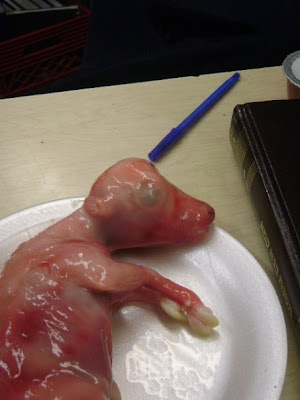


I spoke to a couple of people who raise cows, and to a couple of shochtim about the ben pakua, and was told by all of them that it is very rare nowadays to find. The reason it is rare is twofold:
- Everything is very closely supervised by veterinarians and supervisors, while it used to not be.
- Financial reasons - if a grower realizes he has a pregnant cow, he will not have it slaughtered. He will wait until the calf is born before he slaughters the cow, as that gives him another cow to raise which will be worth a lot more when it grows up, then it is worth at the time as a calf.
Warning: the following pictures might burn your eyes out of your head, if you are sensitive.


Aug 27, 2007
yesterday's shchita
I was going to write a post describing yesterday's shchita with more pictures, but I have written such posts in the past, and how different can it be anyway, unless something goes wrong.
If you want me to put up some gory pictures and a description, write so in the comments...
---------
I could just put up the old pictures from previous shchitas, and you guys would never know. the pics look pretty similar to the old ones. A cow with its head hanging off looks the same in August as it did in March (or whenever the previous one was). But you asked for it, you got it.
My 10 year old son accompanied me this time and took most of the pictures....


If you want me to put up some gory pictures and a description, write so in the comments...
---------
I could just put up the old pictures from previous shchitas, and you guys would never know. the pics look pretty similar to the old ones. A cow with its head hanging off looks the same in August as it did in March (or whenever the previous one was). But you asked for it, you got it.
My 10 year old son accompanied me this time and took most of the pictures....


Subscribe to:
Posts (Atom)
Related Posts
