
Showing posts with label Germany. Show all posts
Showing posts with label Germany. Show all posts
May 20, 2025
Fulda Family Heritage Reunion_2023 (video)
------------------------------------------------------
Reach thousands of readers with your ad by advertising on Life in Israel
Reach thousands of readers with your ad by advertising on Life in Israel
------------------------------------------------------
May 21, 2023
Eurovision and the Holocaust
After Noa Kirel's successful showing at Eurovision (a very respectable third place!) she made a statement about how this was really a victory when receiving the full twelve points from Poland after nearly the entire Kirel family was wiped out in Auschwitz during the Holocaust..
This post-Eurovision statement created a bit of a diplomatic stir. Poland got really upset by this statement of Kirel's.
Polish politicians criticized the week Holocaust education in Israel if young people in Israel think Poland was behind the Holocaust or partners with Germany in the Holocaust rather than as the victim they were.
The Polish government said they are going to be inviting Noa Kirel to Poland to understand better why she thinks about Poland this way (as part of the team of perpetrators of the Holocaust), and them to explain, and for her to see for herself how the Nazis were cruel to the Poles and to the Jews...
If I understand it correctly, Kirel's family was from Austria but they perished in Auschwitz which, as we all know, is in Poland.
I would suggest that Poland misunderstood her intention. She did not say Poland killed her family, but they were all killed in Poland. I dont know why she had to bring it up at all, the Holocaust has nothing to do with Eurovision. If she had to bring it up, she could have accused the Germans of still being anti-semites for giving her 0 points after killing her family if she wanted to refer to the Holocaust... I wonder how many points Poland will give Israel next year after this snafu..
------------------------------------------------------
Reach thousands of readers with your ad by advertising on Life in Israel
Reach thousands of readers with your ad by advertising on Life in Israel
------------------------------------------------------
Sep 13, 2022
Israeli PM & German Chancellor give news conference (video)
------------------------------------------------------
Reach thousands of readers with your ad by advertising on Life in Israel
Reach thousands of readers with your ad by advertising on Life in Israel
------------------------------------------------------
Sep 12, 2022
Picture of the Day

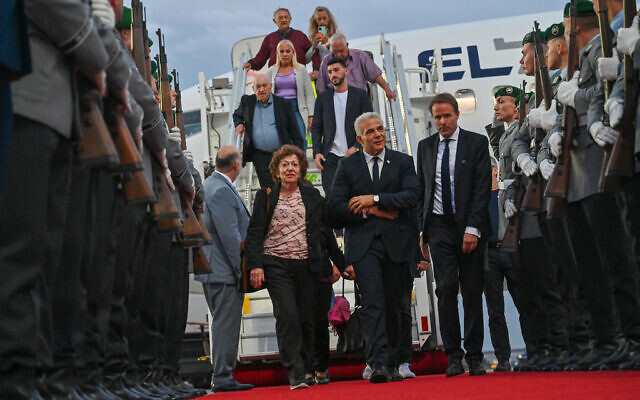
PM Yair Lapid brought along several Holocaust survivors on his trip to Germany. As Lapid said, "This evening, I arrived in Berlin for a diplomatic visit accompanied by Holocaust survivors Pnina, Avraham, Shoshana, Yisrael, and Zvi. As we stepped off the plane together and onto German soil, we were welcomed by a German military honor guard. This is their victory, mine as the son of a Holocaust survivor and ours as a people and a nation. We will never forget.”
------------------------------------------------------
Reach thousands of readers with your ad by advertising on Life in Israel
Reach thousands of readers with your ad by advertising on Life in Israel
------------------------------------------------------
Sep 7, 2022
Israel's President Isaac Herzog addresses the German Bundestag (video)
------------------------------------------------------
Reach thousands of readers with your ad by advertising on Life in Israel
Reach thousands of readers with your ad by advertising on Life in Israel
------------------------------------------------------
Sep 6, 2022
Facebook Status of the Day
This is a fascinating story I saw printed in the Torah Tidbits this past Shabbos by Rabbi Goldscheider. The story is about a town in Germany called Fulda. My grandfather and his family came from that town, and I went to visit the town for a Jewish memorial a few years ago, so this fascinating story held special interest for me.
The one correction, that does not change the story at all, is that Rabbi Michael Cahn did not die in Buchenwald but died in 1920. That is fairly well known and easily discoverable on the Internet and I confirmed it with a friend of mine who is also a great grandson of Rabbi Cahn. Since the story does not have Rabbi Fulda saying in what year it happened, that little tidbit does not change anything.
------------------------------------------------------
Reach thousands of readers with your ad by advertising on Life in Israel
Reach thousands of readers with your ad by advertising on Life in Israel
------------------------------------------------------
Jan 27, 2022
kaddish in the Budenstag
powerful
the Speaker of the Knesset, Miki Levi, spoke in the Budenstag, the German parliament, for International Holocaust Remembrance Day. Levi concluded his speech by opening a siddur that Yad VaShem lent him that had originally been used by a German lad at his bar mitzva, and from that siddur he read and cried the kaddish, for the Jews murdered in the Holocaust.
Upon conclusion, the German Members of Parliament gave a standing ovation.
As I always say (and now there is even a book about it), the world loves dead Jews and shows them great honor.. (Jews do too, but that's not for now)
------------------------------------------------------
Reach thousands of readers with your ad by advertising on Life in Israel
Reach thousands of readers with your ad by advertising on Life in Israel
------------------------------------------------------
Dec 16, 2021
Michael Braunold: Kristallnacht and the demise of the Fulda Jewish community (video)
------------------------------------------------------
Reach thousands of readers with your ad by advertising on Life in Israel
Reach thousands of readers with your ad by advertising on Life in Israel
------------------------------------------------------
Kristallnacht ceremony in Fulda Germany (video)
I descend from Fulda Jews and have been there. The work being done to restore the memories of the Jewish past is tremendous. This is the ceremony they had to remember Kristallnacht in November
and the digital memorial book of the Fulda Jews who had been deported to Riga
------------------------------------------------------
Reach thousands of readers with your ad by advertising on Life in Israel
Reach thousands of readers with your ad by advertising on Life in Israel
------------------------------------------------------
Nov 10, 2020
We remember (the Jews of Fulda) (video)
The project group "Jews in Fulda" of the Winfriedschule Fulda commemorates the Crystal Night with a personal contribution,
------------------------------------------------------
Reach thousands of readers with your ad by advertising on Life in Israel
Reach thousands of readers with your ad by advertising on Life in Israel
------------------------------------------------------
May 21, 2020
German city of Fulda purchases old shul buildings
This post was very difficult to write. I never thought I would be interested in, or care about, actions by Germans meant to "do right" by the Jews, or to somehow make up for what was done during the Holocaust.
This past year I had an opportunity to go to Fulda, the city in Germany where my grandfather grew up. The City of Fulda, led by Oberburgermeister, the Lord Mayor, Dr Heiko Wigenfeld, sponsored a trip to Fulda for many descendants of Holocaust victims from Fulda. While I do not quite know who exactly is responsible for what, I must mention my friend Anja Listman who is a driving force behind much of what happens in Fulda to memorialize the local Jewish community from the Holocaust period. Anja is neither Jewish nor does she hold any formal position in the local government of Fulda, yet she works non-stop on behalf of the Jewish community, current but mostly former. Anja does it all (in addition to her regular work as a teacher and her other projects she is involved in) just because she feels it is right and necessary, and is behind many of the initiatives that take place.
The local government brought a group of us in to Fulda from around the world, put us up and took us around Fulda and the environs, showed us and explained all the Jewish historical places, opened up the archives to us, showed us our ancestors homes, when possible, and were, in general very hospitable.
I must add that one thing that made an impression on me was that Dr Wigenfeld, Anja, and a number of others are not Jewish, do not have a sizable Jewish community they are trying to placate (the Jewish community in Fulda today is tiny and politically insignificant), and seemingly have no outside pressure to be doing anything so proactively favorable to the memory of the Jews of Fulda and are doing it simply because they feel it is the right thing to do and they believe there is a need for the city to come to terms with what it did and what happened to its people and memorialize it so nothing like it will happen again.
Back to today.
When we were in Fulda 8 or 9 months ago, they showed us the site of the old shul (there is a memorial along the edge with names of local Holocaust victims, includes my great grandparents). Across the street from it was the school and yeshiva. Next door to the shul is a building that was also once the weekday shul and the Jewish community center. Below the weekday shul, in the basement, was the mikva. They told us that they discovered that the mikva had been sealed off by the Jewish community back then in the 1940s and was now rediscovered to be fully intact. It is beneath a building that houses residential apartments and a lower level of stores. The mikva remains beneath all that, intact.
They told us then that they were trying to find ways to open it up again.
They just sent a message letting us know that the city, led by Lord Mayor Dr Wigenfeld, has successfully purchased the entire complex - the building with the weekday shul and community center, the parking lot where the old shul used to stand (part of where the shul was is homes now and part is a parking lot). With the mikva intact, they expect to be able to open it - though I do not know if that means just for viewing or if also for use. I also do not know if it is kosher in its current state or would need renovations and if necessary would they be done. Also, there really aren't too many people there who would use it, if any. But that's not the point. They bought the property of the shuls and community center and mikva and are preserving it to memorialize the Jewish sites.
Dr. Wingenfeld spoke at the announcement of this purchase and spoke about the importance of dignified memory. He said: "Our goal should now be, together with the Jewish community, to preserve the dignity of this memorial." Dr. Wingenfeld announced that city building councilor Daniel Schreiner will work out some suggestions in the coming months in close coordination with the Jewish community on what a design could look like. Silvia Brünnel from the Green Party proposed an architecture competition and Jonathan Wulff from the SPD suggested that the descendants of the Jewish families should also be spoken to. ALL parties in the Fulda parliament, from left to right, support this purchase with very great approval!!!!
Besides for the above article in the image, The Osthessen news site wrote about it, and you can use Google Translate to get it in English.
Nothing can make up for what was done to the Jews of Europe, not my grandparents, nor your grandparents nor anybody else's. I was once in touch with a person who was a descendant of a German soldier (she claimed he was not a Nazi and due to some illness I do not recall he was released from the German army early in World War II) who helped me gratis with some genealogy research because she "wanted to make up" for what her people had done.
The people today in Fulda, Dr Wigenfeld, Anja and the others, are not doing this to make up for anything, nor due to political or social pressures. They are doing it because they feel it is important that the residents of Fulda today know what once was and what happened there and to prevent, through knowledge, anything similar from possibly happening again.
I think I was always ambivalent about the need for memorials, especially in Germany. Maybe for them, so they can learn from it, but I always thought I don't need it. And I don't. If nothing would have ever happened, I would never have thought about it and would not think it necessary or important. Now that they are doing it, without pressure from anyone, I think it is notable and significant, and even meaningful. It somewhat surprised me that this is what it turned into. On their own initiative they turned something I was ambivalent about into something that is meaningful.
(By the way, I speak for nobody else but me. Perhaps other people who are descendants of Fulda victims, or victims of other places, always felt memorials are important, or maybe some feel even now they are still not. I speak only for myself)
This past year I had an opportunity to go to Fulda, the city in Germany where my grandfather grew up. The City of Fulda, led by Oberburgermeister, the Lord Mayor, Dr Heiko Wigenfeld, sponsored a trip to Fulda for many descendants of Holocaust victims from Fulda. While I do not quite know who exactly is responsible for what, I must mention my friend Anja Listman who is a driving force behind much of what happens in Fulda to memorialize the local Jewish community from the Holocaust period. Anja is neither Jewish nor does she hold any formal position in the local government of Fulda, yet she works non-stop on behalf of the Jewish community, current but mostly former. Anja does it all (in addition to her regular work as a teacher and her other projects she is involved in) just because she feels it is right and necessary, and is behind many of the initiatives that take place.
The local government brought a group of us in to Fulda from around the world, put us up and took us around Fulda and the environs, showed us and explained all the Jewish historical places, opened up the archives to us, showed us our ancestors homes, when possible, and were, in general very hospitable.
I must add that one thing that made an impression on me was that Dr Wigenfeld, Anja, and a number of others are not Jewish, do not have a sizable Jewish community they are trying to placate (the Jewish community in Fulda today is tiny and politically insignificant), and seemingly have no outside pressure to be doing anything so proactively favorable to the memory of the Jews of Fulda and are doing it simply because they feel it is the right thing to do and they believe there is a need for the city to come to terms with what it did and what happened to its people and memorialize it so nothing like it will happen again.
Back to today.
When we were in Fulda 8 or 9 months ago, they showed us the site of the old shul (there is a memorial along the edge with names of local Holocaust victims, includes my great grandparents). Across the street from it was the school and yeshiva. Next door to the shul is a building that was also once the weekday shul and the Jewish community center. Below the weekday shul, in the basement, was the mikva. They told us that they discovered that the mikva had been sealed off by the Jewish community back then in the 1940s and was now rediscovered to be fully intact. It is beneath a building that houses residential apartments and a lower level of stores. The mikva remains beneath all that, intact.
They told us then that they were trying to find ways to open it up again.
They just sent a message letting us know that the city, led by Lord Mayor Dr Wigenfeld, has successfully purchased the entire complex - the building with the weekday shul and community center, the parking lot where the old shul used to stand (part of where the shul was is homes now and part is a parking lot). With the mikva intact, they expect to be able to open it - though I do not know if that means just for viewing or if also for use. I also do not know if it is kosher in its current state or would need renovations and if necessary would they be done. Also, there really aren't too many people there who would use it, if any. But that's not the point. They bought the property of the shuls and community center and mikva and are preserving it to memorialize the Jewish sites.
 |
| the building and parking lot right in front, and extending down out of view, is the site of the old shul. The building at the right edge of the picture is the former community center and weekday shul with the mikva beneath. That black wall is a memorial for the local Holocaust victims - in that gray strip near the top of it is engraved all the names of local victims. |
Dr. Wingenfeld spoke at the announcement of this purchase and spoke about the importance of dignified memory. He said: "Our goal should now be, together with the Jewish community, to preserve the dignity of this memorial." Dr. Wingenfeld announced that city building councilor Daniel Schreiner will work out some suggestions in the coming months in close coordination with the Jewish community on what a design could look like. Silvia Brünnel from the Green Party proposed an architecture competition and Jonathan Wulff from the SPD suggested that the descendants of the Jewish families should also be spoken to. ALL parties in the Fulda parliament, from left to right, support this purchase with very great approval!!!!
Besides for the above article in the image, The Osthessen news site wrote about it, and you can use Google Translate to get it in English.
Nothing can make up for what was done to the Jews of Europe, not my grandparents, nor your grandparents nor anybody else's. I was once in touch with a person who was a descendant of a German soldier (she claimed he was not a Nazi and due to some illness I do not recall he was released from the German army early in World War II) who helped me gratis with some genealogy research because she "wanted to make up" for what her people had done.
The people today in Fulda, Dr Wigenfeld, Anja and the others, are not doing this to make up for anything, nor due to political or social pressures. They are doing it because they feel it is important that the residents of Fulda today know what once was and what happened there and to prevent, through knowledge, anything similar from possibly happening again.
I think I was always ambivalent about the need for memorials, especially in Germany. Maybe for them, so they can learn from it, but I always thought I don't need it. And I don't. If nothing would have ever happened, I would never have thought about it and would not think it necessary or important. Now that they are doing it, without pressure from anyone, I think it is notable and significant, and even meaningful. It somewhat surprised me that this is what it turned into. On their own initiative they turned something I was ambivalent about into something that is meaningful.
(By the way, I speak for nobody else but me. Perhaps other people who are descendants of Fulda victims, or victims of other places, always felt memorials are important, or maybe some feel even now they are still not. I speak only for myself)
------------------------------------------------------
Reach thousands of readers with your ad by advertising on Life in Israel
Reach thousands of readers with your ad by advertising on Life in Israel
------------------------------------------------------
May 10, 2020
Headline of the Day
German military spy chief apologizes for wiping Israel off map
oops. sorry.
The Final Solution
If we couldn't do it to your people, at least we did it to your country on the map..
(all in good humor)
------------------------------------------------------
Reach thousands of readers with your ad by advertising on Life in Israel
Reach thousands of readers with your ad by advertising on Life in Israel
------------------------------------------------------
May 3, 2020
no talking in shul
According to reports, the German government is allowing shuls to reopen, along with churches and mosques, under certain conditions.
Basically the rules for shuls will be social distancing and no socializing.
The rules include:
- requiring the synagogue administration to disinfect all siddurim and chumashim before and after services.
- each congregant keep a distance of at least 2m from others. Only family members can sit together
- face masks must be worn. Only the rabbi and the cantor can go without, and only while they are on the bima alone
- no handshakes, hugging or kissing
- no kissing the Torah and mezuzas, and no carrying the Torah around the shul amongst the congregants
- congregants called up to the Torah should stand away from the bima
- people should preferably register with their shul to attend services there
- no singing during services
- prayer times should be kept as short as possible
- for now only large shuls can be used, where social distancing can be kept. small shul structures that might be more crowded and harder to allow the necessary distancing cannot be used.
It looks like the Germans also don't like the shleppy long drasha or the drawn out chazzanus....
I am not sure what is wrong with singing during the services. Perhaps they think it will lead to dancing. And maybe even mixed dancing (especially in a non-Orthodox synagogue).
So the Germans are opening the shuls but not allowing the Jews praying inside to socialize. That means no talking in shul.
Presumably, anything the Germans want Jews to do, we are supposed to do the opposite, right? So we should talk in shul, when we get to go back, right?
Basically the rules for shuls will be social distancing and no socializing.
The rules include:
- requiring the synagogue administration to disinfect all siddurim and chumashim before and after services.
- each congregant keep a distance of at least 2m from others. Only family members can sit together
- face masks must be worn. Only the rabbi and the cantor can go without, and only while they are on the bima alone
- no handshakes, hugging or kissing
- no kissing the Torah and mezuzas, and no carrying the Torah around the shul amongst the congregants
- congregants called up to the Torah should stand away from the bima
- people should preferably register with their shul to attend services there
- no singing during services
- prayer times should be kept as short as possible
- for now only large shuls can be used, where social distancing can be kept. small shul structures that might be more crowded and harder to allow the necessary distancing cannot be used.
It looks like the Germans also don't like the shleppy long drasha or the drawn out chazzanus....
I am not sure what is wrong with singing during the services. Perhaps they think it will lead to dancing. And maybe even mixed dancing (especially in a non-Orthodox synagogue).
So the Germans are opening the shuls but not allowing the Jews praying inside to socialize. That means no talking in shul.
Presumably, anything the Germans want Jews to do, we are supposed to do the opposite, right? So we should talk in shul, when we get to go back, right?
------------------------------------------------------
Reach thousands of readers with your ad by advertising on Life in Israel
Reach thousands of readers with your ad by advertising on Life in Israel
------------------------------------------------------
Jan 23, 2020
German President makes a bracha at Holocaust forum
The world loves dead Jews. Far more than live Jews. Israel is going through an historic few days with world leaders raining down on Jerusalem, the capital of Israel, to commemorate dead Jews. It is historic, even if it is for dead Jews. It used to be unthinkable even for dead Jews. It is a big show, and while some of it might include ulterior motives (eg Putin), this is a tremendous accomplishment of Israel, Netanyahu and Rivlin (and whoever else was involved). I tend to dislike the reinforcement of the connection of Israel's legitimacy with the memory of the Holocaust, but we take what we can get.
Among all the craziness, this might take the cake. German President Frank Walter Steinmeier started off his speech at the Forum with a few sentences in Hebrew, including the bracha of Shehecheyanu.
------------------------------------------------------
Reach thousands of readers with your ad by advertising on Life in Israel
Reach thousands of readers with your ad by advertising on Life in Israel
------------------------------------------------------
Sep 4, 2019
going to Germany to see what was
I recently went on a trip to Germany. Something I never thought I would do.
So, how did this happen?
The City of Fulda sponsored a program bringing children of Holocaust survivors and victims from Fulda to Fulda. My grandfather was from Fulda, and while he got out after a stint in Buchenwald, his parents, my great grandparents, (among other relatives) were deported and murdered in Sobibor. They put together a program tracing roots, memorializing the victims, seeing the current community, seeing what was and what is.
Fulda is a city about 100km from Frankfurt. Outside of Frankfurt it is the biggest city in its area, and it is located in the state of Hessen. The current Jewish community is largely made up of Russian Jews who came from the Soviet Union after the Cold War and after the Berlin Wall fell and the fence between East and West Germany came down, though there are still two German Jews in town.
So we get to Germany, and the City sent someone to pick us up from the airport and drive us to Fulda. We checked into Hotel Esperanto and settled in. As I had asked about kosher food and no kosher food being available in Fulda, the city had ordered enough kosher meals for me, my father, and my cousins from the glatt kosher restaurant, Sohar, in Frankfurt. We had dinner with a German beer. Just for a shout out, the food was very good throughout the trip - 3 meals a day from Sohar, though some of the items were difficult to identify (being very European dishes), and all 3 meals each day were meaty. Other people in the group either didn't keep kosher and ate hotel food or made their own arrangements with a combination of bringing food along and eating what was ok from the hotel.
Another point to note is that I wore my yarmulka openly the entire trip. I went in not sure about whether to wear a kipa or hat. I had been told about the danger, but I felt it was likely exaggerated, and I had also heard that while some places in Europe really have problems, Fulda is a friendly and quiet town with no such incidents (and not such a large refugee/migrant population). So, I brought a hat along and was ready to wear it if I should feel uncomfortable or if I should feel in danger. I and my father were the only ones to wear our kipas in public - everyone else who was religious in the group wore hats. And I felt perfectly fine the entire time. We were easily identified as Jews, and received a number of random "shaloms" from people in the streets or present at events we attended. In addition to the random shaloms, we also had people approach us thanking us for coming to Germany and that they travel to Israel regularly for business or vacation. So I think wearing a yarmulka openly was a success. I felt comfortable and I think I showed myself as a proud and unafraid Jew comfortable in my own skin (I am not commenting anything about those who chose not to - everybody made their own decisions for their own reasons each with his own considerations and no one decision is more legitimate than another. I am just saying I am happy I decided to do what I did).

The first day, on Wednesday, after breakfast we got a walking tour of the main area of Fulda. The tour started with a few minutes walk over to the plaza in front of the train station. This plaza is where the Jews of Fulda were marched to, in front of the screaming gentile residents who were also throwing stones at them, by the Nazis for deportation, once in 1941 and again in 1942. We then contineud to walk through town and saw the street named for the Maharam Schiff, who lived there and headed a yeshiva in Fulda a few hundred years ago. From there we went to the street called Jerusalemplatz which is the location of the old Jewish cemetery. This cemetery no longer exists but is a park and a residential building and parking lot.
The cemetery was closed in 1906 as the city expanded and the community stopped using it (actually the last burial was in 1927 of someone who had purchased a plot there before it had been closed in 1906). From 1906 the community began burying its dead in the new Jewish cemetery, which we would see on Friday.
The government basically forced the community to sell the cemetery, that had been completely destroyed in Kristallnacht, to the government who would then convert it to being part of the city and despite agreeing not to build a building on it, they built the park and a building which went up too fast to stop. According to what we were told, when the park and building were being built, bones were frequently seen in the ground and among the construction. Recently the government made a memorial room at the bottom of the building, with no external signs indicating such a memorial, that contains pictures of the old cemetery, some Jewish items and some other memorial stuff. As well, some people made a memorial at the edge of the park with a stone bearing an inscription about the cemetery, along with a number of stone son the ground bearing the names and dates of some of the people buried in the cemetery - there was even a stone with the name of the grandmother of one of the people on the trip. The other end of the plot has a wall plaque honoring, again, the Maharam Schiff. No mention anywhere of a Jewish cemetery that had been there (and still is, underground), though there are people working hard to change that, pressuring the government to make a public memorial sign.
We continued to walk though town, seeing some general historic sights of Fulda. We also saw the bus depot which used to be the cattle market that was largely used by Jewish businessmen. The Jews were not allowed to be members of the variosu guilds, so they could ot be craftsmen and had to turn to other businesses, such as the classic money lending and insurance and whatnot, but also they dominated the cattle market. My great grandfather had been a cattle trader, so he worked in that very market. Someone else in the group had his father who had been a leather worker, and eh too had worked in that market.
 Soon after we went for a reception in the castle, in which City Hall is now located, with the Lord Mayor, the Oberburgermeister, Lord Mayor Wingenfeld. We met some people from the current Jewish community at this event, and some other prominent people, and then the lord mayor came. He is a very genial fellow, young and friendly. He pushed hard for this and funded the entire program, seemingly with no political gain to him, so I am not quite sure why, unless it is truly altruistic or if there are reasons I am not aware of. The Lord Mayor greeted people and then spoke to the crowd. He spoke about history and community and the need to be aware of what happened and prevent such things in the future, and more.
That was basically the end of the official day, but we had a little more in store for the Goldmeier group. The driving force behind the trip, and behind a lot of what goes on for the memory fo the Jews of Fulda, is a Christian woman named Anja. She has taken on remembering the victims of oppression and has done tremendous research into the Jews of Fulda, has pushed to open the city archives, pushes for memorials, and was very involved in this trip. Anja does not work for the government, but does all her work on her own, but she has made strong connections and pushes the government offices to assist and cooperate. I will also add that the Director of Culture for the eCity of Fulda is a man named Dr. Hylan. Dr Hylan opened the archives for us but he has also been instrumental in researching the history of the Jews of Fulda through the archives, and he has ordered the archives be put online and made fully available to the public - and they are.
So, after the reception with the Lord Mayor, Anja took us to see where the old shul was. The old shul was a beautiful structure on Am Stokhaus St, honorarily named Juden Grasse. The old shul is now a small residential building with a parking lot, and another larger residential building behind it. Next to the shul was a building with a mikva and a smaller beis medrash which they used during the weekdays. The mikva was discovered and still exists fully intact, but we could not see it as it is underground and has been sealed. The city rented the storefront (used to be a car dealership) at the bottom of the building and has put a memorial for the shul in there with images of what it looked like. Outside the parking lot on the wall around the lot is a plaque with the names of the 200+ Jewish residents of Fulda who were deported in the 1942 deportation. My great grandparents names were in this memorial, along with some other relatives.
The small street in front of the shul going down the hill was known as Judenberg, back in the day. On the other side of that little street, in what is now all residential buildings, was the yeshiva of Fulda, and another smaller shul (for the "eastern Jews"). We then walked a couple more blocks and saw the building where my grandfather and great grandparents lived. We were able to go into the building, but not into the apartment because the guy who lives there now was not home when we were there - he has let other relatives in to see in the past. Interestingly, behind the building is now a parking lot, but it used to be where they kept the cattle, with what are clearly barn doors and windows for lowering hay still all there. Funny story my father told - the Jews had cattle, and the gentile neighbors kept pigs there. So, the Jews had to be careful to take in their buckets and not leave them outside, or else the goyim would use the buckets to milk their pigs and that would be a problem for the Jews to then use the buckets for the cows milk.
Day 2, Thursday, was not specifically Jewish in content. Fulda is very central Germany, and is a popular destination for conferences from around the country because it is on the train line and is about maximum 3 hours travel from every major city in Germany. Fulda is also the closest city to what was the wall and fence between East and West Germany, the US Army had a small base outside of Fulda at one of the main junctions of the fence - this is called Point Alpha. I would note that because of this army base, many Jewish soldiers pent a lot of time as part of the Jewish community in Fulda throughout the years, but that ended when the US Army closed the base and pulled its troops out after the wall came down. Point Alpha is now a museum about the division of Germany, and the people who suffered because of it. And near that is the army base that is now a museum about the US Army activities there. I would note, that when Germany was reunited, Soviet Jews came flooding into West Germany - with Fulda being a nearby town, many went to Fulda, and they largely make up the Jewish community in Fulda now.
Thursday afternoon we had off, while some people got private tours of where their families had lived.
Friday we went back to the old cemetery and heard the story more in full than the brief description we had been given on the first day. This time it was with Dr Hylan as well who also showed us images from the city archives of the city expansion and of the cemetery. We also now got to go into the memorial room and see the pictures and items therein. We (most of us) went as a group to the old shul and heard more about that, again with official pictures from the city archives. We later went to the new cemetery and saw the graves of relatives buried there. They had some interesting graves and memorials - including a memorial plaque of the Jews of Fulda who had died in battle in World War I. We then met with Dr Hylan at the archives and he showed us records of our families. Besides for seeing records of the individuals, we discovered that when the Jews were deported their homes were sealed and eventually sold by the State. When they would seal a home, they would catalog all the items inside and put them up for sale. The archives had recorded lists of items sold from any relevant person - things like curtains 50 Rechsmarks. 2 gold rings, 17 Recihsmarks, 4 knives, 3 Reichsmarks, mirror 2 Reichsmarks, etc. And, the Nazis had altered the records of the Jews, adding the name Israel to the records of Jewish men and the name Sarah to the records of Jewish women.
Shabbos was interesting in that we got to interact with the current Jewish community. We walked about 20 minutes to the new shul. The shul is located inside what sued to be a house - two people on the trip had been born in that house! Their parents went back after the war and left Fulda for greener pastures in 1949. In the meantime, these two brothers had been born there. This building also used to function as the school, so it was where my grandfather, and everyone else, went to school for Jewish studies after general school hours. Now the building functions as the shul and the lower floor bears a museum of sorts with images and memorials of the community and the school.
 The shul only has services on Shabbos -Friday night and Shabbos morning, and on Monday morning. After davening the community eats Shabbos dinner and lunch together, though ti is really a light pareve meal - I am told the only time they have meat at the communal meal is Pesach night. The rabbi is a young man born in Moscow, living in Fulda, after having lived in Israel for a number of years. He led the davening, read the torah and spoke at the meals. He spoke in 3 languages - Russian, German and Hebrew. The rabbi also services other, smaller, communities, so he trades off with someone else, Reven Melamed who is one of the directors of the Jewish community of Fulda, and travels to the other communities, being in Fulda about 2 Shabbatot per month and in other communities on other shabbatot. Rabbi Jedwabni seems very dedicated to his work and the community and is doing avodas kodesh, giving these people some Judaism to be connected to. The crowd was just 15-20 people. The davening was nice, the meals were pleasant, we chatted with some of the community members and the rabbi, sang songs and had a nice time. The community is almost entirely old Russian Jews, so unless the course of the world undergoes some seismic change and God sends more Jews to Fulda, pretty soon (in 30 to 40 years) there won't be a Jewish community left - there are no kids, and the younger people left long ago for other cities in Germany or Europe. I would note, the front gate and entrance is kept locked and they only use the back entrance, and a police car is stationed in the lot near the door during the times of services or other activities takign place in the shul.
Saturday night there was a concert, as the City of Fulda is celebrating a Jubilee year - celebrating its 1275th year. The concert was a special production of Beethoven's Ninth Symphony.
Wednesday through Friday I also went running early in the morning. Fulda is really a beautiful, quiet, city.
Sunday was checkout and flying back to Israel, with a little bit of walking around town in the downtime. Being a very Christian city, all the stores and businesses, not including some restaurants, are closed on Sundays. The main strip was eerily quiet.
My main takeaway, I think, is that we have it so good nowadays, and we, most of the time, don't even realize it. We have freedom. We have so much freedom we love to fight with each other. We have so much freedom we strive to find ways to serve in ways that were unimaginable in previous generations, when they were just happy to be allowed to live their miserable lives and not be killed or deported ( and I am not just talking about the time of the Holocaust) before the end of the day. We have so much freedom we can go where we want, when we want, how we want. We can daven openly, learn torah openly, work in any profession a person might desire to work in, participate in sports or other public activities, easily find readily available kosher food in most places. We have it so good.
some other pictures of interest:


So, how did this happen?
The City of Fulda sponsored a program bringing children of Holocaust survivors and victims from Fulda to Fulda. My grandfather was from Fulda, and while he got out after a stint in Buchenwald, his parents, my great grandparents, (among other relatives) were deported and murdered in Sobibor. They put together a program tracing roots, memorializing the victims, seeing the current community, seeing what was and what is.
Fulda is a city about 100km from Frankfurt. Outside of Frankfurt it is the biggest city in its area, and it is located in the state of Hessen. The current Jewish community is largely made up of Russian Jews who came from the Soviet Union after the Cold War and after the Berlin Wall fell and the fence between East and West Germany came down, though there are still two German Jews in town.
So we get to Germany, and the City sent someone to pick us up from the airport and drive us to Fulda. We checked into Hotel Esperanto and settled in. As I had asked about kosher food and no kosher food being available in Fulda, the city had ordered enough kosher meals for me, my father, and my cousins from the glatt kosher restaurant, Sohar, in Frankfurt. We had dinner with a German beer. Just for a shout out, the food was very good throughout the trip - 3 meals a day from Sohar, though some of the items were difficult to identify (being very European dishes), and all 3 meals each day were meaty. Other people in the group either didn't keep kosher and ate hotel food or made their own arrangements with a combination of bringing food along and eating what was ok from the hotel.
Another point to note is that I wore my yarmulka openly the entire trip. I went in not sure about whether to wear a kipa or hat. I had been told about the danger, but I felt it was likely exaggerated, and I had also heard that while some places in Europe really have problems, Fulda is a friendly and quiet town with no such incidents (and not such a large refugee/migrant population). So, I brought a hat along and was ready to wear it if I should feel uncomfortable or if I should feel in danger. I and my father were the only ones to wear our kipas in public - everyone else who was religious in the group wore hats. And I felt perfectly fine the entire time. We were easily identified as Jews, and received a number of random "shaloms" from people in the streets or present at events we attended. In addition to the random shaloms, we also had people approach us thanking us for coming to Germany and that they travel to Israel regularly for business or vacation. So I think wearing a yarmulka openly was a success. I felt comfortable and I think I showed myself as a proud and unafraid Jew comfortable in my own skin (I am not commenting anything about those who chose not to - everybody made their own decisions for their own reasons each with his own considerations and no one decision is more legitimate than another. I am just saying I am happy I decided to do what I did).

The first day, on Wednesday, after breakfast we got a walking tour of the main area of Fulda. The tour started with a few minutes walk over to the plaza in front of the train station. This plaza is where the Jews of Fulda were marched to, in front of the screaming gentile residents who were also throwing stones at them, by the Nazis for deportation, once in 1941 and again in 1942. We then contineud to walk through town and saw the street named for the Maharam Schiff, who lived there and headed a yeshiva in Fulda a few hundred years ago. From there we went to the street called Jerusalemplatz which is the location of the old Jewish cemetery. This cemetery no longer exists but is a park and a residential building and parking lot.
The cemetery was closed in 1906 as the city expanded and the community stopped using it (actually the last burial was in 1927 of someone who had purchased a plot there before it had been closed in 1906). From 1906 the community began burying its dead in the new Jewish cemetery, which we would see on Friday.
The government basically forced the community to sell the cemetery, that had been completely destroyed in Kristallnacht, to the government who would then convert it to being part of the city and despite agreeing not to build a building on it, they built the park and a building which went up too fast to stop. According to what we were told, when the park and building were being built, bones were frequently seen in the ground and among the construction. Recently the government made a memorial room at the bottom of the building, with no external signs indicating such a memorial, that contains pictures of the old cemetery, some Jewish items and some other memorial stuff. As well, some people made a memorial at the edge of the park with a stone bearing an inscription about the cemetery, along with a number of stone son the ground bearing the names and dates of some of the people buried in the cemetery - there was even a stone with the name of the grandmother of one of the people on the trip. The other end of the plot has a wall plaque honoring, again, the Maharam Schiff. No mention anywhere of a Jewish cemetery that had been there (and still is, underground), though there are people working hard to change that, pressuring the government to make a public memorial sign.
We continued to walk though town, seeing some general historic sights of Fulda. We also saw the bus depot which used to be the cattle market that was largely used by Jewish businessmen. The Jews were not allowed to be members of the variosu guilds, so they could ot be craftsmen and had to turn to other businesses, such as the classic money lending and insurance and whatnot, but also they dominated the cattle market. My great grandfather had been a cattle trader, so he worked in that very market. Someone else in the group had his father who had been a leather worker, and eh too had worked in that market.
 Soon after we went for a reception in the castle, in which City Hall is now located, with the Lord Mayor, the Oberburgermeister, Lord Mayor Wingenfeld. We met some people from the current Jewish community at this event, and some other prominent people, and then the lord mayor came. He is a very genial fellow, young and friendly. He pushed hard for this and funded the entire program, seemingly with no political gain to him, so I am not quite sure why, unless it is truly altruistic or if there are reasons I am not aware of. The Lord Mayor greeted people and then spoke to the crowd. He spoke about history and community and the need to be aware of what happened and prevent such things in the future, and more.
That was basically the end of the official day, but we had a little more in store for the Goldmeier group. The driving force behind the trip, and behind a lot of what goes on for the memory fo the Jews of Fulda, is a Christian woman named Anja. She has taken on remembering the victims of oppression and has done tremendous research into the Jews of Fulda, has pushed to open the city archives, pushes for memorials, and was very involved in this trip. Anja does not work for the government, but does all her work on her own, but she has made strong connections and pushes the government offices to assist and cooperate. I will also add that the Director of Culture for the eCity of Fulda is a man named Dr. Hylan. Dr Hylan opened the archives for us but he has also been instrumental in researching the history of the Jews of Fulda through the archives, and he has ordered the archives be put online and made fully available to the public - and they are.
So, after the reception with the Lord Mayor, Anja took us to see where the old shul was. The old shul was a beautiful structure on Am Stokhaus St, honorarily named Juden Grasse. The old shul is now a small residential building with a parking lot, and another larger residential building behind it. Next to the shul was a building with a mikva and a smaller beis medrash which they used during the weekdays. The mikva was discovered and still exists fully intact, but we could not see it as it is underground and has been sealed. The city rented the storefront (used to be a car dealership) at the bottom of the building and has put a memorial for the shul in there with images of what it looked like. Outside the parking lot on the wall around the lot is a plaque with the names of the 200+ Jewish residents of Fulda who were deported in the 1942 deportation. My great grandparents names were in this memorial, along with some other relatives.
 |
| the stables/garage |
Day 2, Thursday, was not specifically Jewish in content. Fulda is very central Germany, and is a popular destination for conferences from around the country because it is on the train line and is about maximum 3 hours travel from every major city in Germany. Fulda is also the closest city to what was the wall and fence between East and West Germany, the US Army had a small base outside of Fulda at one of the main junctions of the fence - this is called Point Alpha. I would note that because of this army base, many Jewish soldiers pent a lot of time as part of the Jewish community in Fulda throughout the years, but that ended when the US Army closed the base and pulled its troops out after the wall came down. Point Alpha is now a museum about the division of Germany, and the people who suffered because of it. And near that is the army base that is now a museum about the US Army activities there. I would note, that when Germany was reunited, Soviet Jews came flooding into West Germany - with Fulda being a nearby town, many went to Fulda, and they largely make up the Jewish community in Fulda now.
Thursday afternoon we had off, while some people got private tours of where their families had lived.
Friday we went back to the old cemetery and heard the story more in full than the brief description we had been given on the first day. This time it was with Dr Hylan as well who also showed us images from the city archives of the city expansion and of the cemetery. We also now got to go into the memorial room and see the pictures and items therein. We (most of us) went as a group to the old shul and heard more about that, again with official pictures from the city archives. We later went to the new cemetery and saw the graves of relatives buried there. They had some interesting graves and memorials - including a memorial plaque of the Jews of Fulda who had died in battle in World War I. We then met with Dr Hylan at the archives and he showed us records of our families. Besides for seeing records of the individuals, we discovered that when the Jews were deported their homes were sealed and eventually sold by the State. When they would seal a home, they would catalog all the items inside and put them up for sale. The archives had recorded lists of items sold from any relevant person - things like curtains 50 Rechsmarks. 2 gold rings, 17 Recihsmarks, 4 knives, 3 Reichsmarks, mirror 2 Reichsmarks, etc. And, the Nazis had altered the records of the Jews, adding the name Israel to the records of Jewish men and the name Sarah to the records of Jewish women.
Shabbos was interesting in that we got to interact with the current Jewish community. We walked about 20 minutes to the new shul. The shul is located inside what sued to be a house - two people on the trip had been born in that house! Their parents went back after the war and left Fulda for greener pastures in 1949. In the meantime, these two brothers had been born there. This building also used to function as the school, so it was where my grandfather, and everyone else, went to school for Jewish studies after general school hours. Now the building functions as the shul and the lower floor bears a museum of sorts with images and memorials of the community and the school.

Saturday night there was a concert, as the City of Fulda is celebrating a Jubilee year - celebrating its 1275th year. The concert was a special production of Beethoven's Ninth Symphony.
Wednesday through Friday I also went running early in the morning. Fulda is really a beautiful, quiet, city.
Sunday was checkout and flying back to Israel, with a little bit of walking around town in the downtime. Being a very Christian city, all the stores and businesses, not including some restaurants, are closed on Sundays. The main strip was eerily quiet.
My main takeaway, I think, is that we have it so good nowadays, and we, most of the time, don't even realize it. We have freedom. We have so much freedom we love to fight with each other. We have so much freedom we strive to find ways to serve in ways that were unimaginable in previous generations, when they were just happy to be allowed to live their miserable lives and not be killed or deported ( and I am not just talking about the time of the Holocaust) before the end of the day. We have so much freedom we can go where we want, when we want, how we want. We can daven openly, learn torah openly, work in any profession a person might desire to work in, participate in sports or other public activities, easily find readily available kosher food in most places. We have it so good.
some other pictures of interest:
 |
| the park that used to be a Jewish cemetery |

 |
| memorial at the edge of the cemetery/park |

 |
| memorial plaques of the deported Jews of 1942 outside what used to be the shul |
 |
| imahes of the old shul |

These are from point Alpha


 |
| there was a mine field between the two fences |
 |
| wandered into the train station and saw the train is exactly like the Israeli trains |
 |
| Dr Hylan at the cemetery\park |


these were displayed in a storefront we passed.. it seems you can just walk in and buy any of these if you are over 18


 |
| on display in a show we wandered in to |
The new Jewish cemetery


 |
| the section for children |


 |
| a bush grew over the grave. we had to pull back the branches to access the grave |
At the archives


 |
| group picture at City Hall, in the castle |
------------------------------------------------------
Reach thousands of readers with your ad by advertising on Life in Israel
Reach thousands of readers with your ad by advertising on Life in Israel
------------------------------------------------------
Oct 4, 2018
Quote of the Day
Germany bears the main responsibility for the Holocaust... it is sad to see how people from other countries participated in the murderous acts..
-- German Chancellor Angela Merkel, visiting Yad Vashem
no duh, Sherlock
-- German Chancellor Angela Merkel, visiting Yad Vashem
no duh, Sherlock
------------------------------------------------------
Reach thousands of readers with your ad by advertising on Life in Israel
Reach thousands of readers with your ad by advertising on Life in Israel
------------------------------------------------------
Jan 30, 2018
Germans test gas on people
according to the news (a simple search will turn up all the newspapers reporting on it, so no need to link), German automakers tested their exhaust and emissions systems on humans (and monkeys) making them inhale nitrogen dioxide to see the results and effects of the exposure.
I guess the German scientists and automakers felt the tests with the Zyklon B 70 years ago weren't quite conclusive enough... no word yet on whether the test subjects were Jews..
I guess the German scientists and automakers felt the tests with the Zyklon B 70 years ago weren't quite conclusive enough... no word yet on whether the test subjects were Jews..
------------------------------------------------------
Reach thousands of readers with your ad by advertising on Life in Israel
Reach thousands of readers with your ad by advertising on Life in Israel
------------------------------------------------------
Oct 30, 2017
Anne Frank transporting people through Germany
This is weird.
 One of the Deutsch Bahn's new Intercity Express High Speed trains (aka ICE-4) has been christened with the name "Anne Frank". Officials explain that the name Anne Frank has become symbolic of tolerance and coexistence.
Source: DerWesten (with the help of Google Translate)
Very strange.
I mean, who wants to see a German train called Anne Frank transporting people back and forth? Maybe they can put this train on the Bergen Belsen route.
It is hard to believe anyone actually thought this is a good idea...
One of the Deutsch Bahn's new Intercity Express High Speed trains (aka ICE-4) has been christened with the name "Anne Frank". Officials explain that the name Anne Frank has become symbolic of tolerance and coexistence.Source: DerWesten (with the help of Google Translate)
Very strange.
I mean, who wants to see a German train called Anne Frank transporting people back and forth? Maybe they can put this train on the Bergen Belsen route.
It is hard to believe anyone actually thought this is a good idea...
------------------------------------------------------
Reach thousands of readers with your ad by advertising on Life in Israel
Reach thousands of readers with your ad by advertising on Life in Israel
------------------------------------------------------
Dec 20, 2016
Rent a Jew? Really?
According to NBC News, Germany has developed a program they call "Rent A Jew" as a method of fighting antisemitism.
The idea is that helping people get familiar with Jews would give them an opportunity to overcome their prejudices, often borne out of lack of familiarity. Direct contact with Jews will help them overcome stereotypes.
So, to help people become more familiar with Jews, they are getting different types of Jews to volunteer to visit school, universities and churches. Yes, despite the name "rent a Jew", they aren't even paying and want the Jews to volunteer. And they said Jews are cheap!
The name of the project, Rent a Jew, itself is offensive, as if people can pay Jews to be theirs for a period of time...
Now, if they were actually paying money for these rentals I might ask how to sign up...
The idea is that helping people get familiar with Jews would give them an opportunity to overcome their prejudices, often borne out of lack of familiarity. Direct contact with Jews will help them overcome stereotypes.
So, to help people become more familiar with Jews, they are getting different types of Jews to volunteer to visit school, universities and churches. Yes, despite the name "rent a Jew", they aren't even paying and want the Jews to volunteer. And they said Jews are cheap!
The name of the project, Rent a Jew, itself is offensive, as if people can pay Jews to be theirs for a period of time...
Now, if they were actually paying money for these rentals I might ask how to sign up...
------------------------------------------------------
Reach thousands of readers with your ad by advertising on Life in Israel
Reach thousands of readers with your ad by advertising on Life in Israel
------------------------------------------------------
Sep 20, 2015
Concentration Camps being recycled as refugee housing
last week, with the flood of refugees and migrants into Europe, there was a news item that was interesting and strange.

Refugees are being housed, seemingly for lack of other options, in Buchenwald, Dachau, and maybe other locations that were once concentration camps.
source; Ynetnews, The Guardian, and many others
This honestly aroused in me conflicting thoughts and emotions, as well as some tasteless jokes.
1. how could they put these structures to use housing refugees and migrants? They are there to remind us of the atrocities and horrors of what happened during the Holocaust? now they are being used for this, what will they be used for next time - housing for Olympic athletes or maybe the Ice Capades?
2. at least something good is being done with it. Nothing can make up for the evil done there, but perhaps some good deed like housing refugees can be some worthwhile balance and effort.
3. I understand Germany is just waiting for the shipment of Zyklon B to arrive in the mail and they can get back to their work. Everything else is already in place. It's a tasteless joke, but Germany deserves it. They always will.

Refugees are being housed, seemingly for lack of other options, in Buchenwald, Dachau, and maybe other locations that were once concentration camps.
source; Ynetnews, The Guardian, and many others
This honestly aroused in me conflicting thoughts and emotions, as well as some tasteless jokes.
1. how could they put these structures to use housing refugees and migrants? They are there to remind us of the atrocities and horrors of what happened during the Holocaust? now they are being used for this, what will they be used for next time - housing for Olympic athletes or maybe the Ice Capades?
2. at least something good is being done with it. Nothing can make up for the evil done there, but perhaps some good deed like housing refugees can be some worthwhile balance and effort.
3. I understand Germany is just waiting for the shipment of Zyklon B to arrive in the mail and they can get back to their work. Everything else is already in place. It's a tasteless joke, but Germany deserves it. They always will.
------------------------------------------------------
Reach thousands of readers with your ad by advertising on Life in Israel
------------------------------------------------------
Subscribe to:
Posts (Atom)
Related Posts
