
Showing posts with label Rav Aviner. Show all posts
Showing posts with label Rav Aviner. Show all posts
Mar 12, 2026
Interesting Psak: serving with women in armored vehicles
Recently reporesentaives of the Dati Leumi community, especially rabbonim in the ocmmunity, have made a big deal about an army logistical change in which female soldiers are being taken to serve in the armored corps, most notably in hummers and namers. They are generally serving in these vehicles as either drivers or paramedics. Traditionally the armored corps is a division that the Dati Leumi community frequently sent its soldiers, especially hesder students, to serve in. The community reps, especially the rabbonim see this as a breach of tzniyus and have basically considered this a "breach of contract" of sorts (figuratively speaking) with the dati leumi community, and if necessary they will instruct their students to serve in other divisions instead.
On this topic, INN brings a psak from Rav Dovid Fendel, Rosh Yeshiva of the Yeshiva Hesder Sderot, after being asked by some soldiers what to do in such a situation, would they be able to be in the vehicle when the hummer driver is a female or if a female paramedic is assigned to their armored vehicle, etc..
Rav Fendel, with other rabbonim of the yeshiva, said that the Rama is lenient about yichud in certain situations (specifically 1 woman with 3 men present) but in today's reality it would be difficult to rely on this - the Ramas leniency is when the people involved are kosher and not "prutzim" but today we are all exposed to inappropriate content online so it would be difficult to meet the standards of kosher for this leniency to apply.
Additionally, the reality of the situation is that other problems also exist, such as being in the vehicle for long periods of time would lead to violation prohibitions of looking at women, joking and talking with women and inappropriate thoughts.
The rabbonim said that from what they have been told by many soldiers in these situations, being in these situations of a crowded and cramped military vehicle and how at times it can be difficult to avoid even physical contact, among the other problems already mentioned. Therefore, Rav Fendel and the rabbonim have pasked for their soldiers to avoid these situations. A soldier caught in such a situation should complain to his commander and to the IDF Rabbinate to not allow such yichud. EVen in times of war this is a problem as in times of war and great distress, more safeguarding of the holiness of the camp is warranted..
Similarly, Srugim brings a similar psak from Rav Aviner, though not form a yichud perspective, makng it slightly different than Rav Fendel's psak.
Rav Aviner was asked about the same situation - 3 religious soldiers serving in a hummer with a female soldier as a paramedic or driver, what should they do?
Rav Aviner responded that this is not allowed but not really from a yichud perspective. The issue of yichud does not really apply. The issue really is one of "gas libo" - when people are familiar and confortable with each ther after spending time together and experiencing experiences together (such as in an army vehicle possibly experiencing some harrowing circumstances).
The problem here is less yichud and more the issues of looking at women, talking and joking with women. When serving many hours of the day together in a ttight army vehicle, these situations would be unavoidable.
Practically speaking, Rav Aviner said this situation should be stopped right away. Religious soldiers cannot let themselves be in such a situation. They should request to not serve with a female paramedic/driver. If the commanders ignore these requests, the soldiers should respond saying these instructions are in contradiction to the terms of the shared service agreement. If the commanders continue to force them to serve like this, they should refuse to serve, even at the price of being thrown in the brig.
If this situation is made permanent, the soldiers should be told to not induct to those units and more.
------------------------------------------------------
Reach thousands of readers with your ad by advertising on Life in Israel
Reach thousands of readers with your ad by advertising on Life in Israel
------------------------------------------------------
Oct 24, 2023
Picture of the Day

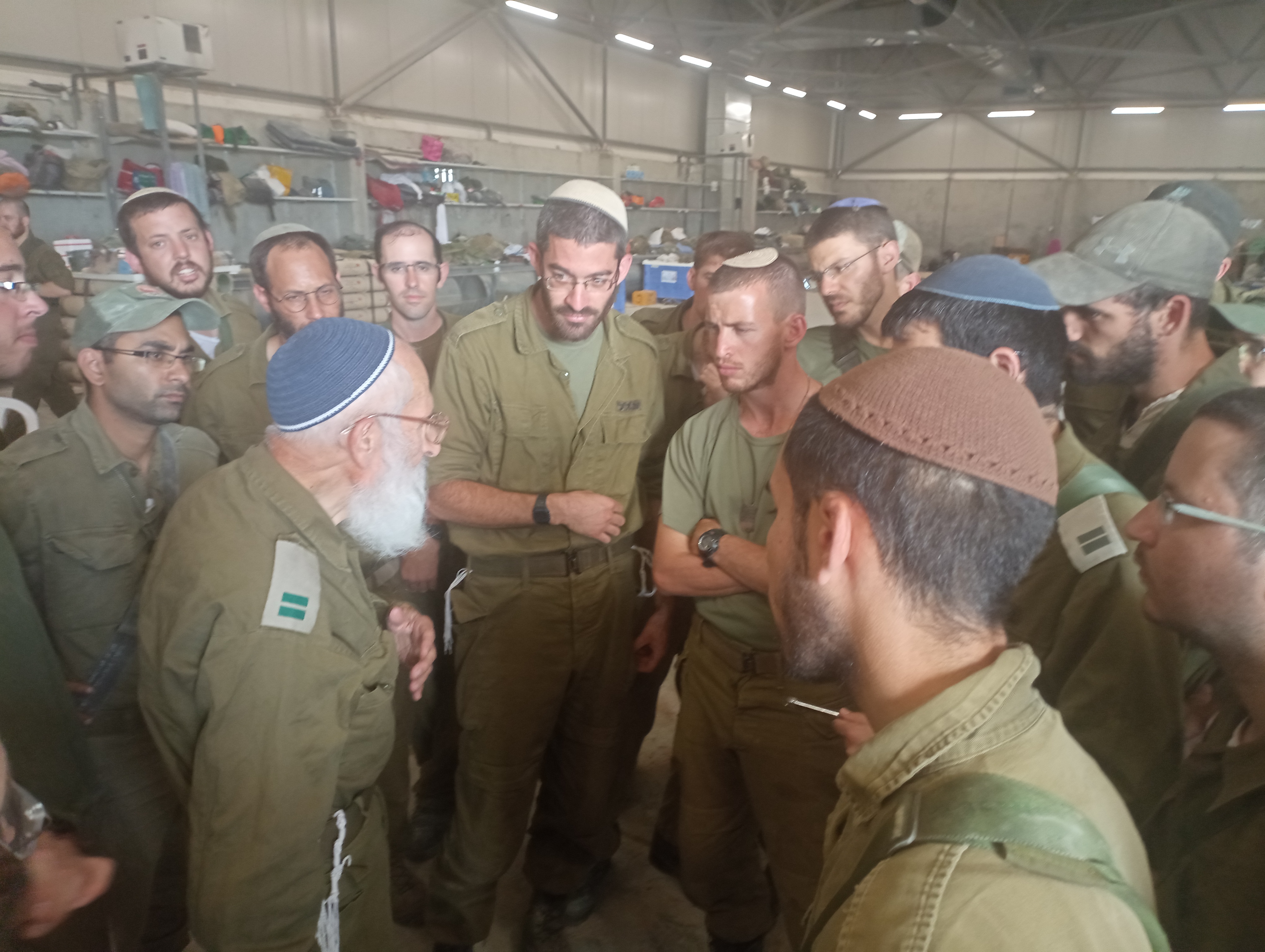
That is Rav Shlomo Aviner, rosh yeshiva of Ateret Kohanim and formerly rav of Bet El among other communities.
At 80 years old Rav Aviner joined the IDF Reserves and put on his uniform and went to strengthen the soldiers and give chizuk. I assume he is serving, if in an official capacity, in the IDF Rabbinate.
According to Wikipedia Rav Aviner as a younger man served in the IDF partaking in both the Six Day War and the Yom Kippur War rising to the rank of Lieutenant.
Be Safe and Godspeed!
------------------------------------------------------
Reach thousands of readers with your ad by advertising on Life in Israel
Reach thousands of readers with your ad by advertising on Life in Israel
------------------------------------------------------
Mar 13, 2022
The farce of "One Kashrut"
Rav Shlomo Aviner posted the following series of questions online (this is my translation):
14 questions to the competing kashrut agency1. Who is the great posek and expert in kashrut that is guiding you?2. who runs your kashrut department, who is recognized in Israel and globally as an expert in kashrut?3. How many years of experience do you have in the field of kashrut?4. How many places that had their kashrut certification removed by the Rabbanut due to serious infractions - transferred to you to get kashrut in its place?5. Do you allow products that the Chief Rabbinate does not allow?6. Do you regularly scoff at the Rabbanut claiming its kashrut is flawed according to halacha?7. Did you write a halachic opinion in opposition to that of the Rabbanut? Halachic articles with positions not acceptable to the majority of poskim?8. Did places under your supervision have any of the following issues: bringing in treif food, using regular cauliflower, unsupervised winery, kashrut for a bakery inside a treif restaurant, cooking on Shabbos, importing artichokes infested with bugs?9. Is a mashgiach who receives a salary from the institution owning the factory paying him - is he free to pasken as he wishes even to remove the kashrut?10. will competition of two institutions not cause people to find more and more leniencies with the institutions providing minimal kashrut supervision?11. Is it true that a mashgiach working for the Rabbanut receives 37nis per hour of supervision and by you he receives 73nis per hour - meaning, double? Will this not cause the prices to go up?12. Is it correct that a business pays the Rabbanut fee of between 527nis and 1383nis for the year and they pay you between 18000 and 30000nis per year - and maybe that causes prices to rise (meaning, 120 million for all the businesses together rather than 10 million)?13. is it correct that your entire apparatus is supported by donations reaching the millions, ten times the revenue brought in, and in your opinion is that proper?14. in your opinion is the ideal being one kashrut that everyone can eat from or a multitude of kashrut organizations?[signed off] One Nation, One State, One Kashrut!
I am not sure the individual questions are all that important but maybe I will relate to some of them, after relating to the bigger picture.
It seems clear, to me at least, that Rav Aviner is referring to Tzohar without saying so explicitly. Unless there are specific claims regarding faults in their supervision (which he alludes to in question #8), the rest of it is mostly irrelevant. I dont care about their individual policies or pricing if it brings about the intended results, of reliable kashrut at a price the public is willing to pay [for the final product].
More generally, if Rav Aviner's goal is one kashrut for everyone, he should be opposed equally to all the other kashrut organizations, yet I have not seen him speak out against them (even if, to be fair, he does prefer the Rabbanut). Why is it ok for Eida, Mahfoud, Rubin, Landau, Kehilot, Beit Yosef, OU and others to operate in the field of kashrut but not Tzohar (or whatever organization he is referring to) - Israel is very far from his ideal of "one Kashrut" and as long as other players are allowed to operate there is no reason to not allow one more. The public will decide which of them to rely on and to support and which not.
Now to specific questions-
1-3: Rav Aviner's implication is that they do not have kashrut experts and rabbonim. He might not like them or agree with them but they do. Some of them even left the Rabbanut to work for Tzohar.
4. nothing wrong with this if the infractions were fixed and dealt with or if they were only infractions by not meeting Rabbanut standards but were ok by Tzohar (or other) standards... Plenty of food establishments lose one hechsher for whatever reason and then go to another.
5. maybe, maybe not. They do not have to follow Rabbanut policy. They have to follow Tzohar policy.
6. I dont know if they do or not, but if they do just add them to the list of all the Haredi hechshers that do the same.
7. similar to #5, there is no obligation to agree with Rabbanut decisions. they are allowed to disagree on halachic opinions and formulate their own. Disagreement in halacha is nothing new. Nobody has ever made the Rabbanut the final arbiter in halacha.
8. if these issues are true this is a valid issue being raised and hopefully they will fix whatever policies and workflows led to these problems. no hechsher is immune from this. There is no shortage of similar faults in the Rabbanut system either.
9. I dont know Tzohar policy on this but this is a well known problem and is one that plagues many of the kashrut organizations in Israel.
10. competition is always good. It gives the consumer more choice and makes the providers come closer to what the consumer wants. That might be more lenient or more strict. In the Haredi community the more competition the stricter it seems to get, so I am not sure the claim is proven. It might start a drive for more leniencies, it might not. And if it does and the leniencies are all within halacha, there is nothing wrong with it and people can choose which they want to rely on.
11. I dont care what they get paid. If they can pay the mashgiach more without it causing price increases, even better. if it becomes too expensive people wont but the product and food establishments wont hire them.
12. this sounds ridiculous and I have no idea if it is accurate or not but if they are charging so much more than the Rabbanut it seems unlikely restaurants or food producers would be willing to pay that price and they will go out of business.
13. if they are supported by donations, so what?
14. If Tzohar closes down due to the argument of "one kashrut", will we then have one kashrut? Is Tzohar preventing that ideal from happening? There are dozens of kashrut organizations in Israel. Tzohar is just one more.
------------------------------------------------------
Reach thousands of readers with your ad by advertising on Life in Israel
Reach thousands of readers with your ad by advertising on Life in Israel
------------------------------------------------------
Nov 17, 2021
Interesting Psak: respecting the Prime Minister
the question was posed to Rav Shlomo Aviner, rav of Bet El and Rosh Yeshiva of Ateret Yerushalayim, if the Prime Minister today, Naftali Bennett, has to be treated with respect and honor befitting a Prime Minister or if because he achieved the office by lying and deceit perhaps he does not deserve any honor or respect?
Rav Aviner responded that the question actually applies equally tot he entire government, as the Prime Minister does not act alone. However, Rav Aviner said, while clearly one should not lie and e deceitful even to achieve such a position, once he has achieved the position he must be shown respect - after all, he is the Prime Minister.
Rav Aviner compares this to the situation from Tanakh in which Absalom stole the hearts of the people and became king. The Yerushalmi says that at that time had David needed to bring a korban he would have brought an individual korban, not a kingly korban - even though Absalom won the office with deceit, he was in fact king.
So, again, while it is prohibited to lie and use deceit, once it has been done we must show him the honor and respect that the office demands. If we dont show him the respect due a national leader, our enemies will pounce on the opportunity of our disunity.
source: Srugim
------------------------------------------------------
Reach thousands of readers with your ad by advertising on Life in Israel
Reach thousands of readers with your ad by advertising on Life in Israel
------------------------------------------------------
Dec 14, 2020
Interesting Psak: musical Hallel
musical Hallels have become very popular in recent years. They provide inspiration and an outlet for many people to experience the joy of Hallel. And they might be fun for many.
In a Chassidishe shteibel, a kloiz, in Modiin Ilit experienced an incident at what was turning into a musical Hallel. A local resident came to the shul to daven and pulled out a violin during Hallel and started playing music to liven up the Hallel.
Somebody else in the minyan told this fellow to stop, but it turned into a bit of a ruckus, with some people saying to leave him alone, not shame him, and let him play the music, and the original upset person stood his ground claiming that music during davening came from the Reform and we cannot allow it to continue and create a breach in our walls. They argued, with examples from the Levites in the Beit Hamikdash (an argument he rejected, saying they also shechted animals on Shabbos in the Mikdash, and that does not mean we can), and from rabbonim (Rav Kook is mentioned) who did so.
Eventually they agreed to let this fellow ask a rav and they would act accordingly.
The fellow asked Rav Aviner, who said that a shul is not a beis hamikdash, and this fellow is also not King David. The Sde Chemed says not to turn davening into a concert (Rav Aviner is also against significant chazzanut performances in davening for this reason).
Rav Aviner concluded that there is a spirit of Reformism entering the Dati and even Haredi worlds, so playing instruments in shul should be avoided.
source: Actualic
The article is strange and a bit questionable. It refers to an incident in Modiin Ilit, Brachfeld, in a kloiz. Yet they asked the question of Rav Aviner and referred to Rav Kook in the arguments. Very strange. I suspect there is something incorrect or inaccurate about this.
------------------------------------------------------
Reach thousands of readers with your ad by advertising on Life in Israel
Reach thousands of readers with your ad by advertising on Life in Israel
------------------------------------------------------
Sep 8, 2020
Rosh Hashana Roundup with CoronaVirus
Rosh Hashana is just a week and a half away and nobody really knows what will be allowed then and what will be recommended, what regulations will be in place, if there will be a closure or not, will the shuls be open or not and if yes for how many people.... so many questions, and we likely won't know until a day or two before the holiday starts. Any decisions and announcements made between now and then will likely be reversed or changed closer to the holiday.
In preparation, as much as possible, for a Rosh Hashana that might have all sorts of limitations, different rabbonim are issuing rulings as to what can, and sometimes should, be changed and what should be kept as normal....
Kipa quotes the rulings from Chief Rabbi Rav Yitzchak Yosef. According to Rav Yosef, all instructions from the Ministry of Health must be followed, including social distancing and wearing masks, and opening the windows of the shul. Anybody who is not careful to wear masks and does not keep his distance in shul and infects other people, and especially if he infects people with prior health conditions and gets him sick and causes death, has transgressed a very serious sin.
After that introduction, Rav Yosef says, regarding:
Shuls: 2 minyanim should be organized, with one operating at sunrise, netz hachama, and the second later. It is better to have the minyanim outdoors if possible, making arrangements for shade and airflow. If davening indoors, the people davening should be divided up into groups as per the instructions from the Health Ministry
Davening: singing and piyutim should be minimized. When necessary, selling the aliyos and other honors should be minimized or cut out, as should the Mi Shebeirachs after aliyahs as well. Rabbonim should shorten any speeches to be given (such as before the shofar blowing). The Mizmor said before the shofar blowing, normally repeated 7 times, should only be said once.
Shofar: People should not stand near the person blowing the shofar to avoid the particles of breath and spittle blown out of the shofar. In necessary situations, the large opening of the shofar can be covered with a face mask, but in such scenarios the mask should be on it tightly and should not go into the shofar itself at all. In such a situation, before the holiday it should be tested to ensure the mask covering the shofar is not changing the sound of it at all.
Anybody sick with CoronaVirus or in quarantine, or anyone in the high risk category, should not go to shul but should daven alone at home and should find someone to blow near his house by a window so he can hear the shofar. One can fulfill his obligation of hearing the shofar blown like this even through a closed door.
Women: women who always go to shul on the Yomim Noraim are not obligated to go to shul and do not need to perform an annulment of vows, a hatarat nedarim. Because women are not obligated in the mitzva of shofar, if there is no space available in shul, a shofar blowing for women should be arranged for later in the afternoon.
Tashlich: someone in quarantine should say tashlich in his house near a bowl of water or by the running water of the faucet.
Selichot: someone in quarantine can say selichot via the telephone or other forms of communication (eg zoom, whatsapp video, etc)
Hatarat Nedarim (Annulment of Vows): someone in quarantine can perform the customary annulment of vows via telephone and other forms of communication, by saying the text along with someone else saying it, and when the "beis din matirim" respond with their text they should have in mind all the participants, including those on the telephone and zoom, etc
Kikar brings the rulings of a number of Rabbis as well on these matters.
Rav Shlomo Raanan, Director of Ayelet Hashachar, asked several poskim the following questions:
1. considering the increased risk of spreading the virus via blown particles, can oen cover the shofar with a mask or a filter, or can the shofar blower keep his mask on while blowing the shofar? (note, I have no idea how the shofar can be blown physically while wearing a mask)
2. can the shofar opening be directed downward?
3. is it ok lechatchila to blow just 30 blasts, and is it ok to skip piyutim?
4. (Ayelet Hashachar is an organization that arranges minyanim and torah learnign in secular areas, especially on secular kibbutzim) in such minyanim as those arranged by Ayelet Hashachar, is it appropriate to be more lenient on being more careful? (note, I dont understand the question. At first I thought there must be a typo in the article, but based on answers below, it was not just me )
Rav Yitzchak Zilbershtein, Rav of Ramat Elchonon neighborhood of Bnei Braq, responded:
1. you cannot blow shofar through a mask - that is a chatzitza.
2. you cannot blow less than 100 blasts, but ask people to keep their distance from the shofar blower.
3. do not cut out piyutim, especially now being in a time when we need more heavenly mercy, but it is really too early to discuss this possibility as things change daily.
4. Rav Zilbershtein didn't understand this question.
Rav Mendel Shafran, posek, av beis din and rosh kollel in Bnei Braq, responded:
1. a. the shofar blowers mouth cannot be covered with a mask because of chatzitza, and disinfecting between people might not help
b. possibly soaking the shofar in alcohol between people using it might help
c. at the large opening of the shofar, a cloth filter can be attached. It is not a chatzitza nor does it affect the sound of the shofar, and dulling the strength of the sound is not a problem.
2. the shofar can be turned downward
3. if there are instructions to finish the minyan quickly, 30 blasts would be enough, and that can be done if chazarat hashatz is not ebing said. It would be better though to say chazarat hashatz but skip the yotzros, and then blow another 30 during the brachos.
Technically, the yotzros can be minimized and even skipped, but, Rav Shafran says, he thinks the congregation will not want to skip some of the regular yotzros that are sung nicely,.
4. all instructions from the Ministry of Helth should be strictly adhered to no matter where you are - in Haredi, Religious or Secular communities.
Rav Gershon Bess, rav of Kehilas Yaakov community responded:
1. covering the shofar with a mask has been checked and found to not affect the sound, so it is fine.
2. It is preferable to not minimize the number of blasts blown and piyutim said.If we follow all the guidelines as instructed, wearing masks and distancing then we have performed our obligations faithfully. Rav Bess says he is hesitant that being lenient on minhagei yisrael could weaken the minhag and next year or in another year there mightbe some issue and people will say but last year we canceled it so it is less important. If necessary, we will dow hat is necessary but if there is no outstanding reason, we should not minimize them.
Rav Shlomo Aviner, one of the leading Religious Zionist rabbis, responded:
1. the mask is a chatzitza (I don't know if he means the mask ont he shofar, the mask on the shofar blower, or both)
2. the shofar can be turned downward
3. piyutim should not be skipped
4. it should be blown near an open window
------------------------------------------------------
Reach thousands of readers with your ad by advertising on Life in Israel
Reach thousands of readers with your ad by advertising on Life in Israel
------------------------------------------------------
Nov 17, 2019
my father is Rav Aviner (video)
------------------------------------------------------
Reach thousands of readers with your ad by advertising on Life in Israel
Reach thousands of readers with your ad by advertising on Life in Israel
------------------------------------------------------
Oct 10, 2019
the Rabbi Who Wants To Be A Modest 12 Year Old Girl aka FSotD
Rav Shlomo Aviner writes:
Translation:
If Rav Aviner wants to be a 12 year old girl, who am I to stop him? In today's day and age, we have accepted each and every person's right to self-identification.
More seriously, this post of Rav Aviner's created quite a brouhaha. Rav Aviner is entitled to his opinion on what modesty is, no matter how extreme his opinion might be, and as a spiritual leader to many, he is perfectly right in publicizing his opinion on the matter. I am not sure the style was such a good idea, seems a little sick and disturbed to me, but he got everybody talking about it, so I guess he won't win any style points but he got his message out successfully.
Rav Aviner's list of modesty rules is the extreme end of extreme, and that is fine for him and for those who want to follow him, no matter how much he is busy sexualizing 12 year old girls in the process.. The best comment I saw on this list is from Rav Amnon Bazak who said that he will only comment on the tenth commandment, despite the entire list being overly extreme. About the tenth he commented that the way to make Hashem happy is to keep the mitzvos. During the 3 regalim, the holidays, Hashem commanded us to be happy and joyous. The Rabam and the Shulchan Aruch explain that this includes making our family members happy, in the way that is fitting for each one. He specifically says that one should buy beautiful clothes and jewelry for the women, as much as he can afford.
Not only is pretty jewelry and clothes not a deficiency, but it is a mitzva to buy these before the holidays. The Torah recognizes that a desire for beauty and aesthetics are part of human nature. Dovid eulogized Saul, who is mentioned in these "ten commandments" mentioning Saul's daughters who wore golden jewelry and adornment son their clothes. An entire chapter in Shulchan Aruch discusses with which types of jewelry a woman can walk outside on Shabbos, and it concludes, "nowadays women are accustomed to going out in all types of jewelry. the Rama adds that now jewelry is common and women wear them outside during the week as well. Not a single commentary on the Shulchan Aruch found any problem with this. Torat Yisrael throughout the generations did not suppress the natural desire to look beautiful and did not fight against it. After this is recognized, one can implement the values of appropriate modesty in a balanced human way.
Translation:
I want to be a modest young lady
by Rav Shlomo Aviner
Soon I will be bat mitzva, and I want to be a modest young lady. I want to be a good girl in the eyes of God, meaning modest. And I do not care what others in the family will say about me. This is my life.
Therefore, I have decided the following:
1. I will not grow bangs, even short bangs, but will gather my hair in braids.
2. I will button all the buttons of my shirt up to the top-most button, and will wear the type of shirt where even the bottom of the neck is covered
3. I will wear a wide shirt that hides my body shape, and one that is not at all transparent
4. I will make sure the buttons on my shirt are close together
5. I will have sleeves that are long, all the way to my palm. Though in the house of Saul they even covered the fingers, but this is enough for me
6. my shirt will be untucked outside the skirt, because if it is tucked into the skirt it will make the skirt tight on my hips and that is not modest.
7. a wide skirt that hides my body shape both when walking and when sitting. I particularly like layers of clothing
8. the skirt will be until my ankles
9. quiet shoes in a modest color without heels
10. no earrings, no jewelry, and no decorations
These are my ten commandments and this is how I will make God happy
If Rav Aviner wants to be a 12 year old girl, who am I to stop him? In today's day and age, we have accepted each and every person's right to self-identification.
More seriously, this post of Rav Aviner's created quite a brouhaha. Rav Aviner is entitled to his opinion on what modesty is, no matter how extreme his opinion might be, and as a spiritual leader to many, he is perfectly right in publicizing his opinion on the matter. I am not sure the style was such a good idea, seems a little sick and disturbed to me, but he got everybody talking about it, so I guess he won't win any style points but he got his message out successfully.
Rav Aviner's list of modesty rules is the extreme end of extreme, and that is fine for him and for those who want to follow him, no matter how much he is busy sexualizing 12 year old girls in the process.. The best comment I saw on this list is from Rav Amnon Bazak who said that he will only comment on the tenth commandment, despite the entire list being overly extreme. About the tenth he commented that the way to make Hashem happy is to keep the mitzvos. During the 3 regalim, the holidays, Hashem commanded us to be happy and joyous. The Rabam and the Shulchan Aruch explain that this includes making our family members happy, in the way that is fitting for each one. He specifically says that one should buy beautiful clothes and jewelry for the women, as much as he can afford.
Not only is pretty jewelry and clothes not a deficiency, but it is a mitzva to buy these before the holidays. The Torah recognizes that a desire for beauty and aesthetics are part of human nature. Dovid eulogized Saul, who is mentioned in these "ten commandments" mentioning Saul's daughters who wore golden jewelry and adornment son their clothes. An entire chapter in Shulchan Aruch discusses with which types of jewelry a woman can walk outside on Shabbos, and it concludes, "nowadays women are accustomed to going out in all types of jewelry. the Rama adds that now jewelry is common and women wear them outside during the week as well. Not a single commentary on the Shulchan Aruch found any problem with this. Torat Yisrael throughout the generations did not suppress the natural desire to look beautiful and did not fight against it. After this is recognized, one can implement the values of appropriate modesty in a balanced human way.
------------------------------------------------------
Reach thousands of readers with your ad by advertising on Life in Israel
Reach thousands of readers with your ad by advertising on Life in Israel
------------------------------------------------------
Jul 4, 2019
Rav Aviner wrong but right about Ayelet Shaked
The fact that Rav Aviner has something against women being out of their own house and doing anything in public is nothing new. I happen to agree with him this time, just on the latest, but for different a reason.
Earlier this week Rav Aviner made a statement in response to a question asked saying it is immodest for men to go to a shiur led by Sivan Rahav Meir. This was shortly after he said that a shul that allows a woman to give a shiur in it from the podium is not an Orthodox shul.
Today Rav Aviner said that Ayelet Shaked should not be let back to lead Habayit Hayehudi (Ichud Hayemin) and that politics is no place for women.
I happen to agree with him that Ayelet Shaked is not the right fit for leading Habayit Hayehudi, and should not be put in that position just because it is a convenient, and possibly available, platform and she is a dynamic and popular leader. Habayit Hayehudi is a religious party for the Dati Leumi sector and Shaked is not religious. That is not a good fit. Habayit Hayehudi has shown that it does not have aspirations to lead the general Israeli public or to include them in its ranks, but it wants to be the national religious party for national religious people. It can make do with Shaked in the party, as a bdieved, but she cannot represent them. She is more fitting for the Likud, or Bennett's Hayemin Hechadash party which is not explicitly religious, but not Habayit Hayehudi.
So, Shaked should not lead Habayit Hayehudi not because she is a woman but because she is not religious and that crowd does not want her as their leader. She does not represent them.
Earlier this week Rav Aviner made a statement in response to a question asked saying it is immodest for men to go to a shiur led by Sivan Rahav Meir. This was shortly after he said that a shul that allows a woman to give a shiur in it from the podium is not an Orthodox shul.
Today Rav Aviner said that Ayelet Shaked should not be let back to lead Habayit Hayehudi (Ichud Hayemin) and that politics is no place for women.
I happen to agree with him that Ayelet Shaked is not the right fit for leading Habayit Hayehudi, and should not be put in that position just because it is a convenient, and possibly available, platform and she is a dynamic and popular leader. Habayit Hayehudi is a religious party for the Dati Leumi sector and Shaked is not religious. That is not a good fit. Habayit Hayehudi has shown that it does not have aspirations to lead the general Israeli public or to include them in its ranks, but it wants to be the national religious party for national religious people. It can make do with Shaked in the party, as a bdieved, but she cannot represent them. She is more fitting for the Likud, or Bennett's Hayemin Hechadash party which is not explicitly religious, but not Habayit Hayehudi.
So, Shaked should not lead Habayit Hayehudi not because she is a woman but because she is not religious and that crowd does not want her as their leader. She does not represent them.
------------------------------------------------------
Reach thousands of readers with your ad by advertising on Life in Israel
Reach thousands of readers with your ad by advertising on Life in Israel
------------------------------------------------------
May 3, 2018
The Pelegesh Yerushalmi
Despite the increasing number of women choosing to serve in the IDF, as per their draft obligations, and not take the exemption given to religious women, Rav Shomo Aviner remains steadfast in his opposition to women joining the army.
According to Rav Aviner it is absolutely prohibited for a woman to serve in the IDF as it is not tzanua and is therefore against halacha. Rav Aviner even says a non-religious woman who lies to get out of serving and says she is religious is doing the right thing - even though she isnt religious she still has to keep halacha and she can keep this one even if she isnt keeping others, and even if it is only to get out of the army, at worst it is a mitzva shelo lishma which is fine.
The most interesting part of Rav Aviner's steadfast opposition is his statement that women should refuse to serve, even if it means going to jail, and he quips that at least the jails are gender-separate!
source: Ynet
Rav Aviner has always been on this side of that debate, so this is nothing really new. It is interesting because of the trend of more and more women, even religious women, choosing to serve - even in combat units. And it is interesting because of him saying they should prefer jail over serving. This is actually a strange statement because they would never need to go to jail - if they are really religious, they would easily get the exemption if they do not want to serve and would never need to choose between serving and jail.
Despite it being strange, his statement is reminiscent of the position of the Peleg Yerushalmi people for men - better to go to jail than to serve (and even rather than just signing the paper to get out of serving). Maybe Rav Aviner can head the women's division of Peleg - what can we call it? Maybe Pelegesh? :-)
According to Rav Aviner it is absolutely prohibited for a woman to serve in the IDF as it is not tzanua and is therefore against halacha. Rav Aviner even says a non-religious woman who lies to get out of serving and says she is religious is doing the right thing - even though she isnt religious she still has to keep halacha and she can keep this one even if she isnt keeping others, and even if it is only to get out of the army, at worst it is a mitzva shelo lishma which is fine.
The most interesting part of Rav Aviner's steadfast opposition is his statement that women should refuse to serve, even if it means going to jail, and he quips that at least the jails are gender-separate!
source: Ynet
Rav Aviner has always been on this side of that debate, so this is nothing really new. It is interesting because of the trend of more and more women, even religious women, choosing to serve - even in combat units. And it is interesting because of him saying they should prefer jail over serving. This is actually a strange statement because they would never need to go to jail - if they are really religious, they would easily get the exemption if they do not want to serve and would never need to choose between serving and jail.
Despite it being strange, his statement is reminiscent of the position of the Peleg Yerushalmi people for men - better to go to jail than to serve (and even rather than just signing the paper to get out of serving). Maybe Rav Aviner can head the women's division of Peleg - what can we call it? Maybe Pelegesh? :-)
------------------------------------------------------
Reach thousands of readers with your ad by advertising on Life in Israel
Reach thousands of readers with your ad by advertising on Life in Israel
------------------------------------------------------
Mar 26, 2018
Interesting Psak: Singing with Koolulam
President of Israel, Reuven "Ruvi" Rivlin, has a nationwide musical program planned for this coming Yom Haatzmaut. Rivlin is using Koolulam to put together a mass singing event which will be videoed and broadcast on Yom Haatzmaut.
To that end, someone asked Rav Aviner about the Koolulam experience and how to relate to it from a halachic perspective.
Here is an example of the most recent Koolulam event, from the Shneider Children's Hospital in Petach Tikva:
and here is my favorite of the Koolulam events, their rendition of Matisyahu's One Day:
So someone asked Rav Aviner about Koolulam events. The initial question asked was if it is kosher, to which Rav Aviner replied it is definitely not kosher and the two problems with it are mixing and mingling of men and women along with mixed singing.
The follow-up question was if it is done in a shul, with men and women separated, is it ok then? Rav Aviner said that would take away the mingling, but would add a problem of doing something improper in a shul and damaging the kedusha of the shul. Regarding this question, I do not know why they asked about doing it in a shul rather than just a gender-separate event anywhere.
Q: What about if they sing "holy songs"?
A: Even worse. Any sin while connecting it to kedusha is worse.
Q: Men cannot hear women sing but what about if it is a lot of women together or many men hearing many women?
A: Even worse, as the sin is magnified by so many people..
Q: what about the fact that at the Koolulam events it is unifying people among the spectrum of Israeli society?
A: unity is good, but not through sin
Q: So how should we unify?
A: have separate Koolulam events for men and for women. And, real unity isnt created by a passing experience. Real unity is created through service in the IDF, mesirut nefesh for each other and for klal yisrael.
Q: And in our daily lives [how is unity created]?
A: helping others, doing chessed. that is true love.
source: Kipa
The main method of creating unity is through army service? Army service, like any difficult/challenging/dangerous experience will be a bonding experience and create some sort of unity, but is that really the main or only way to create unity, discounting all others? Especially when you don't want half the people (the women) to serve in the army, and many others also do not, such as Arabs and Haredim, among others. It creates a bond, and perhaps unity, but only among those serving together in the same unit.
I am not sure what the premise was for asking if hearing women is still a problem if it is many men listening to many women. Why would the number of men listening change anything?
I do not know why they did not ask about the common hetter of "two voices cannot be heard", meaning with so many people singing together, you aren't hearing anybody's voice, or anybody specific's voice, thus it is allowed and not kol isha. I also don't know why they did not ask about the men singing as well and thus not hearing the other women singing. Either way, Rav Aviner very well might reject those hetterim and say it does not matter, or he might say even if such a hetter could be valid (in some circumstances) it is still inappropriate and still mingling of men and women,but it still should have been asked. I think they are more relevant questions than, for example, asking about doing the event inside a shul.
To that end, someone asked Rav Aviner about the Koolulam experience and how to relate to it from a halachic perspective.
Here is an example of the most recent Koolulam event, from the Shneider Children's Hospital in Petach Tikva:
So someone asked Rav Aviner about Koolulam events. The initial question asked was if it is kosher, to which Rav Aviner replied it is definitely not kosher and the two problems with it are mixing and mingling of men and women along with mixed singing.
The follow-up question was if it is done in a shul, with men and women separated, is it ok then? Rav Aviner said that would take away the mingling, but would add a problem of doing something improper in a shul and damaging the kedusha of the shul. Regarding this question, I do not know why they asked about doing it in a shul rather than just a gender-separate event anywhere.
Q: What about if they sing "holy songs"?
A: Even worse. Any sin while connecting it to kedusha is worse.
Q: Men cannot hear women sing but what about if it is a lot of women together or many men hearing many women?
A: Even worse, as the sin is magnified by so many people..
Q: what about the fact that at the Koolulam events it is unifying people among the spectrum of Israeli society?
A: unity is good, but not through sin
Q: So how should we unify?
A: have separate Koolulam events for men and for women. And, real unity isnt created by a passing experience. Real unity is created through service in the IDF, mesirut nefesh for each other and for klal yisrael.
Q: And in our daily lives [how is unity created]?
A: helping others, doing chessed. that is true love.
source: Kipa
The main method of creating unity is through army service? Army service, like any difficult/challenging/dangerous experience will be a bonding experience and create some sort of unity, but is that really the main or only way to create unity, discounting all others? Especially when you don't want half the people (the women) to serve in the army, and many others also do not, such as Arabs and Haredim, among others. It creates a bond, and perhaps unity, but only among those serving together in the same unit.
I am not sure what the premise was for asking if hearing women is still a problem if it is many men listening to many women. Why would the number of men listening change anything?
I do not know why they did not ask about the common hetter of "two voices cannot be heard", meaning with so many people singing together, you aren't hearing anybody's voice, or anybody specific's voice, thus it is allowed and not kol isha. I also don't know why they did not ask about the men singing as well and thus not hearing the other women singing. Either way, Rav Aviner very well might reject those hetterim and say it does not matter, or he might say even if such a hetter could be valid (in some circumstances) it is still inappropriate and still mingling of men and women,but it still should have been asked. I think they are more relevant questions than, for example, asking about doing the event inside a shul.
------------------------------------------------------
Reach thousands of readers with your ad by advertising on Life in Israel
Reach thousands of readers with your ad by advertising on Life in Israel
------------------------------------------------------
Mar 14, 2018
Interesting Psak: learning with someone who goes to Har Habayit
Someone asked Rav Aviner if he can continue learning, "bchavrusa", with his friend, as his friend, who is a good person with fine character traits and is learned, goes up to Har Habayit.
Rav Aviner responded that one should break off the learning partnership. He said you can continue being friends, doing things and doing mitzvos together, but not to learn together - learning Torah is the basis for the proper outlook and approach to life, and clearly this person has something messed up in him.
However, one need not cancel a shidduch that was arranged with a person who goes up to Har Habayit. Rav Aviner explains that nobody is perfect and we are judged by the majority of our actions, as we all have benefits and detriments. Torah is Godly and must be exact and we cannot allow distorted views in, but for a shidduch it is ok as none of us are perfect.
source: Srugim
interesting
Rav Aviner responded that one should break off the learning partnership. He said you can continue being friends, doing things and doing mitzvos together, but not to learn together - learning Torah is the basis for the proper outlook and approach to life, and clearly this person has something messed up in him.
However, one need not cancel a shidduch that was arranged with a person who goes up to Har Habayit. Rav Aviner explains that nobody is perfect and we are judged by the majority of our actions, as we all have benefits and detriments. Torah is Godly and must be exact and we cannot allow distorted views in, but for a shidduch it is ok as none of us are perfect.
source: Srugim
interesting
------------------------------------------------------
Reach thousands of readers with your ad by advertising on Life in Israel
Reach thousands of readers with your ad by advertising on Life in Israel
------------------------------------------------------
Jun 29, 2017
new wedding minhagim irk Rav aviner
Rav Aviner wrote an interesting piece against what he calls new customs that have taking hold in the community at weddings, yet they do not have sources to them and are against halacha. He begins with an example of decorating the chuppa and says it isn't beautifying the mitzva, but denigrating the chuppa itself, as if the chuppa isn't good enough on its own to make the couple happy. And if you say it is to make the guests happy, that is also a new invention, as the guests are coming to make the new couple happy, but now we have to make the guests happy!
(as an aside, by the above logic, why would we ever beautify any mitzvah - wouldn't it be denigrating to the essence of the mtizva as if saying it alone isn't enough? a sukka? a tallis with an atara? a Shabbos table beautifully set? silver kiddush cubs or shabbos candlesticks? and on and on and on.. but we have a concept of zeh keli v'anveihu - it is important to beautify the mitzvah)
Rav Aviner wrote a list of examples. I am not going to translate the list, but I'll summarize it briefly. They are all interesting and can raise many interesting halachic and hashkafic debates, and I will leave that to others. I will comment on a few.
Another noteworthy minhag is #8 - women holding the chuppa poles. It is funny how he adds that the men can do it just fine without their help. As if they are doing it to help the men, rather than having found a way to participate in some small way in the wedding ceremony (and maybe even with a desire to take advantage of the supposed segula for finding a marriage partner). Again, something that is not halachic in any way, and is not even a woman doing anything in public - speaking, singing, saying a bracha, or anything ceremonial like that, but still she can't do it.
A third minhag I would comment on is #7 - the bride saying the bracha of shehechiyanu. I have personally never seen this, but that is beside the point. His comment is that surely she is happy in the mitzva about to be performed but happiness is internal and not for public display. He left it out, but he must have meant that happiness for a woman can only be internal, as it is very common for the man to make the sheheyanu bracha on a tallis and he does not mention that as a new minhag or as an inappropriate public display of happiness.
#14 seems silly. Just because one idiot did it does not turn it into a minhag that needs to be counted in a list of common issues.
Another would be #13. he has a problem with the pool or the boat, I am not sure. I am pretty sure that prior to it being done today, over the generation plenty of people have gotten married while on boats. Though those boats were most often not in swimming pools. So he is against one person who got married in a boat i a pool. That sounds important enough to decry as a new minhag. Again, just because one idiot does something does not turn it into a minhag.
And just because people find ways to make their chuppa stand out and be unique in some way, whether by having flowers or near a pool or in a boat or in a pool or whatever, does not turn it into a minhag that needs to become a halachic discussion. If it is not against halacha (and some of the issues he raised can surely be discussed as potential halachic problems), it does not necessarily need to be considered a minhag. Many of the things we do in our daily lives, and at lifecycle events or at ceremonial events, are not halachic in nature, but they make us feel good/unique/special in some way or they provide for a meaningful experience based on the person's personal interests. If it is not against halacha, sometime sit is worth being happy that Jews are celebrating in a Jewish way.
(as an aside, by the above logic, why would we ever beautify any mitzvah - wouldn't it be denigrating to the essence of the mtizva as if saying it alone isn't enough? a sukka? a tallis with an atara? a Shabbos table beautifully set? silver kiddush cubs or shabbos candlesticks? and on and on and on.. but we have a concept of zeh keli v'anveihu - it is important to beautify the mitzvah)
Rav Aviner wrote a list of examples. I am not going to translate the list, but I'll summarize it briefly. They are all interesting and can raise many interesting halachic and hashkafic debates, and I will leave that to others. I will comment on a few.
1. saying Im Eshkocheich Yerushalayim. breaking the cup and putting ash on the head - yes, Im Eshkocheich no. That led to singing it, and at the third stage playing music to it and fourth stage adding more verses to what the chattan saysI am not sure what his problem is with #6 - women reading the kesuba. he goes on to say anybody, even a monkey, can do it because no action is needed, but he still seems opposed to it, though he doesn't say why. It seems, considering that along with some of the others, he is just against women participating in any way, even in ways they are halachically allowed to.
2. the minhag was always to have both fathers walk groom and both mothers to walk bride. new minhag is to have each set of parents walk their own child.
3. playing music between each bracha. can be a hefsek
4. saying divrei torah before or during the wedding blessings. this also led to women saying divrei torah
5. mentioning dead relatives being present with us even though they physically couldn't be present. there is minhag to go to cemetery before wedding and invite them to the chuppa, but mentioning them under the chuppa is new
6. women reading the kesuba. purpose of reading is just to effect a break, so anybody can do it,
7. bride saying shehechiyanu. Sure she is happy and can make a bracha on a new garment and include the wedding, but thanking God is an internal thing and not one for presentations
8. women holding the chuppa poles. There is no need to create new things and change things. Men can hold them up just fine. Even though women hold up the house, that is not connected to this.
9. bride and groom hugging publicly. kissing is definitely prohibited
10. an important person called up for sheva brachos, and his wife stands beside him to show support. That led to him and her saying the bracha together, which led to women saying the bracha alone
11. bride giving ring to groom
12. bride and groom descending to chuppa in a cage lowered from above
13. chuppa in a boat in a pool
14. a chuppa that was by the pool. The rav and the chattan started arguing about something, and the chattan pushed the rav into the pool. Then it was revealed that it was not really the rav but an actor playing the part just for fun. The rav came right after and performed the ceremony. While not specifying, I guess the new minhag here is having an acting performance.
Another noteworthy minhag is #8 - women holding the chuppa poles. It is funny how he adds that the men can do it just fine without their help. As if they are doing it to help the men, rather than having found a way to participate in some small way in the wedding ceremony (and maybe even with a desire to take advantage of the supposed segula for finding a marriage partner). Again, something that is not halachic in any way, and is not even a woman doing anything in public - speaking, singing, saying a bracha, or anything ceremonial like that, but still she can't do it.
A third minhag I would comment on is #7 - the bride saying the bracha of shehechiyanu. I have personally never seen this, but that is beside the point. His comment is that surely she is happy in the mitzva about to be performed but happiness is internal and not for public display. He left it out, but he must have meant that happiness for a woman can only be internal, as it is very common for the man to make the sheheyanu bracha on a tallis and he does not mention that as a new minhag or as an inappropriate public display of happiness.
#14 seems silly. Just because one idiot did it does not turn it into a minhag that needs to be counted in a list of common issues.
Another would be #13. he has a problem with the pool or the boat, I am not sure. I am pretty sure that prior to it being done today, over the generation plenty of people have gotten married while on boats. Though those boats were most often not in swimming pools. So he is against one person who got married in a boat i a pool. That sounds important enough to decry as a new minhag. Again, just because one idiot does something does not turn it into a minhag.
And just because people find ways to make their chuppa stand out and be unique in some way, whether by having flowers or near a pool or in a boat or in a pool or whatever, does not turn it into a minhag that needs to become a halachic discussion. If it is not against halacha (and some of the issues he raised can surely be discussed as potential halachic problems), it does not necessarily need to be considered a minhag. Many of the things we do in our daily lives, and at lifecycle events or at ceremonial events, are not halachic in nature, but they make us feel good/unique/special in some way or they provide for a meaningful experience based on the person's personal interests. If it is not against halacha, sometime sit is worth being happy that Jews are celebrating in a Jewish way.
------------------------------------------------------
Reach thousands of readers with your ad by advertising on Life in Israel
Reach thousands of readers with your ad by advertising on Life in Israel
------------------------------------------------------
Jun 20, 2017
Interesting Psak: Yichud among pilots
Ever since PM Benjamin Netanyahu publicized the existence of the first female Haredi pilot last week, I have seen much discussion online about whether or nto she should really be considered Haredi, and if there is a problem with yichud in the pilots cabin when flying a plane.
People just don't take well to anybody who does things a little differently than the average.
Anyways, someone asked Rav Aviner about it, and because the topic is interesting, I'll share it here..
According to what is reported on Srugim, Rav Aviner responded to the query by saying that a similar question was asked about a private plane that was being rented to take a female passenger somewhere. Rav Asher Weiss said there is no yichud because they will not come to any "hanky panky" as the pilot has to focus on flying the plane and if he gets drawn away from that the plane will surely crash.
Rav Aviner says that in a large plane, even more so it is not a problem. In a large plane there are stewards and stewardesses going into the cabin. And even with auto-pilot, the pilot still has to be alert and focused and ready to take over the controls at any moment.
Rav Aviner concludes with an anecdote of how he once answered a similar question on a halachic program for the army. He was asked about a pilot with a religious female navigator being yichud. He says he answered then that it is not yichud (though he says there were other problems, though he does not specify). After the fact he was called by a reporter asking how he can answer army questions as a civilian. He responded that he is discussing theoretical questions, not practical, so it is ok, though he says after that he stopped answering army-related question and directs them to the IDF Rabbinate..
interesting
People just don't take well to anybody who does things a little differently than the average.
Anyways, someone asked Rav Aviner about it, and because the topic is interesting, I'll share it here..
According to what is reported on Srugim, Rav Aviner responded to the query by saying that a similar question was asked about a private plane that was being rented to take a female passenger somewhere. Rav Asher Weiss said there is no yichud because they will not come to any "hanky panky" as the pilot has to focus on flying the plane and if he gets drawn away from that the plane will surely crash.
Rav Aviner says that in a large plane, even more so it is not a problem. In a large plane there are stewards and stewardesses going into the cabin. And even with auto-pilot, the pilot still has to be alert and focused and ready to take over the controls at any moment.
Rav Aviner concludes with an anecdote of how he once answered a similar question on a halachic program for the army. He was asked about a pilot with a religious female navigator being yichud. He says he answered then that it is not yichud (though he says there were other problems, though he does not specify). After the fact he was called by a reporter asking how he can answer army questions as a civilian. He responded that he is discussing theoretical questions, not practical, so it is ok, though he says after that he stopped answering army-related question and directs them to the IDF Rabbinate..
interesting
------------------------------------------------------
Reach thousands of readers with your ad by advertising on Life in Israel
Reach thousands of readers with your ad by advertising on Life in Israel
------------------------------------------------------
May 9, 2017
Rav Aviner would cancel Lag bOmer
I am not a follower of Rav Aviner and don't know much of what he says or talks about. The little I have heard from him have mostly been tings I did not agree with and I don't normally personally really connect to what I see quoted from him.
That being said, when he said today that if it were up to him he would cancel lag bOmer entirely, I can find myself agreeing with that. It is a made-up holiday and has come in recent years to have way too much significance on society and our daily lives. It does not need to be a day off of school. It does not need to cause even the slightest possibility of chilul shabbos. It does not require people to throw off their schedules staying up throughout the night and traveling up north.
People, as always, can do what they want, go to Meron or not, dance, cut hair or whatever, but Lag bOmer does not need to be considered a holiday.
That being said, when he said today that if it were up to him he would cancel lag bOmer entirely, I can find myself agreeing with that. It is a made-up holiday and has come in recent years to have way too much significance on society and our daily lives. It does not need to be a day off of school. It does not need to cause even the slightest possibility of chilul shabbos. It does not require people to throw off their schedules staying up throughout the night and traveling up north.
People, as always, can do what they want, go to Meron or not, dance, cut hair or whatever, but Lag bOmer does not need to be considered a holiday.
------------------------------------------------------
Reach thousands of readers with your ad by advertising on Life in Israel
Reach thousands of readers with your ad by advertising on Life in Israel
------------------------------------------------------
Aug 31, 2015
The rodef and the nirdaf
Rav Aviner was asked about the status of people who "harass" the Rabbanut and work to its demise. Rav Aviner's response was that it is very serious, and he quoted Rav Shapira who said such people have the din of a rodef.
While personally I am [relatively] confident Rav Aviner was employing hyperbole in his answer and did not actually mean such people should be killed, as is the common understanding people get when the term rodef is used, I do think it behooves our leaders, both rabbinic and otherwise, to tone down the level of speech.
The term rodef is highly charged nowadays and we need to take extra care to not give people an excuse to act, especially in the name of the Torah, in a violent manner.
And really? Is a person really a rodef every time he does something you don't like? Have we not overused the rodef title by a lot?
And nothing to do specifically with Rav Aviner, as I have wondered about this in the past, if you use the term and call someone a "rodef" when he isn't one, using hyperbole or whatever, does that person then become a nirdaf and the speaker become the rodef?
While personally I am [relatively] confident Rav Aviner was employing hyperbole in his answer and did not actually mean such people should be killed, as is the common understanding people get when the term rodef is used, I do think it behooves our leaders, both rabbinic and otherwise, to tone down the level of speech.
The term rodef is highly charged nowadays and we need to take extra care to not give people an excuse to act, especially in the name of the Torah, in a violent manner.
And really? Is a person really a rodef every time he does something you don't like? Have we not overused the rodef title by a lot?
And nothing to do specifically with Rav Aviner, as I have wondered about this in the past, if you use the term and call someone a "rodef" when he isn't one, using hyperbole or whatever, does that person then become a nirdaf and the speaker become the rodef?
------------------------------------------------------
Reach thousands of readers with your ad by advertising on Life in Israel
------------------------------------------------------
Jan 26, 2015
Interesting Psak: Har Habayit or the Knesset
Rav Aviner today announced that he cannot support Otzma Yehudit, or support the possible merge with Eli Yishai's Yachad - Ha'am Itanu, due to one factor, despite them being a group that will prevent the continued legislation against the Torah and Judaism. That factor is, the members of Otzma Yehudit, or some of them at least, either go up to har habayit or they support ascending Har Habayit.
Rav Aviner said only if the parties together announce that they are against the ascension to har habayit can he support them.
While I would think that this would be a relatively minor issue, considering the limitations in place and the other major issues that are front and center in these elections, Rav Aviner puts this issue at top priority.
Rav Aviner said that the issue of ascending Har Habayit is not personal, but is one that affects all of Klal Yisrael. He said, this is something that was prohibited by the rabbis of previous generations, and it is not the field of any particular rabbi to allow it. Just like we cannot allow or cause damage to the Torah, we cannot allow or cause damage to Har Habayit.
So, Rav Aviner said, they must denounce ascension to Har Habayit, and if they don't, they should not be cooperated with.
So, the interesting psak is that Rav Aviner says you cannot vote for or support a party that supports going up to Har Habayit.
Dr. Michael Ben Ari and the others have to decide, which is more important to them - Har Habayit or the Knesset. That is, if they want Rav Aviner's support.
source: Srugim
Rav Aviner said only if the parties together announce that they are against the ascension to har habayit can he support them.
While I would think that this would be a relatively minor issue, considering the limitations in place and the other major issues that are front and center in these elections, Rav Aviner puts this issue at top priority.
Rav Aviner said that the issue of ascending Har Habayit is not personal, but is one that affects all of Klal Yisrael. He said, this is something that was prohibited by the rabbis of previous generations, and it is not the field of any particular rabbi to allow it. Just like we cannot allow or cause damage to the Torah, we cannot allow or cause damage to Har Habayit.
So, Rav Aviner said, they must denounce ascension to Har Habayit, and if they don't, they should not be cooperated with.
So, the interesting psak is that Rav Aviner says you cannot vote for or support a party that supports going up to Har Habayit.
Dr. Michael Ben Ari and the others have to decide, which is more important to them - Har Habayit or the Knesset. That is, if they want Rav Aviner's support.
source: Srugim
------------------------------------------------------
Reach thousands of readers with your ad by advertising on Life in Israel
------------------------------------------------------
Sep 1, 2014
Interesting Psak: no playing Tkof Taaseh Biguim
The song "Tkof, Taaseh Biguim" was clearly the hit song of the summer. Hamas published and released a song that was mean to be threatening and upsetting, and play some psychological warfare on the Israelis.. Somehow and somewhy, the song instead went viral in Israel, with many satirical parodies being made of the song.
Now, when the song has already faded and will no longer qualify in any way for Casey Kasem's Top 40, we get some rabbinic attention devoted to the song.
Rav Shlomo Aviner (and those of you who know my affinity for Rav Aviner will surely recognize that this gets attention not because of him but because of the song), rosh yeshiva of Ateret Kohanim, has paskened that it is prohibited to listen to the Tkof song, and it is prohibited to create parodies of the song as well..
Rav Aviner explains that the song, the original song, arouses aggressive and threatening feelings, and its point is to arouse people to kill Jews. According to the Rambam the words of a song must be pure, clean and kosher.
Rav Aviner also says there is importance to the identity of the creator of a song, and not just the words used. A singer must be an appropriate person, as he is also a form of a teacher. He must be an example in his ways and behavior..
Rav Aviner also relates to the tune, and says it must be kosher. The tune must arouse sensitive feelings and not aggressive feelings.. a song is not just entertainment but it affects the soul.
Therefore, Rav Aviner concludes, the song is not kosher, and it is not kosher to make parodies of it.
source: NRG
the original
one of the many parodies
Now, when the song has already faded and will no longer qualify in any way for Casey Kasem's Top 40, we get some rabbinic attention devoted to the song.
Rav Shlomo Aviner (and those of you who know my affinity for Rav Aviner will surely recognize that this gets attention not because of him but because of the song), rosh yeshiva of Ateret Kohanim, has paskened that it is prohibited to listen to the Tkof song, and it is prohibited to create parodies of the song as well..
Rav Aviner explains that the song, the original song, arouses aggressive and threatening feelings, and its point is to arouse people to kill Jews. According to the Rambam the words of a song must be pure, clean and kosher.
Rav Aviner also says there is importance to the identity of the creator of a song, and not just the words used. A singer must be an appropriate person, as he is also a form of a teacher. He must be an example in his ways and behavior..
Rav Aviner also relates to the tune, and says it must be kosher. The tune must arouse sensitive feelings and not aggressive feelings.. a song is not just entertainment but it affects the soul.
Therefore, Rav Aviner concludes, the song is not kosher, and it is not kosher to make parodies of it.
source: NRG
------------------------------------------------------
Reach thousands of readers with your ad by advertising on Life in Israel
------------------------------------------------------
May 19, 2014
Is patriotism worthless?
In light of the victory of Maccabi Tel Aviv over Real Madrid for the Euroleague champuionship last night, someone asked Rav Aviner if such a victory is a kiddush hashem and if it brings honor and respect to the State of Israel...
basically Rav Aviner's answer was that no, it is not a kiddush hashem and it is narishkeit. We should be proud of chessed or scientific discoveries... but not sports..
source: Srugim
I more or less agree with Rav Aviner, even though I am a sports fan, both enjoying to play and participate in many different sports as well as watching and following some sports (much less now than I used to). And no, I did not watch the Maccabi Tel Aviv game last night. Despite my loving sports, I know it is narishkeit to watch and follow a sports team (rather than participating in sports in which there are health benefits and learnign to be a part of a team, learning to deal with loss, learning how to win graciously, etc.)...
It is definitely not a kiddush hashem when one team wins over another. If it were, that would also mean the next day when the team loses it is a chilul hashem. It is just sports. As long as they play with sportsmanlike behavior and give it their best shot, that is good, but a victory or loss is not a kiddush hashem
But so many people, despite it being narishkeit, do follow sports. There is a sense of pride and patriotism when the team from your city or country wins. Is it worthless? Perhaps. I don't know. People like to be proud of their successes, the successes of their nation. Is it as important as a significant science or medical discovery? obviously not. Is it as important as a group of people who create a program to feed the needy and succeed in feeding thousands of destitute people a month? obviously not. But is it worthless? I don't know. Is patriotism worthless?
basically Rav Aviner's answer was that no, it is not a kiddush hashem and it is narishkeit. We should be proud of chessed or scientific discoveries... but not sports..
source: Srugim
I more or less agree with Rav Aviner, even though I am a sports fan, both enjoying to play and participate in many different sports as well as watching and following some sports (much less now than I used to). And no, I did not watch the Maccabi Tel Aviv game last night. Despite my loving sports, I know it is narishkeit to watch and follow a sports team (rather than participating in sports in which there are health benefits and learnign to be a part of a team, learning to deal with loss, learning how to win graciously, etc.)...
It is definitely not a kiddush hashem when one team wins over another. If it were, that would also mean the next day when the team loses it is a chilul hashem. It is just sports. As long as they play with sportsmanlike behavior and give it their best shot, that is good, but a victory or loss is not a kiddush hashem
But so many people, despite it being narishkeit, do follow sports. There is a sense of pride and patriotism when the team from your city or country wins. Is it worthless? Perhaps. I don't know. People like to be proud of their successes, the successes of their nation. Is it as important as a significant science or medical discovery? obviously not. Is it as important as a group of people who create a program to feed the needy and succeed in feeding thousands of destitute people a month? obviously not. But is it worthless? I don't know. Is patriotism worthless?
------------------------------------------------------
Reach thousands of readers with your ad by advertising on Life in Israel
------------------------------------------------------
Jan 2, 2014
Rav Aviner on davening for Ariel Sharon
Rav Aviner issued an interesting psak in regards to the sterioration of the already poor health of Ariel Sharon.
Rav Aviner said there is no need to daven for Ariel Sharon's health.
I'll admit that when I first heard the announcement I assumed it was because of Sharon's involvement in the Disengagement from Gaza. Rabbi Aviner was very involved in opposing the Disengagement. I could understand if Rav Aviner would think very badly of Sharon, as a result of that conflict, and would therefore say Sharon is a rasha whose life shiould not be davened for.
I admit that is what I first thought was going on.
But that was wrong. That was not the reasoning employed by Rav Aviner. It had absolutely nothing to do with it.
Rav Aviner said that one need not pray for Ariel Sharon's health because even if gets out of his current predicament, it would bring him to a life not worth living. Davening for him would not be doing him a favor.

Regarding the idea that maybe he should not be prayed for because of his involvement in the Disengagement, Rav Aviner said that he did problematic things, but he also did good things. He is a hero, in the Yom Kippur War he saved us - not just him, but he saved us. He has many merits, and he has debts. We must be grateful to him for his good aspects.
One could daven very generally. Just like we daven for rain but we dont specify how much rain we want on how many dunam of land, we can daven generally for Sharon and let Hashem decide what to do with the prayers.
(source: Srugim)
I would suggest that one can daven that Sharon be in less pain or suffer less. I have no idea what he feels and what he doesn't. While davening for his recovery might be pointless, one could still daven regarding his level of suffering.
However, that was a side point. I am surprised to hear such a statement, that even if he could recover from this it could only be to a life of tremendous pain, one of serious brain injury, and one not worth living. I always thought that we, as Orthodox Jews, believed that our prayers can overcome anything. And that any additional moment of life is worth living, no matter what state the person is in.
I have been torn many times, not knowing what is right. Someone who suffers tremendously, do you daven for his recovery or not. For example, just like we can daven generally for Ariel Sharon, as Rav Aviner explained, why can we not also daven that he recover from his brain injury? He says we can daven, but if the prayers help it would bring him to a bad situation - so why not daven for that situation to be repaired as well?
What are the limits of our tefilla? Are there limits? Are there no limits? All sorts of questions come to mind as a result of Rav Aviner's statement...
Rav Aviner said there is no need to daven for Ariel Sharon's health.
I'll admit that when I first heard the announcement I assumed it was because of Sharon's involvement in the Disengagement from Gaza. Rabbi Aviner was very involved in opposing the Disengagement. I could understand if Rav Aviner would think very badly of Sharon, as a result of that conflict, and would therefore say Sharon is a rasha whose life shiould not be davened for.
I admit that is what I first thought was going on.
But that was wrong. That was not the reasoning employed by Rav Aviner. It had absolutely nothing to do with it.
Rav Aviner said that one need not pray for Ariel Sharon's health because even if gets out of his current predicament, it would bring him to a life not worth living. Davening for him would not be doing him a favor.
Regarding the idea that maybe he should not be prayed for because of his involvement in the Disengagement, Rav Aviner said that he did problematic things, but he also did good things. He is a hero, in the Yom Kippur War he saved us - not just him, but he saved us. He has many merits, and he has debts. We must be grateful to him for his good aspects.
One could daven very generally. Just like we daven for rain but we dont specify how much rain we want on how many dunam of land, we can daven generally for Sharon and let Hashem decide what to do with the prayers.
(source: Srugim)
I would suggest that one can daven that Sharon be in less pain or suffer less. I have no idea what he feels and what he doesn't. While davening for his recovery might be pointless, one could still daven regarding his level of suffering.
However, that was a side point. I am surprised to hear such a statement, that even if he could recover from this it could only be to a life of tremendous pain, one of serious brain injury, and one not worth living. I always thought that we, as Orthodox Jews, believed that our prayers can overcome anything. And that any additional moment of life is worth living, no matter what state the person is in.
I have been torn many times, not knowing what is right. Someone who suffers tremendously, do you daven for his recovery or not. For example, just like we can daven generally for Ariel Sharon, as Rav Aviner explained, why can we not also daven that he recover from his brain injury? He says we can daven, but if the prayers help it would bring him to a bad situation - so why not daven for that situation to be repaired as well?
What are the limits of our tefilla? Are there limits? Are there no limits? All sorts of questions come to mind as a result of Rav Aviner's statement...
------------------------------------------------------
Reach thousands of readers with your ad by advertising on Life in Israel
------------------------------------------------------
Subscribe to:
Posts (Atom)
Related Posts
