
Apr 14, 2025
meat minhag

Reach thousands of readers with your ad by advertising on Life in Israel
Oct 6, 2022
a strange minhag with the kapparot bird
זקן האדמו"רים הרבי ממשכנות הרועים לאחר כפרות במעונו בשריפת הנוצה של התרנגול, כחלק מהמנהג לעשות זכר למיתות בי"ד ע"י זריקת התרנגול, שריפת הנוצה, והרג וחנק - שחיטה pic.twitter.com/7cJSjuq4u7
— משה ויסברג (@moshe_nayes) October 3, 2022
The elder Admor, the Rebbe of Mishkenot HaRo'im, after performing the kapparot ritual in his office - burning the feathers of the chicken, as part of the minhag to perform a "zecher", a symbolic memorial, of the 4 deaths meted out by beis din for various sins on the kapparot bird - by throwing the bird (like skila), burning feathers, strangulation and beheading - both of which are memorialized by the shchita of the bird.
Reach thousands of readers with your ad by advertising on Life in Israel
Sep 15, 2022
Interesting Psak: apple in honey or sugar
Rav Benzion Mutzafi was asked about the custom of eating apple dipped in honey on Rosh Hashana. Specifically for Sefardim. He was asked if Sefardim have the custom of eating the apple dipped in honey on Rosh Hashana, as the questioners grandfather had told him that they do not?
RavMutzafi responded not to eat apple dipped in honey on Rosh Hashana. Honey, he said, is symbolic of the midat hadin, the attribute of judgment, which we do not wish to trigger on Rosh Hashana. Rav Mutzafi said - your grandfather is right, Sefardim do not eat apple in honey on Rosh Hashana but we cook different fruits and vegetables with sugar and eat them like that.
As an aside, I have had several Rosh Hashana meals in Sefardi homes and they did not have apple and honey that I can remember, but did dip the challa in sugar.
Rav Mutzafi added another reason that I did not understand as it involved gematria and combining letters, and comparing honey to the shofar that sweetens the judgement...
source: Kikar
Reach thousands of readers with your ad by advertising on Life in Israel
Jun 19, 2019
the horse and carriage minhag is on its way out
Dovid Halberstam got married last night to the daughter of Rav Moshe (her first name was not mentioned in the announcements I saw) Halperin from London.
The minhag in Tzanz is that the chosson and kalla, each separately, is brought to the wedding, and escorted by the chassidim, in a horse-drawn carriage, with elders of the chassidus riding the horses.
Being form London, the kalla requested that this minhag be cancelled. She has no interest in being brought in via a horse-drawn carriage. I imagine she feels too refined for such a spectacle.

Despite it being explained to her, and explained that the carriage and horses have already been ordered and that all the Tzanz family weddings follow this minhag, she persisted in her refusal to be brought out as if she is living in the 18th century.
Her request was considered and agreed to, and the horses and carriage order were canceled. I guess it is good that amazon takes returns with so little hassle!
source: Behadrei
I have been to weddings on kibbutzim and in moshavim where at times horses or tractors are used during the wedding (I remember one where the horse was brought into the hall during the dancing, and it slipped on the slick dance floor - that was a big problem. they had a hard time getting it up and was a very difficult site to witness), and the crowd generally enjoys the spectacle.
Turning that into a holy minhag just because a hundred or two hundred or five hundred years ago there were no cars and horses and carriages was the common mode of transportation is just silly. I guess that is similar to wearing a coat under the chuppa because back in Poland or Russia it was freezing cold at outdoor weddings, or like some other customs that have developed over the years. This "minhag" has been dropped by everyone by now, including all hassidic sects, except for Tzanz, and even in Tzanz it is only limited to the family of the rebbe. Not much of a real minhag. I guess now even with the Tzanz family it will peter out after this kalla broke the tradition. I have no problem since this isnt a real minhag anyway. You want a horse at your wedding, get yourself a horse. It doesnt have to be considered an ancient holy minhag.
Reach thousands of readers with your ad by advertising on Life in Israel
Sep 28, 2017
embrace your chicken
Sarah Chandler of the Isabella Freedman Jewish Retreat Center has come up with a new procedure for kappparos. Instead of grabbing the chicken and whipping it through the air, as she says, one would say the kapparos and then embrace the chicken while confessing the sins. A hug solves all ills.
Just to be fair, I would protest the use of the terms grabbing the chicken and whipping it through the air. I rarely see people whip it through the air. Most people wave it gently and uncomfortably. Also the grabbing it is unusual. Most people pick up the chicken very hesitatingly and cautiously.
Back to the hugs, even though hugging the chicken is not the Standard Operating Procedure, I don't think hugging the chicken is really any weirder than waving it over one's head. Or any weirder than waving palm fronds, confessing sins over a body of water with fish (and throwing crumbs in or not), eating a fish head or any of the other symbolic customs we perform on our holidays...
Still weird. I am not hugging a chicken, though I am also not waving it over my head...
Reach thousands of readers with your ad by advertising on Life in Israel
Sep 18, 2017
Interesting Psak: wearing gold jewelry on Rosh Hashana and Yom Kippur
the supposed reason for this custom is to not raise the memory of the Golden Calf on the day we stand in judgement. Presumably wearing gold jewelry would cause God to remember the sin of the Golden Calf.
Personally I do not believe in "new" minhagim so I wear my watch on Yom Kippur (and Rosh Hashana), in addition to the practical reasons to wear it (i.e. to tell the time, and I have no other watch - during the week I use my cellphone or other digital contraptions for telling time).
Someone asked Rav Bentzion Mutsafi about wearing a watch on Rosh Hashana and Yom Kippur with a silver strap that has gold stripes on it.
Rav Mutsafi responded that both men and women can wear gold jewelry on Rosh Hashana and Yom Kippur and there is absolutely no source for the minhag to not wear such jewelry. Only the kohen gadol would remove his gold jewelry and garments when he went into the kodesh kodashim on Yom Kippur. nobody else needs to remove anything. Rav Mutsafi exhorts the questioner, and I guess everyone else, to not make up things from their imagination.
source: Kikar
as an aside, Rav Mutsafi also criticized another new custom.
While everyone talks about going to Uman for Rosh Hashana, there is also a custom, common in Breslav among those who do not go to Uman along with some other people, to spend Rosh Hashana by the grave of Rabbi Shimon Bar Yochai in Meron, also often leaving one's family behind.
I first learned of this custom a few years ago when a friend went with a hassidic rebbe with whom he was close.
Rav Mutsafi said one should preferably daven calmly and peacefully in a shul close to home and eat is meals at home with his family.
New customs all around. None of them are real. People can make up whatever they want and whatever makes them feel good and fulfilled - but it does not mean you have to follow suit.
Reach thousands of readers with your ad by advertising on Life in Israel
Aug 29, 2017
no kapparos with chickens in Petach Tikva
City Hall of Petach Tikva is actually only banning the slaughtering of the chickens, but the practice of kapparos with a chicken without slaughtering it will be allowed but only with a permit from the veterinary services. Permits for this should be requested no later than September 9. I am not sure what people with permits are going to do with the chickens after the kapparos if they will not be allowed to shecht them, but I guess they'll figure something out.
City Hall recommends changing your minhag to do the kapparos with a donation of money to tzedaka instead of using the chicken.
Source: Srugim
It must be Elul already....
Reach thousands of readers with your ad by advertising on Life in Israel
Jun 29, 2017
new wedding minhagim irk Rav aviner
(as an aside, by the above logic, why would we ever beautify any mitzvah - wouldn't it be denigrating to the essence of the mtizva as if saying it alone isn't enough? a sukka? a tallis with an atara? a Shabbos table beautifully set? silver kiddush cubs or shabbos candlesticks? and on and on and on.. but we have a concept of zeh keli v'anveihu - it is important to beautify the mitzvah)
Rav Aviner wrote a list of examples. I am not going to translate the list, but I'll summarize it briefly. They are all interesting and can raise many interesting halachic and hashkafic debates, and I will leave that to others. I will comment on a few.
1. saying Im Eshkocheich Yerushalayim. breaking the cup and putting ash on the head - yes, Im Eshkocheich no. That led to singing it, and at the third stage playing music to it and fourth stage adding more verses to what the chattan saysI am not sure what his problem is with #6 - women reading the kesuba. he goes on to say anybody, even a monkey, can do it because no action is needed, but he still seems opposed to it, though he doesn't say why. It seems, considering that along with some of the others, he is just against women participating in any way, even in ways they are halachically allowed to.
2. the minhag was always to have both fathers walk groom and both mothers to walk bride. new minhag is to have each set of parents walk their own child.
3. playing music between each bracha. can be a hefsek
4. saying divrei torah before or during the wedding blessings. this also led to women saying divrei torah
5. mentioning dead relatives being present with us even though they physically couldn't be present. there is minhag to go to cemetery before wedding and invite them to the chuppa, but mentioning them under the chuppa is new
6. women reading the kesuba. purpose of reading is just to effect a break, so anybody can do it,
7. bride saying shehechiyanu. Sure she is happy and can make a bracha on a new garment and include the wedding, but thanking God is an internal thing and not one for presentations
8. women holding the chuppa poles. There is no need to create new things and change things. Men can hold them up just fine. Even though women hold up the house, that is not connected to this.
9. bride and groom hugging publicly. kissing is definitely prohibited
10. an important person called up for sheva brachos, and his wife stands beside him to show support. That led to him and her saying the bracha together, which led to women saying the bracha alone
11. bride giving ring to groom
12. bride and groom descending to chuppa in a cage lowered from above
13. chuppa in a boat in a pool
14. a chuppa that was by the pool. The rav and the chattan started arguing about something, and the chattan pushed the rav into the pool. Then it was revealed that it was not really the rav but an actor playing the part just for fun. The rav came right after and performed the ceremony. While not specifying, I guess the new minhag here is having an acting performance.
Another noteworthy minhag is #8 - women holding the chuppa poles. It is funny how he adds that the men can do it just fine without their help. As if they are doing it to help the men, rather than having found a way to participate in some small way in the wedding ceremony (and maybe even with a desire to take advantage of the supposed segula for finding a marriage partner). Again, something that is not halachic in any way, and is not even a woman doing anything in public - speaking, singing, saying a bracha, or anything ceremonial like that, but still she can't do it.
A third minhag I would comment on is #7 - the bride saying the bracha of shehechiyanu. I have personally never seen this, but that is beside the point. His comment is that surely she is happy in the mitzva about to be performed but happiness is internal and not for public display. He left it out, but he must have meant that happiness for a woman can only be internal, as it is very common for the man to make the sheheyanu bracha on a tallis and he does not mention that as a new minhag or as an inappropriate public display of happiness.
#14 seems silly. Just because one idiot did it does not turn it into a minhag that needs to be counted in a list of common issues.
Another would be #13. he has a problem with the pool or the boat, I am not sure. I am pretty sure that prior to it being done today, over the generation plenty of people have gotten married while on boats. Though those boats were most often not in swimming pools. So he is against one person who got married in a boat i a pool. That sounds important enough to decry as a new minhag. Again, just because one idiot does something does not turn it into a minhag.
And just because people find ways to make their chuppa stand out and be unique in some way, whether by having flowers or near a pool or in a boat or in a pool or whatever, does not turn it into a minhag that needs to become a halachic discussion. If it is not against halacha (and some of the issues he raised can surely be discussed as potential halachic problems), it does not necessarily need to be considered a minhag. Many of the things we do in our daily lives, and at lifecycle events or at ceremonial events, are not halachic in nature, but they make us feel good/unique/special in some way or they provide for a meaningful experience based on the person's personal interests. If it is not against halacha, sometime sit is worth being happy that Jews are celebrating in a Jewish way.
Reach thousands of readers with your ad by advertising on Life in Israel
Oct 10, 2016
the kapparos chickens that died in his hands...
A family went to do their annual kapparos with a chicken ceremony. When performing the ceremony over the 1.5 year old son, immediately after saying the phrase "this rooster will go to its death", the rooster died in their hands.
The father freaked out a bit, as anybody would, and went and replaced it with a different rooster. Upon performing the ceremony again the same thing happened a second time - the rooster died in their hands immediately after saying the phrase "this rooster will go to its death".
As they say, third time is a charm. The third set worked and the rooster did not die until they killed it.
Afterwards the father went to his rav to ask what it all signifies, if they must be concerned. The rav's answer was very rational and instead of saying he has to do tshuva for something or it shows someone was meant to die, God forbid, but received forgiveness, or anything like that, he railed against the kapparos ceremony as performed today saying it is prohibited to do kapparos in the street, the chickens are left in the heat and not given water to drink, they are left outside in the heat for 15 hours, cages on cages... it is tzaar baalei chaim..
Either way, it would freak anyone out...
Sep 26, 2016
Tel Aviv is not Mea Shearim
According to Behadrei, the city spokesperson said that they will not allow slaughtering or harming of animals in the public and open spaces of the city. Tel Aviv is a city that leads the way in the protection of animal rights and will do whatever necessary to prevent the harming of animals and damaging their rights. They also, therefore, do not allow the use of animals in circus performances in the city.
The Haredi representative in Tel Aviv rejected the claim that Tel Aviv is working to prevent the performance of the kapparos minhag, explaining that they are allowing kapparos to be done just not allowing the shechita to be done in the streets - indoors, in a private house, a butcher shop or in a shul is perfectly fine though. To quote Natan Elnatan - "there is no halachic oblogation to shecht the kapparos chicken in the street".
Elnatan also said that the fact that in Mea Shearim they take the coops out to the street and shecht there does not mean that it has become a tradition from our forefathers. In Bnei Braq also, he says, the merchants have taken over Rabbi Akiva street and you cannot pass by because of the shechting of chickens - not in Tel Aviv.
I love his answer. So sensible.
Sep 21, 2016
shpritzing the chicken
On the one hand, I commend this fellow for finding a solution to a common problem. On the other hand, it rubs me wrong, just a bit, though I am not sure why - it seems on the face of it that this is harmless.
Behadrei found a notice someone posted in Hamodia in which the writer is informing the public of a solution he has come up with.
The problem being, often with kapparos - you know, that waving of the chicken over the head ceremony done between Rosh Hashana and Yom Kippur - the chickens that have been used already and filled with someone's sins often get mixed back into the pack of unused chickens (or even more previously used chickens), get taken to the next location and then get used again. And maybe they get reused more than once, being taken from location to location filling up with so many people's sins that these chickens' souls must turn deep black before they ever get shechted.

So this fellow has come up with a solution to the problem. His solution is to bring along a can of black spray paint to the kapparos center. After he waves his bird and relieves himself of his sins, he then sprays a bit of black on the chicken so that the chicken will be easily identifiable as having already been used. A used chicken.
This fellow writes to the public, via Hamodia newspaper letters, that they should:
1. pay attention when you do kapparos and make sure you are picking up a chicken that does not have any black spray paint on it
2. if possible, bring your own spray paint with you when you go to do your kapparos, and give your own chicken a little shpritz as well. The more people doing this, the less likely the chickens will get reused.
I actually laughed when I first read this. I hope he doesn't bring the wrath of PETA down upon him for this...
Dec 8, 2015
unusual Hanukkah custom while lighting in shul
"אצל כמה צדיקים נהגו בהדלקת בית הכנסת להפריע קצת למדליק" (נטעי גבריאל)במספר קהילות חסידיות התייחסו למנהג ברצינות רבה מדי >
Posted by ערוץ 7 on Tuesday, December 8, 2015
there is a custom among a small group of hassidim to throw things at the person lighting the chanukiya in shul during Hanukkah while he is lighting.
I have heard two reasons for this custom:
1. to ensure that he does not have kavanna while lighting in shul, as that is not where the mitzva is to be performed, rather at home. Throwing things while he is lighting will cause him to be distracted.
2. supposedly the Tzanzer Rebbe called it a segula for salvation, as the person lighting is doing a mitzva while suffering shame.
Question: is it a segula for everyone in the shul present and throwing while this fellow suffers his shame or is it a segula only for the guy lighting the menorah?
I've never seen this live, though it looks like a lot of fun, as long as you are not the guy lighting the candles. it also looks like it would either be a fire hazard or just make it very difficult for candles to actually be lit.
Sep 10, 2015
this year we are doing kapparot with money
I found this video very funny.
While I found this video very funny and enjoyable, and I do personally agree with the sentiment conveyed, I did also find it strange, considering something else recently done by the Ministry of Agriculture.
Every year in the past few years we get a anti-chicken-kapparot campaign in the months leading up to Yom Kippur. They issue directives that would force the limitation of the use of chickens. I remember directives banning slaughtering of chickens outside of official slaughterhouses, how the chickens would need to be cooped up and fed in ways that would not work well with the kapparot system, among other directives.
This year we did not have such a campaign. There was no (at least not yet) big media blitz against kapparot with chickens. Just a couple of weeks ago the Ministry of Agriculture announced it would not create any difficulties for those who perform kapparot with chickens, though they would recommend against eating chickens slaughtered outside of an authorized slaughterhouse.
source: Ladaat
So, it seems strange they would decide to ease the restrictions against using chickens, but then pay for a campaign against using chickens.
According to Ladaat "the Haredi sector" is upset at Minister Ariel for this campaign. They say this campaign is meant to weaken the tradition of using a chicken for kapparot.
Jul 8, 2015
Dredging up an old minhag with scare tactics
In the past few hundred years, at least, this minhag has fallen by the wayside, at least among Ashkenazim. Many poskim have written that the minhag is no longer kept.
The reasons for this minhag are unclear.
I do not want to scoff at a minhag, but I really do not appreciate the dredging up of an old minhag that is no longer followed. It is brought up and presented in a way that is meant to scare people into following it. Again, this is a minhag that has not been kept, at least among Ashkenazim, for hundreds of years already. If somebody privately wanted to keep this ancient minhag, that would be his personal decision, but turning it into a social movement by scaring everyone with the possibility of a fatal result is what I do not like.
The Rabbinate of Modiin even issued a letter stating to not drink water during the affected period..

I look at the dredging up of an old and no longer relevant minhag like this to be similar to the anti-vax movement.
If this was a minhag that was commonly kept, that would be one thing. It would be worth keeping, even though it does not make sense. Dredging up some ancient minhag that has not been widely kept in hundreds of years, and scaring people into it, is ridiculous.
Mar 16, 2015
Rabbi G. D. Schwartz explains a Pesach Minhag from the Chofetz Chaim (video)
Dec 23, 2014
Interesting Chassidish Minhag While Lighting Menorah (video)
here is one that definitely would rank up there as one of the kookier looking minhagim, though it does look like it would be fun to participate in.
They are throwing things at the guy lighting the menorah in shul.
I dont know anything about it, but I was told a reason for the minhag and that is, to distract the focus from the fellow lighting, so that he should not actually fulfill his obligation to light, but can then go home and light at home for his obligation. Halachic sources actually deal with this issue and conclude that lighting in shul does not fulfill one's personal obligation of lighting, so this seems like all this raucus in shul would not really be necessary for this purpose.
If anybody has any knowledge about this custom, I'd be happy to be made more knowledgeable..
Sep 15, 2014
Minhag Kapparos saved by MK Yaakov Asher!
Bechadrei is reporting that MK Yaakov Asher (UTJ) requested they hold another session to debate the issue, as it is possible to perform this holy minhag while adhering to the law and while being careful about not causing unnecessary pain, tzaar baalei chayim..
The veterinary services responded positively and decided to allow kapparos on Erev Yom Kippur, but only under tight conditions - kapparos only through approved slaughterhouses and transporting the chickens to designated areas.
Asher expressed appreciation and his thoughts of what dialogue can accomplish instead of ignoring the needs of the community.. and he also said he is going to continue working to get approval for the entire week between Rosh Hashana and Erev Yom Kippur and not just on Erev YK itself...
Sep 1, 2014
will kapparos be banned completely this year?
The annual pre-Yom Kippur attack on the minhag of "Kapparos" is coming early this year..
Kikar is reporting that the Ministry of Agriculture is set to ban slaughter in the streets. Anybody who performs a shechita in the streets anyways, will have the rest of his chickens confiscated and will be fined to the tune of 730 NIS.
In Jerusalem the veterinary services have warned all the slaughterhouses and businesses that normally operate the kapparos centers around the city. They will not be allowed to bring the chickens/roosters/hens from the coop to the streets. They have to be brought from the coop to the slaughterhouses - straight.
One of the complaints against the new directive is that the Muslims are allowed to slaughter sheep on their holidays and nobody put an end to that, but they decide to suddenly ban and put an end to a Jewish customs hundreds of years old!.
The Ministry of Agriculture responded saying that they will soon issue instructions explaining how the minhag of kapparos can be performed according to all the relevant health standards and proper treatment of animals.
I wonder if the new directive only applies to slaughtering in the streets, or also on private property. Maybe they could use schools and shuls courtyards, or parking lots of buildings that are willing to allow it... when they slaughter so many chickens in the street it always reminds me we live in the Middle East. Israel strives to be more like a developed Western country, but we are not that dissimilar from countries like Jordan, Egypt, Afghanistan, Iraq and the like...
Sep 1, 2013
Can this non-dripping kapparos package for your chicken be real?
Can this possibly be real?
From Matzav.com, a non-dripping kapparos package for your chicken:
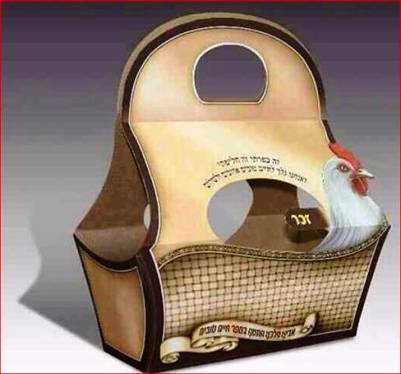
It does not say where this is being sold...
money is still the best option for kapparos
Mar 1, 2012
Turning The Shul Into A Circus For Zachor
This is such an issue that I have seen in many places how after davening is concluded a group of people will go off to the side and blow the shofar according to different customs of how the shofar should be blown - just in case one of the other customs is right and "my" custom is wrong, this would ensure that I have heard or blown the proper shofar anyway.
A similar obligation is upon us this Shabbos with the reading of Parshat Zachor. And also with the reading of Zachor, there are a number of different customs and opinions as to what the proper way to read it is. Personally I have never seen, unlike by the shofar blowing, a shul or yeshiva take out the Torah after davening and have someone re-read Zachor according to the many different customs and opinions.
It seems, though, that in some places they do just that. Some people will take out the Torah again after davening and read according to different traditions and customs. And some might even take out different types of Torahs, to read from both sefardi and ashkenazi torahs perhaps, to read from different torahs written by different scribes - all for the purpose of raising the percentages of successfully fulfilling the obligation.
Rav Zeini, rosh yeshiva of Yeshivat Hesder Ohr V'yishua in Haifa, spoke against the custom of doing just that - taking out additional Torahs and reading according to different customs and opinions. Rav Zeini said the desire to fulfill the mitzva in the most accurate way has led to intolerable phenomena, due to lack of understanding of the essence of the mitzva. Rav Zeini says that sometimes one after the other tens of people will re-read the parsha of Zachor, each according to his custom of how to read the cantillations and pronunciations to the point that it turns the shul into a circus... it says in Megillah that in the future the theaters and circuses will be turned into batei knesset - not that the batei knesset will be turned into circuses. (source: Srugim, and see original article for more on this topic)
------------------------------------------------------
Reach thousands of readers with your ad by advertising on Life in Israel
------------------------------------------------------
Related Posts
