
Showing posts with label Mishpacha. Show all posts
Showing posts with label Mishpacha. Show all posts
Dec 22, 2025
foilishtik vs yiras shamayim
Very recently (was it 6 weeks ago or so?) Mishpacha ran ainterview with Yoeli Landau, a Satmar chassid billionaire. They even put him plugging the interview on the cover photo. They claimed then that while it is unusual to do so, to put a businessman on the cover and give him such prominence but they did it not because they are honoring a businessman who made lots of money but because of his story and how he grew up and then with honesty and yiras shamayim became a success and has complete fealty to his rabbonim... The interview, and especially the cover made waves and with it came a lot of criticism of Mishpacha choosing this and of Landau as well..
Personally I enjoyed the interview, even if I figured much of it was embellishment. For example, they sold him as having even been homeless at one point when he was younger and had to sleep in a shul..in the interview when he tells the story he describes how he slept in the shul so he could play homeless because he needed to qualify for welfare programs (like WICS or SNAP or whatever program it was at the time)...
Anyway, I am wondering if he now regrets having given the interview. it was supposedly a very rare interview as he normally stays away from the limelight and doesn't talk to media. I am wondering if he or those around him might think it caused him an ayn hara of sorts.
According to CBS News, Landau is in lots of legal trouble for playing foilishtik with his nursing homes. honesty and yiras shamayim are the name of the game...A bankruptcy judge blocked an attempt by a nursing home chain's primary investor to shield himself from settlement payments and liability in lawsuits alleging hundreds of patient injuries and deaths, encouraging those pursuing millions in damages.
Genesis HealthCare, once the nation's largest nursing home chain, filed for Chapter 11 reorganization bankruptcy in July with a proposal to protect its controlling investor, Joel Landau, from legal liability. In court papers, Genesis had originally estimated all its settled and pending cases — which it said numbered nearly a thousand — would cost $259 million to resolve.
KFF Health News reported this month that in the years before filing for bankruptcy, Genesis had settled at least 155 patient injury and death lawsuits with provisions that allowed it to delay paying, sometimes for more than a year. As a result, when Genesis filed for bankruptcy in July, it still owed $41 million out of the $58 million promised in those settlements with families of current or former residents, according to the bankruptcy and case records KFF Health News reviewed.
In hearings Wednesday and last week in U.S. Bankruptcy Court in Dallas, Judge Stacey G.C. Jernigan said she would not approve a sale of the company's assets that included legal releases from liability for Landau and a private equity associate, David Gefner. Landau, who was seeking to purchase the assets through another company he controlled, did not attend the bankruptcy hearings or respond to a subpoena, lawyers said in court.
ayin hara indeed... I hope he comes out of it ok and cleared and can make amends but maybe talking in public about how great he is was not a good idea when he is actually in so much trouble... I wonder if Mishpacha will relate to the latest news and regret having interviewed him and especially putting him on the cover
------------------------------------------------------
Reach thousands of readers with your ad by advertising on Life in Israel
Reach thousands of readers with your ad by advertising on Life in Israel
------------------------------------------------------
Nov 15, 2018
Mishpacha Magazine put women on the latest cover!
People are shocked by the cover photo in the latest edition of Mishpacha magazine..
Here it is:

considering Mishpacha policy to not print images of women, this is a shocking breach of policy. I would like them to explain if their spiritual guidance committee of rabbis approved this and if so to lease explain why it is ok to change the policy, or why an exception can be made for these women. A policy of 'no women" means no women. They have always said that even tzanua-dressed women cannot be published, so why are these any different.
Personally I think these might actually be men dressed up as women, so it might be ok because of that. As well, if you look closely the faces have been blurred and pixelated under their burqas, so perhaps that makes it to be considered compliant.
Here it is:

considering Mishpacha policy to not print images of women, this is a shocking breach of policy. I would like them to explain if their spiritual guidance committee of rabbis approved this and if so to lease explain why it is ok to change the policy, or why an exception can be made for these women. A policy of 'no women" means no women. They have always said that even tzanua-dressed women cannot be published, so why are these any different.
Personally I think these might actually be men dressed up as women, so it might be ok because of that. As well, if you look closely the faces have been blurred and pixelated under their burqas, so perhaps that makes it to be considered compliant.
------------------------------------------------------
Reach thousands of readers with your ad by advertising on Life in Israel
Reach thousands of readers with your ad by advertising on Life in Israel
------------------------------------------------------
Oct 7, 2018
The Bet Shemesh - Elad electoral connection
Much ado has been made regarding the fighting, in cities all around Israel, between the various factions of UTJ - in some cities it is Shlomei Emunim vs Degel Hatorah, in other cities it is Degel Hatorah vs Agudat Yisrael, and in some cities it is all 3 against each other. And in some cities Shas is involved as well.
Somehow Elad has turned into one of the most contentious races this time around. With elections happening in municipalities all over the county, and UTJ factions fielding candidates in many of the cities and towns holding elections it seems a bit surprising, to me, that Elad is considered so important that the most bitter of the fighting is happening there.
Mishpacha magazine (Hebrew edition) had an interesting side by side article/interview with Degel chairman Moshe Gafni and Shlomei Emunim chairman Meir Porush. If the topic interests you and you have access to the magazine, I encourage you to read it. I am only going to comment on one small part of it - the end.
The interviewer asked each about the Elad situation.
 Porush explained that in 2013 Degel and Shlomei Emunim came to a deal that in Bet Shemesh they would all support Abutbol for mayor while in Elad Yisrael Porush (from Shlomei Emunim, Meir Porush's son) would be the candidate for mayor (he won) and would be supported by Degel. The deal added that in the upcoming elections in 2018, Degel would run its own candidate in Bet Shemesh, to be supported by Shlomei Emunim, and Shlomei Emunim would be granted the various municipal appointments held by Degel since 2013. And 2018 in Elad Shlomei Emunim would support the Degel candidate for mayor.
Porush says that because Degel chose not to run a candidate for mayor in Bet Shemesh in 2018 they have broken the agreement, as now Shlomei Emunim will not get those various other appointments as per the agreement. Therefore, Porush says, if Degel broke the agreement, we do not need to keep it in Elad either and the current mayor will run for re-election instead of resigning and backing the Degel candidate.
Gafni explained the situation a little differently. Gafni said that Elad was a very straightforward deal - in 2013 Shlomei Emunim puts forward the candidate for mayor, to be supported by Degel, and in 2018 Degel puts forward the candidate for mayor, to be supported by Shlomei Emunim.
Gafni says we supported Porush for mayor in 2013, and now Shlomei has to support our candidate for mayor in 2018.
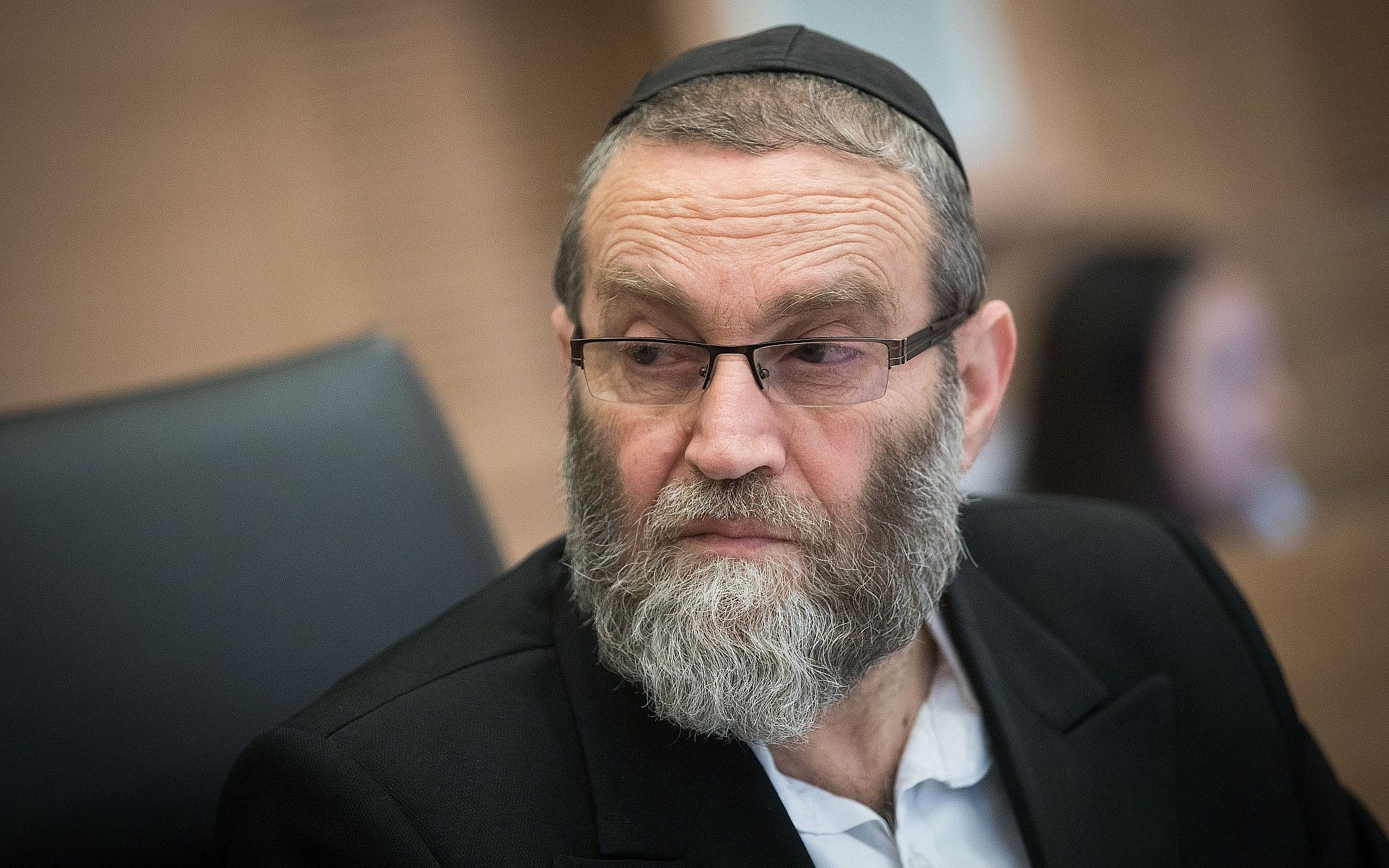
Gafni made no mention of any connection to Bet Shemesh in the deal, and the interviewer did not ask about any such connection. Without asking for a response to the claim of the existence of such a connection, the Mishpacha interviewer did a disservice to its readers. There was some sort of deal in place, but now we do not know if it was just Elad or if it was a package deal of Elad and Bet Shemesh. Some people will believe Porush at face value and some will believe Gafni at face value, and we now have no idea who broke the deal because we do not know what the deal actually was.
I would add that in light of the developments last week by which Moshe Abutbol made some sort of clerical "error" (or some say it was a clever maneuver) when trying to form a new party and getting it disqualified at the last moment and then getting UTJ to put him atop their list, turning Moshe Abutbol into, officially, the mayoral candidate from UTJ, at the end of the day, the agreement as described by Porush has, so far been fulfilled. If Abutbol should win, Porush should demand the various appointments as per the original agreement - and he should even demand them now in order to officially support Abutbol. And in exchange for a commitment to keeping the deal and giving Shlomei Emunim all those appointments, Porush should honor the part of the deal affected Elad.
Somehow Elad has turned into one of the most contentious races this time around. With elections happening in municipalities all over the county, and UTJ factions fielding candidates in many of the cities and towns holding elections it seems a bit surprising, to me, that Elad is considered so important that the most bitter of the fighting is happening there.
Mishpacha magazine (Hebrew edition) had an interesting side by side article/interview with Degel chairman Moshe Gafni and Shlomei Emunim chairman Meir Porush. If the topic interests you and you have access to the magazine, I encourage you to read it. I am only going to comment on one small part of it - the end.
The interviewer asked each about the Elad situation.
Porush says that because Degel chose not to run a candidate for mayor in Bet Shemesh in 2018 they have broken the agreement, as now Shlomei Emunim will not get those various other appointments as per the agreement. Therefore, Porush says, if Degel broke the agreement, we do not need to keep it in Elad either and the current mayor will run for re-election instead of resigning and backing the Degel candidate.
Gafni explained the situation a little differently. Gafni said that Elad was a very straightforward deal - in 2013 Shlomei Emunim puts forward the candidate for mayor, to be supported by Degel, and in 2018 Degel puts forward the candidate for mayor, to be supported by Shlomei Emunim.
Gafni says we supported Porush for mayor in 2013, and now Shlomei has to support our candidate for mayor in 2018.
Gafni made no mention of any connection to Bet Shemesh in the deal, and the interviewer did not ask about any such connection. Without asking for a response to the claim of the existence of such a connection, the Mishpacha interviewer did a disservice to its readers. There was some sort of deal in place, but now we do not know if it was just Elad or if it was a package deal of Elad and Bet Shemesh. Some people will believe Porush at face value and some will believe Gafni at face value, and we now have no idea who broke the deal because we do not know what the deal actually was.
I would add that in light of the developments last week by which Moshe Abutbol made some sort of clerical "error" (or some say it was a clever maneuver) when trying to form a new party and getting it disqualified at the last moment and then getting UTJ to put him atop their list, turning Moshe Abutbol into, officially, the mayoral candidate from UTJ, at the end of the day, the agreement as described by Porush has, so far been fulfilled. If Abutbol should win, Porush should demand the various appointments as per the original agreement - and he should even demand them now in order to officially support Abutbol. And in exchange for a commitment to keeping the deal and giving Shlomei Emunim all those appointments, Porush should honor the part of the deal affected Elad.
------------------------------------------------------
Reach thousands of readers with your ad by advertising on Life in Israel
Reach thousands of readers with your ad by advertising on Life in Israel
------------------------------------------------------
Oct 29, 2015
Please do not stab Haredim. We are not your enemy
Mishpacha magazine (Hebrew) has come under fire today in both social media and on some news sites, and subsequently on the radio talk shows, for something they printed in the latest edition, distributed today.
Here is the image of the offending text:

This is being described as an ad by Mishpacha asking the Arab terrorists to not stab Haredi Jews becuase the Haredim are not a side in the conflict - they do not go to Har Habayit, "so please do not murder us".
Obviously that is a disgusting and offensive ad to run, an offensive request to make.
The problem with it is that the above is being taken out of context. While it itself is inappropriate, it is not an ad being run by Mishapacha asking Arabs to not stab Haredim. It is an excerpt from an editorial in Mishpacha that is being taken out of context.
The first line of the next paragraph after the above excerpt begins "Now, seriously,...". The writer goes on to explore why Haredim are targets, and why in a town like Beitar, with neighboring villages like Husan, things have been relatively quiet. He refers to a conversation he had with a Palestinian laborer in Beitar. He explores the possibility that it is because Haredim are the most easily identifiable as Jews. He explores the possibility that it is a religious war, and Haredim are [perceived as] the most religious.
While the opening paragraph is surely offensive and inappropriate, it is NOT an ad asking Arabs to not stab haredim.
The real purpose of the article is the conclusion. The entire issue of the stabbing and Haredim being targeted is in order to point out to the readers that the Haredim are more representative of the Jews than any other group. Even though he points out that now is not the time to argue over who is more Jewish than whom, he is basically patting himself on the back for the revelation via the stabbings that the Haredim are more Jewish than everyone else.
Here is the image of the offending text:
This is being described as an ad by Mishpacha asking the Arab terrorists to not stab Haredi Jews becuase the Haredim are not a side in the conflict - they do not go to Har Habayit, "so please do not murder us".
Obviously that is a disgusting and offensive ad to run, an offensive request to make.
The problem with it is that the above is being taken out of context. While it itself is inappropriate, it is not an ad being run by Mishapacha asking Arabs to not stab Haredim. It is an excerpt from an editorial in Mishpacha that is being taken out of context.
The first line of the next paragraph after the above excerpt begins "Now, seriously,...". The writer goes on to explore why Haredim are targets, and why in a town like Beitar, with neighboring villages like Husan, things have been relatively quiet. He refers to a conversation he had with a Palestinian laborer in Beitar. He explores the possibility that it is because Haredim are the most easily identifiable as Jews. He explores the possibility that it is a religious war, and Haredim are [perceived as] the most religious.
While the opening paragraph is surely offensive and inappropriate, it is NOT an ad asking Arabs to not stab haredim.
The real purpose of the article is the conclusion. The entire issue of the stabbing and Haredim being targeted is in order to point out to the readers that the Haredim are more representative of the Jews than any other group. Even though he points out that now is not the time to argue over who is more Jewish than whom, he is basically patting himself on the back for the revelation via the stabbings that the Haredim are more Jewish than everyone else.
------------------------------------------------------
Reach thousands of readers with your ad by advertising on Life in Israel
------------------------------------------------------
May 25, 2014
does a convicted murderer deserve to be called by an unearned honorific?
Ami Popper is a convicted murderer. Popper was convicted of stealing an assault rifle and murdering 7 Arabs.
Somehow he has bene adopted by the Right, by the Religious, and even by the Haredi communities. Whenever there has been a prisoner release of Palestinians, the calls have gone out calling for Popper's release.
I have no problem with calling for his release. Part of the prison system includes parole and early release and pardons and commuting sentences. If this or that group or political party wants to put forth efforts to work for Popper's release, that is their prerogative.
What is interesting is something I saw in Mishpacha newspaper over Shabbos. They ran an article detailing the various candidates for the upcoming elections for the position of President of the State of Israel. They mentioned all the candidates and the haredi politicians positions regarding them.
They then also ran a small article in which they said that while the haredi community does not really have much direct interest in the position of the president or regarding who holds that position, as it doesn't really affect the haredi community, there is no reason why the haredi community should not demand of the president things that affect it, such as the pardoning of Ami Popper.
What was interesting is that Mishpacha did not just say "Ami Popper". They called him "Reb Ami Popper".
I am not quite sure how connected Popper is to the Haredi community, though it seems that in jail he became more torani (and was even cellmates with Shlomo Benizri)), and from his more recent pictures (at least from the last few years) he looks more Haredi with a black kippa, white shirt and long beard, If they want to adopt him and call for his release, that is fine by me... but does he really need the honorific of "reb"?
I already don't like that every person who gets married wearing a black hat and grows a beard is called "HoRav" or "Rav".. I find it to be a slight to real rabbonim. But if they want to call people rav or reb or horav, no harm no foul (or not much, at least)... but to call a convicted murdered with the honorific? What's wrong with just calling him by his name? Why does he need the title?
Perhaps one can debate regarding the people who went into jail already bearing the title - do they still deserve top be called by the honorific they earned prior to incarceration or not.. but somebody who is not deserving of the title even regardless of the crime he committed, why append the title to his name?
Does the title really engender such a small amount of respect that it can be given to anybody, even convicted murderers?
Somehow he has bene adopted by the Right, by the Religious, and even by the Haredi communities. Whenever there has been a prisoner release of Palestinians, the calls have gone out calling for Popper's release.
I have no problem with calling for his release. Part of the prison system includes parole and early release and pardons and commuting sentences. If this or that group or political party wants to put forth efforts to work for Popper's release, that is their prerogative.
What is interesting is something I saw in Mishpacha newspaper over Shabbos. They ran an article detailing the various candidates for the upcoming elections for the position of President of the State of Israel. They mentioned all the candidates and the haredi politicians positions regarding them.
They then also ran a small article in which they said that while the haredi community does not really have much direct interest in the position of the president or regarding who holds that position, as it doesn't really affect the haredi community, there is no reason why the haredi community should not demand of the president things that affect it, such as the pardoning of Ami Popper.
What was interesting is that Mishpacha did not just say "Ami Popper". They called him "Reb Ami Popper".
I am not quite sure how connected Popper is to the Haredi community, though it seems that in jail he became more torani (and was even cellmates with Shlomo Benizri)), and from his more recent pictures (at least from the last few years) he looks more Haredi with a black kippa, white shirt and long beard, If they want to adopt him and call for his release, that is fine by me... but does he really need the honorific of "reb"?
I already don't like that every person who gets married wearing a black hat and grows a beard is called "HoRav" or "Rav".. I find it to be a slight to real rabbonim. But if they want to call people rav or reb or horav, no harm no foul (or not much, at least)... but to call a convicted murdered with the honorific? What's wrong with just calling him by his name? Why does he need the title?
Perhaps one can debate regarding the people who went into jail already bearing the title - do they still deserve top be called by the honorific they earned prior to incarceration or not.. but somebody who is not deserving of the title even regardless of the crime he committed, why append the title to his name?
Does the title really engender such a small amount of respect that it can be given to anybody, even convicted murderers?
------------------------------------------------------
Reach thousands of readers with your ad by advertising on Life in Israel
------------------------------------------------------
Dec 24, 2012
Moshe Grylak's Stockholm Syndrome
Moshe Grylak's editorials in Mishpacha magazine are generally one of the best features of the magazine. Even if I don't have time to read the magazine, I will always try to make time to read his editorial column. Not that I always agree with everything he says, but I always enjoy reading what he has to say.
This past week I just didn't understand Grylak. In one of his smaller editorial spots this past week, Grylak stuck his neck into the ongoing fight between the Yated faction and the "HaPeles" faction, which has now become the "Netzach" political party faction opposing Degel haTorah, of Litvishe haredim that has been percolating over the past 6-8 weeks. Until now he has been pretty silent about it, but now he had to comment on something the "Netzach" spokesman said recently.
Netzach spokesman Yaakov Friedman recently commented, to the media, after the meeting last week between Rav Shmuel Auerbach and Rav Shteinman, that "Bnei Braq will burn, blood will be spilled".
Grylak criticized Friedman, rightfully so as what Friedman said was very inappropriate, but he criticized him with scorn.
Grylak wrote "Blood will spill? that's what the head of the Ashdod faction said when he wanted to describe to the secular media what will happen in unity does not return to the Litvishe community in accordance with the conditions that he sets. Blood will spill! Bnei Braq will tremble!... Without sticking our heads into the argument over nothing being led by a fired journalist, what is this type of speech? what is this - the Black Panthers? Harlem? Hamas?.. "
The Netzach-Peles faction calls themselves the "Jerusalem faction" of the haredi community, led by Rav Shmuel Auerbach, in contrast to the Bnei Braq faction led by Rav Shteinman. Calling them the "Ashdod faction" is scorn rather than criticism for the statement, considering them even smaller and worth-less than how they consider themselves.
No doubt they deserve the criticism, and haredi insiders should be fuming at them for that aspect of the disunity they are affecting. Though the truth is that Degel, the original Litvishe faction seems to be fighting with everyone - the Jerusalem faction of Litvaks, the hassidim, Shomrei Emunim... so maybe Degel is being too obstinate and responsible for much of the fighting. I don't know. I am not looking to decide who is at fault, but whoever is at fault, causing a split is pretty serious for what is already a small political party that has a lot to lose. So no doubt they deserve to be criticized, both for their part in the disunity and specifically for that incendiary statement made by Friedman.
However, Grylak? Is Grylak really the right person for this task? Even though he was one of the founders of the Yated many moons ago, more recently he himself was the target of a vicious campaign led by the Yated. Yated led a relentless attack against the Mishpacha magazine and it's leadership, with letters signed by gedolim and rabbonim against Mishpacha, pashkevilim, editorials in the Yated about how bad Mishpacha is with no daas torah and the like.. and now Grylak is doing more than criticizing Friedman's statement, he is just about taking the side of the Yated.
I don't know if that is something akin to the Stockholm Syndrome, with the Yated beating on him but he feels the need to support the Yated anyway, but I would have preferred Grylak stay out of it and let them continue "beating each other up" on their own...
This past week I just didn't understand Grylak. In one of his smaller editorial spots this past week, Grylak stuck his neck into the ongoing fight between the Yated faction and the "HaPeles" faction, which has now become the "Netzach" political party faction opposing Degel haTorah, of Litvishe haredim that has been percolating over the past 6-8 weeks. Until now he has been pretty silent about it, but now he had to comment on something the "Netzach" spokesman said recently.
Netzach spokesman Yaakov Friedman recently commented, to the media, after the meeting last week between Rav Shmuel Auerbach and Rav Shteinman, that "Bnei Braq will burn, blood will be spilled".
Grylak criticized Friedman, rightfully so as what Friedman said was very inappropriate, but he criticized him with scorn.
Grylak wrote "Blood will spill? that's what the head of the Ashdod faction said when he wanted to describe to the secular media what will happen in unity does not return to the Litvishe community in accordance with the conditions that he sets. Blood will spill! Bnei Braq will tremble!... Without sticking our heads into the argument over nothing being led by a fired journalist, what is this type of speech? what is this - the Black Panthers? Harlem? Hamas?.. "
The Netzach-Peles faction calls themselves the "Jerusalem faction" of the haredi community, led by Rav Shmuel Auerbach, in contrast to the Bnei Braq faction led by Rav Shteinman. Calling them the "Ashdod faction" is scorn rather than criticism for the statement, considering them even smaller and worth-less than how they consider themselves.
No doubt they deserve the criticism, and haredi insiders should be fuming at them for that aspect of the disunity they are affecting. Though the truth is that Degel, the original Litvishe faction seems to be fighting with everyone - the Jerusalem faction of Litvaks, the hassidim, Shomrei Emunim... so maybe Degel is being too obstinate and responsible for much of the fighting. I don't know. I am not looking to decide who is at fault, but whoever is at fault, causing a split is pretty serious for what is already a small political party that has a lot to lose. So no doubt they deserve to be criticized, both for their part in the disunity and specifically for that incendiary statement made by Friedman.
However, Grylak? Is Grylak really the right person for this task? Even though he was one of the founders of the Yated many moons ago, more recently he himself was the target of a vicious campaign led by the Yated. Yated led a relentless attack against the Mishpacha magazine and it's leadership, with letters signed by gedolim and rabbonim against Mishpacha, pashkevilim, editorials in the Yated about how bad Mishpacha is with no daas torah and the like.. and now Grylak is doing more than criticizing Friedman's statement, he is just about taking the side of the Yated.
I don't know if that is something akin to the Stockholm Syndrome, with the Yated beating on him but he feels the need to support the Yated anyway, but I would have preferred Grylak stay out of it and let them continue "beating each other up" on their own...
------------------------------------------------------
Reach thousands of readers with your ad by advertising on Life in Israel
------------------------------------------------------
Jan 15, 2012
Banning Distribution Of Mishpacha
Somebody sent to me a copy of a letter sent by a group of rabbonim to Mishpacha. The rabbonim signed on the letter are from various haredi neighborhoods/communities of Bet Shemesh.
 The letter says:

To the Administrators of Mishpacha Newspaper,I find it interesting that they would go this route of trying to convince Mishpacha to not distribute their newspaper and magazine in Bet Shemesh, rather than just telling their flock to not read it.
We have already expressed our intent that you should not distribute in our city of Bet Shemesh your weekly newspaper that was prohibited to be read by the gedolim.
And now we have heard that you are publishing a new additional newspaper that is being distributed for free in haredi neighborhoods.
We request that you not distribute it in our cit, and will tell those involved in distribution that they should not distribute it here, and not put it in mailboxes and not near the stores.
Signed...
Dec 1, 2011
The Yated Just Banned Itself In The Latest Pashkevil
As the Mishpacha is just about set and ready to begin distribution of a free weekly newspaper, in addition to the subsciption edition that is distributed and sold on Thursdays, the Yated has been opposing it.
It seems pretty clear this is a business fight, as the Mishpacha is their main competition. Yated has been distributing a free paper once a week for a couple of years already, in addition to their paid daily newspaper. The free edition is a big boon to them, as it allows them to spread their influence, for free of course, along with increasing advertising (at leeast on the free day) as the distribution numbers are kept up.
With Mishpacha jumping into the free-paper market as well, Yated is looking at absorbing yet another big hit. It is not enough that they have already fallen lower down the totem poll in the haredi newspaper industry, now they are looking at competitino for their free newspaper as well.
When the Yated fights, instead of improving their product, they turn to religion. According to them, Mishpacha is a spiritual danger. They have been threatening to get the various rabbonim to sign a letter against it.
And now they did..

Besides for the obvious - nobody is ever going to change their lifestyle or behavior just because of a sign on a wall, I would point out that this pashkevil, seemingly directed subtly against the Mishpacha, does the Yated no favors. The pashkevil says ALL free papers and weeklies are prohibited as they corrupt the Torah and are a spiritual danger. While Mishpacha is identified, it is only identified as "All weekly and free papers, includnig Mishpacha".
The rabbonim who signed on the letter above seemingly did not make an excption for the Yated. Just like thye are supposedly saying it is prohibited to read Mishpacha, or other free newspapers, by the same decree it is assur to read, or print, the Yated Neeman.
I wonder if the Yated is going to listen to the gedolim on this. or maybe they will simply print next week the their rabbonim made an exception for them....
It seems pretty clear this is a business fight, as the Mishpacha is their main competition. Yated has been distributing a free paper once a week for a couple of years already, in addition to their paid daily newspaper. The free edition is a big boon to them, as it allows them to spread their influence, for free of course, along with increasing advertising (at leeast on the free day) as the distribution numbers are kept up.
With Mishpacha jumping into the free-paper market as well, Yated is looking at absorbing yet another big hit. It is not enough that they have already fallen lower down the totem poll in the haredi newspaper industry, now they are looking at competitino for their free newspaper as well.
When the Yated fights, instead of improving their product, they turn to religion. According to them, Mishpacha is a spiritual danger. They have been threatening to get the various rabbonim to sign a letter against it.
And now they did..

Besides for the obvious - nobody is ever going to change their lifestyle or behavior just because of a sign on a wall, I would point out that this pashkevil, seemingly directed subtly against the Mishpacha, does the Yated no favors. The pashkevil says ALL free papers and weeklies are prohibited as they corrupt the Torah and are a spiritual danger. While Mishpacha is identified, it is only identified as "All weekly and free papers, includnig Mishpacha".
The rabbonim who signed on the letter above seemingly did not make an excption for the Yated. Just like thye are supposedly saying it is prohibited to read Mishpacha, or other free newspapers, by the same decree it is assur to read, or print, the Yated Neeman.
I wonder if the Yated is going to listen to the gedolim on this. or maybe they will simply print next week the their rabbonim made an exception for them....
Nov 17, 2011
Letter To the Editor: The Judge Wears A Wig???
This past week's Mishpacha (Hebrew) Magazine had a Letter To The Editor that I'd like to point out. I have seen many similar letters over the years, and it bothers me.
The week before, Mishpacha ran an article about a Jew in England who has reached the pinnacle of the justice system and is a justice on the Supreme Court of England. I no longer have the original article, but it was interesting, dealing with his relationship with many rabbonim and gedolim and the jewish community and issues in general.
Last week someone wrote a Letter to the Editor about that article:
 To translate:
[The interview with the judge of the Supreme Court was very interesting but raised a number of questions: Who allowed the judge to wear a wig? What about "Lo Tilbash"? And even if there is no issue of "Lo Tilbash", there might be an issue of "chukas ha'goyim".
I did not come to complain about the judge, who seems to be God fearing and careful about light and serious commandments equally, and has even merited to pour water on the hands of the gedolim, but it is important to point out in the article that his actions were done in coordination with the gedolei yisroel.. and not take things for granted....]
To be honest, when I first started reading this letter, and I got to the point of "Who allowed the judge to wear a wig?", I said to myself - his issue are that wigs are not allowed? not tzniyus? What does he want - the judge should wear a tichel??? I thought that was funny.
Then continuing on I saw his issue was with the Lo Tilbash. The answer seems obvious to me, even if perhaps some might not agree - this is not the type of wig that is a woman's wig, and therefore is not under the "Lo Tilbash" issue. It is unique for the justices, most of whom anyway have always been men, and therefore not an issue.
Then his suggestion that it might be "chukas ha'goyim" led me to wonder. His wearing a wig is chukas ha'goyim? His whole existence on the court is dealing with chukas ha'goyim! And he should be worried about the wig?? In Israel the chief of the Beis Din ha'Gadol had been offered the position of a Supreme Court Justice and had supposedly been told by gedolim not to accept it so as not be part of "erchaos" - the secular court system, the man-made laws rather than the laws of God - and this fellow is worried about the wig being chukas ha'goyim??!!
Besides for the specific points, as mentioned they each can easily be responded to, what bothers me is more the attitude that people feel it is ok to poke their nose in the relationship others have with God. If this fellow is frum, and he is, and he has a relationship with rabbonim and gedolim, can't we just assume he asked his own questions on issues he needed resolved? Do we really have to look for the things other people might be doing wrong?
If he was harming people with his actions or court decisions, by forcing non-Jewish ways on the jewish community, I could see room for such a discussion of justifying, or lack thereof, of his actions. But to dig into his personal life and ask how he can do this or that, is just too much, and unfortunately too common.
The week before, Mishpacha ran an article about a Jew in England who has reached the pinnacle of the justice system and is a justice on the Supreme Court of England. I no longer have the original article, but it was interesting, dealing with his relationship with many rabbonim and gedolim and the jewish community and issues in general.
Last week someone wrote a Letter to the Editor about that article:

[The interview with the judge of the Supreme Court was very interesting but raised a number of questions: Who allowed the judge to wear a wig? What about "Lo Tilbash"? And even if there is no issue of "Lo Tilbash", there might be an issue of "chukas ha'goyim".
I did not come to complain about the judge, who seems to be God fearing and careful about light and serious commandments equally, and has even merited to pour water on the hands of the gedolim, but it is important to point out in the article that his actions were done in coordination with the gedolei yisroel.. and not take things for granted....]
To be honest, when I first started reading this letter, and I got to the point of "Who allowed the judge to wear a wig?", I said to myself - his issue are that wigs are not allowed? not tzniyus? What does he want - the judge should wear a tichel??? I thought that was funny.
Then continuing on I saw his issue was with the Lo Tilbash. The answer seems obvious to me, even if perhaps some might not agree - this is not the type of wig that is a woman's wig, and therefore is not under the "Lo Tilbash" issue. It is unique for the justices, most of whom anyway have always been men, and therefore not an issue.
Then his suggestion that it might be "chukas ha'goyim" led me to wonder. His wearing a wig is chukas ha'goyim? His whole existence on the court is dealing with chukas ha'goyim! And he should be worried about the wig?? In Israel the chief of the Beis Din ha'Gadol had been offered the position of a Supreme Court Justice and had supposedly been told by gedolim not to accept it so as not be part of "erchaos" - the secular court system, the man-made laws rather than the laws of God - and this fellow is worried about the wig being chukas ha'goyim??!!
Besides for the specific points, as mentioned they each can easily be responded to, what bothers me is more the attitude that people feel it is ok to poke their nose in the relationship others have with God. If this fellow is frum, and he is, and he has a relationship with rabbonim and gedolim, can't we just assume he asked his own questions on issues he needed resolved? Do we really have to look for the things other people might be doing wrong?
If he was harming people with his actions or court decisions, by forcing non-Jewish ways on the jewish community, I could see room for such a discussion of justifying, or lack thereof, of his actions. But to dig into his personal life and ask how he can do this or that, is just too much, and unfortunately too common.
Mar 2, 2011
Mesoras Reb Moshe
Rav Michel Shurkin does not consider himself worthy of eulogizing Reb Moshe, nor of praising him. But he does have mesorahs from Reb Moshe to relay to the public, culled from more than a quarter century in Reb Moshe's shadow. While Rav Shurkin shares insight into Reb Moshe's approach to the public and to psak halachah, he reveals an insider's view of Reb Moshe's passionate effort to defend and cling to mesorah, and his efforts to validate the way Klal Yisrael has done things in the past: "He held there was no way that the entire public would go to Gehinnom. There must be a reason why what they were doing was permissible, and he would find that reason. He held that just as you have to have emunah in Hashem, you have to have emunah in Klal Yisrael."
Rav Michel Shurkin is not a man who has time for interviews. A consummate masmid who, talmidim relate, will not miss night seder in Yeshivas Toras Moshe in Yerushalayim for his own children's sheva brachos, he seemed an unlikely candidate to spend time discussing his rebbi, Rav Moshe Feinstein, ztz"l. Why would the maggid shiur who is so devoted to his talmidim that he once flew into America for a simchah and returned to yeshivah directly from the airport so that he wouldn't miss more than one day of shiur spare an hour for us?
As if reading my mind, Rav Michel answers that question as soon as I arrive at his Har Nof apartment. "I'm not worthy of eulogizing Reb Moshe, or of giving you a biography of him. But I have mesorahs [traditions] from Reb Moshe that I feel obligated to relay to the public.
"This is a mesorah session," he concludes, spelling out the ground rules. "It's not an interview or a hesped."
In those words, Rav Michel has encapsulated the purpose of his monumental work, Megged Givos Olam, in which he chronicles his memories of several gedolei Yisrael with whom he was fortunate to share a relationship. While full of stories, the sefer is a work in mesorah, in which a reader feels each gadol's persona and views -- both in halachah and hashkafah -- come to life through the lens of a devoted talmid. In our time together, Rav Michel shares the mesorah he gleaned from over a quarter of a century in Reb Moshe's shadow.
Much More than a Rebbi Listening to Rav Michel talk about his rebbi, one senses both awe and love resonating from his voice. He shares a story that offers us a glimpse into the source of the awe. "I recently read that Rav Aharon Leib Steinman, shlita, was decrying the terrible yeridas hadoros [deterioration of the generations]. He pointed to the fact that just one generation ago, we had Reb Moshe and Rav Aharon Kotler, and now we don't have anyone of their stature.
"My father (Rav Yaakov Moshe Shurkin) held differently. He told me that Reb Moshe wasn't from the previous generation -- he was equivalent to gedolim from hundreds of years ago. And my father knew. He was a talmid of the Chofetz Chaim for sixteen years, and he knew all of the gedolim of prewar Europe."
But that awe is mixed with love, which provided the impetus for Rav Michel to take an active role in the kavod acharon of his rebbi.
"When Reb Moshe was niftar, I performed the taharah on him. At first I was scared, but then I remembered that my father performed the taharah on the Chofetz Chaim, so I considered it a maaseh avos siman labanim."
We caught Rav Michel with a Dibros Moshe on his table, in which, a talmid later reveals, he has the distinctive honor of being mentioned by name several times. In one place (Yevamos, perek 4, note 84), Reb Moshe wrote, "HaRav HaGaon Rav Michel Shurkin, who learned in the yeshivah in 5723, asked …"
The respect and affection, it seems, went both ways -- Reb Moshe appreciated the brilliance of the young man in his yeshivah long before the world had heard of him. And aside from being a talmid, Rav Michel was also a relative. Reb Moshe's father, Rav Dovid, and Rav Yaakov Kantrowitz married sisters. Rav Michel's mother was Rav Yaakov Kantrowitz's daughter, Reb Moshe's first cousin.
To Reb Moshe, family was very important. The day before Rav Michel's first son's bris, he visited Reb Moshe, who was very old and weak. Rav Michel assumed that he would be unable to attend the bris, so he came to get a brachah beforehand. While he was there, he heard the family celebrating. They explained that a Vaad HaRabonim meeting had been canceled, freeing Reb Moshe from having to attend in his weakened state. Rav Michel then asked for a brachah, and left.
"That night," he recounts, "between my fifteenth and sixteenth phone calls to inform people about the bris, the phone rang. Reb Moshe was on the line. 'Michel, where's the bris?' he asked."
Reb Moshe didn't have the energy for a Vaad HaRabonim meeting, but family was family and he wouldn't miss the bris.
"In a picture from our second son's bris that we cherish until today, you can see his overwhelming love towards the little baby on his lap." (Reb Moshe was sandak at both of Rav Michel's older sons' brissim.)
But the relationship went far beyond the blood bond. When Rav Michel's father passed away, "Reb Moshe took over my life. I didn't budge without him. In fact, Reb Moshe wrote a letter stating, 'Kol maasav hu oseh al pi -- all of his actions are based on my words.'"
For the rest of this article, see Mishpacha.com
Rav Michel Shurkin is not a man who has time for interviews. A consummate masmid who, talmidim relate, will not miss night seder in Yeshivas Toras Moshe in Yerushalayim for his own children's sheva brachos, he seemed an unlikely candidate to spend time discussing his rebbi, Rav Moshe Feinstein, ztz"l. Why would the maggid shiur who is so devoted to his talmidim that he once flew into America for a simchah and returned to yeshivah directly from the airport so that he wouldn't miss more than one day of shiur spare an hour for us?
As if reading my mind, Rav Michel answers that question as soon as I arrive at his Har Nof apartment. "I'm not worthy of eulogizing Reb Moshe, or of giving you a biography of him. But I have mesorahs [traditions] from Reb Moshe that I feel obligated to relay to the public.
"This is a mesorah session," he concludes, spelling out the ground rules. "It's not an interview or a hesped."
In those words, Rav Michel has encapsulated the purpose of his monumental work, Megged Givos Olam, in which he chronicles his memories of several gedolei Yisrael with whom he was fortunate to share a relationship. While full of stories, the sefer is a work in mesorah, in which a reader feels each gadol's persona and views -- both in halachah and hashkafah -- come to life through the lens of a devoted talmid. In our time together, Rav Michel shares the mesorah he gleaned from over a quarter of a century in Reb Moshe's shadow.
Much More than a Rebbi Listening to Rav Michel talk about his rebbi, one senses both awe and love resonating from his voice. He shares a story that offers us a glimpse into the source of the awe. "I recently read that Rav Aharon Leib Steinman, shlita, was decrying the terrible yeridas hadoros [deterioration of the generations]. He pointed to the fact that just one generation ago, we had Reb Moshe and Rav Aharon Kotler, and now we don't have anyone of their stature.
"My father (Rav Yaakov Moshe Shurkin) held differently. He told me that Reb Moshe wasn't from the previous generation -- he was equivalent to gedolim from hundreds of years ago. And my father knew. He was a talmid of the Chofetz Chaim for sixteen years, and he knew all of the gedolim of prewar Europe."
But that awe is mixed with love, which provided the impetus for Rav Michel to take an active role in the kavod acharon of his rebbi.
"When Reb Moshe was niftar, I performed the taharah on him. At first I was scared, but then I remembered that my father performed the taharah on the Chofetz Chaim, so I considered it a maaseh avos siman labanim."
We caught Rav Michel with a Dibros Moshe on his table, in which, a talmid later reveals, he has the distinctive honor of being mentioned by name several times. In one place (Yevamos, perek 4, note 84), Reb Moshe wrote, "HaRav HaGaon Rav Michel Shurkin, who learned in the yeshivah in 5723, asked …"
The respect and affection, it seems, went both ways -- Reb Moshe appreciated the brilliance of the young man in his yeshivah long before the world had heard of him. And aside from being a talmid, Rav Michel was also a relative. Reb Moshe's father, Rav Dovid, and Rav Yaakov Kantrowitz married sisters. Rav Michel's mother was Rav Yaakov Kantrowitz's daughter, Reb Moshe's first cousin.
To Reb Moshe, family was very important. The day before Rav Michel's first son's bris, he visited Reb Moshe, who was very old and weak. Rav Michel assumed that he would be unable to attend the bris, so he came to get a brachah beforehand. While he was there, he heard the family celebrating. They explained that a Vaad HaRabonim meeting had been canceled, freeing Reb Moshe from having to attend in his weakened state. Rav Michel then asked for a brachah, and left.
"That night," he recounts, "between my fifteenth and sixteenth phone calls to inform people about the bris, the phone rang. Reb Moshe was on the line. 'Michel, where's the bris?' he asked."
Reb Moshe didn't have the energy for a Vaad HaRabonim meeting, but family was family and he wouldn't miss the bris.
"In a picture from our second son's bris that we cherish until today, you can see his overwhelming love towards the little baby on his lap." (Reb Moshe was sandak at both of Rav Michel's older sons' brissim.)
But the relationship went far beyond the blood bond. When Rav Michel's father passed away, "Reb Moshe took over my life. I didn't budge without him. In fact, Reb Moshe wrote a letter stating, 'Kol maasav hu oseh al pi -- all of his actions are based on my words.'"
For the rest of this article, see Mishpacha.com
Feb 23, 2011
Smuggler Without Borders
In 1947, the Haganah gave him the mission of a lifetime: help the Holocaust survivors stranded on the Exodus. Professor Meier Schwarz, scientist, historian, and former Haganah member, was no stranger to secret operations. Already an orphan when he fled from Germany to Eretz Yisrael at age thirteen, he helped smuggle thousands of refugees into the Holy Land, learning his lesson early on how to be self-reliant and how to place duty before emotions
Libi Astaire
“There were Torah-observant Jews in the Haganah?”
Professor Meier Schwarz stares at me, as if to ask, “What's the question?”
What's the question, indeed? There's an old saying that goes, “History is written by the winners,” and the history of the modern State of Israel is no different. Therefore, when most people think of the Haganah -- the paramilitary organization that defended Jewish settlements during the British Mandate and brought tens of thousands of Jewish refugees and Holocaust survivors to Eretz Yisrael illegally -- the image that comes to mind is not that of a frum yungerman from Nuremberg.
But on a wintry day in Jerusalem, which just happens to coincide with International Holocaust Remembrance Day, Professor Schwarz, eighty-five, sets the record straight: “Everyone on my kibbutz joined the Haganah. We helped them and they helped us.”
“Us” were the members of a religious kibbutz that later became known as Kibbutz Chafetz Chaim. Its members were mostly young people who had fled Nazi Germany alone, as children -- people like Meier Schwarz. And so before we talk about the dramatic events that took place during those twilight years between World War II and the founding of the State of Israel, Professor Schwarz -- who was part of the clandestine operation to run illegal immigrants against and around the British blockade -- puts his German childhood into the perspective of his future brush with history.
If Only … “I was born in Nuremberg, in 1926,” says Meier Schwarz -- current head of Beit Ashkenaz, a historical research organization dedicated to preserving the memory of Germany's destroyed Jewish communities -- describing a childhood that was cut off in the middle. “My father was an officer in the German army in World War I. He was also one of the heads of our synagogue, Adas Yisrael, which was burned down on Kristallnacht. My mother came from a little village not far from Nuremberg. I had an older brother, Yosef, who was five years older than me.
“Hitler was appointed chancellor of Germany in January 1933, and it took just a few days to realize that something was different. But most German Jews didn't leave. They said, 'I have a business here. I have money. My family has lived here for hundreds of years. What can happen to me?'”
The Schwarz family found out in September 1937 -- a full two years before World War II began. Ludwig Schwarz, Meier's father, was on his way to work when he was pulled off the train by some Germans and killed.
Yet despite the deteriorating situation in Germany, Meier remembers taking a walk with his brother on a Sunday morning, intending to enjoy the beautiful spring weather. The atmosphere became tense when they spotted an official-looking limousine. “In the front seat was a chauffeur. In the backseat was Hitler. No one else was around -- no one. If only my brother or I had had a gun, we perhaps could have changed history.”
But they didn't have a gun, and so the diabolical plans of the Nazi regime continued. Meanwhile, Meier's mother became ill and was taken to a hospital, where she was refused medicine because she was Jewish. And then came Kristallnacht. The two brothers were alone when five Nazi soldiers stormed inside their family's apartment at two in the morning and smashed everything in sight. Yosef, as the acting head of the family, decided that the time had come to get Meier out of Germany.
Goodbye Forever By this time, the Kindertransport was sending Jewish children to England, but Meier wasn't eligible since children who spoke some English were given preference. “In my school, we learned French. So I wasn't accepted.”
Meier also didn't qualify for the Aliyat HaNoar (Youth Aliyah) program that was sending Jewish children to Eretz Yisrael. Children had to be at least fifteen, and he was only thirteen. But then a new program -- Aliyat HaYeladim (Children's Aliyah) -- was started for children who were thirteen or younger and Meier was accepted. Somehow Yosef came up with the 25,000 German marks needed for all the paperwork and train and boat tickets, and Meier packed his suitcase.
“I said goodbye to my mother, who was in the hospital. Then I went with my brother to the Munich train station. He put me on the train.”
That was the last time Meier saw his family. His mother died in the hospital in 1940. Yosef, who was the head of a hachsharah institute -- an agricultural school that trained young people for life in Eretz Yisrael -- refused to leave Germany unless everyone in the institute could emigrate as well. He was deported to Auschwitz in 1942 and died a year later.
Meier, alone in Jerusalem, studied at the Horev School, dorming with other children who were refugees from Nazi Germany. It was a lonely time, but it was there that he learned qualities that would serve him well later on: how to be self-reliant and how to place duty before emotions.
He left Horev when he was fifteen and joined an Aliyat HaNoar group that became the nucleus of a new religious kibbutz that later became Chafetz Chaim. There was no water amusement park back then -- just a lot of hard work; the young men spent half a day in the fields and half a day learning Gemara.
“We didn't know what was going on in Europe,” Meier explains. “On the kibbutz there was one newspaper, which we all had to share. News about Europe was never on the front page. No one could believe that so many Jews were being killed.”
While Meier was living on the kibbutz, he received one letter from his brother, which was delivered to him by the Red Cross. “A person was allowed to write twenty-five words, and you couldn't complain. In my brother's letter he wrote, 'Tomorrow we are going to the East.' From that I understood that he was being sent to Auschwitz.”
Professor Schwarz is silent for a few moments, but he is not someone who dwells in sadness. Already he is moving on to the next stage of his life, which began after the end of the war: “I decided that I wanted to help Jewish people come to Palestine.”
For the full article, buy the current edition of Mishpacha.com
Libi Astaire
“There were Torah-observant Jews in the Haganah?”
Professor Meier Schwarz stares at me, as if to ask, “What's the question?”
What's the question, indeed? There's an old saying that goes, “History is written by the winners,” and the history of the modern State of Israel is no different. Therefore, when most people think of the Haganah -- the paramilitary organization that defended Jewish settlements during the British Mandate and brought tens of thousands of Jewish refugees and Holocaust survivors to Eretz Yisrael illegally -- the image that comes to mind is not that of a frum yungerman from Nuremberg.
But on a wintry day in Jerusalem, which just happens to coincide with International Holocaust Remembrance Day, Professor Schwarz, eighty-five, sets the record straight: “Everyone on my kibbutz joined the Haganah. We helped them and they helped us.”
“Us” were the members of a religious kibbutz that later became known as Kibbutz Chafetz Chaim. Its members were mostly young people who had fled Nazi Germany alone, as children -- people like Meier Schwarz. And so before we talk about the dramatic events that took place during those twilight years between World War II and the founding of the State of Israel, Professor Schwarz -- who was part of the clandestine operation to run illegal immigrants against and around the British blockade -- puts his German childhood into the perspective of his future brush with history.
If Only … “I was born in Nuremberg, in 1926,” says Meier Schwarz -- current head of Beit Ashkenaz, a historical research organization dedicated to preserving the memory of Germany's destroyed Jewish communities -- describing a childhood that was cut off in the middle. “My father was an officer in the German army in World War I. He was also one of the heads of our synagogue, Adas Yisrael, which was burned down on Kristallnacht. My mother came from a little village not far from Nuremberg. I had an older brother, Yosef, who was five years older than me.
“Hitler was appointed chancellor of Germany in January 1933, and it took just a few days to realize that something was different. But most German Jews didn't leave. They said, 'I have a business here. I have money. My family has lived here for hundreds of years. What can happen to me?'”
The Schwarz family found out in September 1937 -- a full two years before World War II began. Ludwig Schwarz, Meier's father, was on his way to work when he was pulled off the train by some Germans and killed.
Yet despite the deteriorating situation in Germany, Meier remembers taking a walk with his brother on a Sunday morning, intending to enjoy the beautiful spring weather. The atmosphere became tense when they spotted an official-looking limousine. “In the front seat was a chauffeur. In the backseat was Hitler. No one else was around -- no one. If only my brother or I had had a gun, we perhaps could have changed history.”
But they didn't have a gun, and so the diabolical plans of the Nazi regime continued. Meanwhile, Meier's mother became ill and was taken to a hospital, where she was refused medicine because she was Jewish. And then came Kristallnacht. The two brothers were alone when five Nazi soldiers stormed inside their family's apartment at two in the morning and smashed everything in sight. Yosef, as the acting head of the family, decided that the time had come to get Meier out of Germany.
Goodbye Forever By this time, the Kindertransport was sending Jewish children to England, but Meier wasn't eligible since children who spoke some English were given preference. “In my school, we learned French. So I wasn't accepted.”
Meier also didn't qualify for the Aliyat HaNoar (Youth Aliyah) program that was sending Jewish children to Eretz Yisrael. Children had to be at least fifteen, and he was only thirteen. But then a new program -- Aliyat HaYeladim (Children's Aliyah) -- was started for children who were thirteen or younger and Meier was accepted. Somehow Yosef came up with the 25,000 German marks needed for all the paperwork and train and boat tickets, and Meier packed his suitcase.
“I said goodbye to my mother, who was in the hospital. Then I went with my brother to the Munich train station. He put me on the train.”
That was the last time Meier saw his family. His mother died in the hospital in 1940. Yosef, who was the head of a hachsharah institute -- an agricultural school that trained young people for life in Eretz Yisrael -- refused to leave Germany unless everyone in the institute could emigrate as well. He was deported to Auschwitz in 1942 and died a year later.
Meier, alone in Jerusalem, studied at the Horev School, dorming with other children who were refugees from Nazi Germany. It was a lonely time, but it was there that he learned qualities that would serve him well later on: how to be self-reliant and how to place duty before emotions.
He left Horev when he was fifteen and joined an Aliyat HaNoar group that became the nucleus of a new religious kibbutz that later became Chafetz Chaim. There was no water amusement park back then -- just a lot of hard work; the young men spent half a day in the fields and half a day learning Gemara.
“We didn't know what was going on in Europe,” Meier explains. “On the kibbutz there was one newspaper, which we all had to share. News about Europe was never on the front page. No one could believe that so many Jews were being killed.”
While Meier was living on the kibbutz, he received one letter from his brother, which was delivered to him by the Red Cross. “A person was allowed to write twenty-five words, and you couldn't complain. In my brother's letter he wrote, 'Tomorrow we are going to the East.' From that I understood that he was being sent to Auschwitz.”
Professor Schwarz is silent for a few moments, but he is not someone who dwells in sadness. Already he is moving on to the next stage of his life, which began after the end of the war: “I decided that I wanted to help Jewish people come to Palestine.”
For the full article, buy the current edition of Mishpacha.com
Feb 16, 2011
Pressing Reset On The Recession
There is good-natured banter as our roundtable discussion participants file into the conference room at Mishpacha’s Brooklyn offices. Platters of baked goods and steaming cups of coffee are arrayed on the polished table. Someone jokes about expecting a full lunch, rather than just refreshments.
“Look, there’s a recession; everyone’s cutting back,” quips another.
No one laughs.
Not even a weak smile.
For the men gathered here today, the recession and the devastation it’s wrought are serious business. Each of them falls asleep at night dreaming of new jobs, new industries, hopes for recovery, and ways that their fellow Jews can feed their families with dignity.
The Number One Focus Since the current recession took hold in December 2007, the employment landscape has changed dramatically across much of America. According to a June 2010 Pew Research survey, roughly a third of adults in the labor force have been unemployed for a period of time during the recession. Furthermore, 55 percent of adults in the labor force who were surveyed reported that they had suffered financially during the recession, be it a spell of unemployment, a cut in pay, a reduction in hours, or an involuntary spell in a part-time job.
“Young adults have taken the biggest losses on the job front,” the Pew staff concluded. “Middle-aged adults have gotten the worst of the downturn in house values, household finances, and retirement accounts. Men have lost many more jobs than women. And across most indicators, those with a high school diploma or less education have been hit harder than those with a college degree or more.”
Among the frum community, these trends have spelled disaster for all too many families. The basics costs of running a Torah-observant home are challenging even for gainfully employed householders. Pay cuts or spells of unemployment can transform that challenge into an unattainable feat. Family after family has been crushed and demoralized by the ongoing recession, which the Pew team described as having presented the most “punishing combination of length, breadth, and depth” of the thirteen recessions experienced by America since the Great Depression of 1929. Despite talk of recovery, this recession stubbornly refuses to cede ground to optimism and rebounds.
It’s that intractable recession that has united the men sitting around the table today. All are driven by the same goal: finding viable parnassah sources for their fellow Jews. Each is a driving force behind an initiative to restore financial viability and dignity to families ravaged by the recession. They also offer counseling to young entrepreneurs who want to make the leap to the business world, but lack experience and skills. The work is tough and demanding. It is also incredibly consuming. At least one of the panelists attests that he’s lost weight, sleep, and serenity due to his constant exposure to men stripped of their livelihood and dignity. But in the course of their work, they’ve also identified promising approaches and suggestions that have helped make a dent in the numbers.
An opening snippet of conversation is especially interesting. Yussie Feldman is recalling the early days of Professional Career Services (PCS), founded in the desperation of the recession in 1991. At the time, he needed the support of Rav Shach to launch the innovative idea: helping kollel yungeleit who wished to enter the workplace by arming them with training and opportunities. The elderly rosh yeshivah wished him well, telling him that America is America while Eretz Yisrael is Eretz Yisrael, and that the two countries had entirely different value systems.
Dovid Honig, who wasn’t yet bar mitzvah at that time, today plays a key role in finding solutions for job-seekers. He recently visited Eretz Yisrael, seeking the support of Rav Aharon Leib Steinman for his Learn and Network program — which shares the aims of PCS. The rosh yeshivah was effusive in his good wishes. His gabbai, Reb Yisroel Friedman, expressed the sentiment that American bnei Torah had distinguished themselves in the workforce. “Today, someone can go to work and still grow as an ehrliche Yid. Working bnei Torah have shown their accomplishment, both spiritually and materially.”
The dream of 1991 has become reality.
But today the challenge is more daunting. It’s not about awareness or mindset. People want to work, are ready to work, need work — but they can’t find any. It’s not just deciding on a career anymore. The challenge entails identifying the available jobs, writing a proper résumé, and knowing how to interview. Networking and forging connections have become as important as formal education once was.
Just a few hours after our roundtable discussion, the president of the United States delivered his State of the Union address to the nation. “For every success story,” he said, “there are other stories, of men and women who wake up with the anguish of not knowing where their next paycheck will come from, who send out résumés week after week and hear nothing in response. That is why jobs must be our number-one focus in 2011.”
Pressing Reset
The call of the hour, according to all the panelists, is networking — a word once associated solely with computers, but whose definition now includes “the act of meeting new people in a business or social context.” These meetings, and the connections they generate, are critically important in our job-starved communities.
“All day, people are talking,” says Honig, “discussing shidduchim and politics and all kinds of insignificant things. Let this be what they schmooze about. Jobs, positions that are available, industries that are taking off. When you’re walking out of shul with your buddy, talk jobs.”
“There is a reset button being pressed on the global economy; everything is starting again,” observes Michael Rosner, international director of the OU Job Board.
And when so many people are adjusting their perceptions and standards, it’s a good time to implement small-scale changes that can better people’s chances of finding jobs. “In our communities, there are adjustments we can make that can benefit everyone,” Rosner suggests. “One is a readiness to accept jobs that weren’t conventionally ‘Jewish’ jobs, to open up options for others at the same time.”
Michael Rosner and Zisha Novoseller, executive director of Emergency Parnossa Initiative (EPI), exchange glances and smile as Michael shares a familiar anecdote.
“Last year, we heard about two hundred available jobs as security guards at JFK airport. The training was minimal and they were paying twenty-four dollars an hour plus benefits, which is nice. The work was in the back of the airport, where no one had to worry about being visible, yet there were few takers. One woman called me to ask how I could have encouraged her husband to accept such demeaning work.
“Interestingly,” he observes, “the only ones who did take the job were chassidim. They didn’t have issues with it.”
Aside from shifting one’s perception of what constitutes a “respectable job,” the panelists also suggest that the community adopt a readiness to relocate from the more established frum neighborhoods and areas.
“Out of town, there is often more work and opportunity, and in a smaller community, there is more of a sense of responsibility,” says Feldman.
He shares another practical suggestion that has resulted in jobs: “Anyone with experience in a specific field can serve as a ‘guidance counselor’ to people contemplating entering the field.”
That, in fact, is the premise behind Honig’s Learn and Network program. “After kollel hours come to a close, our program invites experienced professionals to share the benefit of their insight and information with the yungeleit. Our presenters have experience in technology or sales or media … the point is that people in the field and on-site are counseling us on the opportunities.”
For the rest of this article, buy Mishpacha.com
“Look, there’s a recession; everyone’s cutting back,” quips another.
No one laughs.
Not even a weak smile.
For the men gathered here today, the recession and the devastation it’s wrought are serious business. Each of them falls asleep at night dreaming of new jobs, new industries, hopes for recovery, and ways that their fellow Jews can feed their families with dignity.
The Number One Focus Since the current recession took hold in December 2007, the employment landscape has changed dramatically across much of America. According to a June 2010 Pew Research survey, roughly a third of adults in the labor force have been unemployed for a period of time during the recession. Furthermore, 55 percent of adults in the labor force who were surveyed reported that they had suffered financially during the recession, be it a spell of unemployment, a cut in pay, a reduction in hours, or an involuntary spell in a part-time job.
“Young adults have taken the biggest losses on the job front,” the Pew staff concluded. “Middle-aged adults have gotten the worst of the downturn in house values, household finances, and retirement accounts. Men have lost many more jobs than women. And across most indicators, those with a high school diploma or less education have been hit harder than those with a college degree or more.”
Among the frum community, these trends have spelled disaster for all too many families. The basics costs of running a Torah-observant home are challenging even for gainfully employed householders. Pay cuts or spells of unemployment can transform that challenge into an unattainable feat. Family after family has been crushed and demoralized by the ongoing recession, which the Pew team described as having presented the most “punishing combination of length, breadth, and depth” of the thirteen recessions experienced by America since the Great Depression of 1929. Despite talk of recovery, this recession stubbornly refuses to cede ground to optimism and rebounds.
It’s that intractable recession that has united the men sitting around the table today. All are driven by the same goal: finding viable parnassah sources for their fellow Jews. Each is a driving force behind an initiative to restore financial viability and dignity to families ravaged by the recession. They also offer counseling to young entrepreneurs who want to make the leap to the business world, but lack experience and skills. The work is tough and demanding. It is also incredibly consuming. At least one of the panelists attests that he’s lost weight, sleep, and serenity due to his constant exposure to men stripped of their livelihood and dignity. But in the course of their work, they’ve also identified promising approaches and suggestions that have helped make a dent in the numbers.
An opening snippet of conversation is especially interesting. Yussie Feldman is recalling the early days of Professional Career Services (PCS), founded in the desperation of the recession in 1991. At the time, he needed the support of Rav Shach to launch the innovative idea: helping kollel yungeleit who wished to enter the workplace by arming them with training and opportunities. The elderly rosh yeshivah wished him well, telling him that America is America while Eretz Yisrael is Eretz Yisrael, and that the two countries had entirely different value systems.
Dovid Honig, who wasn’t yet bar mitzvah at that time, today plays a key role in finding solutions for job-seekers. He recently visited Eretz Yisrael, seeking the support of Rav Aharon Leib Steinman for his Learn and Network program — which shares the aims of PCS. The rosh yeshivah was effusive in his good wishes. His gabbai, Reb Yisroel Friedman, expressed the sentiment that American bnei Torah had distinguished themselves in the workforce. “Today, someone can go to work and still grow as an ehrliche Yid. Working bnei Torah have shown their accomplishment, both spiritually and materially.”
The dream of 1991 has become reality.
But today the challenge is more daunting. It’s not about awareness or mindset. People want to work, are ready to work, need work — but they can’t find any. It’s not just deciding on a career anymore. The challenge entails identifying the available jobs, writing a proper résumé, and knowing how to interview. Networking and forging connections have become as important as formal education once was.
Just a few hours after our roundtable discussion, the president of the United States delivered his State of the Union address to the nation. “For every success story,” he said, “there are other stories, of men and women who wake up with the anguish of not knowing where their next paycheck will come from, who send out résumés week after week and hear nothing in response. That is why jobs must be our number-one focus in 2011.”
Pressing Reset
The call of the hour, according to all the panelists, is networking — a word once associated solely with computers, but whose definition now includes “the act of meeting new people in a business or social context.” These meetings, and the connections they generate, are critically important in our job-starved communities.
“All day, people are talking,” says Honig, “discussing shidduchim and politics and all kinds of insignificant things. Let this be what they schmooze about. Jobs, positions that are available, industries that are taking off. When you’re walking out of shul with your buddy, talk jobs.”
“There is a reset button being pressed on the global economy; everything is starting again,” observes Michael Rosner, international director of the OU Job Board.
And when so many people are adjusting their perceptions and standards, it’s a good time to implement small-scale changes that can better people’s chances of finding jobs. “In our communities, there are adjustments we can make that can benefit everyone,” Rosner suggests. “One is a readiness to accept jobs that weren’t conventionally ‘Jewish’ jobs, to open up options for others at the same time.”
Michael Rosner and Zisha Novoseller, executive director of Emergency Parnossa Initiative (EPI), exchange glances and smile as Michael shares a familiar anecdote.
“Last year, we heard about two hundred available jobs as security guards at JFK airport. The training was minimal and they were paying twenty-four dollars an hour plus benefits, which is nice. The work was in the back of the airport, where no one had to worry about being visible, yet there were few takers. One woman called me to ask how I could have encouraged her husband to accept such demeaning work.
“Interestingly,” he observes, “the only ones who did take the job were chassidim. They didn’t have issues with it.”
Aside from shifting one’s perception of what constitutes a “respectable job,” the panelists also suggest that the community adopt a readiness to relocate from the more established frum neighborhoods and areas.
“Out of town, there is often more work and opportunity, and in a smaller community, there is more of a sense of responsibility,” says Feldman.
He shares another practical suggestion that has resulted in jobs: “Anyone with experience in a specific field can serve as a ‘guidance counselor’ to people contemplating entering the field.”
That, in fact, is the premise behind Honig’s Learn and Network program. “After kollel hours come to a close, our program invites experienced professionals to share the benefit of their insight and information with the yungeleit. Our presenters have experience in technology or sales or media … the point is that people in the field and on-site are counseling us on the opportunities.”
For the rest of this article, buy Mishpacha.com
Feb 9, 2011
Mishpacha: The Gene Marker's Promise
The Gene Marker's Promise
Rabbi Yosef Ekstein of Dor Yeshorim Vowed that No Couple Would Know His Pain
When Rabbi Yosef Ekstein's fourth Tay-Sachs baby was born, he knew he had two options - to fall into crushing despair, or take action. “The Ribono Shel Olam knew I would bury four children before I could take my self-pity and turn it outward,” Rabbi Ekstein says. But he knew nothing about genetics or biology, couldn't speak English, and didn't even have a high school diploma. How did this Satmar chassid, a shochet and kashrus supervisor from Argentina, evolve into a leading expert in the field of preventative genetic research, creating an international screening program used by most people in shidduchim today?
Rachel Ginsberg
He spoke little English, knew nothing about genetics, and never set foot in a college classroom. So how did Rabbi Yosef Ekstein, a shochet from Argentina , manage to create an international system that has virtually eradicated the occurrence of Tay-Sachs and other recessive genetic illnesses common to the Ashkenazic Jewish community?
Today, Dor Yeshorim is a household word, at least among families with shidduch-aged children. Who in the Torah world looks into a prospective match without first ascertaining genetic compatibility by calling in their numbers to the Dor Yeshorim hotline? But in 1983, when Rabbi Ekstein first set out to prevent others from experiencing what he was so painfully living through himself, people thought he was a dreamer at best -- a digger of skeletons at worst.
Maybe it was because he was a war baby -- born while the Budapest building where his mother had taken shelter was being bombed -- that Yosef Ekstein became such a stubborn fighter, forging ahead with his program in the face of raised eyebrows and skeptical smirks. Yet at the beginning of his personal journey, his only fight was to get through his own pain.
The year was 1965, and Rabbi Ekstein, a Satmar chassid, shochet, and head of kashrus in Argentina, had just become a father to a newborn son. How simple it seemed in this generation, he thought. It was nothing like the situation his parents faced when he had been born.
His father, Rabbi Kalman Eliezer Ekstein, used to tell him, “You survived by a miracle. I don't know why, but it must be for a purpose.”
After his mother, Pessel, crawled out of the rubble of the bombed-out building with her hours-old infant, she hid him for several months until they could plan their escape. Meanwhile, Rabbi Kalman Ekstein was hiding in a pit. Having contacted smugglers who promised to get them over the border to Romania, Pessel and her sister -- who looked like a non-Jew and donned a cross around her neck -- dressed little Yosef up as a girl (they had given him a bris and didn't want anyone checking) and took a train to the border. At the border station, however, the little group realized they were being followed by nilosh -- Hungarian bounty hunters who whispered to each other, “They're ours.” Then, when one of them excused himself to the bathroom, the other one fell asleep waiting, and the Ekstein trio, hearing the snoring, tore out of the station and hid in the high grass until they could make contact with the smugglers. Rabbi Ekstein, who was to arrive the following night, got word that the smugglers had suddenly gone out of business, and so remained hiding in his pit until the end of the war.
The family was finally reunited and made their way to Israel, where they lived for nine years before moving to South America, where Rabbi Ekstein senior established the kehillah in Buenos Aires.
However, for the younger Rabbi Ekstein, twenty years removed from war-torn Europe, becoming a father proved to be far from simple.
“For the first six months, my son seemed to be thriving,” Rabbi Ekstein recounts, describing the shock of his first Tay-Sachs baby, the heart-wrenching onset of the disease and its devastating progression, as the infant seemed perfect for the first half-year of his life. “But soon I noticed he began to regress. There is nothing as horrible as watching your child deteriorate in front of you. It began with floppy muscle tone, then he couldn't swallow, and soon it progressed to seizures, paralysis, mental retardation, and blindness.”
In 1965, there was no testing or diagnostic method available for Tay-Sachs, other than seeing a red patch that eventually develops on the retina. Finally, at age two, the now severely disabled child was diagnosed with Tay-Sachs, an incurable genetic disorder that always results in a very young death.
“We looked on in horror as he turned into a vegetable and died at age four.”
The next child, a girl, was also afflicted with the disease. “With every child born the suspense was horrible, waiting to see if the child would be healthy or not.”
The Eksteins had buried two children, but forged ahead faithfully. The third child was healthy. But the next two …
In 1983, the Eksteins' fourth Tay-Sachs baby was born.
“The Ribono shel Olam knew it would take four children for me to get out of my own self-pity and turn my pain outward,” Rabbi Ekstein says. “I had two choices: despair or action. It took me nearly twenty years to get the message. But He paid me back with interest. Since starting Dor Yeshorim, we've been zocheh to five more healthy children.
“You have to understand the culture then. Everyone would hide their sick children, especially if we were talking about a genetic disease. It would put a black mark on the family. Who would want to do a shidduch with a genetically diseased family? At the time, we were living in Monroe. I was probably the first individual in our community who came out and said, 'I have a problem. I'm bleeding to death. Let's make sure no one else has to go through this.'”
We're All Carriers
Without genetic screening, the Eksteins, and thousands of couples like them, could never have known in advance that they were carriers for Tay-Sachs, a genetic mutation noted for its frequency among Ashkenazic Jews of Eastern European descent. This is because it is biologically impossible for a carrier to actually have the disease himself. However, if two carriers marry, each child born will have a 25 percent chance of falling ill.
Truth be told, everyone is a carrier of various genetic mutations and recessive lethal diseases that we'll never be aware of -- sickle-cell anemia, cystic fibrosis, Tay-Sachs, spinal muscle atrophy, familial dysautonomia, and Bloom syndrome, to name a few. But because our parents bestow upon us two “copies” of every gene, as long as there is only one genetic mutation between the two, the carrier will not be affected by the mutation.
That genetic mutation is still transmitted, however, and makes the person who receives it a “carrier.” As long as both parents are not carriers, there is no danger of their child being affected by the mutation carried by only one parent. However, if both parents possess the same genetic mutation, their children are at risk of inheriting a matched set of mutant genes. These genetic mutations can pass quietly for generations until two carriers marry; then their children have a one-in-four chance of being afflicted with the disease.
To purchase the full edition, go to Mishpacha.com
Rabbi Yosef Ekstein of Dor Yeshorim Vowed that No Couple Would Know His Pain
When Rabbi Yosef Ekstein's fourth Tay-Sachs baby was born, he knew he had two options - to fall into crushing despair, or take action. “The Ribono Shel Olam knew I would bury four children before I could take my self-pity and turn it outward,” Rabbi Ekstein says. But he knew nothing about genetics or biology, couldn't speak English, and didn't even have a high school diploma. How did this Satmar chassid, a shochet and kashrus supervisor from Argentina, evolve into a leading expert in the field of preventative genetic research, creating an international screening program used by most people in shidduchim today?
Rachel Ginsberg
He spoke little English, knew nothing about genetics, and never set foot in a college classroom. So how did Rabbi Yosef Ekstein, a shochet from Argentina , manage to create an international system that has virtually eradicated the occurrence of Tay-Sachs and other recessive genetic illnesses common to the Ashkenazic Jewish community?
Today, Dor Yeshorim is a household word, at least among families with shidduch-aged children. Who in the Torah world looks into a prospective match without first ascertaining genetic compatibility by calling in their numbers to the Dor Yeshorim hotline? But in 1983, when Rabbi Ekstein first set out to prevent others from experiencing what he was so painfully living through himself, people thought he was a dreamer at best -- a digger of skeletons at worst.
Maybe it was because he was a war baby -- born while the Budapest building where his mother had taken shelter was being bombed -- that Yosef Ekstein became such a stubborn fighter, forging ahead with his program in the face of raised eyebrows and skeptical smirks. Yet at the beginning of his personal journey, his only fight was to get through his own pain.
The year was 1965, and Rabbi Ekstein, a Satmar chassid, shochet, and head of kashrus in Argentina, had just become a father to a newborn son. How simple it seemed in this generation, he thought. It was nothing like the situation his parents faced when he had been born.
His father, Rabbi Kalman Eliezer Ekstein, used to tell him, “You survived by a miracle. I don't know why, but it must be for a purpose.”
After his mother, Pessel, crawled out of the rubble of the bombed-out building with her hours-old infant, she hid him for several months until they could plan their escape. Meanwhile, Rabbi Kalman Ekstein was hiding in a pit. Having contacted smugglers who promised to get them over the border to Romania, Pessel and her sister -- who looked like a non-Jew and donned a cross around her neck -- dressed little Yosef up as a girl (they had given him a bris and didn't want anyone checking) and took a train to the border. At the border station, however, the little group realized they were being followed by nilosh -- Hungarian bounty hunters who whispered to each other, “They're ours.” Then, when one of them excused himself to the bathroom, the other one fell asleep waiting, and the Ekstein trio, hearing the snoring, tore out of the station and hid in the high grass until they could make contact with the smugglers. Rabbi Ekstein, who was to arrive the following night, got word that the smugglers had suddenly gone out of business, and so remained hiding in his pit until the end of the war.
The family was finally reunited and made their way to Israel, where they lived for nine years before moving to South America, where Rabbi Ekstein senior established the kehillah in Buenos Aires.
However, for the younger Rabbi Ekstein, twenty years removed from war-torn Europe, becoming a father proved to be far from simple.
“For the first six months, my son seemed to be thriving,” Rabbi Ekstein recounts, describing the shock of his first Tay-Sachs baby, the heart-wrenching onset of the disease and its devastating progression, as the infant seemed perfect for the first half-year of his life. “But soon I noticed he began to regress. There is nothing as horrible as watching your child deteriorate in front of you. It began with floppy muscle tone, then he couldn't swallow, and soon it progressed to seizures, paralysis, mental retardation, and blindness.”
In 1965, there was no testing or diagnostic method available for Tay-Sachs, other than seeing a red patch that eventually develops on the retina. Finally, at age two, the now severely disabled child was diagnosed with Tay-Sachs, an incurable genetic disorder that always results in a very young death.
“We looked on in horror as he turned into a vegetable and died at age four.”
The next child, a girl, was also afflicted with the disease. “With every child born the suspense was horrible, waiting to see if the child would be healthy or not.”
The Eksteins had buried two children, but forged ahead faithfully. The third child was healthy. But the next two …
In 1983, the Eksteins' fourth Tay-Sachs baby was born.
“The Ribono shel Olam knew it would take four children for me to get out of my own self-pity and turn my pain outward,” Rabbi Ekstein says. “I had two choices: despair or action. It took me nearly twenty years to get the message. But He paid me back with interest. Since starting Dor Yeshorim, we've been zocheh to five more healthy children.
“You have to understand the culture then. Everyone would hide their sick children, especially if we were talking about a genetic disease. It would put a black mark on the family. Who would want to do a shidduch with a genetically diseased family? At the time, we were living in Monroe. I was probably the first individual in our community who came out and said, 'I have a problem. I'm bleeding to death. Let's make sure no one else has to go through this.'”
We're All Carriers
Without genetic screening, the Eksteins, and thousands of couples like them, could never have known in advance that they were carriers for Tay-Sachs, a genetic mutation noted for its frequency among Ashkenazic Jews of Eastern European descent. This is because it is biologically impossible for a carrier to actually have the disease himself. However, if two carriers marry, each child born will have a 25 percent chance of falling ill.
Truth be told, everyone is a carrier of various genetic mutations and recessive lethal diseases that we'll never be aware of -- sickle-cell anemia, cystic fibrosis, Tay-Sachs, spinal muscle atrophy, familial dysautonomia, and Bloom syndrome, to name a few. But because our parents bestow upon us two “copies” of every gene, as long as there is only one genetic mutation between the two, the carrier will not be affected by the mutation.
That genetic mutation is still transmitted, however, and makes the person who receives it a “carrier.” As long as both parents are not carriers, there is no danger of their child being affected by the mutation carried by only one parent. However, if both parents possess the same genetic mutation, their children are at risk of inheriting a matched set of mutant genes. These genetic mutations can pass quietly for generations until two carriers marry; then their children have a one-in-four chance of being afflicted with the disease.
To purchase the full edition, go to Mishpacha.com
Feb 2, 2011
Mishpacha: Man's Grand Plans
Here is this week's partial article from the current edition of [English] Mishpacha:
To purchase the issue, click on Mishpacha.com..
Man's Grand Plans
The failure of Dubai’s “The World” project is just another entry in a long list of grand plans dreamed up by man — and upended by logic, nature, or sloppy calculations. Here’s a lighthearted look at some of man’s grander projects that met their ends in fiascos or near-disasters
Michal Ish Shalom
It was going to be the most flamboyant and ostentatious project of its kind. But “The World” — an archipelago of 300 artificial islands in the shape of a world map, off the coast of Dubai — has come to an end.
Dubai or Don’t Buy? Dubai, one of the seven emirates of the United Arab Emirates (UAE), is like the peasant who married the princess. Dubai was a small fishermen’s and oyster divers’ village until the 1960s, when its huge deposits of oil were discovered. Seemingly limitless possibilities opened before Dubai’s wide-eyed citizens, who wanted to rule it all — the land, the sea, and the air — and see their name splashed across the world’s headlines. They’ve since erected skyscrapers galore, for habitation, tourism, and business. Dubai’s Burj Al Arab, consistently voted the world’s most luxurious hotel, stands on an artificial island with a private bridge leading to the mainland.
But Dubai sought to go higher still. Its Burj Khalifa, the world’s tallest building at 2,717 feet, dwarfs every structure in the vicinity.
Even as Dubai aimed for the heights (and world records), the country’s innovators also focused on the ground, with a project called the Palm Islands, three man-made islands built in the shape of a palm tree.
The three islands, named the Palm Jumeirah, the Palm Jebel Ali, and the Palm Deira, boast residential, leisure, and entertainment centers, and add about 325 miles of beach to Dubai.
The result is unusually beautiful. In 2001, the Jumeirah Palm project was initiated with great fanfare. The homes, splendid mansions in the grandest Oriental style, seemed straight from a fairy tale. They were ready in 2006.
But the project entitled “The World,” a plan to create artificial islands in the shape of the world map that would serve as private resorts for the world’s billionaires, flopped. Some of them had been sold, and 70 percent of them had reached various stages of construction when, about a year ago the bottom, quite literally, fell out.
It turned out that “The World” developer, Dubai World — owned by Sheikh Mohammed bin Rashid Al Maktoum, the prime minister and vice president of the UAE, as well as Dubai’s absolute monarch — went bankrupt at the end of 2009 to the tune of $25 billion. Only “Greenland,” a showpiece personally owned by Sheikh Mohammed, was populated.
And all the other “countries” of “The World”?
Britain’s Telegraph reported last week that the islands are sinking back into the sea, and navigational channels connecting them to the mainland are “silting up” — in other words, becoming clogged by silt, the grains or particles of disintegrated rock.
Britain’s Sun went a step further in predicting that the project would shortly be completely discontinued.
What happened to Dubai? They forgot to do their marketing homework. Who really needed the skyscrapers or the extravagant homes on the various islands? En route to their multiple entries in Guinness, they accrued huge debts. Their sloppy bookkeeping and poor understanding of the supply-demand dynamic made for one of the region’s more spectacular fiascoes.
To purchase the issue, click on Mishpacha.com..
Jan 19, 2011
Mishpacha Magazine: New Heights, New Views
Mishpacha's feature article in this week's edition, which focuses mainly on various aliyah issues, is an article entitled "New heights, New Views". The article is very interesting as it gives a perspective of moving to Eretz Yisrael from the perspective of 3 community leaders.
An announcement from friends or relatives that they have decided to make aliyah will always elicit surprise, but when such an announcement comes from a rav or community leader, it is all that much more shocking. How and by whom will the void left in their wake be filled? Will the community continue to thrive with a new leader?
But devastating as the news may seem to those left behind, aliyah seems to be gaining popularity among leaders, with several North American rabbanim making the move each year.
Gathered at Mishpacha’s headquarters in Jerusalem are three people — giants, really, each in his own way — whose departure from America left great voids: Rabbi Emanuel Feldman, who built and led the Atlanta kehillah for several decades before making aliyah; Rabbi Mayer Horowitz, the Bostoner Rebbe of Yerushalayim, who founded and ran several Torah institutions in Boston before moving; and Rabbi Shmuel Bloom, who recently retired as executive vice president of Agudath Yisrael of America.
Geographic distance between their respective cities in the US notwithstanding, the three turn out to be old friends, and as we settle into our discussion, they commiserate about some of the banes of living here these days: the difficulty in finding parking and the continuous rise in the price of the shekel verses the dollar. The overwhelming mutual respect is obvious, and they all feel that the others should be the first to speak.
The first and most obvious question is: What would make a leader of American Jewry pack up and leave? Were you harboring thoughts of making the move all along and were just waiting for the opportunity, or was it a snap decision at some point?
Rabbi Feldman and the Bostoner Rebbe both yield to Rabbi Bloom, who, the Bostoner Rebbe notes, is “the youngest here” — i.e., the one who most recently made the move and had his “rebirth” in Eretz Yisrael.
Rabbi Bloom:
“Back when I was living in America, whenever I used to visit Eretz Yisrael, taxi drivers would ask me, ‘Why don’t you live in Eretz Yisrael?’
‘Where does the Israeli ambassador to America live?’ I would reply. ‘In Washington DC, because that’s where his diplomatic mission is.’
“When you are an ambassador for the Ribono shel Olam, you may have an assignment in a different part of the world. But when the assignment is done or you find a new assignment, then it’s time to go back home.
“For me, the decision was simply to follow what I had been telling the taxi drivers all along.”
Bostoner Rebbe:
“Why did I come here? I want to answer from both my father’s standpoint and my own. My father came here for his bar mitzvah — perhaps one of the first boys to be brought to Eretz Yisrael for his bar mitzvah. My grandfather quoted a Zohar that states that if you become bar mitzvah in Eretz Yisrael, you are given a special neshamah, so he insisted on bringing my father here. For my father, being in Eretz Yisrael was a homecoming of sorts; he always wanted to be here.
“As for me, I benefited from the system that thousands of young Americans are gaining from until today — I came to learn in Eretz Yisrael as a bochur. When I came, of course, it wasn’t de rigueur. It wasn’t an accepted fact that everyone came to learn here. My older brother had been the trailblazer, and I followed in his footsteps. There were three or four Americans in Ponevezh at the time, and almost no Americans in Mir, which had less than 100 talmidim then.
“The experience was life altering. At first, I wasn’t sure if it was the right move for me. I had taken the SATs before I left America, and had scored high enough to make university studies a viable option. But I remember a turning point when I felt that I wanted to be here: I was about to walk up the hill to Ponevezh, and three young children were standing at the bottom of the hill. One of them turned to the others and said with pride as he pointed to me, ‘Hu lomeid b’Ponovezh’ (He learns in Ponovezh).
“When I saw that the recognition of the value of Torah, the importance of Torah, is so much greater here in Eretz Yisrael than it is elsewhere, I knew that I wanted to be here. I’m not putting down America, chas v’shalom. There are great yeshivos there, and a lot of Torah learning there. But there is a counterbalance: the focus on the money that one can earn, which is much less of a consideration here. As soon as you have something on the other side of the scale, the weightiness of Torah is not as significant.”
Rabbi Feldman:
“Sometimes, when I’m standing in front of a Misrad Hapnim [Interior Ministry] clerk or some other government bureaucrat, I ask myself that very question: ‘Why am I here?’
“But when I see the side that the Rebbe just mentioned — the ruchniyus that’s available here that’s not available elsewhere — I know why I came. In truth, I wanted to come all through my life. About twenty years before I came, I asked my father, who was a rav in Baltimore, whether I could move. He told me that I have a tafkid, a purpose to fulfill in America, and I may not move. I also addressed the question to other gedolei Yisrael, and they told me the same thing.
“I still had a tafkid when I moved, but I left my son behind to fill that job.”
“My cousin, Rabbi Yosef Nayowitz,” adds Rabbi Bloom, “founded many Jewish initiatives in Memphis, and he made many baalei teshuvah. He wanted to move to Eretz Yisrael, but before doing so, he came here and visited gedolei Yisrael. They told him that he can’t move unless he finds someone to replace him. Their advice to him was always in the back of my mind. As long as I felt that there was no one to replace me in the Agudah, I felt that I had no choice but to stay. But when people came up in the ranks who could take over, I felt that it was time to make the move.”
(you can see more of the article on mishpacha.com (it is too long to post the whole thing here), buy the magazine, or wait until it appears here in full in a few days)
Why would an American success story leave it all behind and start the painful process of putting down roots in a new country? Ever since Avraham Avinu passed the challenge of Lech Lecha, his descendants have had the yearning for the kedushah of Eretz Yisrael implanted in their genetic composition, and have been drawn there as if by gravitational pull. In a candid discussion, Rabbi Emanuel Feldman, the Bostoner Rebbe, and Rabbi Shmuel Bloom, all of whom were at the height of their “careers” as leaders of communities in America when they made the move, discuss the pull that they felt towards Eretz Yisrael, and share some insight into the prospects of making aliyah today
 |
| No Coca Cola? |
But devastating as the news may seem to those left behind, aliyah seems to be gaining popularity among leaders, with several North American rabbanim making the move each year.
Gathered at Mishpacha’s headquarters in Jerusalem are three people — giants, really, each in his own way — whose departure from America left great voids: Rabbi Emanuel Feldman, who built and led the Atlanta kehillah for several decades before making aliyah; Rabbi Mayer Horowitz, the Bostoner Rebbe of Yerushalayim, who founded and ran several Torah institutions in Boston before moving; and Rabbi Shmuel Bloom, who recently retired as executive vice president of Agudath Yisrael of America.
Geographic distance between their respective cities in the US notwithstanding, the three turn out to be old friends, and as we settle into our discussion, they commiserate about some of the banes of living here these days: the difficulty in finding parking and the continuous rise in the price of the shekel verses the dollar. The overwhelming mutual respect is obvious, and they all feel that the others should be the first to speak.
The first and most obvious question is: What would make a leader of American Jewry pack up and leave? Were you harboring thoughts of making the move all along and were just waiting for the opportunity, or was it a snap decision at some point?
Rabbi Feldman and the Bostoner Rebbe both yield to Rabbi Bloom, who, the Bostoner Rebbe notes, is “the youngest here” — i.e., the one who most recently made the move and had his “rebirth” in Eretz Yisrael.
Rabbi Bloom:
“Back when I was living in America, whenever I used to visit Eretz Yisrael, taxi drivers would ask me, ‘Why don’t you live in Eretz Yisrael?’
‘Where does the Israeli ambassador to America live?’ I would reply. ‘In Washington DC, because that’s where his diplomatic mission is.’
“When you are an ambassador for the Ribono shel Olam, you may have an assignment in a different part of the world. But when the assignment is done or you find a new assignment, then it’s time to go back home.
“For me, the decision was simply to follow what I had been telling the taxi drivers all along.”
Bostoner Rebbe:
“Why did I come here? I want to answer from both my father’s standpoint and my own. My father came here for his bar mitzvah — perhaps one of the first boys to be brought to Eretz Yisrael for his bar mitzvah. My grandfather quoted a Zohar that states that if you become bar mitzvah in Eretz Yisrael, you are given a special neshamah, so he insisted on bringing my father here. For my father, being in Eretz Yisrael was a homecoming of sorts; he always wanted to be here.
“As for me, I benefited from the system that thousands of young Americans are gaining from until today — I came to learn in Eretz Yisrael as a bochur. When I came, of course, it wasn’t de rigueur. It wasn’t an accepted fact that everyone came to learn here. My older brother had been the trailblazer, and I followed in his footsteps. There were three or four Americans in Ponevezh at the time, and almost no Americans in Mir, which had less than 100 talmidim then.
“The experience was life altering. At first, I wasn’t sure if it was the right move for me. I had taken the SATs before I left America, and had scored high enough to make university studies a viable option. But I remember a turning point when I felt that I wanted to be here: I was about to walk up the hill to Ponevezh, and three young children were standing at the bottom of the hill. One of them turned to the others and said with pride as he pointed to me, ‘Hu lomeid b’Ponovezh’ (He learns in Ponovezh).
“When I saw that the recognition of the value of Torah, the importance of Torah, is so much greater here in Eretz Yisrael than it is elsewhere, I knew that I wanted to be here. I’m not putting down America, chas v’shalom. There are great yeshivos there, and a lot of Torah learning there. But there is a counterbalance: the focus on the money that one can earn, which is much less of a consideration here. As soon as you have something on the other side of the scale, the weightiness of Torah is not as significant.”
Rabbi Feldman:
“Sometimes, when I’m standing in front of a Misrad Hapnim [Interior Ministry] clerk or some other government bureaucrat, I ask myself that very question: ‘Why am I here?’
“But when I see the side that the Rebbe just mentioned — the ruchniyus that’s available here that’s not available elsewhere — I know why I came. In truth, I wanted to come all through my life. About twenty years before I came, I asked my father, who was a rav in Baltimore, whether I could move. He told me that I have a tafkid, a purpose to fulfill in America, and I may not move. I also addressed the question to other gedolei Yisrael, and they told me the same thing.
“I still had a tafkid when I moved, but I left my son behind to fill that job.”
“My cousin, Rabbi Yosef Nayowitz,” adds Rabbi Bloom, “founded many Jewish initiatives in Memphis, and he made many baalei teshuvah. He wanted to move to Eretz Yisrael, but before doing so, he came here and visited gedolei Yisrael. They told him that he can’t move unless he finds someone to replace him. Their advice to him was always in the back of my mind. As long as I felt that there was no one to replace me in the Agudah, I felt that I had no choice but to stay. But when people came up in the ranks who could take over, I felt that it was time to make the move.”
(you can see more of the article on mishpacha.com (it is too long to post the whole thing here), buy the magazine, or wait until it appears here in full in a few days)
Apr 28, 2009
Who is the true Zionist?
The most surprising thing I read in this past weeks Mishpacha newspaper, was an editorial column by Yerucham Landsman. The actual content of what he said is less important, and I do not want to debate whether the specific point he made is correct or not correct. What I find more important was the simple fact that such a column ran in a haredi newspaper.
The column, entitled, "Who is really best serving the concept upon which the Jewish State was founded?" goes on to argue about how the haredim are the real Zionists. The purpose of the State, as it was delineated in its early days, was to provide a home for the Jews, as they have no other home. A place where the continuance of the Jewish People would be "guaranteed".
He goes on to argue (I am presenting his argument very briefly because my point is not to debate his points) that the Haredim really ensure the continuity of the Jewish State more than anyone else, as they have more kids, the kids are encouraged to stay in Israel and travel abroad much less, etc.
The army, the government, the public community, institutions, etc. are all mediums for the functioning of the State. the State itself is for the continuity of the Jewish people. So haredim are really the ones who are most Zionist as they are the ones who are really best fulfilling the function of the State.
The fact that in the days before Yom Ha'atzmaut a haredi paper will run an article arguing the point that haredim are more Zionist than the secular, is mind blowing. Just the essence of the existence of the debate is an indication of the shifts in the haredi world. Debating who is more Zionist? A short while ago there never would have been such a discussion at all!
The column, entitled, "Who is really best serving the concept upon which the Jewish State was founded?" goes on to argue about how the haredim are the real Zionists. The purpose of the State, as it was delineated in its early days, was to provide a home for the Jews, as they have no other home. A place where the continuance of the Jewish People would be "guaranteed".
He goes on to argue (I am presenting his argument very briefly because my point is not to debate his points) that the Haredim really ensure the continuity of the Jewish State more than anyone else, as they have more kids, the kids are encouraged to stay in Israel and travel abroad much less, etc.
The army, the government, the public community, institutions, etc. are all mediums for the functioning of the State. the State itself is for the continuity of the Jewish people. So haredim are really the ones who are most Zionist as they are the ones who are really best fulfilling the function of the State.
The fact that in the days before Yom Ha'atzmaut a haredi paper will run an article arguing the point that haredim are more Zionist than the secular, is mind blowing. Just the essence of the existence of the debate is an indication of the shifts in the haredi world. Debating who is more Zionist? A short while ago there never would have been such a discussion at all!
Apr 26, 2009
Don't get arrested, give tzedaka
There was an interesting article in the Mishpacha newspaper this week. It was about the grave site of Rav Ashi (a tanna from the Talmud Bavli) and his son Mar bar Rav Ashi. The grave is located in southern Lebanon, just beyond the Israeli-Lebanon border.
I had heard in the past about Breslavers who used to sneak into Lebanon to go to daven at the grave. I had not heard about it in a long time, so I thought they no longer could because of tighter security at the border, perhaps because of the recent war. I was not really familiar with how it worked though - how they snuck in and exactly where it was.
Last week I saw somewhere on the internet - perhaps Bechadrey, perhaps Ladaat, perhaps Ynet (I don't remember) that some yeshiva boys (did not say Breslav, but I think it is safe to assume they were) were stopped/arrested when trying to sneak into the grave of Rav Ashi in South Lebanon. interesting.
This week, the Mishpacha ran the story of how they do this, and what happened with these yeshiva boys. I found it fascinating. They are not really sneaking into Lebanon (at least these boys did not - what they did in previous incidents I do not know). Basically there is a series of fences, and they were able to get through or around all of them until the last one. the last fence is just a couple of inches away from the grave, so standing at that fence is really being right at the grave.
It seems these boys at least knew not to touch the fence or reach in and touch the grave. They were quoted as saying they knew not to as that would start an international incident. I am not sure how they knew that, but did not know they should not be sneaking through the 2 or 3 fences they passed until that point, when they later claimed they did nothing wrong and did not touch the fence and did not know they were not supposed to be there, etc. The 3 fences up to that point should have given it away that they should not be there....and I am assuming there were signs on the fence to not pass (but that could be a mistaken assumption).
Anyways, the whole story and description was interesting. One point though struck me. After the boys were caught, the article quotes the boys, one of them had an opportunity to use his cellphone. he quickly called one of the tzedaka organizations (does not say which - no free advertising I guess) and gave his credit card info and a 36NIS donation. Shortly after that, the commander told them that they have a few moments before the police would arrive and he is going to let them leave. As long as they are gone by the time the police get there, they will be free. Needless to say they left immediately (there was a bit of an argument between 2 commanders - one did not want to let them go, but the other ended up convincing him).
I find it interesting that this was the boys first instinct. To call and donate tzedaka. Not to call his rebbe for a bracha or his lawyer for advice or parents, etc.. He knew the number of the tzedaka org and called them first.
It seems like in the next yeshua booklet put out by the tzedaka organizations describing some of the great salvations people had by donating money in a time of need, this story will be featured...
I had heard in the past about Breslavers who used to sneak into Lebanon to go to daven at the grave. I had not heard about it in a long time, so I thought they no longer could because of tighter security at the border, perhaps because of the recent war. I was not really familiar with how it worked though - how they snuck in and exactly where it was.
Last week I saw somewhere on the internet - perhaps Bechadrey, perhaps Ladaat, perhaps Ynet (I don't remember) that some yeshiva boys (did not say Breslav, but I think it is safe to assume they were) were stopped/arrested when trying to sneak into the grave of Rav Ashi in South Lebanon. interesting.
This week, the Mishpacha ran the story of how they do this, and what happened with these yeshiva boys. I found it fascinating. They are not really sneaking into Lebanon (at least these boys did not - what they did in previous incidents I do not know). Basically there is a series of fences, and they were able to get through or around all of them until the last one. the last fence is just a couple of inches away from the grave, so standing at that fence is really being right at the grave.
It seems these boys at least knew not to touch the fence or reach in and touch the grave. They were quoted as saying they knew not to as that would start an international incident. I am not sure how they knew that, but did not know they should not be sneaking through the 2 or 3 fences they passed until that point, when they later claimed they did nothing wrong and did not touch the fence and did not know they were not supposed to be there, etc. The 3 fences up to that point should have given it away that they should not be there....and I am assuming there were signs on the fence to not pass (but that could be a mistaken assumption).
Anyways, the whole story and description was interesting. One point though struck me. After the boys were caught, the article quotes the boys, one of them had an opportunity to use his cellphone. he quickly called one of the tzedaka organizations (does not say which - no free advertising I guess) and gave his credit card info and a 36NIS donation. Shortly after that, the commander told them that they have a few moments before the police would arrive and he is going to let them leave. As long as they are gone by the time the police get there, they will be free. Needless to say they left immediately (there was a bit of an argument between 2 commanders - one did not want to let them go, but the other ended up convincing him).
I find it interesting that this was the boys first instinct. To call and donate tzedaka. Not to call his rebbe for a bracha or his lawyer for advice or parents, etc.. He knew the number of the tzedaka org and called them first.
It seems like in the next yeshua booklet put out by the tzedaka organizations describing some of the great salvations people had by donating money in a time of need, this story will be featured...
Sep 2, 2008
Interesting psak from the Satmar Rebbe: Hetter Mechira (in the US), sort of
The Mishpacha newspaper reported this past week about an interesting psak given by the Satmar Rebbe (Rav Aharon of Satmar) that utilizes the concept of hetter mechira to solve a technical problem.
Like many communities, the Satmar community goes en masse to a bungalow colony for the summer. It seems this colony has been plagued by having many bears enter the site, scaring many of the inhabitants.
They discovered the reason why their colony attracts bears more than others is due to the presence of a specific fruit tree in the camp. The bears come and hang out in or near the tree. Families are afraid to go out and relax, and nobody goes out calmly because they have no idea of they will be attacked by a bear.
Jewish law prohibits us from cutting down fruit trees (proof it seems that George Washington was not a Jew, or at least a religious one), and therefore that solution is not one that can easily be implemented, without finding some halachic loophole.
When Reb Aharon, the rebbe, was there, he was asked what they could do about this problem. After much research that included piles of seforim, along with going to the site of the tree and inspecting it, the rebbe paskened that the tree can be removed in the following fashion: Sell the tree, and the ground beneath it, to a non-Jew with a full sale, with a contract and everything. Request the buyer not cut down the tree, but let him know that he can uproot it and transfer it to another location.
The truth is that this use of the "hetter mechira" has no relevance on the validity of hetter mechira use to circumvent shmitta issues in Eretz Yisrael. In Israel there is a prohibition against selling land to a non-Jew, thus putting the whole validity of such a sale in question. There are solutions, some people hold of them and some do not (this post is not taking a stance on the issue).
Now, I wonder - if there was a clear danger to human life, wouldn't that allow them to cut down the tree with no questions, because of pikuach nefesh, just like it allows you to do anythign else such as breaking the laws of shabbos, for example?
It must be that it is not a clear danger. I have not heard of any Satmar Hassidim getting mauled by a Black Bear or a Grizzly Bear, though that does not mean it has not happened. But if it did not happen and the only problem is that they are afraid and it is disturbing their tranquility, then I can understand why cutting down the tree would remain a problem requiring an innovative solution.
Like many communities, the Satmar community goes en masse to a bungalow colony for the summer. It seems this colony has been plagued by having many bears enter the site, scaring many of the inhabitants.
They discovered the reason why their colony attracts bears more than others is due to the presence of a specific fruit tree in the camp. The bears come and hang out in or near the tree. Families are afraid to go out and relax, and nobody goes out calmly because they have no idea of they will be attacked by a bear.
Jewish law prohibits us from cutting down fruit trees (proof it seems that George Washington was not a Jew, or at least a religious one), and therefore that solution is not one that can easily be implemented, without finding some halachic loophole.
When Reb Aharon, the rebbe, was there, he was asked what they could do about this problem. After much research that included piles of seforim, along with going to the site of the tree and inspecting it, the rebbe paskened that the tree can be removed in the following fashion: Sell the tree, and the ground beneath it, to a non-Jew with a full sale, with a contract and everything. Request the buyer not cut down the tree, but let him know that he can uproot it and transfer it to another location.
The truth is that this use of the "hetter mechira" has no relevance on the validity of hetter mechira use to circumvent shmitta issues in Eretz Yisrael. In Israel there is a prohibition against selling land to a non-Jew, thus putting the whole validity of such a sale in question. There are solutions, some people hold of them and some do not (this post is not taking a stance on the issue).
Now, I wonder - if there was a clear danger to human life, wouldn't that allow them to cut down the tree with no questions, because of pikuach nefesh, just like it allows you to do anythign else such as breaking the laws of shabbos, for example?
It must be that it is not a clear danger. I have not heard of any Satmar Hassidim getting mauled by a Black Bear or a Grizzly Bear, though that does not mean it has not happened. But if it did not happen and the only problem is that they are afraid and it is disturbing their tranquility, then I can understand why cutting down the tree would remain a problem requiring an innovative solution.
Jul 31, 2008
a tzaddik with no kipa
I fell a little behind in my reading this past week, so I just read this inspiring story in the Hebrew Mishpacha magazine of last weeks edition:
The story is about a secular man, who had become frum, but refused to wear a yarmulke.
The story is about a secular man, who had become frum, but refused to wear a yarmulke.
This fellow became exposed to the work of the Lev L'Achim organization. An avreich knocked on his door and suggested they learn a bit of Torah together. At first he wanted to toss this avreich down the stairwell. But he agreed to the suggestion and experienced a shiur like he had never before experienced.
They continued learning together and over time he became closer to religion, taking upon himself more and more mitzvos; Shabbos, family purity, tefillin, etc. But through all this he refused to wear a kipa.
One of the Rabbonim of Lev L'Achim asked this fellow why he refused, despite his process of becoming frum, to wear a kipa.
His response was "The avreich learning with me is waiting for me to have done a complete teshuva, so that he can move on to his next "project" - to another Jew to suggest a shiur to. I do not want him to move on. I want him to continue learning with me. As long as I do not wear a kipa, as far as he is concerned I have not yet done teshuva, and he therefore continues learning with me.
Jul 8, 2008
abusing good will in NY

Last year there was a video news report about permission that had been given to use a specific rest stop on the side of the highway on the way up to the mountains of NY for a davening stop. The news report showed how people were abusing the privilege and selling food there. They were selling salads for Shabbos, cholent, sandwiches, etc., people were collecting tzedaka, etc. A result of this was making a tremendous mess, leaving their garbage piled up there.
The authorities got pretty PO'ed that the permission they had given had been abused.
The machers of NY who just had to sell cholent will be proud to know that because of them this year the police have canceled the permission to use the stop for davening.
An alternate location, much smaller, has been promised, on condition the mess of last year does not repeat itself. This itself was a fight, as the police, understandably, did not want to hear more promises how it would only be for prayer. but in the end they agreed, with the threat that they would cancel it immediately if the rules are not adhered to.
(source: Mishpacha newspaper)
Subscribe to:
Posts (Atom)
Related Posts
