
Showing posts with label Rav Gershon Edelstein. Show all posts
Showing posts with label Rav Gershon Edelstein. Show all posts
Jun 4, 2023
too little too late or all is forgiven?
Yaron Angel, CEO of Angels Bakery, and Omer Bar Lev, Director of the Board of Angels and the person whose participation in a protest near Rav Gershon Edelstein's home led to an ad hoc Haredi boycott of Angels Bakery, just went to pay a condolence call to the Edelstein mourners, and to apologize for what happened.


Here are the two apology letters presented to the Edelstein family, one by Yaron Angel and the other by Omer Bar Lev:
Angel's letter:

Bar Lev's letter (the date is incorrect):

to summarize each letter:
Angel apologized for a misunderstanding saying Angels had nothing to do with any protest and calculated that any statement made after the fact would appear to be them getting involved in political matters, which they always refused to do, and it turned out to be taken exactly the opposite way and their silence was taken as compliance instead.
Bar Lev apologized for the situation - his intent was not to protest against Torah study or against the rav. His intention was to make a personal statement of protest but not against the Torah or the gadol hador and had he been aware of the situation he would not have done so.
Ok, let's see what happens next. Will this relieve the situation and will all be forgiven and Angels goods allowed back into the camp, or will this be deemed too little too late (as Rav Kook from Tiberias said the other day that with the death of Rav Edelstein there is no choice but to continue the boycott of Angels until the coming of the Mashiach, even if they should apologize)?
------------------------------------------------------
Reach thousands of readers with your ad by advertising on Life in Israel
Reach thousands of readers with your ad by advertising on Life in Israel
------------------------------------------------------
May 28, 2023
Eruv Tavshilin chumra or Interesting Psak?
I need some explanation of this story..
Behadrei brings a story from Rav Gershon Edelstein. Rav Edelstein fell ill during the holiday of SHvuos and had to be taken to the hospital Maayanei Hayeshua in Bnei Braq (Refuah Shleima!).
As Friday progressed and it became clear Rav Edelstein would be staying in the hospital through Shabbos, if not longer, he got concerned. He had made an eruv tavshilin on Thursday, erev chag, in his house, and now being stuck in the hospital nobody would be lighting candles in his home for Shabbos or cooking. Without any melacha to do on Friday in preparation for Shabbos, the Eruv Tavshilin bracha would be considered in retrospect to have been in vain. This greatly disturbed Rav Edelstein..
The problem was solved as the hospital administration had a pot of soup brought to Rav Edelstein's room and he stirred it, thus assisting in the cooking for Shabbos on Friday afternoon, turning the eruv tavshilin he had made on Thursday into an actualized bracha. All's well that ends well, as they say.
Now, what I do not understand is that I thought the purpose of the Eruv Tavshilin is to ALLOW one to do a melacha in preparation for Shabbos should it be necessary, and it almost always would be necessary for the lighting of the Shabbos candles at minimum. I do not recall learning that one MUST do a mleacha if having made an Eruv Tavshilin or else it would be a bracha levatala..
Was Rav Edelstein concerned due to a chumra of some sort or is it actually an obligation and if not fulfilled it would be a bracha levatala? Is this an interesting psak that a melacha must be done if one made an Eruv Tavshilin or is it a chumra?
------------------------------------------------------
Reach thousands of readers with your ad by advertising on Life in Israel
Reach thousands of readers with your ad by advertising on Life in Israel
------------------------------------------------------
Oct 27, 2022
need a shidduch? canvass for UTJ
Rav Gershon Edelstein made an interesting commitment for the elections.
Rav Edelstein was speaking with a group of yeshiva bochurim working in the UTJ field offices to influence potential voters to vote UTJ. Rav Edelstein said they should keep at it even though the new zman has begun and their work to influence voters is a kiddush hashem, obligated by the Torah. That's not the interesting part. The interesting part is that he also said that of all the boys working in the offices and headquarters any of them that needs a shidduch will merit from this to a good shidduch quickly.
If my wife starts to volunteer for them I will know something is up! :-)
------------------------------------------------------
Reach thousands of readers with your ad by advertising on Life in Israel
Reach thousands of readers with your ad by advertising on Life in Israel
------------------------------------------------------
Oct 4, 2022
Interesting Psak: Davening for elections
Behadrei is reporting that Rav Gershon Edelstein, Rosh Yeshiva of Ponevesz Yeshiva, was asked an interesting question, leading to an interesting psak.
Among a series of questions, Rav Edelstein was asked if it is appropriate to daven for good results of the upcoming elections.
Rav Edelstein responded that yes, one should daven for the elections, as many Torah institutions are dependent upon the results.
I dont see a big chiddush in that, as we daven for all sorts of physical and personal needs beyond just forgiveness and life/death. Also it is a long day in shul and there is plenty of time to focus on all sorts of things, including a few minutes for elections, if that is your thing.
------------------------------------------------------
Reach thousands of readers with your ad by advertising on Life in Israel
Reach thousands of readers with your ad by advertising on Life in Israel
------------------------------------------------------
Nov 16, 2021
Interesting Psak: frum women working
Actualic brings a psak to be published in tomorrow's Yated Neeman. The psak is signed by Rav Kessler, rav of Modiin Ilit, and Rav Gershon Edelstein. The topic of the psak is regarding women working, and more specifically about the schools teaching the young women for their futures.

According to the letter to be posted, the rabbonim praise the women who, in addition to the yoke of running the house, take upon themselves the yoke of financially supporting the family as well so that their husbands can sit and learn Torah. However, Along with that they should not be put into positions in work that are not appropriate for a Haredi woman.
According to the letter, the following guidelines are important to follow:
1. the administration of the various seminaries, and the parents, should research when the student is deciding on which profession or vocation to study for and take into account not just the student's abilities and talents but also the future possibilities of work places and environments to ensure that she studies for a profession that will place in her in an appropriate environment in which she wont be spiritually harmed.
2. There are official bodies in the Defense Ministry, and elsewhere, that are interested in hiring Haredi women, and to that end make very attractive offers. They should not it is not tzanua nor appropriate for bnos yisrael to be associated with these bodies, and joining them would cause a deprecation of proper safeguarding.
3. It should be regularly explained and repeated that parnassah is dependent upon the Creator of the world and parnassa is all decreed in advance on Rosh Hashana. We only have to do the appropriate amount of hishtadlus and not look at the level of the salary being offered. We have to always be aware, during studies and later during work, to not lose the foundations of our education and the form of a Jewish mother raising her children for Torah.
4. During the schooling years, teachers should not put too much stress on preparing for a profession at the expense of the jewish studies needed for the spiritual development. The foundations of emuna and bitachon should be instilled in them deeply and when they act properly they will have siyata dshmaya.
.

halevai this level of emuna and bitachon on all of us. The women have to support the family and play both roles so the husband can learn in kollel but also has to do it at only low paying jobs.....
------------------------------------------------------
Reach thousands of readers with your ad by advertising on Life in Israel
Reach thousands of readers with your ad by advertising on Life in Israel
------------------------------------------------------
Jan 26, 2021
calming Bnei Braq down
Rav Chaim Kanievsky and Rav Gershon Edelstein have called on the Haredi community to avoid participation in any protests and definitely not to join with reckless people who use violence.
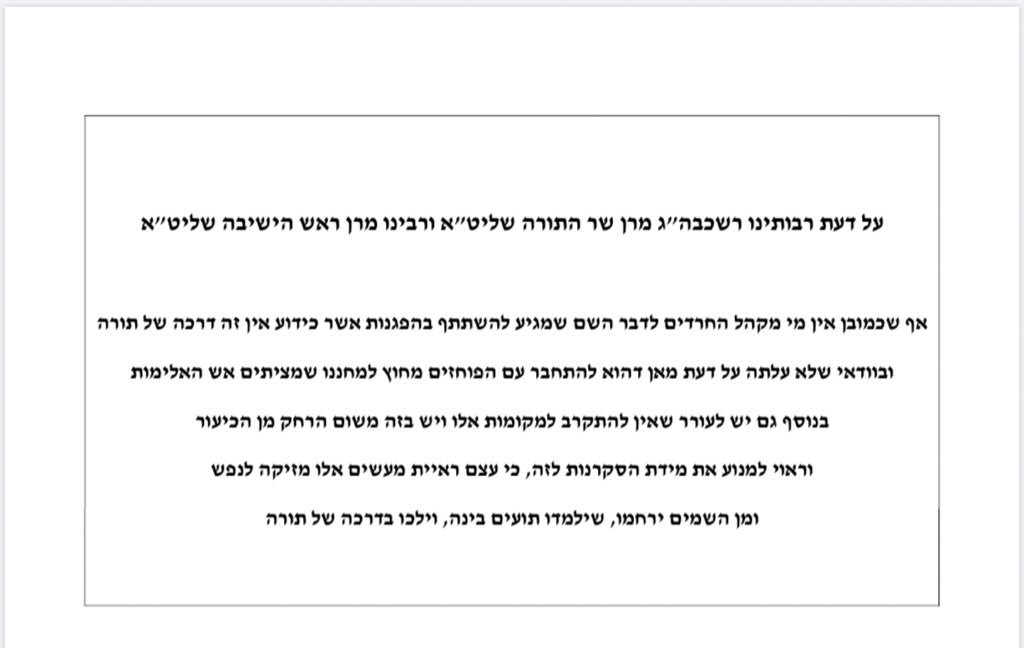
They also say not to get close to any place where such protests are happening, and one should control his sense of curiosity - seeing such events is damaging to the soul.
After expressing my hope that community and police leadership try to find ways to lower the flames, I think it is important to note this call by Bnei Braq leadership. it might not help with the troublemakers, but if the crowds are smaller because the curious bystanders are staying away because of this call, the tensions will not get as high either. I hope the police also put forth similar efforts to calm the situation
------------------------------------------------------
Reach thousands of readers with your ad by advertising on Life in Israel
Reach thousands of readers with your ad by advertising on Life in Israel
------------------------------------------------------
May 6, 2020
Rav Gershon Edelstein on why the Haredim died in much higher percentages
Rav Gershon Edelstein gave a shiur last night about appropriate behavior and what people should be doing at this stage of Corona, with schools and yeshivas restarting.
In it he said something very interesting, and a bit surprising.
Rav Edelstein said that the reason why the Haredi community was hit much worse with Corona deaths, both in Israel and around the world, than others is because as the Chazon Ish said that someone not religious who sins, he is considered as having sinned accidentally. he is a shogeg. That does not deserve much of a punishment. He had no way to know better. Someone frum, a Haredi Jew, who sins - he gets the status of meizid - someone who sinned intentionally. Sinning intentionally is much worse and the Haredim are getting the judgement of Hashem much worse than others because of that.
source: Kikar
That is a very strong statement (though I appreciate it more than statements blaming others such as women and tzniyus, others who speak in shul or lashon hara or others who arent frum enough, etc). I wonder if we find such a thing at other times - other plagues or national or global calamities - that the Haredi community was hit much harder than others and can see any similar pattern. On the one hand, it might make people want to not be frum, as why put yourself in such a position for much harsher judgement just by the nature of your status. On the other hand, the flip side is that the reward must be that much greater as well.
In it he said something very interesting, and a bit surprising.
Rav Edelstein said that the reason why the Haredi community was hit much worse with Corona deaths, both in Israel and around the world, than others is because as the Chazon Ish said that someone not religious who sins, he is considered as having sinned accidentally. he is a shogeg. That does not deserve much of a punishment. He had no way to know better. Someone frum, a Haredi Jew, who sins - he gets the status of meizid - someone who sinned intentionally. Sinning intentionally is much worse and the Haredim are getting the judgement of Hashem much worse than others because of that.
source: Kikar
That is a very strong statement (though I appreciate it more than statements blaming others such as women and tzniyus, others who speak in shul or lashon hara or others who arent frum enough, etc). I wonder if we find such a thing at other times - other plagues or national or global calamities - that the Haredi community was hit much harder than others and can see any similar pattern. On the one hand, it might make people want to not be frum, as why put yourself in such a position for much harsher judgement just by the nature of your status. On the other hand, the flip side is that the reward must be that much greater as well.
------------------------------------------------------
Reach thousands of readers with your ad by advertising on Life in Israel
Reach thousands of readers with your ad by advertising on Life in Israel
------------------------------------------------------
Apr 22, 2020
the Haredi power struggle
The Haredi news sites are all abuzz right now with what seems like a power struggle in the Haredi community in Israel, as a rare public dispute between the gedolim takes place.
It turns out, reportedly, that Rav Chaim Kanievsky has signed a letter ordering schools to reopen, while keeping to the health guidelines.
As an aside, curiously, the health guidelines are that schools cannot open, so any keeping of guidelines can only be partial if they open schools against the guidelines.
Back to the story...
Rav Gershon Edelstein has disagreed and said it is still too dangerous and schools should not yet be reopened. Rav Edelstein has also insisted that people continue to daven at home rather than in outdoor minyanim, also saying it is still too dangerous. He was one of the first to say to stop shuls and outdoor minyanim in the first place.
According to the reports, on the instructions of Rav Edelstein, Yated did not print Rav Kanievsky's letter.
That is big news.
After this hit the airwaves, the damage control kicked in. A statement was released by the courts of Rav Kanievsky and Rav Edelstein saying that the reports are lies and the rabbonim are all in pain from the schools being closed and the bittul torah because of it. The rabbonim are working together to find a solution as quickly as possible...
sources: Kikar, Behadrei, and a bunch more
we can talk about the power struggle between the rabbonim, we can talk about the askanim, we can talk about the changes happening int he Haredi community as a result of Corona, or some other things. But we won't. I'll leave that to other pundits who are all already analyzing those topics online and writing their predictions. Whatever the news reports about a power struggle, there is still too much unknown to me, and surely unreported, about the details to offer an opinion on the matter.
Personally I think this (not the argument, just the raising of the issue) is the beginning of pressure being put on the government to get the schools open. just like they successfully pressured the government this past week to ease regulations and allow outdoor non-porch minyanim and even mikvas, despite the lack of any change in the health situation and still not yet having any knowledge of how much the virus spread over the Pesach holiday, they are now working to do the same for the schools.
That is how I see it. The next step will be having the UTJ reps, MK Gafni and Minister Litzman, pressuring Netanyahu to allow the schools to function in some format in the next stage of "easing the regulations".
It is a power struggle. I don't know if it is a power struggle between Rav Kanievsky and Rav Edelstein, but it is surely a power struggle between the Haredi community and PM Netanyahu and the Health Ministry.
It turns out, reportedly, that Rav Chaim Kanievsky has signed a letter ordering schools to reopen, while keeping to the health guidelines.
As an aside, curiously, the health guidelines are that schools cannot open, so any keeping of guidelines can only be partial if they open schools against the guidelines.
Back to the story...
Rav Gershon Edelstein has disagreed and said it is still too dangerous and schools should not yet be reopened. Rav Edelstein has also insisted that people continue to daven at home rather than in outdoor minyanim, also saying it is still too dangerous. He was one of the first to say to stop shuls and outdoor minyanim in the first place.
According to the reports, on the instructions of Rav Edelstein, Yated did not print Rav Kanievsky's letter.
That is big news.
After this hit the airwaves, the damage control kicked in. A statement was released by the courts of Rav Kanievsky and Rav Edelstein saying that the reports are lies and the rabbonim are all in pain from the schools being closed and the bittul torah because of it. The rabbonim are working together to find a solution as quickly as possible...
sources: Kikar, Behadrei, and a bunch more
we can talk about the power struggle between the rabbonim, we can talk about the askanim, we can talk about the changes happening int he Haredi community as a result of Corona, or some other things. But we won't. I'll leave that to other pundits who are all already analyzing those topics online and writing their predictions. Whatever the news reports about a power struggle, there is still too much unknown to me, and surely unreported, about the details to offer an opinion on the matter.
Personally I think this (not the argument, just the raising of the issue) is the beginning of pressure being put on the government to get the schools open. just like they successfully pressured the government this past week to ease regulations and allow outdoor non-porch minyanim and even mikvas, despite the lack of any change in the health situation and still not yet having any knowledge of how much the virus spread over the Pesach holiday, they are now working to do the same for the schools.
That is how I see it. The next step will be having the UTJ reps, MK Gafni and Minister Litzman, pressuring Netanyahu to allow the schools to function in some format in the next stage of "easing the regulations".
It is a power struggle. I don't know if it is a power struggle between Rav Kanievsky and Rav Edelstein, but it is surely a power struggle between the Haredi community and PM Netanyahu and the Health Ministry.
------------------------------------------------------
Reach thousands of readers with your ad by advertising on Life in Israel
Reach thousands of readers with your ad by advertising on Life in Israel
------------------------------------------------------
Dec 27, 2018
Picture of the Day

US Ambassador to Israel David Friedman went to Rav Chaim Kanievsky and to Rav Gershon Edelstein to get brachas. Friedman described his work n behalf of the people of Israel. Rav Kanievsky gave him a bracha and also told him to make a kiddush hashem with his work. Rav Edelstein asked the ambassador if he could get involved in the issue of the education requirements in New York that are troubling. Friedman asked Rav Edelstein for a bracha for Trump to win a second term in the upcoming presidential elections in 2020.
------------------------------------------------------
Reach thousands of readers with your ad by advertising on Life in Israel
Reach thousands of readers with your ad by advertising on Life in Israel
------------------------------------------------------
May 27, 2018
Interesting Psak: donating kidney to secular Jews
This interesting psak is really a current machlokes, according to the article, so it is really a triple interesting psak, as all sides of the argument are interesting..
Donating a kidney to patients in need of one has become a very popular chessed nowadays, especially in the Haredi community (though not limited to the Haredi community). Much of the popularity can be accredited to the work of an organization called Matnat Chaim that promotes and encourages such kidney donations. Obviously, kidney donations must follow the laws for organ donation, no matter what organization it is being arranged through.
The question was asked if it is permitted to donate a kidney when the recipient might possibly be a secular Jew. This is often the case as the majority of the time it is an altruistic donation with the donor not knowing the recipient. Ergo, the answer can be very influential on the future of kidney donation in the frum community.
The responses are based on the possibility of whether or not the average secular Jew has the status of a tinok shennishba, as per the Chzon Ish's decision.
Starting with the more straightforward responses first:
* Rav Gershon Edelstein responded that one is allowed to make an altruistic kidney donation without knowing who the recipient will be, because [most] secular people retain the status of "tinok shenishbu". They are considered as if having been held captive, meaning they never had the opportunity to learn, so their lack of observance is not considered a fault - sort of like a type of annus. Such a person, considered a tinok shenishba, does not obtain the status of a wicked person, even though he or she does not observe the mitzvos and even transgresses prohibitions publicly. Therefore, one could donate a kidney even if it will go to a secular Jew.
* Rav Yitzchak Zilbershtein responded that one can, and should, donate a kidney even to a secular Jew. Rav Zilbershtein adds that often in such cases we see that a certain bond develops between the donor and the recipient, and when the donor is religious and the recipient is not religious the donation has the ability to have a positive impact and influence on the recipient and bring him closer to Judaism and to fulfilling God's will.
* Rav Chaim Kanievsky is the most complex of the respondents. Rav Kanievsky normally follows the Chazon Ish, his uncle. But he also follows his father in law, Rav Elyashiv. And he also would direct many piskei halacha to Rav Shteinman rather than answering himself, until Rav Shteinman's death. While Rav Kanievsky seems to potentially be pulled in three different directions on this.
Rav Kanievsky paskens in this case like his father in law Rav Elyashiv, saying that secular Jews nowadays do not have the status of tinok shenishba because even if they never learned Torah and Judaism, the information is readily available to them via the computer (I will comment on this point below) and anybody seeking the truth will find a way to discover it. Therefore, according to Rav Elyashiv, secular Jews today do NOT have the status of tinok shenishba but that of a mumar - someone who intentionally sins against God.
Rav Shteinman paskened that secular Jews nowadays do continue to have the status of tinok shenishba. He reasons that there is so much incitement today against religion that no secular Jew can objectively decide he wants to research Judaism and come to the truth.
Rav Chaim Kanievsky, paskening like Rav Elyashiv on this matter, therefore says that one should not donate a kidney to an unknown recipient.
source: Israel Hayom
the debate is very complex and I would add another point that was not mentioned in the opinions brought above. Many secular Jews are even ignorant of the starting point and do not even know to look. They are not necessarily anti-Torah or anti-religion, but they were raised and live lives totally devoid of Jewish halacha and Torah considerations and remain oblivious to it. I am not comfortable with the opinion that they could look for the information if they wanted, thus they are responsible for not having done so, so to speak, because it isnt even on their radar. That's how far removed much of the secular community is.
I would add one point of irony in Rav Kanievskky's opinion as quoted. The information about Judaism might be available to the masses easily "on the computer", but Rav Kanievskly himself, supposedly, considers it a serious prohibition and transgression to use the Internet and smartphones and the like. Maybe they are fulfilling a mitzva following his opinion to not use the internet, even for good things!
I would add, regarding the point made by Rav Zilbershtein, that it irks me in particular, and I have written about this elsewhere, that anything we do in reklation to the secular community seems to have to have an ulterior motive of kiruv. Why must kidney donation be ok because it might possibly cause the recipient to do teshuva? Why cant it just be to save a life? Why do we invite people over and say hopefully it will cause kiruv - cant we just invite a friend to spend time with the friend or because I love my cousin or sibling? Sure, you can do things for kiruv purposes, but why does it seem to very often be the underlying motive in almost anything done in the frum community with the not-frum community? To illustrate further, just the other day I was in a store. The woman before me in line was talking to the clerk about a wedding she is making for her child and she mentioned her two sisters coming in for the wedding that are not frum. She commented that she hopes they will come in and enjoy the wedding and it will hopefully be the start of them becoming frum. Can't they just be invited and come to the wedding because they are siblings, aunts and uncles and we all want to share our simchas with our beloved families? Must their invitation be for the purpose of kiruv?
caveat: as always, do not make a halachic decision based off a brief halachic review article you read on the Internet. If the situation is relevant to you, consult with a competent rabbi on the matter.
Donating a kidney to patients in need of one has become a very popular chessed nowadays, especially in the Haredi community (though not limited to the Haredi community). Much of the popularity can be accredited to the work of an organization called Matnat Chaim that promotes and encourages such kidney donations. Obviously, kidney donations must follow the laws for organ donation, no matter what organization it is being arranged through.
The question was asked if it is permitted to donate a kidney when the recipient might possibly be a secular Jew. This is often the case as the majority of the time it is an altruistic donation with the donor not knowing the recipient. Ergo, the answer can be very influential on the future of kidney donation in the frum community.
The responses are based on the possibility of whether or not the average secular Jew has the status of a tinok shennishba, as per the Chzon Ish's decision.
Starting with the more straightforward responses first:
* Rav Gershon Edelstein responded that one is allowed to make an altruistic kidney donation without knowing who the recipient will be, because [most] secular people retain the status of "tinok shenishbu". They are considered as if having been held captive, meaning they never had the opportunity to learn, so their lack of observance is not considered a fault - sort of like a type of annus. Such a person, considered a tinok shenishba, does not obtain the status of a wicked person, even though he or she does not observe the mitzvos and even transgresses prohibitions publicly. Therefore, one could donate a kidney even if it will go to a secular Jew.
* Rav Yitzchak Zilbershtein responded that one can, and should, donate a kidney even to a secular Jew. Rav Zilbershtein adds that often in such cases we see that a certain bond develops between the donor and the recipient, and when the donor is religious and the recipient is not religious the donation has the ability to have a positive impact and influence on the recipient and bring him closer to Judaism and to fulfilling God's will.
* Rav Chaim Kanievsky is the most complex of the respondents. Rav Kanievsky normally follows the Chazon Ish, his uncle. But he also follows his father in law, Rav Elyashiv. And he also would direct many piskei halacha to Rav Shteinman rather than answering himself, until Rav Shteinman's death. While Rav Kanievsky seems to potentially be pulled in three different directions on this.
Rav Kanievsky paskens in this case like his father in law Rav Elyashiv, saying that secular Jews nowadays do not have the status of tinok shenishba because even if they never learned Torah and Judaism, the information is readily available to them via the computer (I will comment on this point below) and anybody seeking the truth will find a way to discover it. Therefore, according to Rav Elyashiv, secular Jews today do NOT have the status of tinok shenishba but that of a mumar - someone who intentionally sins against God.
Rav Shteinman paskened that secular Jews nowadays do continue to have the status of tinok shenishba. He reasons that there is so much incitement today against religion that no secular Jew can objectively decide he wants to research Judaism and come to the truth.
Rav Chaim Kanievsky, paskening like Rav Elyashiv on this matter, therefore says that one should not donate a kidney to an unknown recipient.
source: Israel Hayom
the debate is very complex and I would add another point that was not mentioned in the opinions brought above. Many secular Jews are even ignorant of the starting point and do not even know to look. They are not necessarily anti-Torah or anti-religion, but they were raised and live lives totally devoid of Jewish halacha and Torah considerations and remain oblivious to it. I am not comfortable with the opinion that they could look for the information if they wanted, thus they are responsible for not having done so, so to speak, because it isnt even on their radar. That's how far removed much of the secular community is.
I would add one point of irony in Rav Kanievskky's opinion as quoted. The information about Judaism might be available to the masses easily "on the computer", but Rav Kanievskly himself, supposedly, considers it a serious prohibition and transgression to use the Internet and smartphones and the like. Maybe they are fulfilling a mitzva following his opinion to not use the internet, even for good things!
I would add, regarding the point made by Rav Zilbershtein, that it irks me in particular, and I have written about this elsewhere, that anything we do in reklation to the secular community seems to have to have an ulterior motive of kiruv. Why must kidney donation be ok because it might possibly cause the recipient to do teshuva? Why cant it just be to save a life? Why do we invite people over and say hopefully it will cause kiruv - cant we just invite a friend to spend time with the friend or because I love my cousin or sibling? Sure, you can do things for kiruv purposes, but why does it seem to very often be the underlying motive in almost anything done in the frum community with the not-frum community? To illustrate further, just the other day I was in a store. The woman before me in line was talking to the clerk about a wedding she is making for her child and she mentioned her two sisters coming in for the wedding that are not frum. She commented that she hopes they will come in and enjoy the wedding and it will hopefully be the start of them becoming frum. Can't they just be invited and come to the wedding because they are siblings, aunts and uncles and we all want to share our simchas with our beloved families? Must their invitation be for the purpose of kiruv?
caveat: as always, do not make a halachic decision based off a brief halachic review article you read on the Internet. If the situation is relevant to you, consult with a competent rabbi on the matter.
------------------------------------------------------
Reach thousands of readers with your ad by advertising on Life in Israel
Reach thousands of readers with your ad by advertising on Life in Israel
------------------------------------------------------
Apr 11, 2018
Interesting Psak: delaying medical treatments until the zman
Rav Gershon Edelstein stated an interesting "psak" that could easily be misunderstood.
Rav Edelstein was speaking at a conference about educational methods and he told the participants that when yeshiva bochurim have to undergo medical treatments it would be better to do so during the zman and not during vacation, bein hazmanim.
Rav Edelstein explained that during bein hazmanim there is less Torah learning happening, so the Torah learning that is being done is that much more important. So, stopping to learn during bein hazmanim is stopping a much more important level of learning, and stopping a more influential learning, and it would be better to undergo the treatments during the yeshiva session when there is so much more learning being done and his learning is far less influential overall.
source: Kikar
This seems to me to be similar to the concept of when someone learns torah at a time when few others are, the reward for that torah is much greater and the influence of that torah learned is greater. I heard it explained once as a pie of torah learning - when many are learning, each slice is smaller, but when only a few are learning, each learning portion is much larger. This is why many yeshivas or shuls or kollels encourage learning at unusual times, such as Purim night after the megilla or right after Yom Kippur, and other such "off times".
So, this yeshiva boy who needs medical care is causing a much more significant loss when he stops learning during bein hazmanim than when he stops during the zman.
A caveat that should be stated is that:
1. the yeshiva boy is learning during bein hazmanim. Not all do. Maybe his plans were for a tiyul, and not for learning. I dont think Rav Edelstein's policy would then apply, as during the zman he is stopping learning and during bein hazmanim he isnt learning anyway.
2. obviously this is talking about someone who needs medical attention that can wait until later. Someone who needs urgent care should not wait until the zman starts but should get himself taken care of as soon as possible.
Rav Edelstein was speaking at a conference about educational methods and he told the participants that when yeshiva bochurim have to undergo medical treatments it would be better to do so during the zman and not during vacation, bein hazmanim.
Rav Edelstein explained that during bein hazmanim there is less Torah learning happening, so the Torah learning that is being done is that much more important. So, stopping to learn during bein hazmanim is stopping a much more important level of learning, and stopping a more influential learning, and it would be better to undergo the treatments during the yeshiva session when there is so much more learning being done and his learning is far less influential overall.
source: Kikar
This seems to me to be similar to the concept of when someone learns torah at a time when few others are, the reward for that torah is much greater and the influence of that torah learned is greater. I heard it explained once as a pie of torah learning - when many are learning, each slice is smaller, but when only a few are learning, each learning portion is much larger. This is why many yeshivas or shuls or kollels encourage learning at unusual times, such as Purim night after the megilla or right after Yom Kippur, and other such "off times".
So, this yeshiva boy who needs medical care is causing a much more significant loss when he stops learning during bein hazmanim than when he stops during the zman.
A caveat that should be stated is that:
1. the yeshiva boy is learning during bein hazmanim. Not all do. Maybe his plans were for a tiyul, and not for learning. I dont think Rav Edelstein's policy would then apply, as during the zman he is stopping learning and during bein hazmanim he isnt learning anyway.
2. obviously this is talking about someone who needs medical attention that can wait until later. Someone who needs urgent care should not wait until the zman starts but should get himself taken care of as soon as possible.
------------------------------------------------------
Reach thousands of readers with your ad by advertising on Life in Israel
Reach thousands of readers with your ad by advertising on Life in Israel
------------------------------------------------------
Mar 7, 2011
The Danger Of The IDF Recruitment Center
Rav Gershon Edelstein, one of the rosh yeshivas of Ponovezh yeshiva, is trying to work out a new arrangement for yeshiva students in their dealing with getting the deferments from the IDF. The way it works right now is that the students who are registered in yeshiva get an automatic deferment, but they have to go down to the recruitment center (lishkat geeyus) on draft day and make the deferment official.
Rav Edelstein is pushing to change the system so the boys wont have to go down at all, but will simply be able to send in the proper forms via the yeshiva, without actually physically going down to the lishkat geeyus.
I am all for minimizing bureaucracy whenever possible, and if this can be worked out, it seems like a great idea. Perhaps it is crucial for the boys to show up, so they can see the person in the flesh and guarantee the person is real, or maybe that is not a concern and this is just a remnant of the high days of Israeli bureaucracy.
I would expect Rav Edelstein's reason for pushing for this change to be to minimize bittul torah. Why should the boys have to waste a large part of the day standing in line, waiting for turns, to take care of something that can probably be taken care of in minutes with a fax machine. However, his reasoning is more interesting than that.
Rav Edelstein is concerned that when the yeshiva boys go down to the lishkat geeyus, in one day they can ruin all their efforts of the whole zman of learning. He said, "It does not make sense that the yeshiva students with yirat shamayim can spend the whole zman being careful about shmeerat einayim - being careful what they look at (i.e. not looking at women, etc) - and then with one visit to the lishkat geeyus they can God forbid ruin everything. (source: Kikar)
Rav Edelstein is pushing to change the system so the boys wont have to go down at all, but will simply be able to send in the proper forms via the yeshiva, without actually physically going down to the lishkat geeyus.
I am all for minimizing bureaucracy whenever possible, and if this can be worked out, it seems like a great idea. Perhaps it is crucial for the boys to show up, so they can see the person in the flesh and guarantee the person is real, or maybe that is not a concern and this is just a remnant of the high days of Israeli bureaucracy.
I would expect Rav Edelstein's reason for pushing for this change to be to minimize bittul torah. Why should the boys have to waste a large part of the day standing in line, waiting for turns, to take care of something that can probably be taken care of in minutes with a fax machine. However, his reasoning is more interesting than that.
Rav Edelstein is concerned that when the yeshiva boys go down to the lishkat geeyus, in one day they can ruin all their efforts of the whole zman of learning. He said, "It does not make sense that the yeshiva students with yirat shamayim can spend the whole zman being careful about shmeerat einayim - being careful what they look at (i.e. not looking at women, etc) - and then with one visit to the lishkat geeyus they can God forbid ruin everything. (source: Kikar)
May 29, 2008
The miracle of the Torah world's resurgence
Rav Gershon Edelstein, one of the Rosh yeshivas of Ponevezsh Yeshiva, in a talk with avreichim and educators, said the following:
....The whole Torah world itself is an open miracle...(source: Mishpacha newspaper)
In the last 200 years, the Torah world has suffered tremendous troubles and difficulties from within and from without. People would shame those who learn Torah. That is the way it was in all generations: the enlightenment, with the heads of the Zionist movement in the Diaspora, and all the rest that chased those who learn Torah. They were successful in their battle and many Torah observant people abandoned the source of fresh water [i.e. the Torah]. All this was up until the post-holocaust era.
In the past 50 years, the Rosh Yeshivas re-established the Torah world, and the people began to respect those who learn Torah. the Torah world has thrived, despite the troubles and disturbances that have arisen due to the development of the western world. There are large Torah centers in places that there were never before, and the nation of Hashem is thirsty to hear the word of Hashem.
We need to give thanks every dayfor the miracles that we see how the Torah world survives despite all the difficulties, both spiritual and physical.
These are open miracles and we need to give thanks for them every single day.
Subscribe to:
Posts (Atom)
Related Posts
